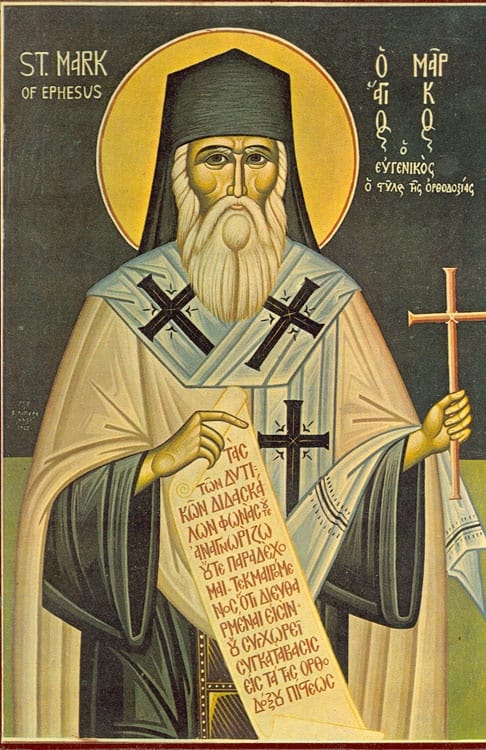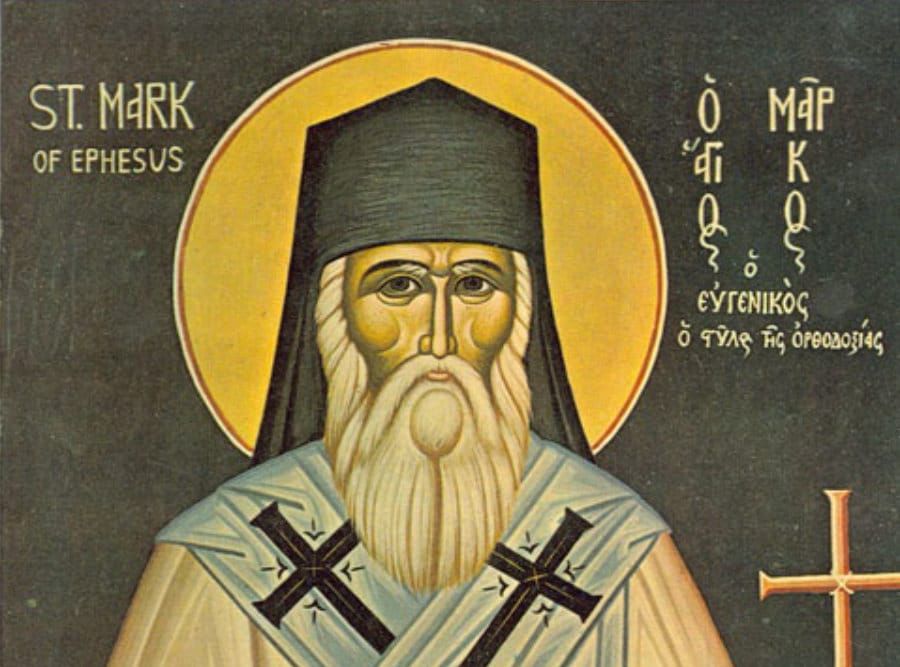
Saint Mark of Ephesus, born Manuel Eugenikos, was a 15th-century prelate, scholar, and theologian who became the primary defender of the Eastern Orthodox faith during the Council of Ferrara-Florence.
He is revered as one of the three Pillars of Orthodoxy alongside Saint Photius the Great and Saint Gregory Palamas. Known as the Atlas of Orthodoxy, Mark is famous for being the only Eastern bishop to refuse to sign the act of union with the Roman Catholic Church in 1439, a stance that single-handedly rallied the Byzantine people against theological compromise.
Origins and Intellectual Formation
Born in Constantinople around 1392, Manuel was the son of George Eugenikos, a deacon and official at the Hagia Sophia, and Maria, the daughter of a pious physician. His father died while Manuel and his brother John were still children, but his mother ensured he received a superb education. He studied under the prominent rhetorician John Chortasmenos and the famous philosopher and mathematician Gemistus Pletho.
Manuel’s intellectual prowess was evident early; by age 20, he had become a patriarchal rhetorician and eventually opened his own private higher school. Despite his proximity to the imperial court and his friendship with Emperor Manuel II, his heart was not bound to the capital’s secular honours.
The Path of the Monk and Metropolitan
At age 26, Manuel withdrew from the world to seek quiet solitude on the island of Antigone in the Sea of Marmara. He took monastic vows under the name Mark and lived there for two years under the guidance of Abbot Simeon. Turkish raids eventually forced him back to Constantinople, where he settled at the Mangana Monastery of the Great Martyr George.
Mark’s reputation for learning and holiness made him a trusted adviser to the Church. In 1437, following the death of Metropolitan Joasaph, Mark was consecrated Metropolitan of Ephesus. Though he longed for a life of silence and prayer, he accepted the office out of obedience to the Church, arriving at a time when the Byzantine Empire was desperately seeking Western military aid against the Ottoman Turks.
The Council of Ferrara-Florence
Emperor John VIII Palaiologos sought a theological union with Rome to secure help from the Pope. Mark was appointed a delegate for the Patriarchate of Antioch and was instrumental in the preparations for the council. The Ferrara-Florence Council opened on 9 April 1438.
Initially, Mark was favourable toward the idea of peace and union, delivering a cordial opening speech to Pope Eugenius IV. However, as the debates dragged on, he became disgusted by the Latin efforts to prevent him from reading the acts of the Ecumenical Councils aloud. He realized that the council was being used as a tool for political expediency rather than a genuine quest for truth.
The Theological Stand
At the heart of the conflict were several doctrines Mark considered contrary to the Ecumenical Councils:
- The Filioque: The Latin addition to the Creed stating the Holy Spirit proceeds from the Father "and the Son". Mark argued that the Spirit proceeds only from the Father.
- Purgatory: Mark rejected the existence of a purgatorial fire that purified souls before they received the Beatific Vision.
- Papal Supremacy: He viewed the notion of a single bishop's supremacy over all other local Churches as an institutionalised sin and a departure from the principle of collegiality.
- Azymes: He opposed the Latin use of unleavened bread in the Eucharist, adhering to the traditional Orthodox use of leavened bread.
Mark engaged in intense debates with the Dominican John Montenero, who argued that the Spirit was "third in dignity" to the Father and Son. Mark condemned this as a form of subordinationism and semi-Arianism.
The Lone Dissenter and the Pope’s Dismay
While the rest of the Orthodox delegation—worn down by pressure and poverty—eventually signed the act of union, Mark remained unyielding. He famously stated, "There can be no compromise in matters of the Orthodox Faith". When Pope Eugenius IV received the signed act and realised Mark’s name was missing, he exclaimed, "Then we have achieved nothing!".
Mark’s refusal to sign resonated with the faithful in Constantinople and Russia, who viewed the union as a betrayal. He later wrote to the people, calling himself not a leader, but the Orthodox Church itself in his commitment to truth.
The Ephesian Warrior in Captivity
After returning to Constantinople, Mark was offered the Patriarchate by the Emperor, but he refused the office and secretly fled the capital for Ephesus, which was then under Turkish rule. He spent his energy restoring his devastated diocese, but his continued writings against the union enraged the Emperor.
While attempting to travel to Mount Athos to mobilise the monks, Mark was seized by imperial police on the island of Lemnos and imprisoned for two years. During this captivity, illness and harsh conditions wore him down, but the islanders credited the miraculous rescue of Lemnos from a Turkish naval siege to the saint's prayers. He was finally released in 1442 on the feast of the Seven Youths of Ephesus.
Final Breath and the Succession of Gennadius
Saint Mark died at age 52 on 23 June 1444 after a two-week illness. On his deathbed, he was not concerned for himself but for Orthodoxy. He appealed to his former pupil, George Scholarios, to take up the leadership of the battle for the faith. Scholarios would eventually become Patriarch Gennadius I, the first Patriarch of Constantinople after the fall of Byzantium, and was instrumental in formally freeing the Church from the union. Mark’s final words were, "Jesus Christ, Son of the Living God, into Thy hands I commit my spirit".
Veneration and Miracles
Saint Mark was buried at the Mangana Monastery, though his remains were later moved to the Monastery of Saint Lazarus in Galata. He was solemnly glorified (canonised) in 1734 by Patriarch Seraphim I. His feast day is celebrated on January 19.
Accounts of his posthumous miracles include the healing of the sister of Demetrios Zourbaios. The sister, who was terminally ill and unconscious for three days, woke to find herself drenched in water; she claimed a bishop had washed her at a fountain and identified himself as "Mark Eugenikos, Metropolitan of Ephesus". Today, portions of his relics are kept in the Russian Orthodox Cathedral of Saint John the Baptist in Washington D.C.. He remains a symbol of faith without compromise, proving that a single person standing in truth can preserve the integrity of the entire Church.
Feast Day: 19 JAN