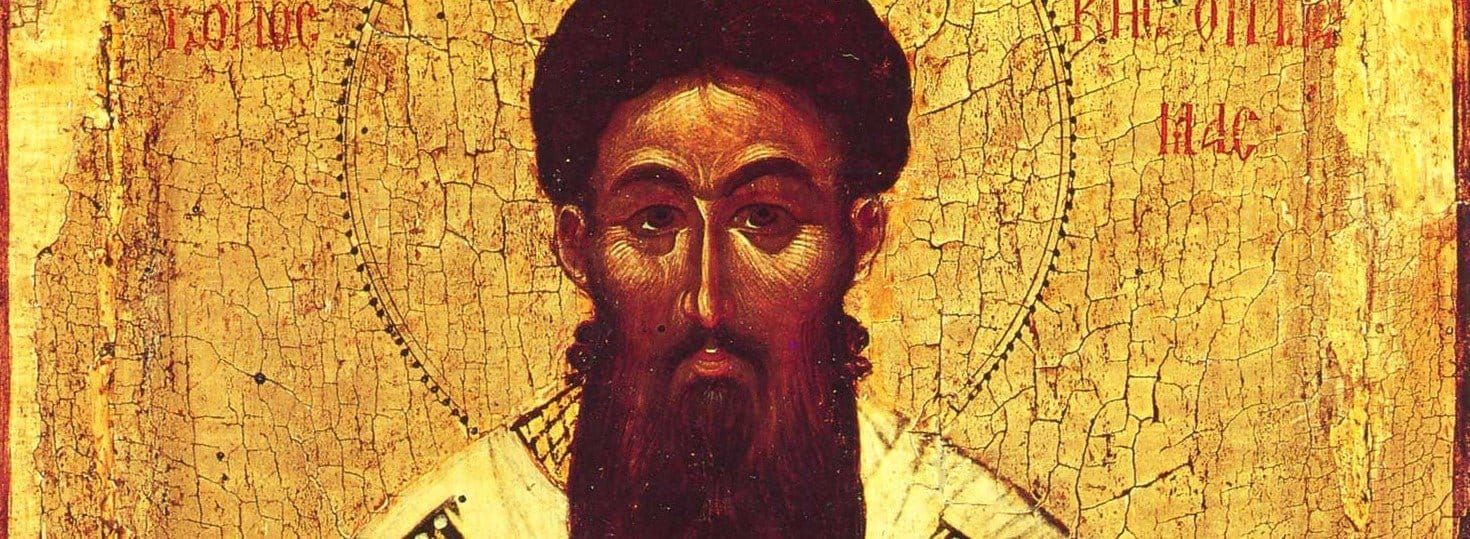
Early Life and Ascetic Formation
Saint Gregory Palamas was a preeminent Byzantine Greek theologian, monk of Mount Athos, and Archbishop of Thessalonica who lived from 1296 to 1359. Born in Constantinople to an aristocratic Anatolian family, his father Constantine was a prominent dignitary at the court of Emperor Andronicus II Palaeologus.
Following the early death of his father, the Emperor took a personal interest in the education of Saint Gregory Palamas, ensuring he mastered the full course of medieval higher education, including grammar, rhetoric, physics, and Aristotelian logic.
Despite a promising future in government service, Saint Gregory Palamas withdrew to Mount Athos in 1316 to pursue a monastic life, successfully persuading his mother and siblings to also embrace monasticism.
His monastic formation occurred primarily at the Vatopedi and Great Lavra monasteries under the guidance of spiritual elders such as Saint Nikodemos and Saint Nikephoros.
He became deeply immersed in the tradition of Hesychasm, a spiritual practice centred on inner stillness, silence, and unceasing prayer, particularly the repetition of the Jesus Prayer.
Threat of Muslim incursions in 1326 forced his temporary relocation to Thessalonica, where he was ordained as a priest before establishing a community of hermits near Veroia. He returned to Mount Athos in 1331, settling at the skete of Saint Savva to continue his theological and ascetic pursuits.
The Hesychast Controversy
The defining theological conflict of the career of Saint Gregory Palamas began around 1337 when Barlaam of Calabria, a humanist scholar and monk, arrived in Constantinople and challenged the practices of the Athonite hesychasts.
Barlaam maintained an extreme form of divine unknowability, arguing that God is ultimately undemonstrable to human reason and that secular philosophy offered a more reliable path to knowledge than the mystical experiences of monks.
He ridiculed the hesychasts for their use of physical prayer techniques, such as controlled breathing and the lowering of the gaze toward the heart or navel, accusing them of the Messalian heresy and mocking them as navel-psychics.
Saint Gregory Palamas was requested by his fellow monks to defend their spiritual tradition against these attacks. He produced a series of nine treatises titled Triads in Defence of the Holy Hesychasts, where he articulated a systematic theology of human participation in the divine life.
He argued that the physical body is a temple of the Holy Spirit and that its involvement in prayer is a necessary consequence of the biblical vision of the human person as a unified whole of body and soul.
He maintained that the light seen by the hesychasts during deep prayer was not a created symbol or a material phenomenon, but the uncreated Light of the Godhead, identical to the glory revealed to the Apostles at the Transfiguration on Mount Tabor.
The Essence-Energies Distinction
Central to the theological framework of Saint Gregory Palamas is the Essence Energy Distinction - a core distinction between the divine essence and the divine energies.
He taught that the essence of God is utterly transcendent, unknowable, and imparticipable; no creature can ever share in or comprehend the being of God as He is in Himself.
However, he affirmed that God reveals Himself and acts within creation through His uncreated energies, which are His operations, manifestations, and grace. These energies are not created effects but are God Himself in His movement toward the world.
This distinction allows for a real and direct union between God and man, known as deification or theosis, without collapsing the distinction between Creator and creature into pantheism. By participating in the divine energies, such as light, wisdom, and love, the believer becomes god by grace and shares in the divine life.
Saint Gregory Palamas utilised the analogy of the sun to illustrate this relationship: while the sun’s disc remains distant and unreachable, its rays truly reach the earth to provide warmth and light, and these rays are the sun itself in its manifestation.
Conciliar Acceptance and Political Conflict
The theological dispute became entangled with the Byzantine Civil War of 1341 to 1347. Supporters of Saint Gregory Palamas were often aligned with the aristocrats and John VI Kantakouzenos, while his opponents initially found favour with the regency and Patriarch John XIV Kalekas.
Consequently, Saint Gregory Palamas suffered imprisonment and excommunication in 1344. However, the eventual victory of Kantakouzenos led to his rehabilitation and his consecration as the Archbishop of Thessalonica in 1347.
The Orthodoxy of the teachings of Saint Gregory Palamas was confirmed by a series of local synods held in Constantinople in 1341, 1347, and 1351. The Council of Blachernae in 1351 is seen as the definitive victory for Palamism, as it codified the essence-energies distinction and condemned opponents such as Akindynos and Gregoras. Many Orthodox Christians regard these gatherings as having ecumenical status, effectively constituting a Ninth Ecumenical Council.