Authorship is attributed to an unidentified Israelite writer, a conclusion derived from the consistent use of the covenantal name of God, Yahweh. While the date of composition is distinct from the setting of the narrative, evidence places the life of Job in the patriarchal era of Abraham, Isaac, and Jacob, approximately 1600 BC.
The Greek Septuagint translation is four hundred lines shorter than the accepted Hebrew text, an omission resulting from difficulties with the unusual language and style of the original Hebrew. For the Eastern Orthodox, the book occupies a central place in the lectionary for Holy Week. The words of the protagonist, "Blessed be the name of the Lord," are formalised as the concluding refrain of the Divine Liturgy.
Identity of Job
Job resided in the land of Ausitis, situated on the borders of Edom and Arabia. Previously known as Jobab, he was an Arabian king and the fifth generation from Abraham. His father was Zare, a son of Esau, and his mother was Bosorra.
Job was a true, blameless, and righteous man who abstained from evil. He was the most noble of all the men of the East, possessing vast wealth in livestock and a large household of servants. Job performed daily purifications and sacrifices for his seven sons and three daughters to atone for any potential impious thoughts.
The Testing of Job
The book begins with a celestial assembly in which the devil challenges God regarding Job’s integrity. The adversary asserts that Job’s righteousness is contingent upon his material prosperity and divine protection. God permits the devil to test Job by stripping away his possessions and family, provided the man himself is not harmed.
In a rapid sequence of catastrophes, Job loses his livestock to raiders and fire from heaven, and his ten children die when a great wind collapses the house in which they were banqueting. Job responds with worship and the declaration that as the Lord gave, so the Lord has taken away. In a second celestial confrontation, the devil is permitted to afflict Job’s person. Job is struck with malignant sores from head to foot, forcing him to scrape his skin with a potsherd while sitting upon a dunghill outside the city.
Job’s wife encourages him to blaspheme God and die, noting the vanishment of his memory from the earth and her own suffering as a wanderer. Job rebukes her as a foolish woman, asserting that if humanity accepts good things from the hand of the Lord, it must also endure evil things. He does not sin against God with his lips throughout these trials.
The Theological Dialogues
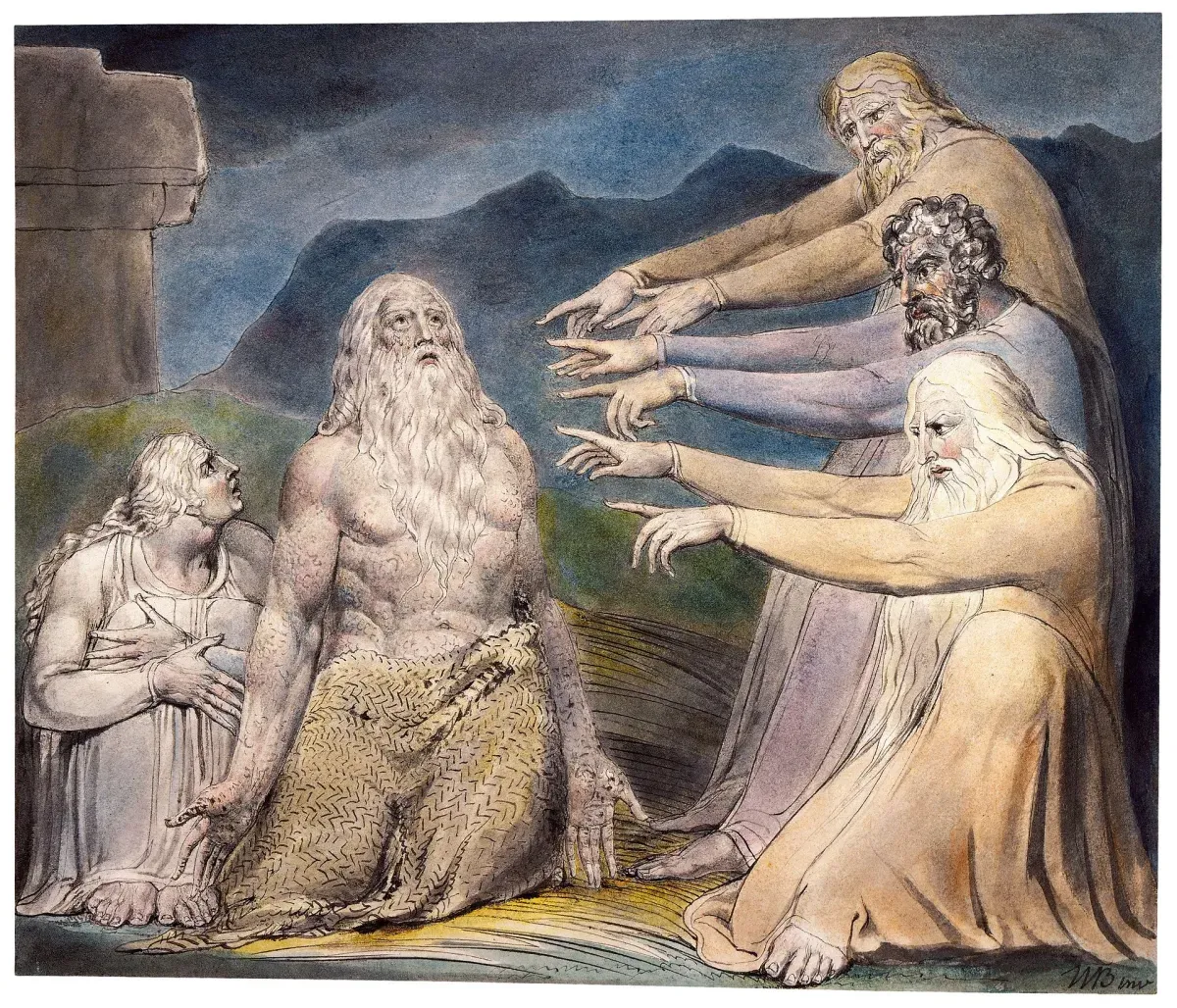
Three kings and friends of Job - Eliphaz the Temanite, Bildad the Shuhite, and Zophar the Naamathite - visit him to provide comfort. Upon seeing his disfigurement, they weep and sit with him in silence for seven days and seven nights. The silence ends when Job curses the day of his birth, expressing a desire for the oblivion of the grave where the weary find rest and prisoners are no longer oppressed.
His subsequent speeches involve the friends attempting to provide a theodicy for Job’s suffering. Their primary argument rests on a mechanical view of divine justice: that suffering is an infallible indicator of personal sin. Eliphaz asserts that no mortal is blameless before God and suggests Job has cast off fear. Bildad argues that God does not trouble righteousness and that Job’s children died because of their lawlessness. Zophar rebukes Job for claiming to be pure in his works and suggests that Job has received less punishment than his sins deserve.
Job rejects these explanations, labelling his companions as bad comforters who offer wind-filled words. He maintains his integrity and innocence while questioning why the ungodly often prosper in this world while the just suffer. He appeals to the testimony of creation, noting that animals, birds, and the earth itself witness the absolute sovereignty of God. Job laments the lack of a mediator between himself and the Creator, yet he expresses a nascent hope in the resurrection, stating that he will wait until he arises.
Intervention and Divine Manifestation
Elihu the Buzite, a younger contemporary, intervenes after the three friends cease their arguments. He is angry with Job for justifying himself rather than God, and with the friends for failing to find a viable answer. Elihu asserts that God speaks to man through dreams, visions, and suffering to draw the soul back from the pit. He proclaims the greatness of God’s works in the natural world, including the clouds, lightning, and snow, as evidence of divine justice that man cannot fully comprehend.
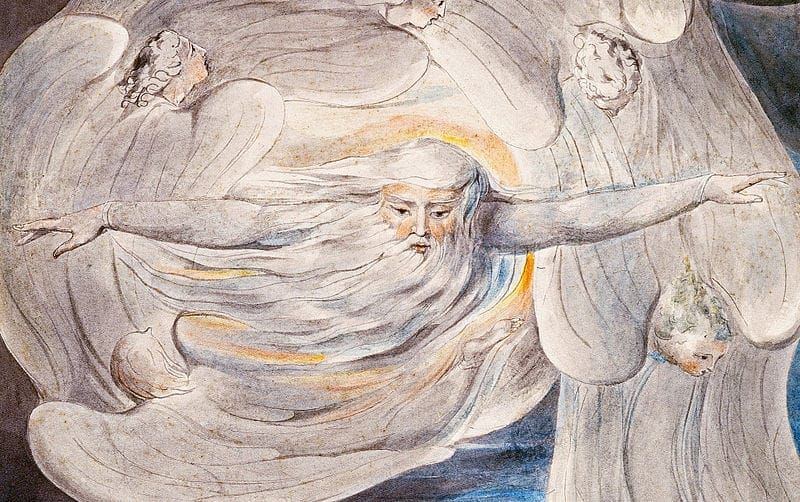
Following Elihu’s discourse, the Lord speaks to Job out of a whirlwind and clouds. The divine response does not address the cause of Job’s suffering but focuses on the limitations of human knowledge. God questions Job regarding the foundations of the earth, the containment of the sea, the movements of the constellations, and the provision for wild animals. Job acknowledges his insignificance and his inability to answer, choosing to lay his hand over his mouth in silence.
After a second divine discourse concerning the power of Behemoth and Leviathan, symbols of the adversary and the chaos of the fallen world, Job repents in dust and ashes. He confesses that he spoke of things he did not understand and acknowledges that nothing is impossible for God.
Vindication and Restoration
The Lord rebukes the three friends for not speaking the truth regarding Job. He commands them to offer burnt offerings and requests Job to intercede for them as their priest. God accepts Job’s prayer and redeems the sin of the friends for Job’s sake.
Following his intercession, Job’s health is restored, and his family and acquaintances return to comfort him, each providing a gift of gold. The Lord blesses the latter days of Job more than his beginning, doubling his former wealth in sheep, camels, oxen, and donkeys. Job fathers seven additional sons and three daughters. His daughters, named Day, Cassia, and Amalthia’s Horn, are the most beautiful in the land and receive an inheritance alongside their brothers. Job lives for another one hundred and seventy years, witnessing four generations of his descendants. He dies old and full of days.
Job as a type of Christ
Both Job and Jesus Christ suffer unjustly as innocent men and are subsequently rewarded and glorified for their godliness. Job’s suffering without sinning in his humanity allows his divinity to be made known, mirroring the pattern of the Passion and Resurrection. His intercession for the friends who persecuted him also acts as a pattern for Christ’s intercession for the world.
The book addresses the profound problem of theodicy, demonstrating that suffering is not always a punishment for sin but can be a means of testing and strengthening the faithful. It refutes the notion of original guilt, affirming that while humanity inherited mortality and corruption from Adam, each individual is accountable for their own transgressions. Job’s insight into the resurrection provides one of the earliest biblical hints of the glorious life after death that becomes available through the power of Christ, a prefiguration of what was to come. The suffering of the innocent man mirrors the patterns of the Passion. The wounds of Job prefigure the wounds of Christ.

G.K. Chesteron on the Book of Job
Chesterton saw the Book of Job as an artistic creation rather than a modern literary document, with the suspicion that the prologue, the speech of Elihu, and the epilogue were added later.
Yet, despite the modern, individualistic obsession with identifying a single author or an exact date to evaluate a work, Chesterton rightly dismissed these biases to point of they amalgam constitutes a cohesive and profound whole. Tribal works are passed from one generation to the next within a connected and cohesive society. Interpolations are natural elements of this process.
The original writers did not prioritise the civic identity of the author. A tribal poem is a collective expression of a people. The text stands apart from the Old Testament canon while maintaining a central unity.
The Central Unity and Divine Loneliness
The central unity of the Old Testament is the loneliness of God. God is the primary character of the narrative. Compared to the clarity of the Divine Purpose, all human worlds appear automatic.
The Patriarchs and the Prophets are the tools of the Creator. They are the hammer and the saw used by the Carpenter. There is no equality in nature between the tool and the one who wields it.
God sits enthroned above the circle of the earth. Human beings are like grasshoppers in comparison. God stretches out the heavens like a canopy and spreads them out like a tent.
The Divine personality is so asserted that it asserts the impersonality of man. Human will is almost obliterated by the overwhelming Majesty of the Divine. The narrative asks if the grander purpose of God is worth the sacrifice of all human wills.
Perplexed Optimism and Formal Pessimism
The Book of Job explores the nature of actuality. It is not satisfied with illusions or temperamental positions. The characters are defined by their relationship to the truth of the universe.
Job is a perplexed and exasperated optimist. He demands an explanation from his Maker because he loves and respects his Maker. He strikes at the heavens to make the stars speak rather than to silence them.
The three friends who attempt to comfort Job are the true pessimists. They believe that God is so strong that it is judicious to call Him good. This is a pagan view of power and personal benefit.
The comforters seek a rational and consecutive pattern within the world. They provide reasons for suffering to reconcile the experience with a mechanical view of justice. Job rejects these solutions because he wishes the universe to be truly justified.
The Sceptical Revelation of the Whirlwind
The entry of God into the narrative does not provide answers to the questions of man. God takes up the role of the sceptic in a drama of scepticism. He turns rationalism against itself. God possesses an enormous humility that allows Him to be prosecuted. He demands the right to cross-examine the witness. When asked who he is, Job realizes he does not know.
Religious faith is accompanied by philosophic doubt. The rationalist bridge ends at a wall of mystery. Eventually, the individual must doubt the one who is doing the doubting. The refusal of God to explain His design is a burning hint of that design. Job is satisfied by the presentation of the impenetrable. The riddles of God are more satisfying than the solutions of man.
God insists on the inexplicableness of everything. He presents a panorama of created things in a song of wonder. The world is even stranger than the human mind can imagine.
Man is most comforted by his paradoxes
Humanity is most comforted by paradoxes. Paradox is the sanity that allows a person to embrace the unknown. Attempting to make sense of paradoxes leads to mental instability.
The willingness to accept that things can be both determined and free is a sign of health. Job was not tormented because he was the worst of men. He was punished because he was the best. This is the central paradox of Job. The best man endured the worst possible fortune. Job is a type of the innocent man punished in the most awful way.