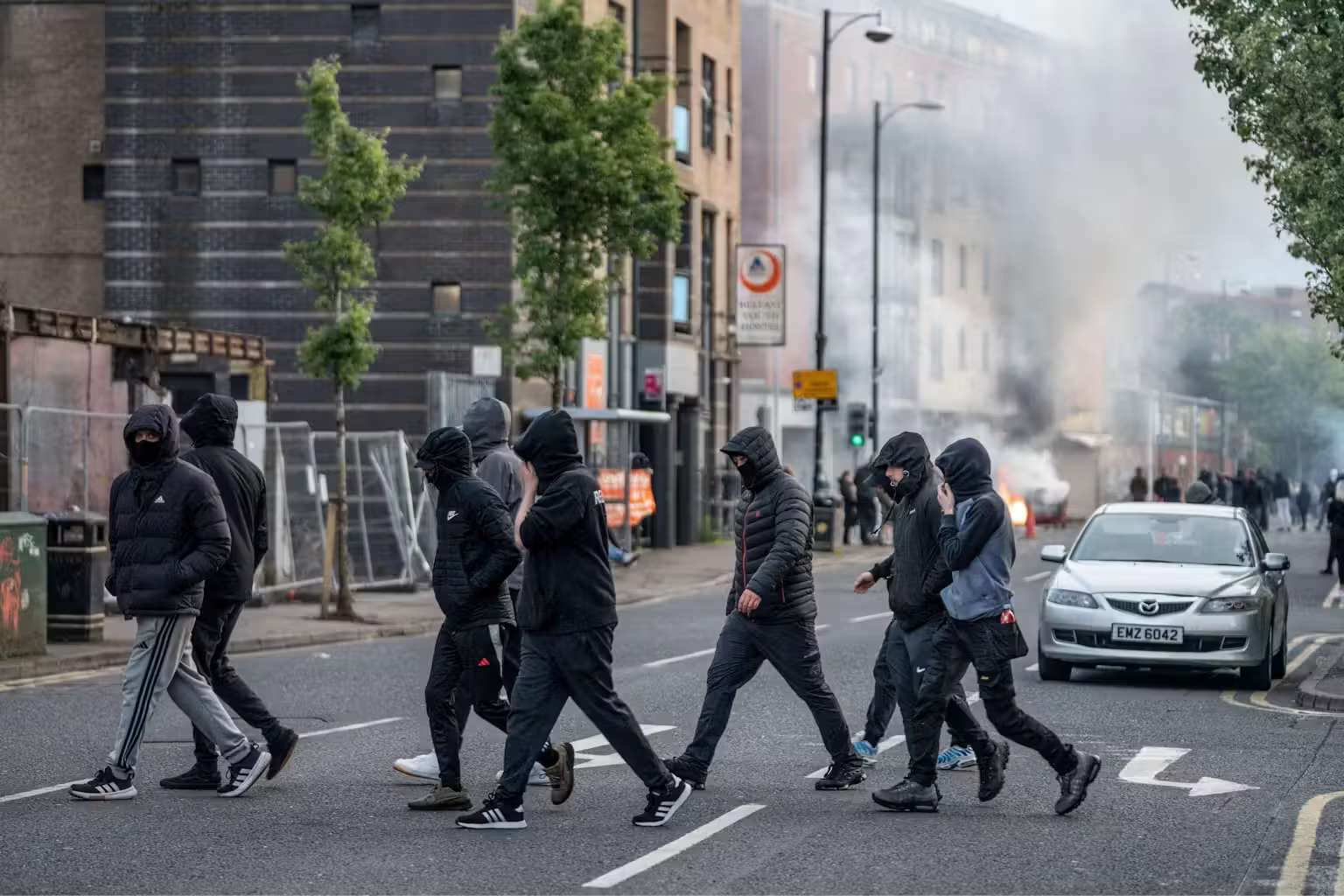
As the British state focuses on the suppression of native dissent through legal prosecution and information control, conditions have precipitated a fundamental shift from symbolic protest toward direct community action in multiple urban centres.
This transformation is most advanced in Northern Ireland where historical experience in civil resistance informs current strategies.
The Belfast 'Incident'
Civil unrest in Belfast follows exactly one week after the conclusion of the Henry Nowak diversity killing. This time it was a thirty-year-old Sudanese national who attempted to decapitate a native White resident in broad daylight in a central Belfast street.
The victim was a man with special needs and hearing impairments who was providing assistance to the assailant during a residential move. Brave local men apprehended the assailant before law enforcement arrived on the scene. The attacker entered the United Kingdom through a transit loophole involving the border between the Republic of Ireland and Northern Ireland.
The British government granted the Sudanese national a five-year visa in 2023, part of a larger infrastructure of migration funded by state departments, NGOs, and private contractors. This infrastructure prioritises the housing of arrivals in residential areas without the consent of the local population, infrastructure that the government maintains using the unregulated movement of third world migrants into British territory under existing common travel agreements.
This latest attack on natives as a result of this state sanctioned population replacement was in the same news cycle as the Nowak case has created a new watermark in the national consciousness.
The Belfast Model of Operational Security
The resistance in Belfast represents a decisive departure from the symbolic protest models observed in English cities like Southampton or Southport. The Belfast movement entirely bypassed all moral appeals to state institutions and law enforcement, and deployed rigorous operational security measures to prevent identification and subsequent state prosecution.
Activists wore masks, hoods and black clothing to negate the effectiveness of facial recognition technology and police body cameras. They intentionally left mobile devices at home to avoid digital mapping of their locations by state surveillance agencies.
The resistance movement actively suppressed the collection of digital evidence by external parties and auditors. News crews were forcibly removed from the vicinity of actions to ensure that no recordings of participants are made. Activists did not engage in live-streaming, self-filming or promotion, all of which mitigates the state from constructing prosecution files - easily at least.
In instances where a camera is present, the operator is a trusted individual who avoids capturing faces on film. This discipline is maintained through the efficient, targeted use or threats of violent consequences for those who attempt unauthorised recording. The focus remains on achieving physical results rather than making moral signaling gestures.
Targeting of Migration Infrastructure
Resistance efforts target the physical infrastructure associated with the migrant industry, from hotels and housing of migrants, to "law centres" that help navigate and exploit the native country. Activists conducted house-to-house searches to identify Houses in Multiple Occupation (HMOs) and hotels receiving government funding.
These properties are subjected to the immediate destruction of windows or arson to force the removal of inhabitants. The objective is to alter the incentive structures and risk calculations for property owners and the state. By increasing the physical and financial risks, the movement seeks to make the housing of foreign nationals an untenable business model.
This approach prioritises the physical removal of migration facilities over political lobbying or peaceful demonstration. Activists exit the scene immediately after an action to avoid direct confrontation with police forces. The strategy recognises that the state prioritises property damage over the social concerns of White residents and uses this as leverage.
Landlords must now calculate the value of government contracts against the potential destruction of their assets (or indeed their health and wellbeing). This creates a decentralised enforcement mechanism that operates independently of the political process. The state lacks the capacity to easily respond to distributed, small-cell actions across multiple urban centres.
Community Level Interventions and Ethnic Unity
Direct action extends to the systematic targeting of immigrant-owned businesses perceived as fronts for illicit activity. The destruction of these premises is intended to force their closure and restore local economic stability. Nationalists establish checkpoints on local roads to scrutinise the ethnicity of vehicle occupants. Delivery drivers of Middle Eastern or African descent are subjected to harassment and the seizure of goods to send a message that the tide has turned, the grift is over.
The unrest in Belfast has facilitated an unprecedented alignment between younger generations of Republican and Loyalist communities. These groups have rejected the positions of established religious divisions and the political parties who seen as part of the globalist establishment.
Younger activists prioritise the protection of their communities over historical sectarian grievances. This demographic consists largely of young White men who have been disinherited, and ostracised from the workforce and social institutions. Those who see the legal system as an instrument of two-tier policing that prioritises foreign interests over the native population. The threat of imprisonment and cancelation has lost its effectiveness as a deterrent for those with no social standing to lose.
Dissident Right, Dissonant Left
As the Right wing are looking to Northern Ireland to see the new pattern of effective resistance, the Left wing in Britain is experiencing terminal cognitive dissonance trying to understand, defend, and explain these events.
Leftists clearly now prioritise abstract ideological principles over the material reality of escalating communal violence. They characterise the predictable outcomes of their migration and policing policies as external atrocities rather than institutional failures.
This ideological insulation prevents the Leftist establishment from offering coherent solutions to societal fragmentation. They view the legitimate rage of the native population merely as a product of disinformation rather than a reaction to material conditions. Yet as bells cannot be un-rung, once people are outside of that leftist bubble their attitudes, dismissals and recriminations become blatantly ridiculous.
In response the British state is deepening its application the Online Safety Act to suppress footage of violent incidents and maintain a controlled public narrative. Official statements from the families of victims are carefully prepared by government departments to prevent the inflammation of communal tensions.
These scripts utilise platitudes about unity, the rejection of racism or racial unity to bypass substantive discussion of the crisis. Political leaders condemn the far right while ignoring the material causes of civil disorder.
The government continues to fund private companies that facilitate the arrival of more foreign nationals despite the ongoing civil instability. This prioritisation of material assets and human rights for offenders over the safety of the native population defines the current political era.
What happened in Belfast served as a blueprint for the Right, whether the historic divisions in Northern Ireland mean this was a unique response by the Northern Irish to their own past, or whether the rest of Britain can also embody these decentralised reflexes is still to be seen.