Veneration of Saint George extends across multiple continents and religious traditions including Christianity, Islam, and the Druze faith. The name George is derived from the Greek word Georgios, meaning tiller of the earth. Liturgical hymns describe the saint as a righteous farmer of the Trinity who uprooted the thorns of idolatry to plant the vine of the Orthodox faith.
Origins and Military Status
Saint George was born between 270 and 280 AD in the Roman province of Cappadocia. His father, Gerontios, served as an officer in the Roman army and died as a martyr for the Christian faith. His mother, Saint Polychronia, was a native of Lydda in Palestine who returned to her homeland with her son following her husband's death. Saint George was secretly baptised as a child by his mother. He grew up in a household divided between the public paganism of his father and the hidden Christian faith of his mother.
Following his father's military path, Saint George joined the Roman legions and achieved the rank of tribunus by his late twenties. He eventually became a member of the Praetorian Guard, the elite unit serving as the personal bodyguard to the Emperor Diocletian.
His position granted him significant social prestige and direct proximity to the imperial seat at Nicomedia. Religious devotion within the Roman army was transactional and essential for victory in battle. Military failure was attributed to the displeasure of the gods, making Christian refusal to sacrifice an act of treason. Saint George held the senior rank of comites and commanded a thousand men.
The Great Persecution
The Emperor Diocletian issued a series of edicts against Christians in 303 to initiate the Great Persecution. These decrees mandated the destruction of churches and scriptures while requiring all citizens to offer sacrifice to pagan deities. Saint George responded by distributing his wealth to the poor and freeing his servants. He entered the imperial senate at Nicomedia and publicly identified himself as a Christian.
The act of defiance occurred in the presence of Diocletian and his Caesar, Galerius. Saint George tore down the official document of the edict in the Roman forum. This repudiation of imperial authority by a trusted guard was regarded as treason and personal betrayal by the emperor. Diocletian initially attempted to persuade the soldier to recant his faith through promises of promotion and wealth. The saint replied that nothing in this inconstant life could weaken his resolve to serve God.
Trial and Martyrdom
The refusal to offer sacrifice resulted in a prolonged period of imprisonment and physical suffering. Saint George was subjected to laceration on a wooden wheel studded with iron spikes and blades. He remained unyielding despite being shod in iron sandals containing red-hot nails. The hagiographic record describes his miraculous survival of poisoning and burial in quicklime. He told the emperor that he was saved only by calling upon Christ and His power.
The endurance of these trials resulted in the conversion of thousands of spectators. Among those who confessed Christ were the imperial officials Anatolius and Protoleon as well as the Empress Alexandra. Diocletian ordered the immediate execution of these converts. To test the saint's power, the emperor commanded him to raise a dead man from a grave, which the saint achieved through prayer. Saint George was beheaded outside the city walls of Nicomedia on 23 April 303.
George and the Dragon
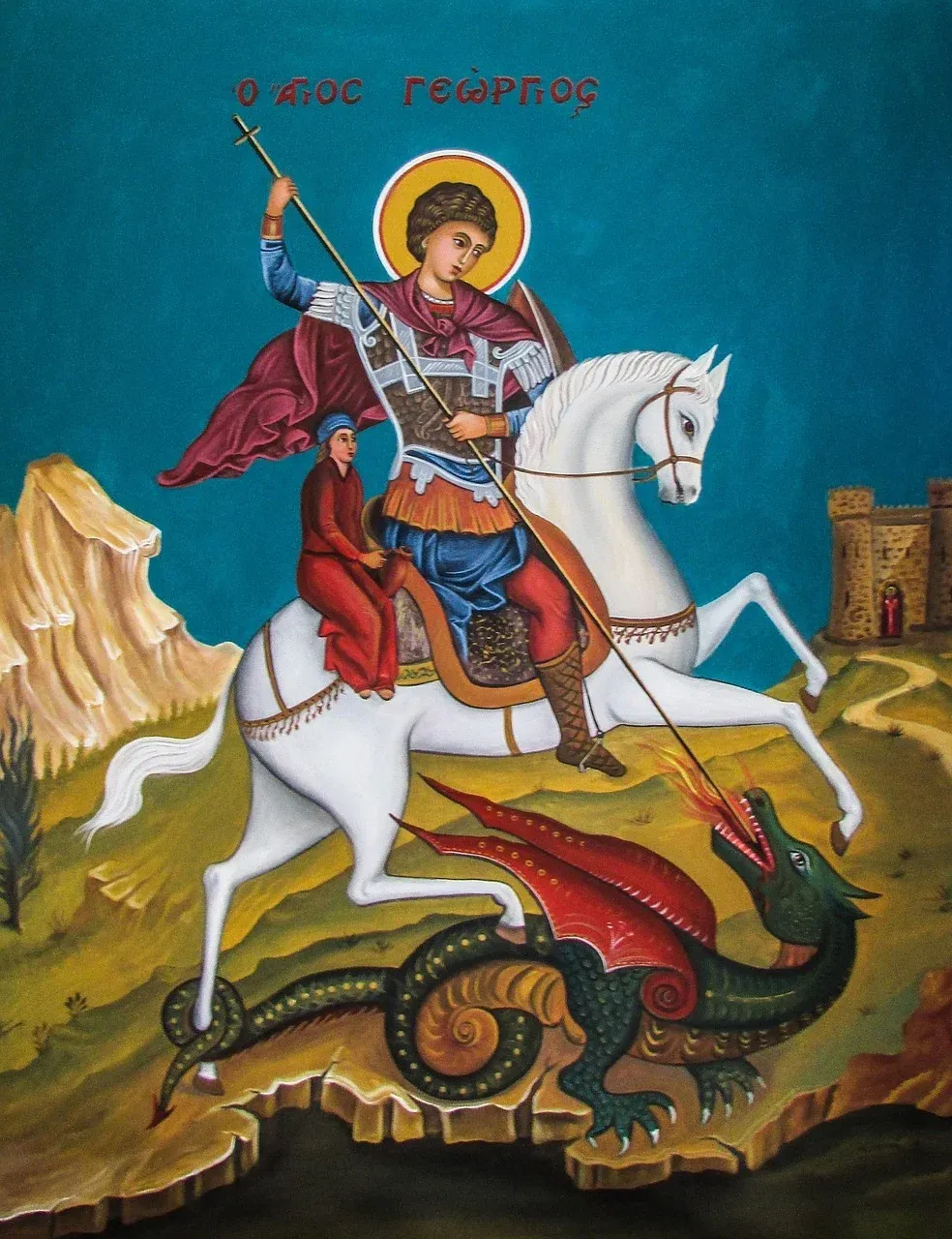
The motif of Saint George slaying a dragon first appeared in visual art during the 11th century in Cappadocia. Narrative versions of this legend date to the same period in Georgia and were later popularised in Western Europe by the Legenda Aurea in 1260. The story describes the saint arriving in a city, often Beirut or Sylene in Libya, where a dragon required human sacrifice. Saint George defeated the beast using a spear after invoking the Holy Trinity.
The dragon represents the prince of darkness and the forces of evil. Coptic traditions identify the persecutor Dadianus directly with the dragon of the abyss mentioned in the Book of Revelation. Iconographic depictions of the scene show Saint George on a white horse representing purity and holiness. The monster is always portrayed as smaller than the horse to signify the triumph of Christ over evil. The shield in these icons often features a sun motif representing Jesus Christ.
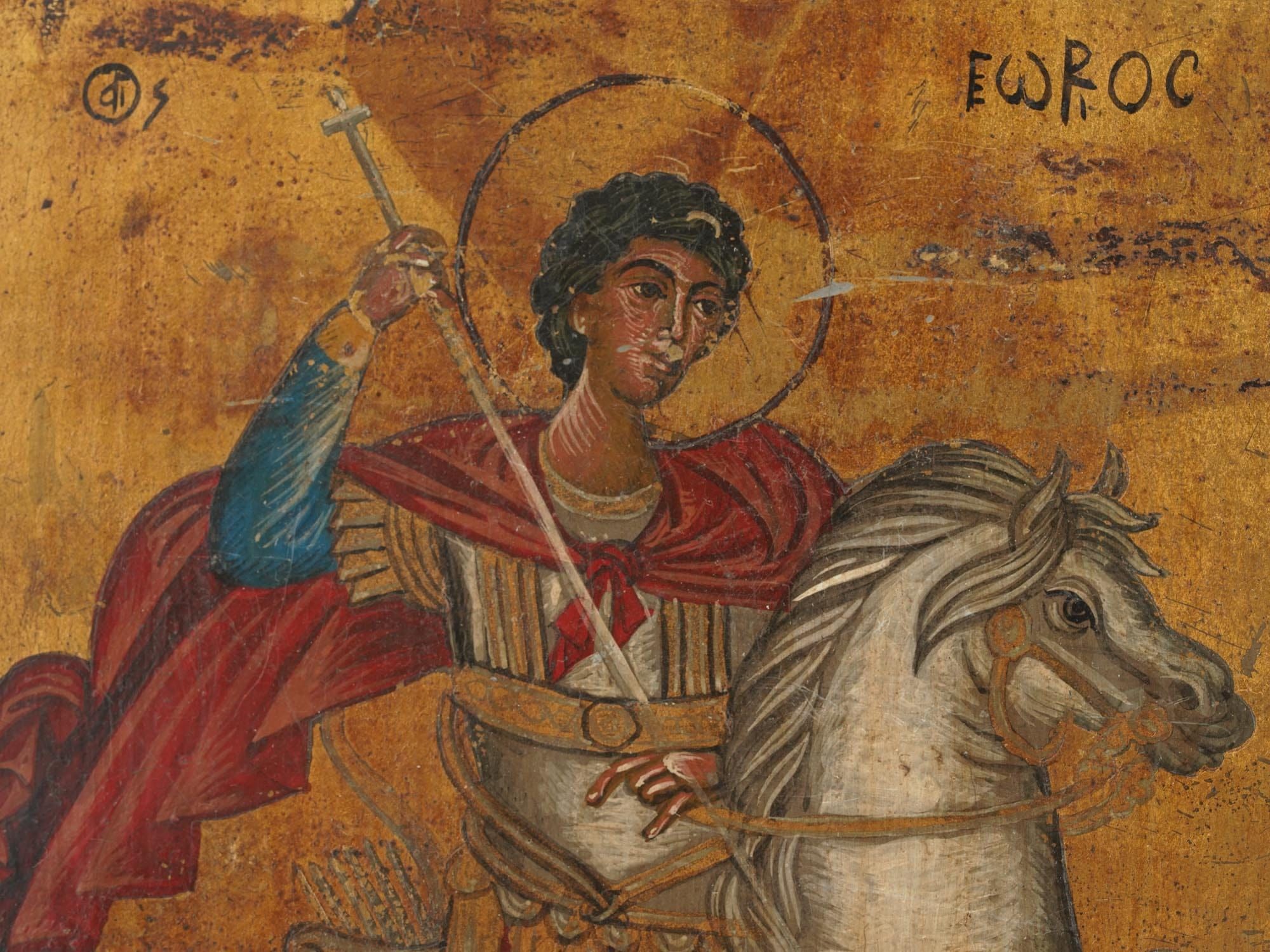
Orthodox iconography divides images of Saint George into three distinct types: wearing armour with weapons, without armour, and as a dragon slayer. Early depictions from the seventh century show the saint in civilian attire alongside other martyrs. Icons from the 10th century onwards primarily portray him in Byzantine military dress with a sword or spear. He is often depicted alongside other military saints such as Saint Demetrios.
Global Veneration and Shrines
Saint George is the patron saint of England, Georgia, Ethiopia, Portugal, and the city of Moscow. The red cross on a white background, known as Saint George's Cross, serves as the national flag of England. In Georgia, exactly 365 churches are named in his honour, representing one for every day of the year. The English name for the country of Georgia is derived from the intense devotion its people show toward the saint.
Christian Arabs in Palestine, Lebanon, and Syria celebrate him as a local hero and protector. The tomb of Saint George is located in the Church of Saint George in Lod, the modern day State of Israel. His head is preserved as a relic in the basilica of S. Giorgio in Velabro in Rome.
The Monastery of Saint George in Al-Khader is a significant pilgrimage site in the West Bank where irons believed to have bound the saint are used for healing. In Cairo, the Greek Orthodox Church of Saint George is built over a Roman fort identified as the site of his imprisonment. The Bay of Saint George in Beirut is the traditional location of the dragon slaying. Caves at Jounieh Bay and Tabarja are also associated with the cleaning of his weapons.
Saint George is regarded as the patron of agricultural workers, shepherds, and field workers. He is also invoked for protection against skin diseases, lepers, and syphilis. His image appears on the coat of arms of numerous cities including Genoa, Milan, and Freiburg im Breisgau. The Order of the Garter, founded by Edward III in 1348, remains under his protection as the oldest chivalric order in the world.
His feast is celebrated on April 23rd.