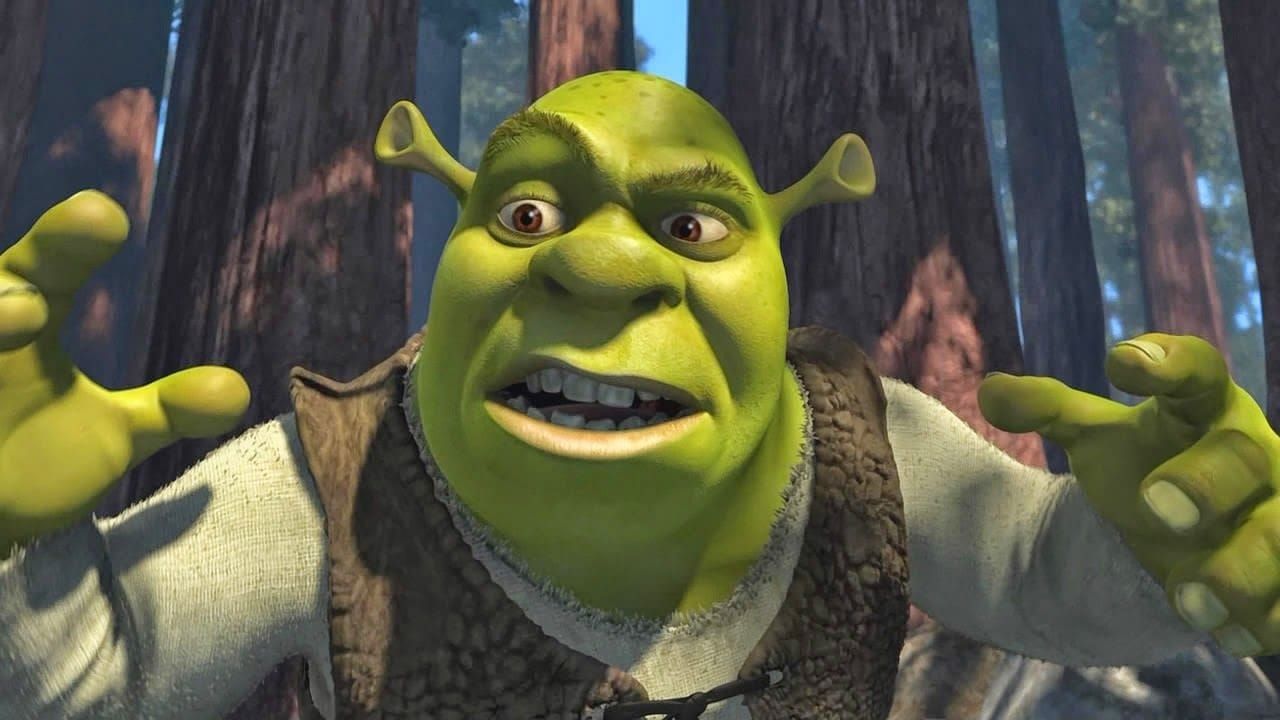
INVERTED CINEMA
The animated motion picture Shrek stands as a remarkably illuminating narrative, particularly for those seeking to comprehend the concept of the periphery or the margin in symbolic discourse.
As an upside-down fairy tale, its very structure foregrounds elements traditionally relegated to the fringes, thereby offering a distinct perspective on the dynamics between the established centre and its chaotic periphery. The symbolic structure of the narrative is announced within its initial moments, a common characteristic of stories seeking to reveal their deeper thematic concerns.
This early exposition sets the stage for a comprehensive exploration of the pathology of the margin and the intricate transition between the pathology of the centre and that of the margin.
The Subversion of Tradition and the Assertion of the Margin
The film commences with the familiar motif of a princess held captive in a tower by a dragon, a narrative archetype often presented within a beautifully Illustrated manuscript. A book, in this context, serves as a powerful image representing knowledge, tradition, order, and beauty.
However, this conventional portrayal is immediately subverted by the protagonist, Shrek, who proceeds to rip a page from this book to use as toilet paper. This singular act, not only to establishes the filmmakers want us to root for the devouring margin, but serves as a potent demonstration of how the margin can overrun the centre.
It is subversion repeated throughout the film, telling the audience that no human process, system, or tradition can be entirely total or all-encompassing; and indeed, nor should it attempt to contain everything.
This concept echoes the Tower of Babel motif, where an attempt at absolute unity and control paradoxically leads to fragmentation. For any complex human construct, there invariably exists something left out, a residue, a remnant, or something that simply does not fit.
It is what is found in the margin or fringe, that highlights the inherent imperfection of any system, the dregs at the bottom of wine. The film's opening moments are replete with potty humour and inverted behaviour presenting a litany of these chaotic, marginal elements.
The margin possesses a dual function: by marking the limit of something, it frames it and signifies its end, thus being akin to death. Concurrently, by embodying this limit, the margin exposes the vulnerability and insufficiency of the system it borders. Therefore, the act of wiping oneself with a page of a traditional fairy tale book precisely illustrates how the margin can assert itself over the established centre.
The Pathology of Control and the Suppression of the Strange
In direct opposition to Shrek, the film introduces Lord Farquaad, a character obsessed with order and perfection. His kingdom is portrayed as excessively straight and organised, reflecting his compulsive need for control. He is a hollow and cynical interpretation if authority, competency and hierarchy.
Farquaad's obsession drives him to try and purge his domain of any strangeness, imprisoning all characters from fairy tales who are deemed not normal or who don't fit.
So, we have two opposing extremes: Shrek, who embodies the chaotic margin by covering the fairy tale with waste, and Farquaad, who represents the rigid centre, seeking to contain the fairy tale by completely imprisoning it. Shrek initially resides contentedly in his swamp, on the edges where he belongs, however, it is the attempt to control or contain the marginal that inevitably forces the ogre to confront Lord Farquaad.
The desire to fully master, fully control the strange invariably backfires. Farquaad's compulsion to control stems from his own hidden insufficiency. His impossibly short stature renders him almost a fairy tale character himself, ironically aligning him with the very strangeness he seeks to eradicate.
When Shrek delivers the princess to Farquaad, the Lord offers him the deed to his marsh. Yet, as the narrative illustrates, there can be no deed to the margin, no rule, and no measurement to the chaos on The Edge. By this juncture, the conflict has escalated beyond a simple transaction.
The monster, Shrek is compelled to take the whole structure down and to take the princess. A situation is analogous to The Matrix, where the Architect attempts to fully account for the anomaly that is Neo within the program itself, an impossible endeavour. The attempt to fully contain what does not fit drives the world to extremes, with the totalising self-replicating agent Smith, representing ego and excessive control, akin to Farquaad - facing the anomaly.
This extreme duality, a reflection of the Tower of Babel's ambition for absolute unity leading to absolute fragmentation, reaches its climax when Farquaad discovers that his princess possesses a monstrous side, a shadow which he cannot handle.
This reveals the inherent presence of a serpent in the garden, an uncontainable element within his desired perfection. Farquaad's final defiant screams, "I am King! I will have order! I will have Perfection!", precede his demise, as he is devoured by a dragon.
This act signifies the victory of the periphery over the controlling centre. The underlying cause of this entire conflict is attributed to an excess of control and an excess of identity, Farquaad shown as being obsessed with himself, paralleling the concept of ego.

The Triumph of the Periphery
The devouring of Farquaad by the dragon is echoed by a subsequent structural transformation within the narrative: Princess Fiona, contrary to conventional fairy tale expectations, does not become a beautiful princess but rather becomes an ugly ogre. This transformation powerfully reinforces the theme that - the periphery has won.
The narrative embraces the triumph of the marginal and the acceptance of unconventional forms. The newly married couple, Shrek and Fiona, choose to reside in a garlic clove, a humble and perhaps unusual dwelling for a royal couple. Another act 3 depiction of 'the new normal' shows of an impossible mixture with the union of a dragon and a donkey. This pairing is presented as an affirmation that "Love Is Love", transcending traditional boundaries and expectations.
The final scene features the gingerbread man, now handicapped, uttering the phrase "God bless us everyone". This "everyone" takes on a heightened significance, extending beyond its original context to encompass all those who were previously excluded or marginalised, underscoring the inclusivity that arises from the margin's victory.
This parallel illustrates a core principle: the tyranny of the margin always proceeds from a tyranny of the centre. This dynamic is like a pendulum swinging.
The Dual Nature of Vice
The complex relationship between centre and margin, and the underlying pathology of control, finds a compelling theological analogue in the symbolism of Saint Maximus the Confessor.
He frames this problem at the individual level using the symbolism of the left and right hand. St. Maximus said the passions of the flesh, such as prostitution and drunkenness, greed and jealousy, belong to the left hand. Conversely, self-conceit, vainglory, and pride are categorised as vices of the right hand.
Demons that combat us by excess of virtue are those that teach us presumption, vainglory, and pride who by the vices of the right, secretly place in us the vices of the left. We can see this in Shrek: the initial sin is consistently a sin of the right hand, a sin of pride as we see in Satan, Adam, Cain and even Peter, who declared unwavering loyalty before denying Christ.
This dynamic is cyclical in its nature, whenever the margin achieves victory and devours the centre, the pendulum will swing once again, with the centre-in-exodus devouring the illegitimate margins, now at the centre. Just as the centre cannot perfectly contain the margin within its order, so too when the margin is victorious in taking the centre, the centre will inevitably be reestablished, because the ascendant margin will inevitably appropriate the language of identity of pride and of exclusion, which were originally the very weapons of the centre.
Contradictions are unstable
There is a power in the margin, but to retain that power it must remain the margin. Correspondingly, there is an authority of the center but to retain that authority it must leave room for the fringe to unfold without absolute control.
There is a tacit agreement fundamental to any traditional society, one that has been forgotten in the modern age characterised by rationality, and the absolute chaos of postmodernism. The pendulum is left to swing.