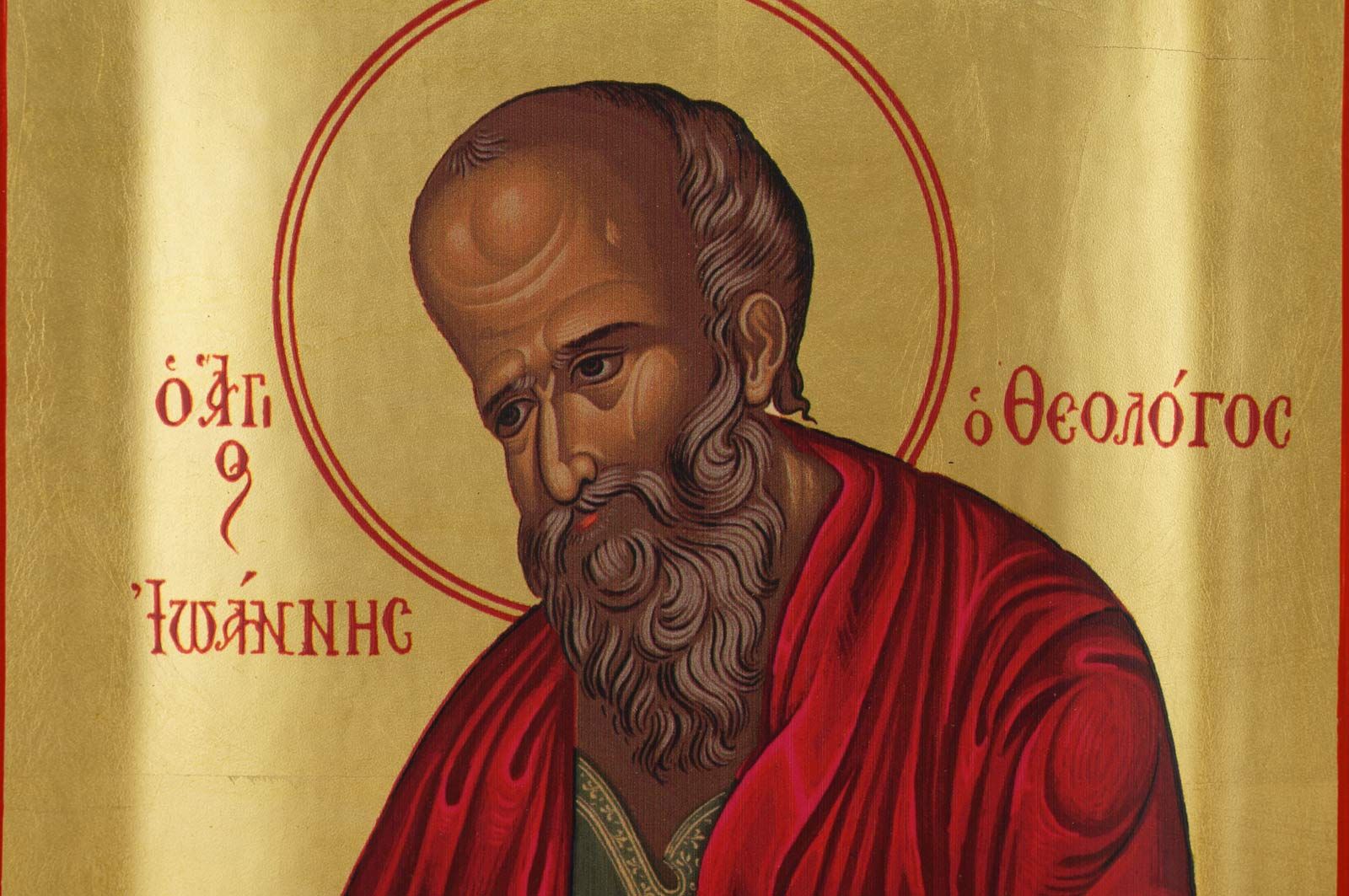
Saint John the Theologian, also known as the Apostle, Evangelist, and Divine, is a central figure in Christian history and a primary pillar of the early Church. He is distinguished by the unique titles of "Virgin," "Beloved friend of Christ," and notably "Theologian," a designation held by only two other figures in the Eastern Orthodox tradition: Saint Gregory the Theologian and Saint Symeon the New Theologian.
As the author of the Fourth Gospel, three epistles, and the Book of Revelation, John’s literary and spiritual legacy is characterized by an elevated focus on the divinity of Jesus Christ and the paramount importance of divine love. His historical existence is supported by the earliest known extant New Testament fragment, the P52 manuscript, dating to the early second century.
The Sons of Thunder
Born in Bethsaida of Galilee, John was the son of Zebedee, a fisherman, and Salome. He and his brother, James the Elder, were following their father’s trade on the Sea of Galilee when they were called by Jesus to become "fishers of men".
Abandoning their nets and worldly possessions, they became part of the original twelve apostles. Jesus nicknamed the brothers "Boanerges," or "Sons of Thunder," likely a reference to their fiery zeal and temperament. This zeal was evidenced early in their ministry when they wished to call down fire from heaven to punish a Samaritan village that had refused to receive their Master.
John held a position of profound intimacy within the apostolic circle, forming an inner nucleus with Peter and James that was present at the most pivotal moments of Christ’s ministry. This group alone witnessed the Transfiguration on Mount Tabor, the raising of the daughter of Jairus, and the agony in the Garden of Gethsemane. Throughout his Gospel, John refers to himself humbly as "the disciple whom Jesus loved," and at the Last Supper, he was the one permitted to recline his head upon the Lord’s bosom. This intimacy was not merely emotional but theological; Irenaeus notes that John was the eyewitness who leaned on Christ’s chest and subsequently published a Gospel to declare what he had seen and heard.
At the Cross and the Care of the Theotokos
During the Crucifixion, when the other disciples had fled in fear, John remained at the foot of the Cross alongside the Theotokos. In a moment of intense collaboration in suffering, Jesus looked down at his mother and his beloved friend, saying to Mary, "Woman, behold your son," and to John, "Behold your mother". Through these words, John was entrusted with the care of the Virgin Mary, effectively becoming a brother to Christ the Teacher and a son to the Mother of God.
The Church views this moment as deeply significant, seeing Mary as the mother of the whole Church, represented in the person of John. Tradition maintains that John took her into his own home and remained in Jerusalem in her service until her Dormition. It was only after her departure from this world that he began his extensive missionary travels to the East.
Persecution and the Miracle of the Oil
John eventually departed for Asia Minor with his disciple Prochorus, focusing his missionary activities in the city of Ephesus. His ministry was interrupted during the second major persecution of Christians under Emperor Domitianaround 95-96 AD. John was taken in bonds to Rome, where he stood trial for his faith before the Emperor. The hagiographic record describes a miraculous event in which he was cast into a vat filled to the brim with boiling oil.
Coming forth from the vat completely unharmed, the Apostle proved the power of Christ over physical torment. The frustrated Emperor, unable to bring any physical harm to the Saint, chose instead to banish him into exile on the isolated island of Patmos. This banishment is considered a form of martyrdom by the Church, fulfilling Christ's prediction that John would "drink his cup".
Patmos and the Apocalypse
On Patmos, John sought refuge in what is now known as the Cave of the Apocalypse. It is believed that one day, the rocks of the cave cracked into three fissures symbolic of the Holy Trinity. Through these fissures, God spoke to the Apostle, instructing him to write down visions of the final days of the world and the creation of a "new heaven and new earth".
Guided by these revelations, John composed the Book of Revelation (the Apocalypse). Today, the cave and the nearby Monastery of Saint John the Theologian, founded in 1088, are recognized as World Heritage Sites. Pilgrims can still visit the cave to touch the fissures on the wall and see the rocky protrusions the Apostle used to prop himself up during his work.
The Theological Gospel and Epistles
Upon the death of Domitian and the accession of Emperor Nerva, John returned to Ephesus. There, he composed his Gospel and three Catholic Epistles. Unlike the Synoptic Gospels, which focus on the humanity and chronology of Christ's life, John’s is a "theological gospel" intended for those already initiated into the Church. He begins his narrative not with a human genealogy but with the eternal pre-existence of the Logos: "In the beginning was the Word".
John's Gospel is characterised by its high Christology and the use of seven specific "signs" to signify Jesus as the Messiah. He uniquely emphasizes the "I AM" statements that identify Jesus with the Yahweh revealed to Moses. Furthermore, his Gospel provides a deeper look at the humanity of Jesus, using the name "Jesus" 247 times—more than any other writer—to keep the reader "face to face with the human Jesus". His writings also record private, deep-reaching conversations such as those with Nicodemus on the new birth and the Samaritan woman on living water.
The Apostle of Love and Asceticism
The last years of John's life were spent in Ephesus in strict asceticism; he ate only bread and water and dressed in simple linen garments. Having outlived all his fellow apostles, he became a modern Church Father to the growing Christian community, teaching only the bishops when he lacked the strength to preach to the crowds.
His message became focused on a single, essential commandment: "Little children, love one another". When his disciples asked why he repeated this incessantly, he replied, "This is the Lord’s commandment; and if ye keep it, it is enough". This emphasis on love as an active, work-based reality is a hallmark of his epistles, where he famously warns that those who do not love their brother whom they have seen cannot love God whom they have not seen. He taught that the commandments of God are not burdensome because they are made easy through love.
The Mystery of the Metastasis
John fell asleep in the Lord in Ephesus around 100-101 AD during the reign of Trajan. He was reportedly over one hundred years old. According to the Synaxarion, he instructed seven disciples to dig a cross-shaped grave outside the city. After praying and bidding them farewell, he entered the grave and commanded them to cover him with earth.
When his disciples later returned and opened the tomb, the Saint's body was not there. Holy Tradition assumes that his body was raised by the Lord, similar to the Dormition of the Theotokos. This event is celebrated as the Metastasis or Translation on September 26. Every year on May 8, a red dust known as "manna from the earth" appears on his grave, which is said to grant healing to the sick. Some sources refer to this feast as the Day of the Roses.
Iconography and Global Veneration
In Orthodox iconography, Saint John is traditionally depicted in two ways: as the youngest, beardless apostle in scenes of the life of Christ, and as an elderly man with a high forehead and long white beard in individual icons. His primary symbolic attribute is the eagle, a symbol of the Holy Spirit and his lofty theology which "hastens toward higher matters". This symbolism stems from the four living creatures seen by the Prophet Ezekiel.
In some Western art, he is shown with a chalice and a snake, referring to a legend where a pagan priest challenged him to drink poison; John survived and even resurrected others who had died from the same draught. He is venerated as the patron saint of those suffering from heart conditions. His influence extended even to the modern era, as he was a primary guide for missionaries like Saint Nicholas of Japan, who used the "Faith of John" to bring Christianity to new lands. Today, his relics and his empty tomb remain some of the most sacred sites in Christendom.
Feast Day: 08 MAY