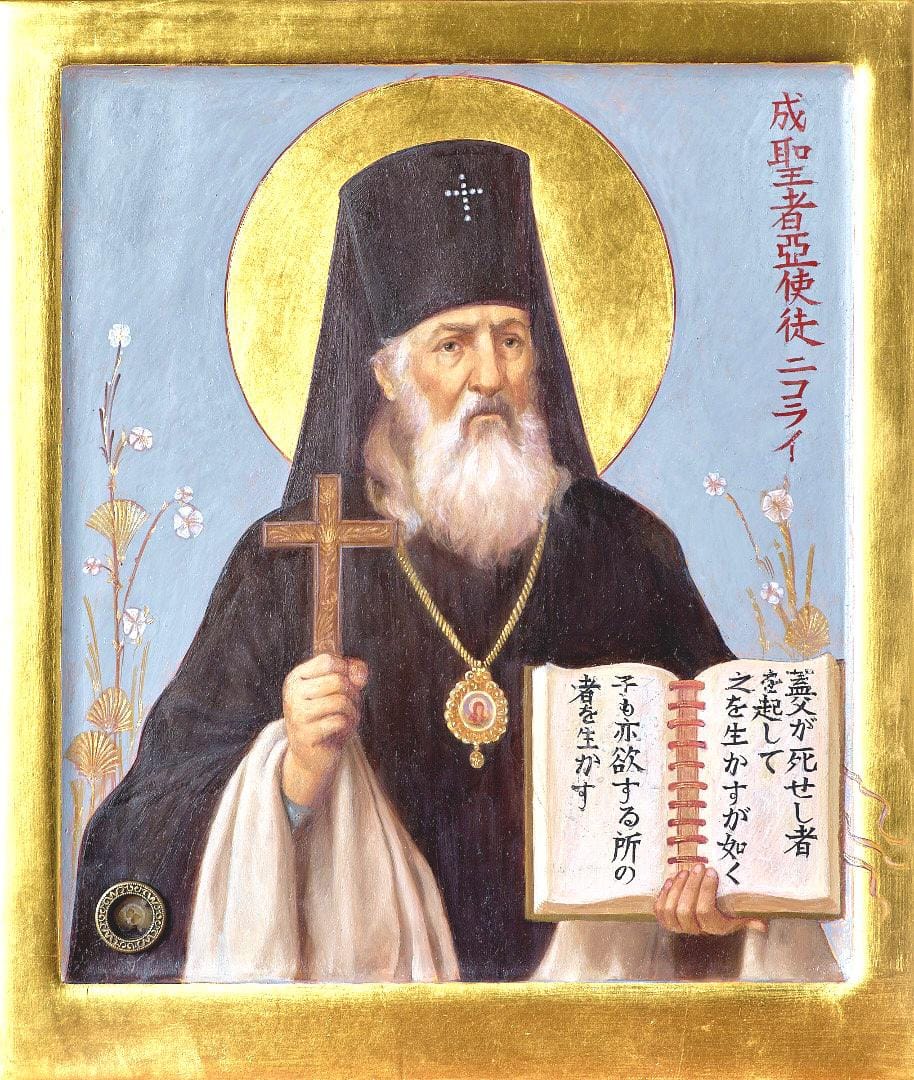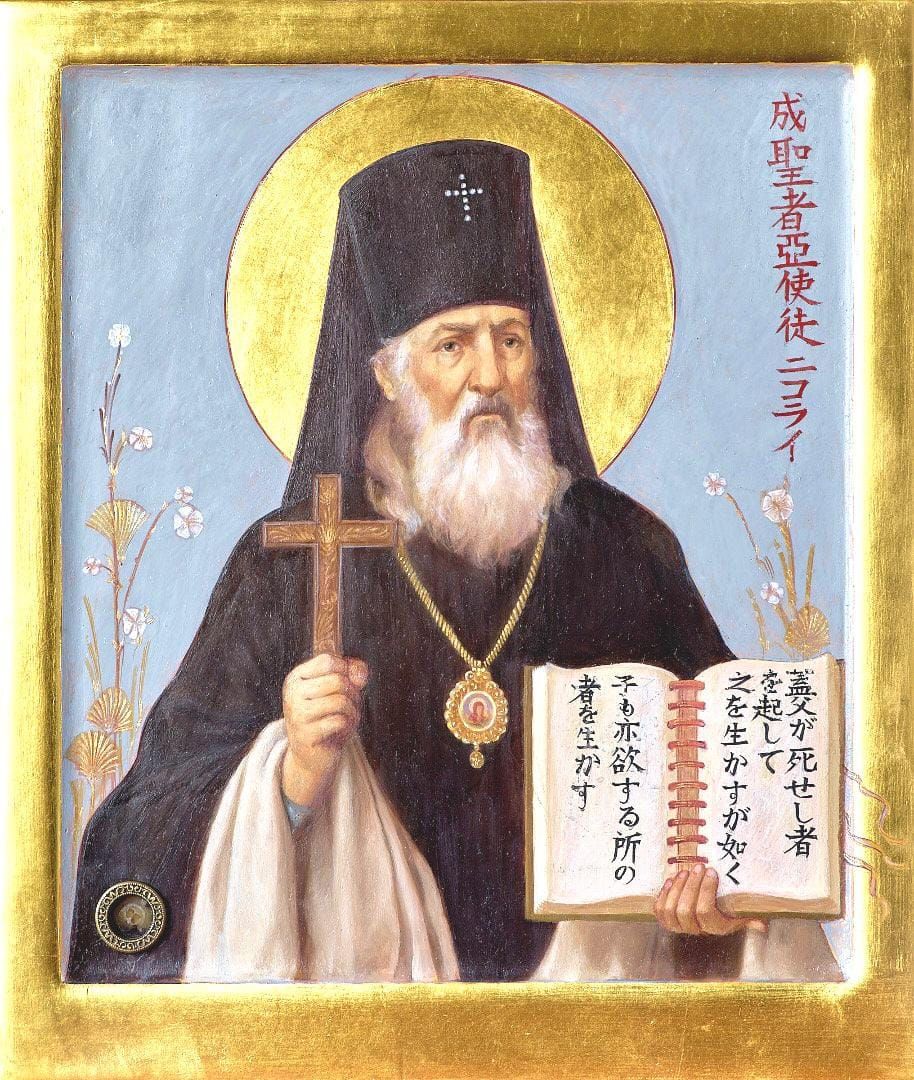
Saint Nicholas of Japan was a Russian Orthodox prelate and missionary who established the Japanese Orthodox Church during the nineteenth century. He held the titles of Archbishop of Tokyo and All Japan and was recognised as an Equal to the Apostles following his canonisation in 1970.
His historical contribution involves the conversion of thousands of Japanese citizens and the translation of the Holy Scriptures into the Japanese language. The Orthodox faith in Japan is frequently referred to as the Faith of Nicholas in recognition of his extensive labours.
Origins and Theological Education
Born Ivan Dmitrievich Kasatkin on 1 August 1836, the future prelate was a native of Berezovsky Pogost in the Smolensk Province. He was the son of a deacon and received his early education at the Belsk Theological School and the Smolensk Theological Seminary. His academic performance earned him a recommendation to the Saint Petersburg Theological Academy in 1857. He studied there until 1860, focusing on the study of theology and preparing for a life of service within the Russian Orthodox Church.
In 1860, the Saint Petersburg Theological Academy received a request from Metropolitan Gregory for a priest to serve at the newly established Russian consulate in Hakodate. Kasatkin accepted the post and was tonsured a monk with the name Nicholas on 23 June 1860. He was ordained a Hieromonk one week later and was awarded a Doctorate in Theology without the requirement of a qualifying essay. He departed the Russian Empire to assume his responsibilities in the Far East.
Cultural Immersion in Hakodate
Saint Nicholas arrived at the port of Hakodate on 2 July 1861. He discovered a society that was largely hostile to foreigners and where the practice of Christianity was strictly prohibited by law. The priest realised that effective communication required an understanding of the local environment and its traditions. He dedicated the first eight years of his residence to the intensive study of the Japanese language, history, and culture.
The Saint resolved to read only Japanese literature and spent hours listening to Buddhist and Shinto preachers in the community. He mastered the nuances of the Japanese language to a degree that was noted to be exceptional for a foreigner. This period of preparation was indispensable for his later success in explaining Christian concepts to a population with no prior exposure to monotheism. He maintained the principle that a missionary must learn before they can teach.
The Samurai and Initial Converts
The first Japanese person to convert to the Orthodox faith was Takuma Sawabe, a samurai and Shinto priest. Sawabe initially approached the priest with a drawn sword and the intent to kill him, accusing the foreigner of spying and harming Japan through his preaching. Saint Nicholas challenged the samurai to listen to his message before condemning it. Sawabe agreed and began to attend secret lectures on the Old Testament and the life of Jesus Christ.
Sawabe was baptised in April 1868 and took the Christian name Paul. Two other Japanese men, Sakai and Urano, were baptised alongside him, marking the beginning of the indigenous church. Paul Sawabe later became the first native Japanese priest ordained into the Orthodox clergy in 1875. Despite the legal ban on conversion, the community grew to twelve members within a year and included twenty-five seekers.
National Expansion and Conciliarity
The headquarters of the mission was moved from Hakodate to Tokyo in 1870. Saint Nicholas established an organisational structure that emphasised the national character of the church. He relied on a system of Japanese catechists and lay preachers to spread the faith to administrative and cultural centres across the country. By the end of 1890, the Japanese Orthodox Church consisted of 216 communities and over 18,000 Christians.
The principle of conciliarity was central to the administrative philosophy of the mission. The prelate established an annual Cathedral Council where clergy and lay representatives gathered to discuss church affairs and distribute resources. Candidates for the priesthood were selected by the Christians themselves rather than being appointed solely by the bishop. This approach ensured that the church remained rooted in the local community rather than functioning as a foreign imposition.
Missionary work followed a clear set of rules developed by the Saint for catechists. Preachers organised meetings for those interested in the basics of the faith and separate lessons for those studying the New Testament. These sessions were held twice a week and focused on the Symbol of Faith, the Lord's Prayer, and the Ten Commandments. Preachers were required to keep logbooks and write down important questions and answers for future use.
Institutional Labours and Iconography
Saint Nicholas founded a theological seminary in Tokyo in 1875 to train local clergy. He also established six theological schools for both boys and girls, a library, and a shelter for those in need. The women's school founded in 1873 was widely regarded as an exceptional educational institution for females in Japan. The Saint taught dogmatic theology and personally tested students at the end of each semester.
Literary and artistic development were significant priorities for the mission. Saint Nicholas translated the New Testament and various liturgical books into Japanese to ensure the faith was accessible to the population. He also established an icon-painting workshop. Irina Rin Yamashita, an early convert and artist, was sent to Russia to study iconography and became the principal painter for the Japanese mission.
The prelate also compiled a Russian-Japanese lexicon, which was the first full dictionary of its kind in Japanese history. In the senior classes of his schools, he used Russian newspapers as teaching materials when educational books were unavailable. Over one thousand students passed through his network of schools. These graduates became influential in various fields of Japanese social and political life.
The Cathedral and the War
The Cathedral of the Holy Resurrection was consecrated in Tokyo on 8 March 1891. The building was designed using Byzantine architecture with thick walls and a large central dome. It was constructed on a site in the Kanda district chosen by the Saint in 1872. The cathedral reached a height of over 34 metres and became a prominent landmark known popularly as Nikorai-do.
The Russo-Japanese War of 1904 to 1905 presented a challenge to the leadership of the mission. As a Russian subject, the Saint could not pray for a Japanese victory over his homeland, but he encouraged his Japanese flock to perform their duty as citizens. He abstained from public services during the conflict while remaining in Japan to care for his people. He stated that his heart felt like a father whose two beloved sons were fighting.
During the war, the prelate established the Society for the Spiritual Consolation of Prisoners of War. This organisation provided guidance and resources to the 73,000 Russian captives held in Japan. He selected five Russian-speaking priests to provide spiritual guidance and supplied the prisoners with icons and books. This service received praise and gratitude from both the Russian and Japanese governments.
Final Years and Legacy
Saint Nicholas was elevated to the rank of Archbishop of Tokyo and All Japan in 1906. By 1911, his mission had produced 266 communities and over 33,000 lay members. The indigenous clergy included 43 priests and 121 lay preachers. The Saint died on 3 February 1912 at the age of 76. Emperor Meiji granted permission for him to be buried at the Yanaka cemetery within the city of Tokyo.
The legacy of the prelate is preserved in the five volumes of his diaries which contain ethnographic materials about Japanese life. He is regarded as a modern Church Father by Japanese Orthodox Christians. The Japanese Orthodox Church remains a national institution that maintains its cultural identity while adhering to universal doctrines. The example of respectful cultural engagement established by the Saint continues to inform missionary methodology.
Feast Day: 03 FEB