
The term Catholic Church refers to those Churches, including the Eastern Catholic Churches and other non-Latin rite churches, in communion with the Bishop of Rome, the Pope.
Roman Catholicism arose in Western Europe, parts of Eastern Europe, and parts of the Middle East after the Great Schism in 1054. The Schism resulted from widening differences between the Eastern and Western Churches, primarily stemming from a dispute over papal authority and the theological soundness of the term Filioque.
The fundamental differences between the Orthodox Church and the Roman Catholic Church continue to be the inclusion of filioque in the Creed and the scope of papal authority. Roman Catholic dogma, defined by the authority of the extraordinary Magisterium, is predicated upon three pillars: Scripture, tradition, and the Magisterium.
The Papacy and Magisterial Authority
The foundational stone of the Roman Catholic Church is asserted to be the dogma of papal infallibility, as defined by the First Vatican Council.
This dogma, legislated officially for the first time in history in 1870, declares that when the Pope speaks Ex Cathedra on matters of faith or morals, his decision is binding on all Catholics and it is considered infallible, and this infallibility is binding even if the Pope speaks from himself and not from the consensus of the church. To be a good Catholic means agreeing with the teachings of the Magisterium and those definitions of the Pope, stated with the prerogative of infallibility, according to the criteria set forth at the First Vatican Council.
Papal Primacy and Jurisdiction
The First Vatican Council’s dogmatic statement, Pastor Aeternus, defines the Pope’s prerogatives. The primacy of jurisdiction over the universal church was immediately and directly promised and given to the Blessed Peter. The jurisdiction of the Pope is asserted to be ordinary and immediate, both over each and all the churches, and over each and all of the pastors and the faithful.
The papal power of primacy remains intact and the Pope is always free to exercise this power. This means the Pope has direct authority over every baptised Christian in the church. This power is intrinsic to the office of the successor of Peter; it is an ordinary power that can be exercised at all times, and an immediate power requiring no coordination or cooperation with local authorities. The council cannot act without the Pope’s consent, but the Pope can act without the council’s consent.
The first see can be judged by no one.
An expansive authority which historically was an innovation.
The First Vatican Council’s view of papal supremacy was simply not in anyone’s mind in the Sixth Council in 680 for example. The idea of an ex cathedra papal statement is found nowhere in the first millennium, where the Church of the first millennium operated in a synodal manner.
Apostolic Canon 34 suggests that the first among bishops should do nothing without the consent of all. Furthermore, the fifth ecumenical council stated that truth cannot be made manifest except in a collegial context.
Temporal Dominion
The papal office expanded historically to include temporal dominion. The Gregorian reforms expanded the temporal authority of the Roman bishop, culminating in the idea of the Pope as a world emperor.
Not only granting the Pope supreme spiritual authority but also significant temporal jurisdiction over Christian kingdoms, emperors, and even the right to depose rulers or intervene in secular governance. This reached peaks under figures like Gregory VII (1073–1085) during the Investiture Controversy, Innocent III (1198–1216), and Boniface VIII (whose 1302 bull Unam Sanctam declared subjection to the Roman Pontiff "altogether necessary to salvation" for every human creature).
Some medieval texts even described the Pope as the "true emperor" (verus imperator), with kings as mere vicars or agents in the temporal realm. These claims were not based on Scripture or early tradition but were significantly bolstered by two major forgeries from the early Middle Ages:
The Donation of Constantine
Likely composed in the mid-8th century, around 750–800 AD, possibly in Rome during negotiations with the Franks), this fabricated imperial decree purported to come from Emperor Constantine the Great. It claimed that Constantine, cured of leprosy by Pope Sylvester I and converted to Christianity, granted the Pope and his successors.
The document was inserted into later canon law collections and first explicitly cited by Pope Leo IX (1049–1054). It provided retroactive "legal" justification for the Papal States (territories in central Italy that the popes ruled as sovereigns from the 8th century until 1870) and for papal interventions in European politics, such as alliances with Pepin the Short and Charlemagne. It was treated as authentic for centuries, even amid the Investiture Controversy and struggles with Holy Roman Emperors
Then there was the Pseudo-Isidorian Decretals (also called the False Decretals, compiled around 850 AD, likely in the archdiocese of Reims in Francia). This massive collection of about 60 forged papal letters, along with manipulated conciliar canons and other texts, was falsely presented as the work of "Isidore Mercator."
Its primary goal was to shield bishops from interference by archbishops (metropolitans) and secular princes by dramatically elevating papal supremacy and centralising authority in Rome. It included the Donation of Constantine and reinforced the idea that the Pope held ultimate jurisdiction in both ecclesiastical and (by extension) temporal matters. These decretals were incorporated into Gratian's Decretum (c. 1140), the foundational text of medieval canon law, giving them enormous influence. They helped create a legal framework for papal monarchy, protecting local bishops while subordinating them (and secular powers) to Rome.
Both forgeries were exposed during the Renaissance: Lorenzo Valla definitively debunked the Donation in 1440 through philological analysis (showing anachronistic Latin and historical inaccuracies), though the Pseudo-Isidorian collection faced similar scrutiny later. By then, however, the ideas they supported had shaped European politics, law, and the Papal States for centuries.
Later this was contradicted, with the Second Vatican Council, convened by Pope John XXIII and concluded under Paul VI, produced 16 documents that fundamentally reframed the Church's self-understanding and its relationship to the modern world. While it reaffirmed papal primacy, it did so in a way that rejected any notion of the Pope exercising temporal "emperor-like" dominion. Instead, it stressed service, collegiality, dialogue, and the legitimate independence of secular society.
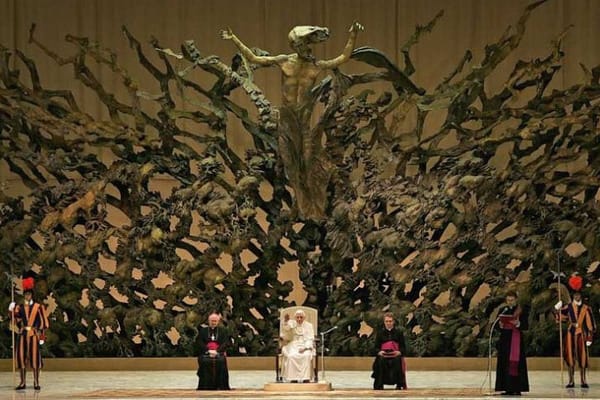
Dogmatic Pronouncements and Contradictions
Ever since the Great Schism, the Roman Catholic Church has continually made their own 'innovations' - pronouncements of doctrine that were not sanctioned by Christ, the Church Fathers, nor the Orthodox Church. These include Purgatory, the Immaculate Conception, original sin, and papal infallibility.
The Immaculate Conception
In 1854, Pope Pius IX officially promulgated the doctrine of the Immaculate Conception of the Virgin Mary. This doctrine, which had previously been adamantly opposed by the Dominican Order, teaches that Mary’s conception was supernaturally free from original sin so that she could be Christ’s mother.
The Filioque
The inclusion of the term Filioque (and the Son) in the Creed by the Western Church without the consent of the Eastern bishops was a primary cause of the Great Schism.
This addition upset the balance of the Triad and the monarchia of the Father. The filioque doctrine effectively creates a diad (Father-Son), whom produce the third person, subordinating the Holy Spirit, necessitating a humanistic role for the Holy Spirit embodied in the person of the Pope.
Second Vatican Council (Vatican II) and Ecumenism
The Second Vatican Council, vaunted by Rome with the full weight of papal authority, produced a clutch of “dogmatic” decrees that constitute nothing less than a brazen rupture with the Apostolic Faith once delivered to the saints.
In its declaration on religious liberty the Council brazenly endorsed freedom of conscience and public worship for every error under the sun, a direct, head-on collision with the solemn condemnations of Pius IX’s Syllabus of Errors and every prior Roman encyclical that rightly anathematised such indifferentist poison.
Worse still, the conciliar texts enshrine the most extreme and reckless ecumenism, treating schismatics, heretics and pagans as honoured partners in dialogue. Beneath it all lies the rotten foundation of generic theism: the blasphemous pretence that there exists some vague, universal “God-idea” upon which all religions can amicably agree.
Thus, with papal signature and fanfare, Rome has not merely erred; it has officially canonised the very modernism and apostasy that the Orthodox Church has always denounced as the spirit of Antichrist.
Islam and Other Non-Christian Religions
Nostra Aetate (Declaration on the Relation of the Church to Non-Christian Religions) and Lumen Gentium_16 detailed the church’s esteem for Muslims, stating that they adore the one God.
Nostra Aetate claims that the God of the Muslims is one, lives and subsists in Himself, is merciful, all-powerful, and the creator of heaven and earth. Muslims, professing to hold the faith of Abraham, adore the one God along with Catholics. This posture stands in direct contradiction to centuries of prior papal teaching. Pope Urban II (1095) identified Muslims as infidel pagans who worship demons. All who died fighting them would have immediate remission of sins.
The Fourth Lateran Council (1215) affirmed that Jews and Muslims should be designated as differently dressed people and that Muslims should not intermarry with Christian women. Pope Innocent III (1217) wrote a bull calling for a crusade against Islam, identifying the false prophet Muhammad as a son of perdition and a great Antichrist.
Pope Clement V at the Council of Vienne (1311-1312) stated that the blasphemous public worship of the Muslims is an insult to the name and a disgrace to the Christian faith. All Christian princes must forbid Muslim worship, which is deemed sacrilegious and displeasing to God.
Pope Calixtus III (1455) referred to Muhammad as the son of the devil, the enemy of Christ, and declared the intent to extirpate the diabolical sect of the reprobate faithless Muhammad. The magisterium’s prior teaching stipulated that for a Muslim to have the faith and be baptised, it was necessary to explicitly believe in the Trinity and the Incarnation.
Vatican II's Nostra Aetate also grants esteem to Hinduism, claiming Hindus seek release through practices, meditation, and have recourse to God in confidence and love. This is also a cleat contradictory, as all 'gods of the nations' are demons.

No Salvation Outside the Church
The Roman Church firmly believes, professes, and proclaims that those not living within her, including not only pagans but Jews, heretics, and schismatics, cannot become participants in eternal life and will be damned in the lake of fire, unless they are added to the Roman Church before the end of their life. This position was articulated at the Council of Florence (Cantate Domino). It specifically asserted that even if one were a martyr for Christ, they would be rejected if they were outside the Roman Church.
The documents of Vatican II deny the unity and communion of the church to now be something confined to the Roman Catholic Church, and acknowledge the existence of martyrs outside of the Roman Communion, yet another outright denial of previous doctrine.
Theological and Philosophical Issues
Roman Catholicism is intrinsically linked to the philosophical doctrines of Thomas Aquinas. The acceptance of Thomism as the official philosophy of the church is a major point of contention.
Divine Simplicity and Created Grace
The Roman Catholic system, dogmatically enshrined at the Fourth Lateran Council, enshrines the notion of Absolute Divine Simplicity, a Hellenic philosophical straightjacket that reduces the living God of Scripture to a static, motionless “pure act” utterly incapable of genuine manifestation in time and space.
What Rome calls “theology” is the the systematic Hellenisation and Judaicising of the Apostolic Faith. The Roman Catholic system further corrupts its anthropology with a Hellenised mind/intellect–body dichotomy that treats the flesh as an enemy to be mortified and subdued rather than the very matter destined for deification. This dualistic error stands in open revolt against the Orthodox patristic vision of the whole man, body and soul alike, being transfigured by uncreated divine grace.
In Christology the rot runs deeper still. Rome’s theology repeatedly veers toward the Nestorian heresy, fragmenting the one Person of Christ, with it's cult of “heart worship” the adoration of isolated parts of the Saviour, was explicitly anathematised at the Council of Ephesus as the hallmark of Nestorian division.
Post-Vatican II, the Papacy has openly enlisted as a willing tool of globalism and the Anglo-American international establishment. The Vatican Bank stands exposed in decades of money-laundering and intimate ties to the world’s most powerful families. Having once rightly forbidden usury, Rome quietly embraced it; having once resisted, it became a documented instrument of the Cold War “Americanism” project.
The final proof of its spiritual trajectory is unmistakable: Pope John Paul II publicly implored Saint John the Baptist to “protect Islam,” an act of staggering delusion that confirms Rome’s steady march toward the spirit of Antichrist.