
Israeli Control of America
The relationship between the United States and the State of Israel constitutes a departure from traditional imperial hierarchies. While the State of Israel functioned as a strategic outpost for American power during the late twentieth century, it has attained a level of sovereignty that subordinates American foreign policy to Israeli objectives.
This reconfiguration is evident in the commencement of total war in the Middle East in 2026. The United States military acts as the primary kinetic force for a strategy devised in Jerusalem.
The State of Israel possesses a degree of autonomy that is unique among nations dependent on American military and financial assistance. It maintains an unofficial nuclear arsenal (see Dimona Nuclear Reactor) and frequently violates diplomatic red lines established by the United States executive branch.
Traditional colonial models, such as the British Raj in India, involved a clear chain of command from the imperial centre. The State of Israel operates as a sovereign entity that dictates terms to the American government.
Strategic Indulgence has been replaced by active coordination. The State of Israel utilises American resources to pursue its own regional objectives regardless of the impact on American global prestige.
Capture of the American Executive
The administration of Donald Trump is an instrument of the State of Israel. Foreign policy regarding Iran is directed by non-official figures such as Jared Kushner and Steve Witkoff.
These individuals maintain constant contact with Benjamin Netanyahu to coordinate military actions. The traditional foreign policy establishment in Washington DC is excluded from the decision-making process.
The killing of the Supreme Leader, Ayatollah Khamenei, was an Israeli objective executed through the American military. This operation occurred without the planning or manufacturing of consent typical of previous American wars, the rest of the world was neither consulted, nor informed of a war that would impact everyone, and was only wanted by a single country: the State of Israel.
Why Israel Wanted War
The State of Israel sought to initiate a fundamental reconfiguration of the Middle East. A strategic move to facilitate the transition of the State of Israel from a regional client of the United States to an autonomous global power. The execution of this conflict is the primary mechanism for the realisation of the Greater Israel project.
The State of Israel seeks to establish a regional hegemony that exists independently of American support. This ambition requires the permanent neutralisation of all competing powers in the Levant and the Persian Gulf.
The war aims to expand the influence of the State of Israel by destabilising surrounding nations. This strategy creates a security environment where the State of Israel acts as the sole arbiter of regional affairs.
The Greater Israel project envisions a future where the State of Israel is a sovereign superpower. It no longer requires the military or financial guarantees provided by the United States. Eliminating regional rivals allows the State of Israel to operate without the constraints of traditional diplomacy. The destruction of the existing state system in the Middle East is a prerequisite for this new order.
Pursuit of Sovereign Autonomy
The State of Israel has intentionally departed from the established international order to assert its sovereignty. It treats the United States as a temporary facilitator for its own national objectives. Total war is the chosen method to bleed the American empire of its resources. The State of Israel accepts the decline of American global prestige as a necessary cost for Israeli independence.
Strategic autonomy is achieved through the direct capture of the American executive branch. This allows the State of Israel to utilise the United States military as a kinetic tool for Israeli goals.
The State of Israel dictates terms to the American government through a network of loyalist decision makers. These individuals bypass traditional diplomatic protocols and military doctrine to serve Israeli interests. Figures within the American administration operate as agents of Israeli policy. This arrangement ensures that American foreign policy is subordinated to the requirements of the State of Israel.
The State of Israel acts with total impunity, frequently violating red lines established by American presidents. This defiance demonstrates that the State of Israel has attained a position of sovereign superiority over its former patron.
Theocratic and Messianic Impulses
The leadership in Jerusalem views the destruction of the current secular order as a providential necessity. Religious factions believe that total war will precipitate the arrival of the Messiah.
The physical destruction of secular Jewish population centres is regarded as a path to spiritual redemption. Proponents of this view in Jerusalem seek the end of the animal soul represented by Tel Aviv.
Suffering and loss are treated as divine instruments to force a return to God. The war is not merely a geopolitical event but a spiritual struggle for the soul of Israel. The emergence of a nationalist theocracy in the State of Israel is the intended outcome of the conflict. This new order replaces the materialistic values of the Western world with religious devotion.
Jerusalem serves as the centre of this new theocratic vision. It stands in opposition to the cosmopolitan and progressive values formerly championed by the State of Israel. The religious elite believe that the State of Israel must suffer to find its true purpose. This eschatological framework overrides conventional concerns for national survival or economic stability.
Strategic Neutralisation of Iran
The State of Israel intends to permanently destroy Iran as a functional nation-state. This is achieved through decapitation strikes against the Iranian leadership and the destruction of civil infrastructure.
The war strategy focuses on the balkanisation of Iran into ethnic enclaves. These divisions ensure that the Persian population is unable to pose a future threat to Israeli hegemony. Targeting water infrastructure is a primary tactical objective. The State of Israel seeks to render the Iranian plateau uninhabitable by exacerbating existing water scarcity.
The resulting refugee crises and internal ethnic conflicts are planned outcomes of Israeli military doctrine. These events ensure the total collapse of Iranian civilisation. The State of Israel aims to divide Iran along ethnic and linguistic lines. This fragmentation prevents the re-emergence of a unified Persian power in the region. The destruction of Iranian leadership removes any pragmatic interlocutors. This escalation ensures that the conflict is fought to a final and absolute conclusion.
Reconfiguration of the Global Order
The State of Israel accepts the collapse of the global financial system as a consequence of the war. The destruction of the Gulf Cooperation Council states serves to bankrupt the American empire. Eliminating the petrodollar system removes the primary source of American influence in the Middle East. The State of Israel anticipates that the resulting global depression will facilitate the rise of theocratic nationalist states.
The war shifts the focus of the Jewish elite away from global finance and toward regional dominance. This transition finalises the end of the post-World War II international order. The State of Israel seeks to replace the secular rules-based order with a system founded on national and religious identity. This transformation marks the end of Western liberal hegemony in the Middle East.
Exhaustion of American military and financial resources is a deliberate goal. This depletion ensures that no external power can interfere with the final establishment of Greater Israel: Pax Judaica. The war serves as a catalyst for a global return to traditional social structures. The State of Israel leads this transition by abandoning modern materialism in favour of spiritual and territorial expansion.
Opening Operations and Leadership Attrition
The initial phase of the conflict involved high-precision strikes directed at the highest levels of the Iranian government by an American military under the spell of the State of Israel.
A decapitation strike in Tehran resulted in the death of the Supreme Leader, Ayatollah Khamenei. While the United States and the State of Israel cite intelligence-led success, the Iranian state felt these deaths as acts of martyrdom that provide a spiritual impetus for total war.
Subsequent operations included the assassination of Ali Larijani, the official overseeing the Iranian war effort. These targeted killings remove pragmatic interlocutors from the theatre of conflict. The removal of established leadership structures precipitates an escalation toward more extreme and violent command elements.
Collateral engagements occurred during these opening strikes, including the destruction of a school in southern Tehran. The State of Israel intentionally targeted civilian infrastructure to demonstrate total commitment to the war. These events solidified the transition from a conventional regional dispute to a religious jihad.
Maritime Contestation and Global Economic Impact
The Strait of Hormuz serves as the primary nexus for the conflict due to its role in the transport of twenty per cent of the global oil supply. Iranian forces successfully closed this maritime corridor, causing immediate disruptions to energy security in Asia and Europe. Japan, which relies on the region for seventy-five per cent of its oil, faces total economic collapse within nine months of the closure.
The military strategy of Iran focuses on the systematic destruction of the global economy. Attacks on the energy infrastructure of the Gulf Cooperation Council (GCC) nations, including Qatar and the United Arab Emirates, have finalised the end of the region’s status as a safe haven for international finance. Qatar, a supplier of twenty per cent of the world's liquefied natural gas, has seen its production facilities targeted by cluster warheads.
This economic warfare strikes at the foundation of the American Empire, which is predicated on the petrodollar system. The collapse of GCC stability removes the demand for the United States dollar as the exclusive currency for oil transactions. The withdrawal of GCC investment from American financial markets threatens the stability of major technology and artificial intelligence firms.
Asymmetric Warfare and Military Doctrine
The conflict demonstrates a significant disparity between conventional Western military hardware and asymmetric Iranian capabilities. Iranian forces utilise Shahed drones, which are produced at a rate of five hundred per day and cost approximately fifty thousand United States dollars each. These drones are highly mobile and easily concealed within the mountainous terrain of Iran.
The United States military responds to these threats with sophisticated air defence systems such as the Terminal High Altitude Area Defense (THAAD). Each interceptor missile costs over one million United States dollars. This economic imbalance forces the United States to expend vast resources to counter inexpensive and plentiful Iranian munitions.
Internal corruption and an adherence to Cold War era military doctrine have rendered the American armed forces ill-equipped for twenty-first century drone warfare. The focus on expensive, prestigious weapon systems provides an illusion of invincibility that does not withstand the reality of decentralised religious resistance. Iranian command and control is structured to remain functional even after the fall of the central government in Tehran.
Internal Factionalism and Social Ruptures
Domestic instability within the combatant nations dictates the progression of the war. In the United States, a conflict persists between the established elite, who seek to maintain the global order, and a counter-elite focused on the Western Hemisphere. The Republican administration utilises the war to enact emergency powers and suspend constitutional norms, while the Democratic opposition anticipates the war’s unpopularity will lead to a permanent shift in political power, and are unified in their support of the war, despite widespead public objection to the war.
The State of Israel experiences a profound internal division between the secular, cosmopolitan population of Tel Aviv and the religious, theocratic elements in Jerusalem. The latter group views the physical destruction of secular cities as a necessary prerequisite for spiritual redemption and the arrival of the Messiah. This internal struggle allows the government of Benjamin Netanyahu to operate with unprecedented autonomy from American interests.
Iran faces a similar divide between secular nationalists and the clerical theocracy. The war radicalises both factions, leading to the rise of Persian exceptionalism and a more extreme version of Shia eschatology. Foreign powers seek to exploit these divisions by encouraging the balkanisation of Iran into ethnic enclaves.
Water Scarcity and Territorial Ambition
Water serves as a primary strategic weapon and target in the current theatre. The GCC nations are entirely dependent on desalination plants for sixty per cent of their fresh water supply. Iranian drones can easily destroy these facilities, rendering the desert cities of the Gulf uninhabitable.
Conversely, the United States and the State of Israel target the water infrastructure of Iran to exacerbate existing drought conditions. The depletion of major water sources, such as Lake Urmia, provides the tactical opportunity to transform the Iranian plateau into a prison for its population. The ultimate objective of Western strategy is the permanent destruction of Iran as a viable nation-state.
Benjamin Netanyahu pursues the Greater Israel project, which envisions an autonomous regional superpower independent of American support.
This project utilizes the military resources of the United States to eliminate regional rivals while disregarding the long-term survival of the American imperial structure. The State of Israel acts as a sovereign entity rather than a colonial outpost, frequently violating American diplomatic constraints without consequence.
The Emergence of the Theocratic Order
The war signals the end of the global secular financial order and the rise of nationalist theocracies. Iran seeks to establish Pax Islamica by unifying the Shia and Gentile Muslim populations against the West. This international jihad targets American embassies and military installations across the globe.
As the global economy enters a period of profound depression, societies shift away from materialism toward spirituality and introspection. The destruction of the modern infrastructure of consumption forces a return to traditional social structures such as the family and the local community. This transition is viewed by religious factions in both Jerusalem and Tehran as the fulfilment of divine purpose through suffering.
The conflict between the United States and Iran is inextricably linked to World War II and the ongoing struggle for energy dominance. European powers, deprived of Russian energy, are forced to intervene in the Middle East to secure their survival. The entry of Russia and China into the conflict on the side of Iran finalises the transition to a global total war.
PHASE TWO
The conflict has entered a phase of direct and sustained engagement. This escalation follows a significant transition in the Iranian strategic command structure and the adoption of a new offensive military doctrine.
Leadership and Strategic Transition
Ali Larijani served as the primary operational leader of the Iranian war effort until his death. A veteran of the Iran-Iraq War and a scholar of Immanuel Kant, Larijani was recognised by Western diplomatic circles as a pragmatist capable of engagement. His operational philosophy emphasized shared risk between the leadership and the civilian population, which included a refusal to utilize specialized bunkers during military strikes.
Hossein Dehghan assumed control of Iranian military logistics following the death of Larijani. Dehghan is a Brigadier General in the Islamic Revolutionary Guard Corps and holds a doctorate in supply chain logistics from an institution in Tehran. His appointment coincides with a shift from a defensive escalatory model to an offensive grounding in military operations.
The current Iranian command focuses on the bombardment of Tel Aviv as a central objective. This doctrine represents a departure from previous strategies where Iran provided prior warning of its strikes to avoid unpredictable outcomes. The military transition has resulted in an intensification of missile waves launched against Israeli territory throughout the day.
Missile Warfare and Defensive Efficacy
Iranian missile strikes against the State of Israel occur continuously and target critical infrastructure. Notable targets include nuclear research facilities located in Dimona and Arad. These strikes follow a policy of exact reciprocity for attacks against Iranian nuclear researchers and facilities.
The efficacy of Israeli missile interception systems, including the Patriot and Iron Dome, has diminished significantly. Standard defensive protocol for the Patriot system requires the deployment of eight interceptors for every single incoming missile. Iran has introduced cluster munitions and advanced missile technology to saturate and bypass these defensive layers.
Israeli early warning systems, including radar and siren networks, have suffered degradation. This loss of infrastructure has reduced the window for civilian retreat to shelters, often leaving populations with no warning before impact. Digital footage confirms extensive damage to Israeli sites previously considered secure by military authorities.
The United States military maintains a doctrine of psychological missile defence. This strategy involves overstating the number of successful interceptions and understating physical damage to influence the morale of the adversary. Despite this doctrine, the State of Israel remains vulnerable to Iranian missile capabilities which are currently more advanced than Western alternatives.
Regional Combat and Allied Involvement
Hezbollah forces are engaged in active ground combat with the Israel Defense Forces in southern Lebanon. Combat reports indicate the destruction of Israeli tanks and the downing of helicopters by Hezbollah units. Units of the Israel Defense Forces have reportedly lost contact with Central Command during these ground engagements.
The Iranian military provides direct aerial and missile support for Hezbollah operations. This support includes strikes against Israeli troop concentrations located in Lebanon. The Houthi movement in Yemen maintains readiness to close the Red Sea to shipping aligned with the State of Israel to exacerbate logistical challenges for the United States and its allies.
Strategic warnings indicate that the conflict could expand to involve ground forces from the Islamic Republic of Iran. The Iranian military consists of a standing force exceeding one million troops capable of deployment into Kuwait or Saudi Arabia. Russian diplomatic warnings suggest intervention if the conflict escalates to the use of nuclear weapons.
International Diplomacy and Strategic Threats
Donald Trump has issued a demand for Iran to restore access to the Strait of Hormuz within a forty-eight hour period. The United States threatens to destroy the entire Iranian electrical grid if this demand is not met. The Islamic Revolutionary Guard Corps has responded with threats to destroy power and desalination plants across the Middle East.
Such an escalation would result in the loss of electricity and potable water for millions of civilians in the Gulf States and the State of Israel. The United States has deployed five thousand Marines to Car Island in preparation for further operations. However, the United States faces a credibility deficit due to a history of launching strikes during active negotiations and the assassination of world leaders.
The United Kingdom and the European Union have declined to enter the conflict directly. Officials from the Ministry of Defence dismissed claims that Iran struck British bases in Cyprus or Diego Garcia. NATO leadership has stated there is no evidence that Iranian missiles possess the range to reach London or other European capitals.
Maritime Logistics and Economic Warfare
The Islamic Republic of Iran maintains functional and military control over the Strait of Hormuz. It grants safe passage to vessels from neutral or friendly nations, including India and China, through bilateral negotiations. This control serves as a counter-sanction against decades of Western economic pressure on the Iranian state.
Vessels from non-aligned or hostile nations are required to pay a toll of two million dollars to secure transit through the strait. Ships associated with the United States or its allies lack guarantees of safety and face the risk of bombardment if they attempt passage without authorization. The Iranian leadership maintains that these measures will continue until international conditions are satisfied.
The Iranian population remains on a total war footing to defend its territory and civilisation. National sentiment emphasizes the defense of a five-thousand-year history against external aggression. This mobilization indicates a lack of diplomatic alternatives for the current leadership in Tehran.
Operation Epic Fury commenced on 28 February 2026 as a high-intensity military engagement between the United States of America and the Islamic Republic of Iran. The conflict resulted in the significant degradation of American regional infrastructure, including the expulsion of personnel from 13 military facilities in the Persian Gulf. This period of warfare transitioned abruptly from total hostilities to a Pakistan-mediated diplomatic process in April 2026.
Military Operations and the Isfahan Incident
Military activity in southwestern Iran featured the loss of approximately 13 American aircraft, including F-15 Strike Eagles and C-130 Combat King transport planes. A notable engagement occurred in the Zagros Mountains involving the downing of an F-15 and the subsequent 48-hour evasion of an American weapons officer holding the rank of Colonel. Official accounts attributed his extraction to Ghost Murmur technology, which utilizes quantum magnetometry and artificial intelligence to detect human cardiac signatures.
The recovery mission required the destruction of two C-130 aircraft stuck in wet sand to prevent capture by Iranian forces. Evidence indicated the rescue narrative served as a public cover for an abortive special operations mission involving elite Navy Seals. The actual objective was the seizure of enriched uranium from the Natanz nuclear facility situated near Isfahan.
Ceasefire
Ceasefire negotiations took place in Islamabad, mediated by the Pakistani Prime Minister and Field Marshal. The United States delegation was led by Vice President JD Vance, supported not by other American politicians or officials, but by Trump's own son-in-law Jared Kushner and the real estate developer Steve Witkoff. The Iranian delegation was headed by Foreign Minister Abbas Araghchi.
Talks lasted for 21 hours but were hampered by a lack of sovereign authority within the American team. Vice President Vance reportedly placed 21 telephone calls to Donald Trump during the proceedings. Trump was simultaneously in communication with Benjamin Netanyahu, the Prime Minister of the State of Israel.
The Iranian Ten-Point Framework
The basis for the negotiation was defined by a ten-point proposal presented by the Islamic Republic of Iran. Stated demands included a permanent cessation of all military actions and the lifting of all United States sanctions. The plan also required the withdrawal of the State of Israel from Lebanese territory.
Control of the Strait of Hormuz was a central component of the framework. Iran proposed a 2 million US dollar toll for every ship passing through the waterway. These fees were intended for reconstruction efforts rather than international compensation.
Blockades
Following the failure to reach a comprehensive agreement, Donald Trump initiated a policy termed blockading the blockade. This involved an attempt by the United States Navy to close the Strait of Hormuz to shipping that complied with Iranian toll regulations. The manoeuvre was intended to squeeze the Iranian economy and apply secondary pressure on the People's Republic of China.
Regional stability was further undermined by Operation Eternal Darkness (!), a campaign launched by the State of Israel against Lebanon. During the ceasefire talks, Israeli forces conducted 100 air strikes within a single minute against the city centre of Beirut. The State of Israel subsequently annexed southern Lebanese territory up to the Litani River. Arab Christians were forced to evacuate their ancestral dwellings before the Israel Defence Forces announced plans for a permanent occupation.
After ignoring a ceasefire to carry on with the ir invasion of Lebenon, Apple Maps shamefully have removed the names of Lebanese cities in areas claimed for annexation. This cartographic erasure coincides with the establishment of a permanent security zone.
Threats to the Vatican
Internal dissent within the Trump administration regarding the conduct of military operations led to a breakdown in the chain of command. Secretary of Defence Pete Hegseth initiated a purge of the military leadership by requesting the resignations of various senior generals. These officers reportedly refused to execute presidential orders deemed unacceptable or illegal.
The United States incredibly threatened the Catholic Church following Pope Leo's condemnation of the war. The Pentagon issued a memo to the United States Ambassador to the Vatican containing implicit threats of military force. The document cited the 14th-century Avignon Papacy as a historical precedent for enforcing temporal control over the Holy See.
Anti-Christian Pattern
The State of Israel conducts military operations in southern Lebanon that involve the systematic targeting of civilian infrastructure and Christian religious sites.
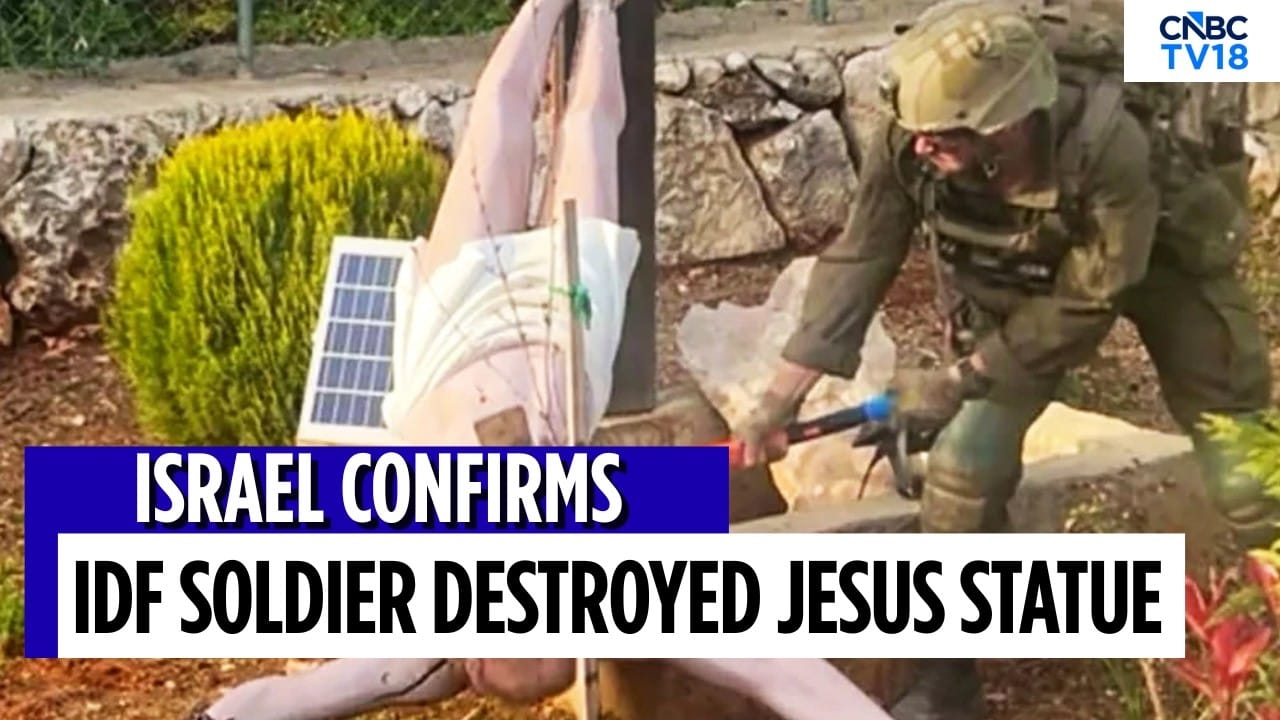
Israeli Defense Force personnel use heavy machinery and manual tools to destroy Christian religious imagery in Lebanese territory. One incident involved a soldier using a sledgehammer to smash the face of a statue of Jesus. An Israeli tank was recorded bulldozing a statue of Saint George slaying the dragon.
Soldiers occupy Christian places of worship to perform blasphemous acts. Video evidence depicts IDF personnel smashing crosses, statues of the Theotokos, and inside a Lebanese church mocking Christian rites and conducting a mock religious ceremony. The objective of these manoeuvres in Lebanon is clearly the systematic ethnic cleansing of the indigenous Christian population.
War Crimes
The State of Israel employs a range of satanic military and judicial measures against Palestinian captives and non-combatants during the ongoing genocide. These practices are characterised by the systematic use of physical violence, the implementation of exceptional legal frameworks, and the targeting of civilian populations.
The Knesset has enacted legislation permitting the death penalty exclusively for Palestinian prisoners. This legal development represents a departure from traditional Jewish religious practice and facilitates the execution of detainees by hanging. Palestinian individuals are frequently held in detention for years without access to a trial or formal court proceedings.
Reports from the Euro-Mediterranean Human Rights Monitor identify the use of sexual torture as an organised state policy endorsed by Israeli political, military, and judicial authorities. Detainees at the Sde Teiman facility are subjected to gang rape by masked soldiers who film the assault while bound naked to metal tables. Military personnel also utilise trained canines to perform rape on naked prisoners during physical beatings.
In other documented instances, soldiers have inserted fire extinguisher nozzles into the bodies of prisoners. These acts of violence result in severe internal injuries and are frequently recorded by the perpetrators,. The Israeli military treats the public disclosure of such recordings as a criminal act of exposure.
The BBC documented the deliberate targeting of Palestinian children by Israeli Defense Force snipers in the Gaza Strip. Analysis of 160 cases indicates that the majority of victims were shot in the head or chest. Most of these children were under the age of 12 at the time of their death.
Military operations involve the use of white phosphorus bombs in densely populated civilian areas. This chemical agent adheres to human tissue and burns through to the bone, necessitating amputations for survivors. The deployment of these weapons causes death by internal burning and oxygen deprivation.
The State of Israel maintains the largest human skin bank in the world. This facility is stocked with biological material harvested from the bodies of deceased Palestinians. This reservoir of human tissue exceeds the capacity of similar facilities in more populous nations such as China or India.
Israeli Defense Force snipers and artillery units have systematically targeted Christian churches and parishioners. documented incidents include the fatal shooting of a mother and daughter within a churchyard and the deliberate destruction of church crosses with tank shells. These actions are accompanied by shameful physical assaults on clergy and the desecration of sacred iconography.
Israeli Censorship
To stop people noticing the war crimes and sins it is committing, the State of Israel and its Zionist proponents are using their extensive apparatus and influence to regulate and censor political speech and the suppression of dissent within Western nations.
Central to these efforts are the shocking redefinition of anti-semitism to encompass political criticism of the modern nation-state, thereby categorising opposition to a foreign government, committing such atrocities as a form of illegal hate speech.
The IGO Anti-Boycott Act represents a significant shift in legal standards regarding political expression in the United States. The act relies upon the International Holocaust Remembrance Alliance definition of anti-semitism, which classifies certain criticisms of the State of Israel as hate crimes. This legal framework effectively prohibits the questioning of the actions of a foreign power under the pretext of protecting Jewish citizens from discrimination.
Diplomatic Tensions & the Memorandum of Understanding
Public sentiment within the United States shifted dramatically away from Trump toward and the State of Israel. For the first time in history, the majority of Americans express a negative opinion of the Israeli state.
Donald Trump, sensing a collapse in his popularity, seeing the failure to achieve objectives in what he was assured would be a simple war, and watching the rouge actions of the State of Israel unfold, the Trump Administration bypassed Israel and directly proposed a 14-point memorandum of understanding with Iran.
This MOU requires the immediate cessation of all military operations on every front. This includes the withdrawal of forces and the termination of hostilities within Lebanon. The United States will remove its naval blockade and extract all warships from the Persian Gulf within a 30-day period.
The Islamic Republic of Iran and the Sultanate of Oman will assume joint control over the Strait of Hormuz. These nations will determine the financial and logistical terms for commercial shipping through this waterway. This shift effectively ends the long-term American military control of the Persian Gulf.
Economic Reconstruction and Financial Restoration
A development fund of 300 billion United States dollars is established for the economic reconstruction of the Islamic Republic of Iran. The United States will facilitate the procurement of these funds from various international sources. This financial commitment is intended to support the Iranian economy following decades of isolation.
The agreement mandates the removal of all unilateral and multilateral sanctions against the Islamic Republic of Iran. All frozen assets belonging to the Iranian state will be made available for immediate use. These funds have been held in global banking institutions since 1979.
Territorial Disputes and Military Actions in Lebanon
The State of Israel utilised American financial support and military hardware to expand its territorial control into southern Lebanon. Operations targeted land south of the Litani River and included the bombardment of Beirut. American officials maintain that these actions were outside the original objectives of the conflict.
The memorandum of understanding requires the State of Israel to relinquish seized Lebanese territory. It emphasises the restoration of the territorial integrity and sovereignty of Lebanon. The United States has expressed dissatisfaction with the conduct of the Israeli military regarding civilian casualties in Beirut.
Industrial Capacity and the Decline of Hegemony
The transition toward diplomacy is necessitated by the depletion of American industrial and military capacity. The United States has expended approximately half of its existing missile defence stock in a period of seven weeks. It lacks the industrial infrastructure required to replenish these advanced THAAD and Patriot interceptors.
This diplomatic shift is historically comparable to the 1956 Suez crisis. That event demonstrated the inability of the British Empire to impose its will and marked the end of its global hegemony. The current peace agreement signifies a reduction in the capacity of the United States to dictate outcomes in the Middle East.
The United States administration did not consult the State of Israel during the formulation of the 14-point memorandum of understanding.
President Donald Trump confirmed that the Israeli government "received a copy" of the finalised text only as a courtesy to a regional partner. This exclusion confirms the termination of the joint military policy that characterised the early stages of the conflict.