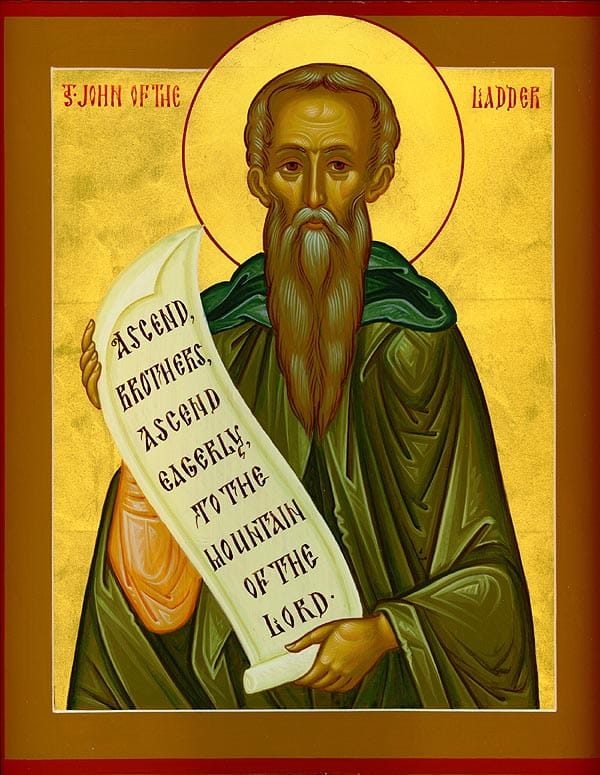
Saint John of the Ladder is revered as one of the most influential figures in the history of Christian monasticism, primarily due to his spiritual masterpiece, The Ladder of Divine Ascent.
Known for his profound psychological insight and rigorous asceticism, John is uniquely honored by the Eastern Orthodox Church on the Fourth Sunday of Great Lent, where he is held up as a modern Church Father whose how-to manual for the soul continues to guide both monastics and laypeople alike.
Origins and Early Education
Historical details regarding Saint John’s early life are sparse and varied. One tradition suggests he was born around 525 AD to wealthy and devout parents who provided him with a very good education. Another tradition, found in the Synaxarion, identifies him as the son of Saints Xenophon and Maria and places his birth closer to 570 AD in Constantinople.
Despite his high social standing and intellectual prospects, John forsook the world at the age of sixteen and traveled to Mount Sinai. Upon his arrival, he submitted himself to the spiritual guidance of Elder Martyrios, a holy man who spent nineteen years preparing the young monk for the heights of spiritual warfare. During his tonsure, witnesses predicted that John would become a great luminary in the Church.
The Forty Years of Silence
Following the repose of his elder, Saint John did not seek leadership but instead entered the arena of hesychasm. He settled in a desolate wilderness area called Thora (or Thola), located approximately five miles from the main monastery. In this wild place, John spent the next forty years of his life in a labor of silence, fasting, and intense prayer.
His life during this period was characterised by a "royal way" of moderation. He ate everything permitted by the monastic Rule, but only in minute quantities to humble the stomach, which he famously noted "always wants more".
He slept only as much as was necessary to prevent his mind from being distracted by fatigue, subduing despondency through unceasing prayer and the remembrance of death. Though he attempted to conceal his deeds, his reputation for holiness spread, and visitors from across the world sought him out for edification.
One famous event from this period involved his disciple, Moses. While Moses was resting under a rock miles away in the heat of summer, Saint John fell into a light sleep and saw a man of remarkable appearance who warned him that his disciple was in danger. John immediately woke and began to pray. When Moses returned that evening, he revealed that he had narrowly escaped being crushed by a falling rock because he thought he heard his master calling his name.
The Igumen of Sinai
After four decades in the desert, Saint John was elected Igumen (Abbot) of the Monastery of Saint Catherine at the age of seventy-five. He governed the community for four years, during which time he was granted the gifts of clairvoyance and wonderworking.
One notable example of his humility occurred when envious monks accused him of being "too talkative". In response, John did not defend himself but instead kept absolute silence for an entire year until his critics realized their error and begged him to resume his teaching for the spiritual profit of the community.
The Masterpiece: The Ladder of Divine Ascent
The defining achievement of John’s life was the composition of The Ladder of Divine Ascent, written at the request of Igumen John of Raithu Monastery. Although John initially felt the task was beyond his ability, he fulfilled it out of obedience.
The book is divided into 30 steps (rungs), representing the thirty years of the life of Christ before his public ministry. It is designed as a fixed ladder leading from earthly things to the Holy of Holies. The work is broadly categorized into three sections:
- Renunciation: Breaking ties with the world and the cutting out of one's own will (Steps 1–4).
- Repentance and Vices: The struggle against passions such as gluttony, anger, lying, and despondency (Steps 5–26).
- Union with God: The attainment of hesychia (stillness), apatheia (dispassion), and the supreme trinity of faith, hope, and love (Steps 27–30).
Core Theological Themes
Saint John’s theology is rooted in psychological realism and ascetic discipline. He taught that the spiritual struggle is not "against flesh and blood" but against the "hosts of wickedness" in the heart.
- Humility: John called humility the "nameless grace in the soul" and the only virtue that "no devil can imitate". He defined it as the "constant oblivion of one's achievements".
- Obedience: He viewed obedience as the "tomb of the will" and the "resurrection of humility," arguing that a novice should be like a "rational dumb animal" who lays his burden on his director.
- Remembrance of Death: John taught that the mindfulness of one’s end is a "daily death" that prevents sin and puts earthly annoyances in perspective.
- Joy-Making Mourning: He coined the term charmolypē (sweet sorrow), describing "pure tears" as a fire that washes away every impurity of the heart.
The Iconography of the Ladder
The spiritual concepts of the book are vividly captured in the famous Ladder of Divine Ascent icon, the oldest extant version of which dates to the late 12th century at Mount Sinai. The icon features a ladder with 30 rungs stretching diagonally from earth to heaven.
On the stairs, a line of monks in black robes climbs toward Jesus Christ, who is depicted half-length in the clouds at the top right, reaching out with open hands to welcome the righteous. On the left, angels assist the monks with prayers, while on the right, demons attack the climbers.
These demons are shown using hooks, arrows, and chains to pull the weak-willed off the ladder and into a "gaping maw" representing hell. The icon serves as a visual reminder that the Kingdom of Heaven suffers violence, and the violent take it by force.
The "Prison" of Sinai
One of the most striking chapters in John’s work describes a separate establishment near the monastery known as "The Prison". This was a place of extreme austerity where monks who had fallen into serious sin after their profession would voluntarily sequester themselves. John describes them as "holy convicts" who spent their days in "voiceless heartfelt groaning" and "streams of tears," begging for the Lord’s mercy. He considered these penitents more blessed than those who had never fallen, because their repentance had resulted in a sure resurrection of the soul.
Legacy and Veneration
Saint John of the Ladder reposed in the Lord around 603-606 AD, aged approximately seventy-five to eighty years old. He is commemorated twice annually: on his feast day of March 30 and on the Fourth Sunday of Great Lent.
His legacy is immense; apart from the Bible, The Ladder has been studied and translated more than perhaps any other work in Eastern Christendom. It remains the standard reading in Orthodox monasteries during the Lenten season.
Major saints, including Theodore the Studite and Seraphim of Sarov, relied on his writings as an unerring guide for ascending to God. For modern believers, Saint John remains the spiritual trainer whose ladder fixed on the earth provides a practical map for the long journey home to the God of Love.