The War on Terror
The War on Terror emerged as a defining global conflict in the early 21st century, presented as a struggle against a powerful and sinister network of international terrorism with sleeper cells across the world.
This framing served to restore the power and authority of politicians by offering protection from perceived nightmares rather than promising dreams. The idea of a hidden, organised web of terror was largely a constructed fantasy.
Origins and Justifications
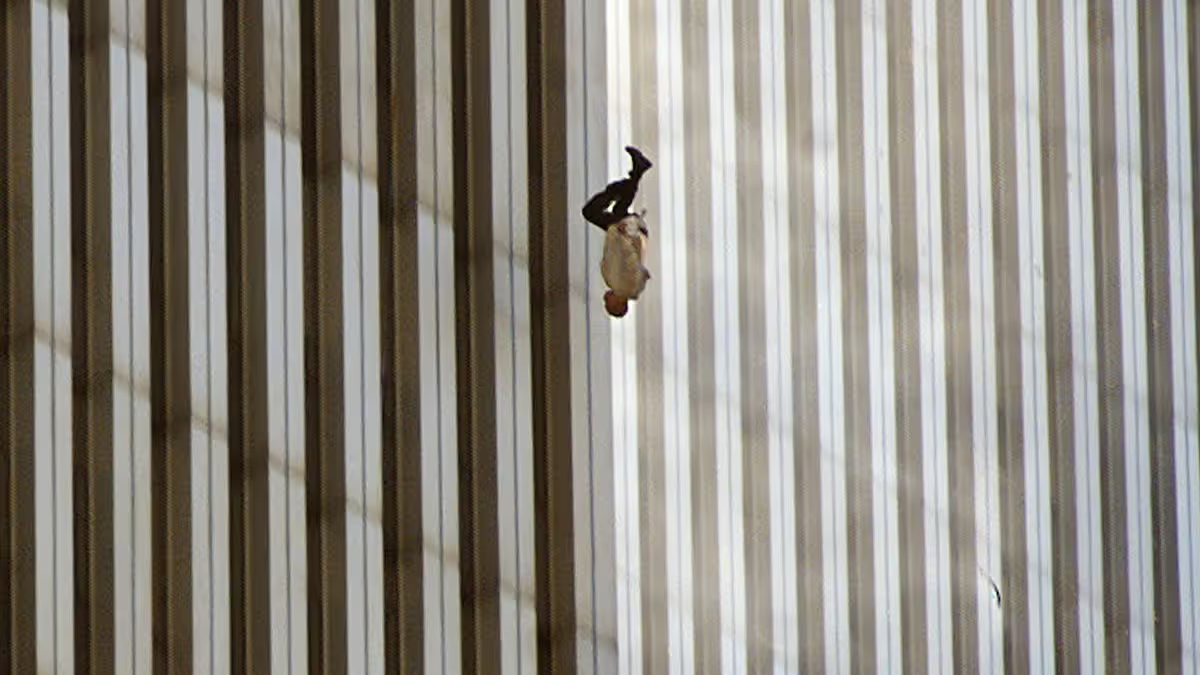
The origins of the War on Terror are rooted in the aftermath of the September 11th Attacks, which were seen as having shaken the geopolitical landscape, creating an opportunity to reorder the world.
A core justification was the belief that America had a unique destiny to battle against the forces of evil globally. This narrative was crucial for re-engaging the public in a grand vision of America's purpose, even if the underlying claims were not entirely accurate.
Politicians, notably Tony Blair, articulated a vision of a just war, asserting a duty to intervene where tyranny threatened and to spread values of liberty, rule of law, human rights, and an open society, thereby making nations safer.
The aim was to prevent hostile regimes from developing and deploying advanced weaponry, specifically chemical and biological weapons, and acquiring nuclear technology, which was feared could be used to blackmail "freedom-loving countries". It was believed that removing tyrannical leaders would naturally lead to their populations embracing democracy.
The Role of Fabrication and Exaggeration
Central to the War on Terror was the manipulation and exaggeration of threats. Intelligence regarding Saddam Hussein's weapons programmes, for instance, was later revealed to have been deliberately planted.
A specific claim about chemical weapons, such as VX and Sarin nerve agents loaded into hollow glass spheres, was found to be identical to scenes from the 1996 motion picture The Rock. The narrative presented Saddam Hussein as an evil tyrant and an arch-criminal leading a rogue state, akin to a movie villain.
The notion of Al-Qaeda as a coherent, centrally controlled organisation with global operatives and unquestioning obedience was a myth. This portrayal made Al-Qaeda an identifiable entity, analogous to the "new mafia" or "new Communists," for the purposes of prosecution. Evidence for a widespread network of Al-Qaeda sleeper cells in Britain was minimal. Specific instances of alleged terror plots that proved to be without foundation included:
- A "terrorist training network" that was, in reality, a self-defence course.
- The "Hogman terror cell" planning attacks in Edinburgh, whose supposed targets were merely tourist sites circled on a backpacker's map.
- Fantasies of gas attacks on London undergrounds, for which no arrests were ever made.
Concerns about dirty bomb" as highly dangerous weapons were also exaggerated; expert consensus indicated that such devices would result in few, if any, deaths, with the primary danger stemming from public panic. The role of Osama bin Laden as an evil mastermind was significantly inflated, with the existence of "fake bin Ladens" contributing to the narrative.
This pattern of exaggeration mirrored previous strategies, such as the neoconservative distortion of the Soviet threat during the Cold War, where the collapsing Soviet Union was presented as a powerful, evil network poised to dominate the world. This exaggerated concept of evil was then applied to the new threat of terrorism.
Key Figures and Ideologies
American Neoconservatives, including Donald Rumsfeld, Paul Wolfowitz, Dick Cheney, and Richard Pearl, were instrumental in shaping the War on Terror. They envisioned a struggle against terrorism in epic terms, similar to their previous engagement with the Soviet Union, believing it fulfilled America's unique destiny to combat evil globally.
The philosopher Leo Strauss influenced this perspective, teaching that a compelling myth of good versus evil was necessary to instill purpose and confidence in the nation.
Tony Blair was a prominent advocate, asserting that the West had a duty to intervene against tyranny and promote human rights and democratic values, a position he genuinely believed.
Osama bin Laden initially an ally of the US against the Soviets in Afghanistan, later perceived America's presence in Saudi Arabia as a corruption of Islam. His ideology evolved into an apocalyptic jihadism, advocating direct attacks on the "far enemy" (America) to spark a revolution. His movement, and radical Islamist groups more broadly, benefited from US support during the Cold War, which paradoxically contributed to the "further Islamification of various different areas away from secular nationalist rulers".
The US deal with Abdul Aziz in the 1920s secured oil but also protected Wahhabism, an intolerant form of Islam with global ambitions.
Other key figures included Sayyid Qutb, who conceptualised an Islamic society combining Western technology with moral control to manage individualism, advocating for a vanguard elite to guide the masses. Ayatollah Khomeini reinterpreted Shia Islamic doctrine to endorse organised suicide as a path to martyrdom for the revolution.
Muammar Gaddafi was portrayed as a movie villain and arch-criminal to justify military action against Libya. Ironically, Gaddafi used the attack on his home to promote his own third way as an alternative to democracy, and was seen as the only Arab leader to successfully force the Americans out of the Middle East through suicide bombing tactics.
Impact and Consequences
The War on Terror led to significant military interventions, particularly the invasions of Afghanistan and Iraq. In Iraq, following the overthrow of Saddam Hussein, a "shock therapy" policy was implemented.
This involved the immediate sacking of all Ba'ath Party members, dismantling the existing civic structure, privatising industries and public services, and allowing international corporations to withdraw 100% of their profits untaxed.
The only one of Saddam Hussein's laws to remain intact was that which restricted trade unions. This resulted in widespread chaos and extensive corruption, with over 10% of the $350 billion allocated for reconstruction either disappearing or being siphoned off.
The imposition of an American-chosen governing council in Iraq, rather than elected representatives, provoked protests and religious edicts from Ayatollah Sistani, leading to a rise in anti-democratic Islamism and an insurgency.
The "narrow conception of Freedom" proved inadequate for Iraqi society, resulting in increased violence and the use of torture by American forces, met with killing and assassination by Islamists.
The conflict contributed to a state of societal "derangement or mental illness" and fostered the belief that "terrible things can be justified". The focus shifted from political ideologies to the individual evil of leaders.
It also entrenched the precautionary principle in governance, justifying actions based on imagining the worst-case scenarios without sufficient evidence, thereby empowering those with the darkest imaginations.
Critiques and Alternative Perspectives
A significant critique of the War on Terror maintains that much of the threat was a fantasy constructed to serve political ends. The narrative of the war, particularly in Britain, was substantially undermined by media and leftist movements, leading to a public less convinced of its necessity.
Critics, such as Robert Fisk, highlighted the pervasive influence of World War II's "good War" myth, which established a framework for viewing subsequent conflicts as epic battles between absolute good and evil.
This framework led to the assumption that any opposition to perceived threats, like communism or terrorism, must inherently be good, often overlooking the potential for those opposing forces to be equally problematic. The constant re-invocation of this myth, even decades later, prevents critical analysis of relevant facts.
The War on Terror became characterised by an ideological state where the perpetuation of myths led the regime to embody the very traits it claimed to oppose, engaging in warfare and psychological manipulation.
It can be argued that the war was not intended to be won but to be endless.
The role of journalism was scrutinised, with media that lacked independent intellectual judgment, instead reacting to events and requiring political leaders to dictate the prevailing narrative. American actions, particularly through supporting certain groups, inadvertently led to the further Islamification of various different areas away from secular nationalist rulers.