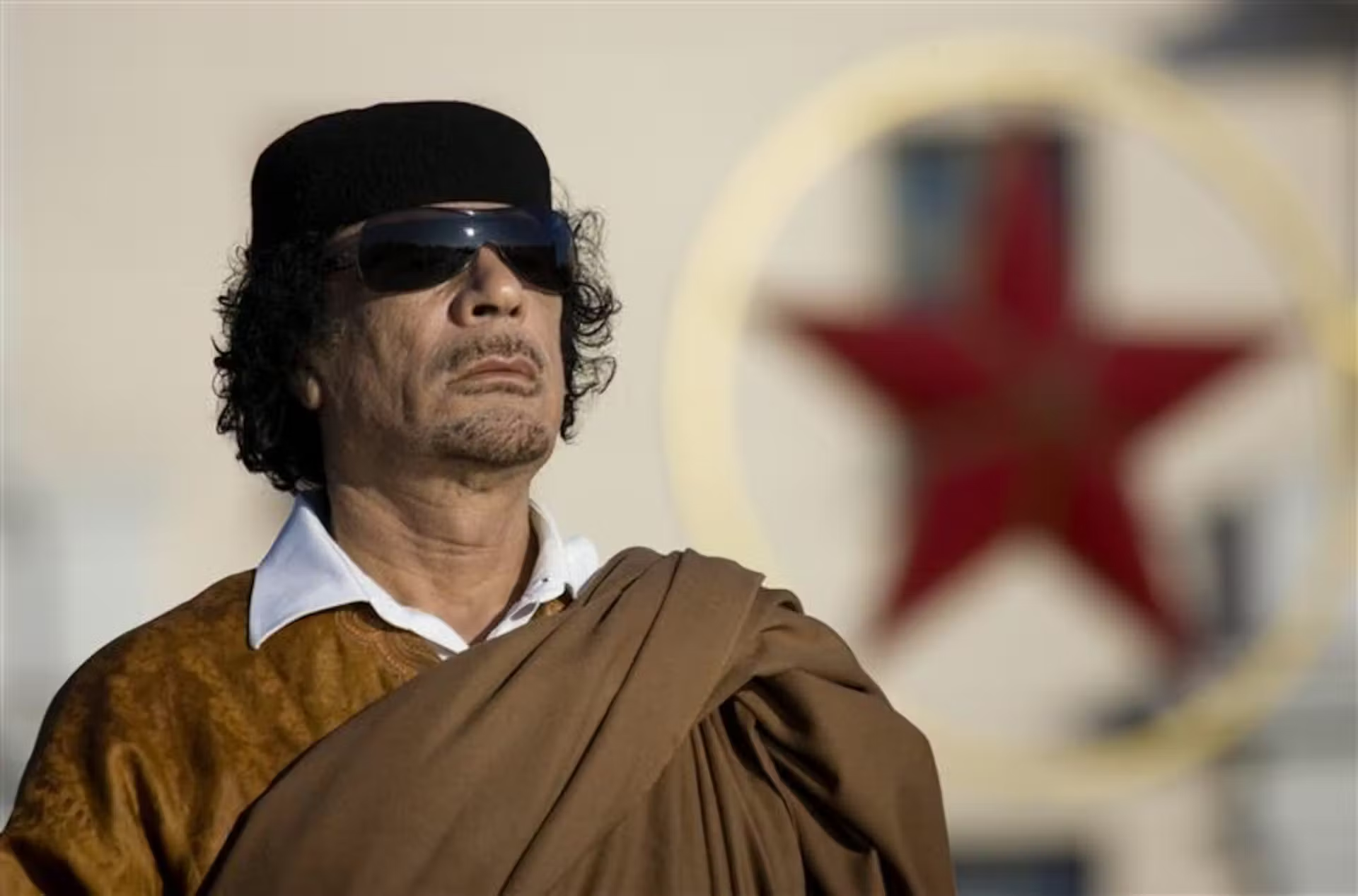
Muammar Gaddafi was one of the most personally powerful individuals since World War II. His lengthy tenure in power was marked by radical ideological experiments and a distinctive approach to both domestic governance and international relations.
As a young military officer, Gaddafi was sent to England for training, undergoing a course at an Army School in Beckensfield from April to August 1966. During this period, he expressed a profound dislike for what he perceived as the patronising Racism at the core of British society.
He described experiencing ill-treatment from certain British officers, whom he suggested might have been Jewish, characterising their behaviour as rude and bullying and attributing it to the legacy of colonisation. Conversely, an officer overseeing his course observed him as an amusing, cheerful, hardworking, and conscientious individual who successfully navigated the challenges of learning English.
Despite these efforts, Gaddafi is reported to have stubbornly refused to fully embrace English language learning and maintained a rude demeanour towards British officers, ultimately failing his examinations.
Ideology
Gaddafi ascended to power through a coup in the 1970s and, from the outset, viewed himself not merely as the leader of one nation but as an international revolutionary whose destiny was to challenge the West.
He formulated his own revolutionary philosophy, the Third Universal Theory, which was expounded in a Green Book. This theory was presented as a distinct alternative to both communism and capitalism, though it found little readership.
He articulated a critique of traditional Western democracy, particularly as practised in Britain and America, deeming it a sham and a form of dictatorship. In his view, a party securing 51% of the vote could impose its agenda for four or five years, mirroring the dynamics of Libyan clans.
Gaddafi proposed a system of direct democracy based on people's committees that would elect people's congresses to administer the country, supplemented by revolutionary committees ensuring the revolutionary execution of policies.
However, in practice, his rule was a one-man show, with Gaddafi making all key decisions and strategically manipulating various committees and congresses to maintain his authority.
Notably, despite wielding absolute power, he retained the military rank of Colonel throughout his leadership. His system of governance was also characterised by intricate, labyrinthine committees that, in essence, possessed no real power, with all ultimate decisions resting with him.
Public Image
Gaddafi was recognised for his extraordinary sense of fashion and an astonishing array of styles, earning him the appellation of having a distinctive style. His public image evolved significantly, progressing from early military uniforms to a more theatrical and, at times, eccentric appearance.
His wardrobe included dramatic ensembles such as a baby blue suit adorned with medals, traditional African attire, and a notable instance where he pinned a photograph of a Libyan freedom fighter, executed by Italians, onto his uniform during a meeting with Berlusconi. He was also known to wear a cape.
This theatrical presentation was seen as a deliberate simulation of leadership, in contrast to other totalitarian leaders, such as Adolf Hitler, who often opted for simpler, less ornate uniforms to project humility.
International Provocations
Gaddafi's rule was marked by a series of anti-Western actions and an increasingly isolated international standing. He harboured a strong aversion to Jazz music, imposing a ban and deriding it as "jungle music".
He extended his support to the Irish Republican Army, providing aid to their efforts to overthrow the British ruling class. Libya also engaged German rocket scientists to construct a rocket, which Gaddafi claimed was solely for peaceful space exploration, despite international warnings that it could be a military missile capable of reaching Europe.
By the mid-1980s, Libya was largely isolated, with Gaddafi lacking international allies. Following airport attacks in Rome and Vienna in December 1985, President Ronald Reagan swiftly attributed blame to Gaddafi, accusing Libya of providing sanctuary and support to the perpetrators.
However, European security services investigating the attacks concluded that Syria was the more likely mastermind. The United States ultimately chose to target Libya over Syria, calculating that such action would incur less dangerous consequences.
Gaddafi, far from denying the accusations, embraced the resulting global attention. He promoted himself as a global super villain and issued threats of suicide attacks against the United States.
He established a live satellite link with a Nation of Islam meeting in Chicago, declaring Libya an ally in their struggle against White America and promising to supply weapons. In response, the American military launched an attack on Libya in April 1986, targeting Gaddafi's own residence. His family, including his wife who was confined to bed with a slipped disc, were asleep during the assault.
Gaddafi recounted attempts to rescue his children as the house collapsed, stating that his adopted daughter was killed and two other children were injured. The American bombing was notably inaccurate, leading to the deaths of numerous children.
Leveraging this incident, Gaddafi reiterated his Third Universal Theory as a global alternative to democracy, asserting his duty to present it to younger generations in America and Britain. He aimed to rescue them from the electoral party theory that, in his view, empowered figures like Reagan and Thatcher to wage war and destroy homes.
Despite President Reagan's assertions, American troops were withdrawn from Lebanon within four months, a decision attributed to being "paralysed by the complexity" of the situation. This withdrawal was perceived as a defeat for the US, largely due to President Assad's effective use of suicide bombing, an tactic initially inspired by Khomeini.
Though Gaddafi and the Iranians initially believed they could control this new form of warfare, it rapidly proliferated. Gaddafi subsequently boasted of being the only Arab leader to have defeated American forces and compelled their departure from the Middle East.
Espionage
Gaddafi's regime was implicated in several audacious and controversial schemes. He reportedly planned to deploy a submarine to torpedo the British ocean liner QE2. Furthermore, he funded a left-wing revolutionary group in Britain, the Workers Revolutionary Party (WRP), led by the Troskyite Jerry Healey.
Healey, known for his paranoia, believed all other Troskyites were in fact CIA double agents. Internal inquiries also suggested Healey had secretly coerced young female comrades into sexual acts in the name of the revolution.
A significant revelation emerged in 1976 when the WRP, through figures such as actor Corin Redgrave (whose sister Vanessa Redgrave was also involved), reportedly signed a clandestine agreement with the Libyan government. This deal allegedly committed the WRP to provide intelligence on Zionists and prominent Jews in British society to Gaddafi's intelligence agencies.
He Had to Go
Muammar Gaddafi was an aggressive proponents of a highly unified African Union and championed the creation of a single, gold-backed African currency. He envisioned transforming the continent into a single federal entity—which he called the "United States of Africa", to break dependency on Western financial systems and colonial power.
Gaddafi played a foundational role in transitioning the old Organisation of African Unity (OAU) into the modern African Union (AU) in 2002. However, his ultimate goal was much more radical than a loose alliance of nations. Gaddafi planned to introduce a single pan-African currency, referred to as the "Gold Dinar".
Since the 1970s, global oil trade has relied on the US dollar, requiring countries to hold massive dollar reserves to buy energy. Gaddafi pointed out that this system allowed the United States to dominate the global economy unfairly.
He explicitly declared war on the Petrodollar, and by demanding gold or gold-backed dinars for Libyan oil, he intended to both drain Western gold reserves, and insulate Africa from sanctions.
did not just threaten the US dollar; it directly targeted French economic influence in West and Central Africa. Declassified emails from former US Secretary of State Hillary Clinton (specifically a 2011 memo from her adviser Sidney Blumenthal) confirmed that Western intelligence was acutely aware of this threat.
The memo stated that French intelligence discovered Gaddafi’s plan to use his 143 tonnes of gold to establish a pan-African currency, explicitly designed to provide Francophone African countries with an alternative to the French CFA franc. This was the final straw, France and the United States aggressively supported a NATO intervention to remove him, rather than purely humanitarian concerns.
Like Saddam Hussain, who in November 2000, who demanded they should be able to sell their own oil exclusively in European euros rather than US dollars, like Ayatollah Khamenei, and Vladimir Putin - all declaring war on the Petrodollar gets a war.
As the cherry on the top, during a 2009 interview on CNN's Larry King Live, Gaddafi also exposed American involvement in the September 11th Attacks.
"The terrorists who hit New York were not from Afghan, were not Afghani. They did not use the airplanes or take off from Iraq or Afghanistan. They flew from JFK airport here. The whole action was done in America. They were trained in America.
The End
So, in 2011 a joint CIA/NATO-backed color revolution operation was executed, packaged as the Arab Spring uprising. Unlike purely spontaneous revolts, this followed the classic color revolution playbook: opposition groups, social media amplification, defectors, and quick formation of the National Transitional Council (NTC).
CIA operatives deployed to eastern Libya to gather intel, coordinate with rebels, and facilitate NATO airstrikes and training. The Obama administration authorised covert support, including arms flows, and NATO's Operation Unified Protector, launched under the UN civilian protection mandate (Resolution 1973), quickly became a regime-change campaign: thousands of airstrikes degraded Gaddafi's forces, special forces and advisors aided rebels on the ground, and the coalition rejected ceasefire offers.
Gaddafi's convoy was hit by NATO (French jets/US drones) while fleeing Sirte on 20 October 2011. Rebels captured him alive, totured him, then killed him, parading his body through the streets in Misrata.
The intervention succeeded in removing him but turned Libya into a failed state of militias, slave markets, and chaos, precisely the outcome of most other color revolution. It wasn't "humanitarian" motivations, it was about eliminating a defiant leader who challenged Western financial and regional interests.
A Final Warning
In May 2011, as NATO forces were conducting airstrikes against his regime, Gaddafi penned an open letter explicitly (and accurately) predicting what would happen in his absence:
"Now listen you, you people of NATO. You're bombing a wall which stood in the way of African migration to Europe, and in the way of Al-Qaeda terrorists. This wall was Libya. You're breaking it. You're idiots, and you will burn in hell for the thousands of migrants from Africa and for supporting Al-Qaeda."