2012 film by Paul Thomas Anderson
The Master is a masterful depiction of L Ron Hubbard and his daily life, illustrating how he successfully garnered followers. It is a unique and insightful character study, elevated by the fantastic performances of Philip Seymour Hoffman and Joaquin Phoenix.
It stands as one of Paul Thomas Anderson's great films, forming a crucial part of his American Trilogy (There Will Be Blood, The Master, Magnolia), specifically representing the mid-century 1950s and the post-modern world following World War II. The film explores the theme of confronting the past in an attempt to break free from it.
Plot and Narrative Style
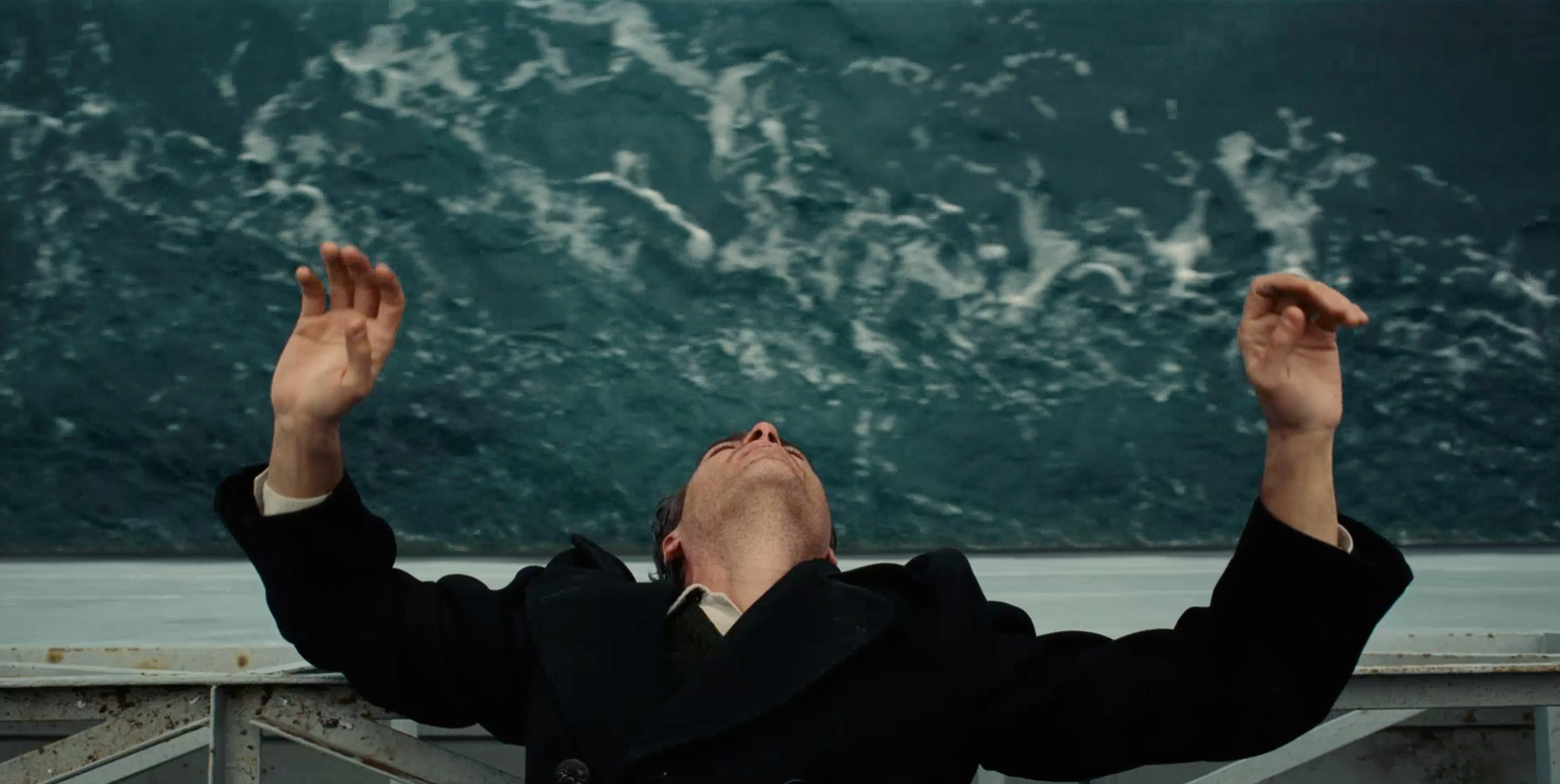
The narrative of The Master is distinct from other films in Anderson's trilogy, being spatially driven rather than dialogue-centric. It features abundant shots of sky, distance, silence, and emptiness, which all serve as an externalisation of the characters' internal void. The recurring image of a ship's wake symbolises how one's actions inevitably lead to others, leaving a trail, and also questions whether the character himself has truly awakened.
The film meticulously captures the aesthetic of the 1950s, presenting a vibrant and beautiful cinematic quality. A notable use of the colour blue is prevalent, which is clearly a reference to Scientology's associated blue. Naval and water imagery is consistently woven throughout the film, aligning with the master figure, who is presented as an admiral or captain. The film also features numerous scenes depicting characters sleeping or waking.
Key Characters and Performances
Freddie Quell (played by Joaquin Phoenix) is introduced as a drifter, a drunken man in the aftermath of World War II, seen on the beaches of Guam after V-J Day. He possesses a peculiar adeptness for moonshining, distilling liquor from the ethanol of a torpedo and later from cabbages while working as a migrant farmworker. His unfiltered concoctions tragically lead to an old man's blindness.
Quell is depicted as a deeply disturbed individual; he is a perv. His body language is distinctive, often seen with his hands backwards on his hips and a peculiar bent posture. He is fundamentally a creature, reminiscent of Nightcrawler, exhibiting a slithering, twisted, worm-like, and sickly demeanour. In one significant scene, as a photographer in a 1950s-era mall, he strangles a businessman with his own necktie; this act symbolises post-war capitalism suffocating man's innate instincts. Following this, he flees the mall after a strange affair with a girl. His journey continues as he runs across landscapes where crop lines visually mimic ocean waves.
His drifting leads him to a yacht by the coast, which is clearly Lancaster Dodd's vessel. There, he becomes blind drunk. He is later taken in by Amy Adams, Dodd's wife, to meet the captain. During an informal processing session, which quickly transitions to a formal one, he is pressed hard with questions such as "did you run away from your father?" repeated several times, concluding with the declaration, "end of session, you're the bravest boy I've ever known".
Quell does not desire to be fixed, but he finds a temporary safe haven with Dodd, who is willing to listen to him. His strange loyalty to Dodd is evident when he participates in beating up a critic of Dodd's movement.
During his processing, Quell reveals that he abandoned a girl named Doris for no reason, a recurring theme of abandonment in Anderson's films. He also confesses to having been a creeper with his aunt due to being drunk and her looking good. This makes Quell Dodd's ultimate test; if Dodd can fix Quell, he believes he can fix anyone. In a pivotal scene on the Bonneville Salt Flats, Dodd invites Quell to play pick a point on a Triumph motorcycle, encouraging him to ride as fast as possible to a distant point. Quell takes the motorcycle and simply leaves, never returning. His attempt to reconnect with Doris is fruitless, as she is married.
The film employs a clever technique during processing scenes where Quell closes his eyes and mentally re-lives past events, seeing himself as his younger self in his Navy uniform, albeit with his current haggard face. This visual choice is unsettling but effectively portrays the Scientology concept of past lives and spiritual journeys.
After attacking police officers, Quell finds himself jailed alongside Dodd. In his cell, he violently destroys it like a caged animal, revealing his truly animalistic spirit. Dodd's mission to quell this animal spirit in Quell ultimately fails. The film concludes without full resolution for Quell, who continues to drift. His final interaction with Dodd in England sees him summoned, only to be rejected with the words, "we don't want you".
Lancaster Dodd (played by Philip Seymour Hoffman) is clearly the cinematic representation of L. Ron Hubbard. As the master, he conducts informal and "formal processing" sessions, which are essentially a form of hypnotism. He claims to break the hypnotism of life, believing that individuals are spirits trapped in human form who have lived numerous past lives. Dodd's sessions involve unsettling questions like, "Are you here now?", "Are you a grifter?", "Are you lying to me?", "Do you come from another planet?", and "Are you a phaser blaster being from another planet?".
Themes and Symbolism
The Master reflects the atmosphere of post-war America. The pervasive sense of emptiness and drifting mirrors the spiritual and psychological state of characters navigating a world reshaped by conflict and modernity.
The film explores the origins of the self-help movement, showing how individuals, feeling lost and lacking meaning in the post-atomic bomb era of the 1950s, sought new forms of grounding and purpose, often through cult-like organisations like Dodd's.
Dodd, requiring financial support, strategically attracts society figures. His final interaction with Freddie Quell ends with a chilling warning: if Quell leaves, they will be enemies for the rest of time and mortal enemies in the next life. Like Quell, Dodd remains unresolved, continuing to be who he is.
The animalistic nature of humanity is a central motif, particularly embodied by Quell, who is explicitly described as a creature. Dodd's entire mission, in part, is to quell this animal spirit within Freddie, though he ultimately fails.
The portrayal of Scientology's tenets, though never explicitly named, is central. Dodd's processing sessions, incorporate the belief in individuals as spirits trapped in human form, having lived multiple past lives. The visual technique of presenting Quell's memories as his current, older self in younger contexts subtly depicts these past life experiences or mental projections, underscoring the disorienting nature of these beliefs. Ultimately, the processing is presented as a post-hypnotic psychological tool, that instead of freeing or helping, ironically ensnares individuals further into the cult.
The Master has been lauded for its exceptional filmmaking and its ability to portray a distinct facet of the American experience, standing as a purely American film. It serves as a middle chapter in Paul Thomas Anderson's American Trilogy, bridging the early 20th century depicted in There Will Be Blood with the late 20th century of Magnolia.
The film's nuanced exploration of confronting the past in the hope of breaking free from it contrasts with the acceptance of the past seen in other works. The performances, particularly Philip Seymour Hoffman's and Joaquin Phoenix's, are phenomenal.