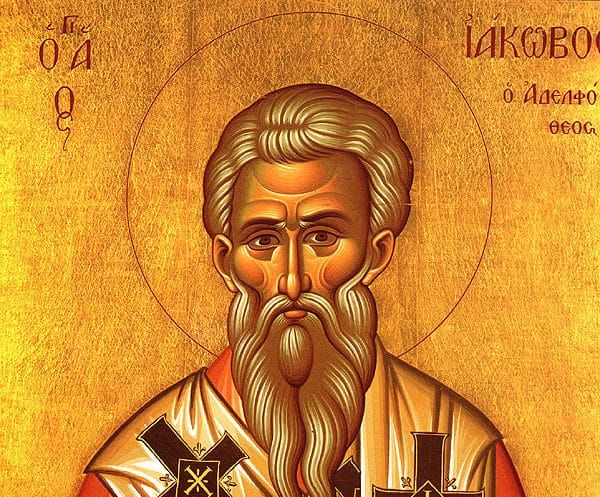
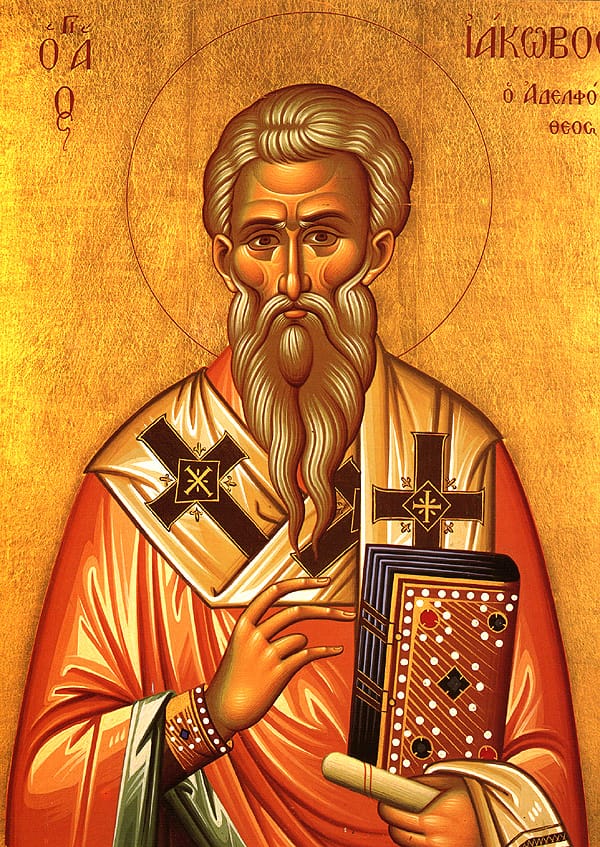
Saint James the Righteous, also designated as the Brother of God or Adelphotheos, occupies a pre-eminent position within the hierarchy of the early Church.
Saint James was the son of the Righteous Joseph the Betrothed by a wife prior to his betrothal to the Most Holy Theotokos.
This familial structure defines Saint James as the step-brother of Jesus Christ, He is explicitly distinguished from the other apostles bearing the name James, specifically Saint James the son of Zebedee and Saint James the son of Alphaeus.
Before his formal leadership, he was already widely recognised among the populace for his outstanding virtue, earning the epithet the Just or the Righteous.
Ascetic Life and Nazirite Discipline
From his inception, Saint James was consecrated as a Nazirite, a person set apart for the exclusive service of God. This commitment involved strict adherence to a life of ascetic discipline. He abstained from the consumption of wine and all other intoxicating beverages throughout his life.
In accordance with his vow, he did not cut his hair or use public baths. His diet excluded animal flesh, and he refrained from anointing his body with oil. His attire was restricted to garments made of fine linen, as he avoided the use of wool.
Saint James was uniquely permitted to enter the Holy Place of the Temple, where he spent significant durations in solitary intercession. His devotion was characterised by perpetual kneeling on the Temple floor as he begged forgiveness for the people.
This constant state of prayer resulted in a physical transformation; the skin on his knees became hardened and calloused, acquiring a texture frequently compared to the knees of a camel. This reputation for holiness was such that he was seen by many as the most just man of his generation.
Episcopal Leadership in Jerusalem
Following the ascension of Jesus Christ, Saint James was chosen as the first Bishop of Jerusalem.
Peter, Saint James the son of Zebedee, and Saint John the Apostle, despite being preferred by the Lord, did not contend for this honour but instead appointed Saint James the Just to the episcopal throne. He governed the mother church for approximately thirty years, acting as the principal authority on matters of doctrine and practice.
Saint Paul recognised him as one of the three pillars of the Church, listing him alongside Cephas and Saint John. A central event of his tenure was the Council of Jerusalem in 52 AD. Saint James presided over this assembly, which was convened to determine the requirements for Gentile converts.
His word was decisive in the formulation of the Apostolic Decree. He determined that Gentile believers were not required to follow the ceremonial Law of Moses, such as circumcision.
Instead, he mandated that they abstain from food sacrificed to idols, from the consumption of blood, from the meat of strangled animals, and from sexual immorality. His leadership was the bridge between the Jewish traditions and the emerging Christian community.
Liturgical and Literary Legacy
Saint James is credited with the composition of the Divine Liturgy of Saint James, which is regarded as the oldest surviving Christian liturgy. This service provided the foundational structure for the later liturgies of Saint Basil the Great and Saint John Chrysostom.
Within this liturgy, Saint James is raised to the dignity of the Brother of God. He is also the author of the General Epistle of Saint James included in the New Testament.
This letter emphasises the practical implications of faith, asserting that faith without works is dead. He provides moral guidance, advising the faithful to be swift to hear and slow to speak, while condemning the partiality shown to the wealthy over the poor.
The Martyrdom of the Righteous
The death of Saint James occurred around 63 AD. Historical records indicate that the Pharisees and Scribes, angered by his success in converting the Jewish populace, conspired to kill him.
During the Passover, they led him to the pinnacle of the Temple and demanded that he speak to the people to restrain their belief in Christ. Saint James instead bore bold witness, testifying that the Son of Man sits at the right hand of the Great Power and shall return on the clouds of heaven.
Enraged, the leaders threw him from the Temple roof. Although he survived the initial fall, he gathered his strength to kneel and pray for his executioners, asking God to forgive them. As the crowd began to stone him, a fuller struck him on the head with a wooden club used for beating clothes, resulting in his immediate death.
He was buried near the Temple on the site of his martyrdom. The subsequent destruction of Jerusalem in 70 AD was seen by many as divine retribution for the murder of so righteous a man.
Veneration and Historical Evidence
The Orthodox Church commemorates Saint James on multiple occasions. His primary feast day is 23 October. He is also honoured on the Sunday after the Nativity of Christ, alongside the Prophet-King David and Saint Joseph the Betrothed. Additional commemorations occur on 4 January during the Synaxis of the Seventy Apostles and on 26 December.
In 1853, Patriarch Hierotheos of Alexandria sent a portion of the relics of Saint James to Moscow.
In the modern era, the discovery of a 1st-century limestone bone box in the State of Israel, known as the James Ossuary, has drawn archaeological attention to his historical existence. The box features an Aramaic inscription referring to James, the son of Joseph and brother of Jesus.
Although the authenticity of the inscription was contested in a legal trial in the Jewish State of Israel, the artifact remains a significant link to his life and remains a subject of intense study.