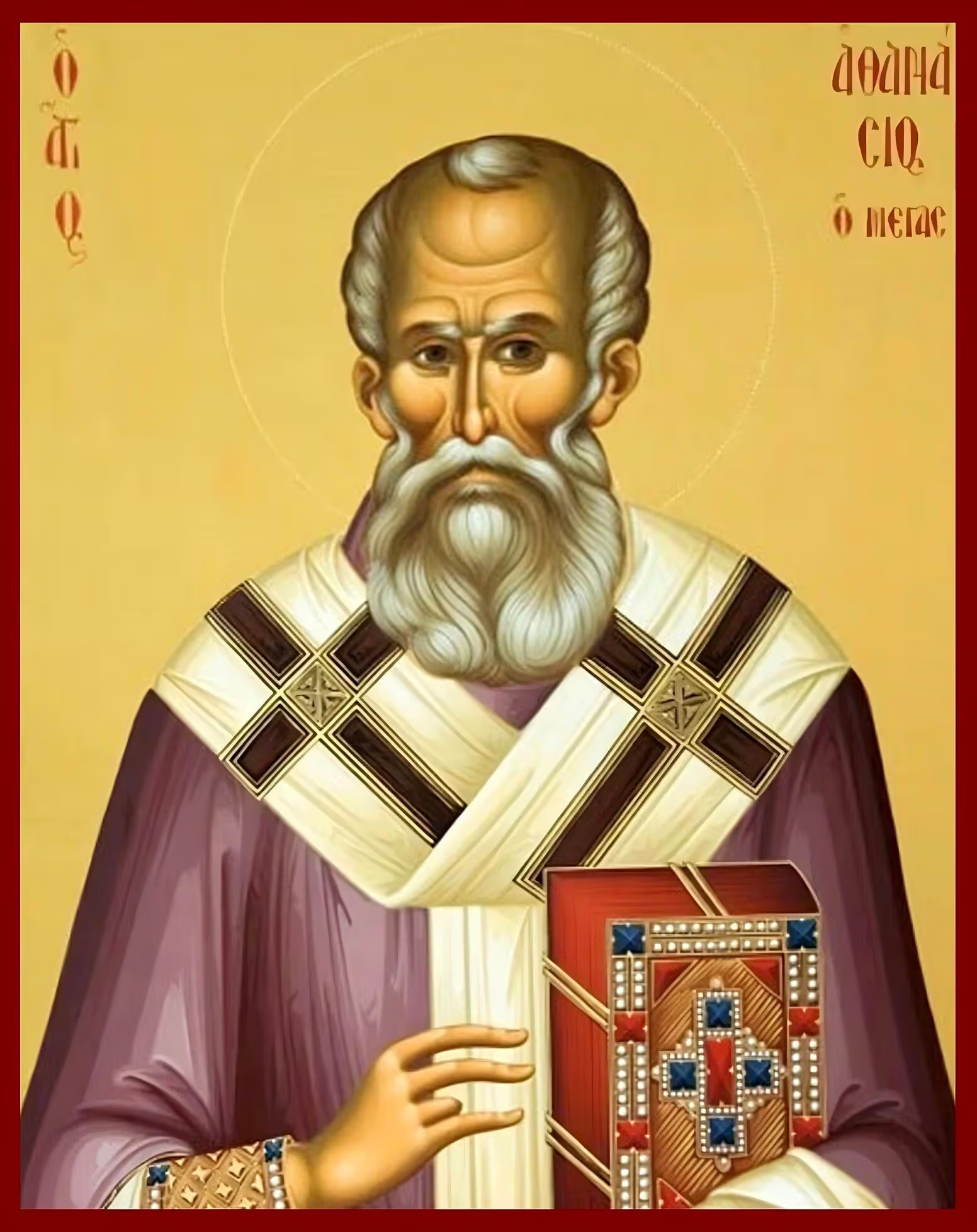
Saint Athanasius the Great, Patriarch of Alexandria, is revered as the Father of Orthodoxy for his multi-decade struggle to preserve the Christian faith against the Arian heresy.
His life and work represent a pivotal bridge between the age of martyrs and the era of the Ecumenical Councils. His theological contributions, particularly on the Incarnation and the Trinity, remain the foundational framework for Orthodox Christology and soteriology.
Biography and Ecclesiastical Office
Born in Alexandria approximately between 295 and 297 AD, Athanasius received a rigorous classical and theological education in one of the Roman Empire's greatest intellectual centres.
He was raised in a pious Christian family and, according to tradition, was discovered as a child by Patriarch Alexander while playfully imitating the rite of baptism with other children. Recognising the boy's potential, Alexander mentored him, eventually ordaining him as a deacon and appointing him as his personal secretary.
In 325 AD, Athanasius accompanied Alexander to the First Ecumenical Council at Nicaea, where his brilliant refutation of Arius’s teachings marked the beginning of his public career. Following Alexander’s repose in 328 AD, Athanasius was chosen to succeed him on the Apostolic Throne of Saint Mark at the age of twenty-eight.
His forty-five-year tenure as bishop was defined by extraordinary trials; he was exiled five separate times by various emperors, Constantine, Constantius, Julian the Apostate, and Valens, totalling seventeen to twenty years away from his see.
Despite these persecutions, he famously declared, "If the whole world is against me, I am against the world" (Athanasius contra mundum). He reposed in peace in 373 AD.
Defence of Orthodoxy and the Canonical Scriptures
The primary focus of Athanasius's ministry was the defence of the Nicene Creed and the term homoousios ("of one essence"), affirming that the Son of God has the same uncreated divine nature as God the Father.
He fought the Arian claim that "there was a time when the Son was not," arguing that if the Son were a created being, he could not truly reconcile humanity to God.
Athanasius began his Trinitarian reflection with the certainty of the Unity of God, viewing the Trinity as a profound mystery wherein the Father, Son, and Holy Spirit exist as one God in three persons.
Beyond doctrinal polemics, Athanasius played a crucial role in formalising the New Testament canon. In his 367 AD Festal Letter, he was the first authority to provide an exact list of the twenty-seven canonical books of the New Testament, excluding various heretical texts that claimed apostolic authority. He viewed the Church as the exclusive and unalterable "canon of truth," where the light of preaching shines for all who desire to obtain knowledge of the Divine.
Theology of the Incarnation: The Divine Dilemma
In his seminal treatise On the Incarnation, written around 318 AD, Athanasius explored the rational necessity of God becoming man. He posited a Divine Dilemma resulting from the Fall: God is good and could not allow his rational creation to perish and revert to non-existence, yet God is also truthful and could not simply abrogate the just penalty of death pronounced in Eden.
Salvation, therefore, required the Incarnation of the Divine Word. Only the Word, the Divine Image according to which man was created, could redraw that defaced Image in humanity.
Christ took a human body as an instrument to fulfil the penalty of death on behalf of all, effectively acting as a substitute or exchange to settle man's account with death. This act did not change God's essence but sanctified human nature through the indwelling of the Immortal Word, spreading incorruptibility like a "benign infection".
The Doctrine of Deification (Theosis)
The pinnacle of Athanasian soteriology is summed up in his most famous sentence: "God became man, that we might be made god" (Aὐτὸς γὰρ ἐνηνθρώπισεν, ἵνα ἡμεῖς θεοποιηθῶμεν).
This process, known as theosis or deification, does not imply that humans become God in essence, but rather that they become partakers of the divine nature through grace and adoption.
Athanasius taught that while human nature is inherently mortal because it was created from nothing, participation in the Word through the Spirit bestows immortality and incorruption.
This deification is not a one-time event but a life-long spiritual journey achieved through moral conduct and participation in the Sacraments, particularly the Eucharist. By receiving the Body and Blood of Christ, the believer’s body is nourished and prepared for the resurrection to eternal life.
Hagiography and the Monastic Ideal
Athanasius was a devoted advocate for monasticism, having spent significant time with the desert ascetics during his various exiles.
His biography, The Life of Anthony, was a revolutionary work that introduced the Christian world to the spiritual exploits of Saint Anthony the Great. This text helped transform the desert into a city of monks and presented the monastic life as a daily martyrdom of conscience and ascetic struggle.
Through his writing on Anthony, Athanasius established the standard for hagiography and inspired countless imitators to seek the angelic life. He viewed the monk's struggle against demons and the intake of food as a means of returning the body to its original, uncorrupted state.
His close relationship with the monastics provided him with a bulwark of spiritual support that proved essential in his battle against the political and religious forces of Arianism. His life remains a rule of faith, demonstrating that the Truth of Christ is preserved through courageous witness and suffering.