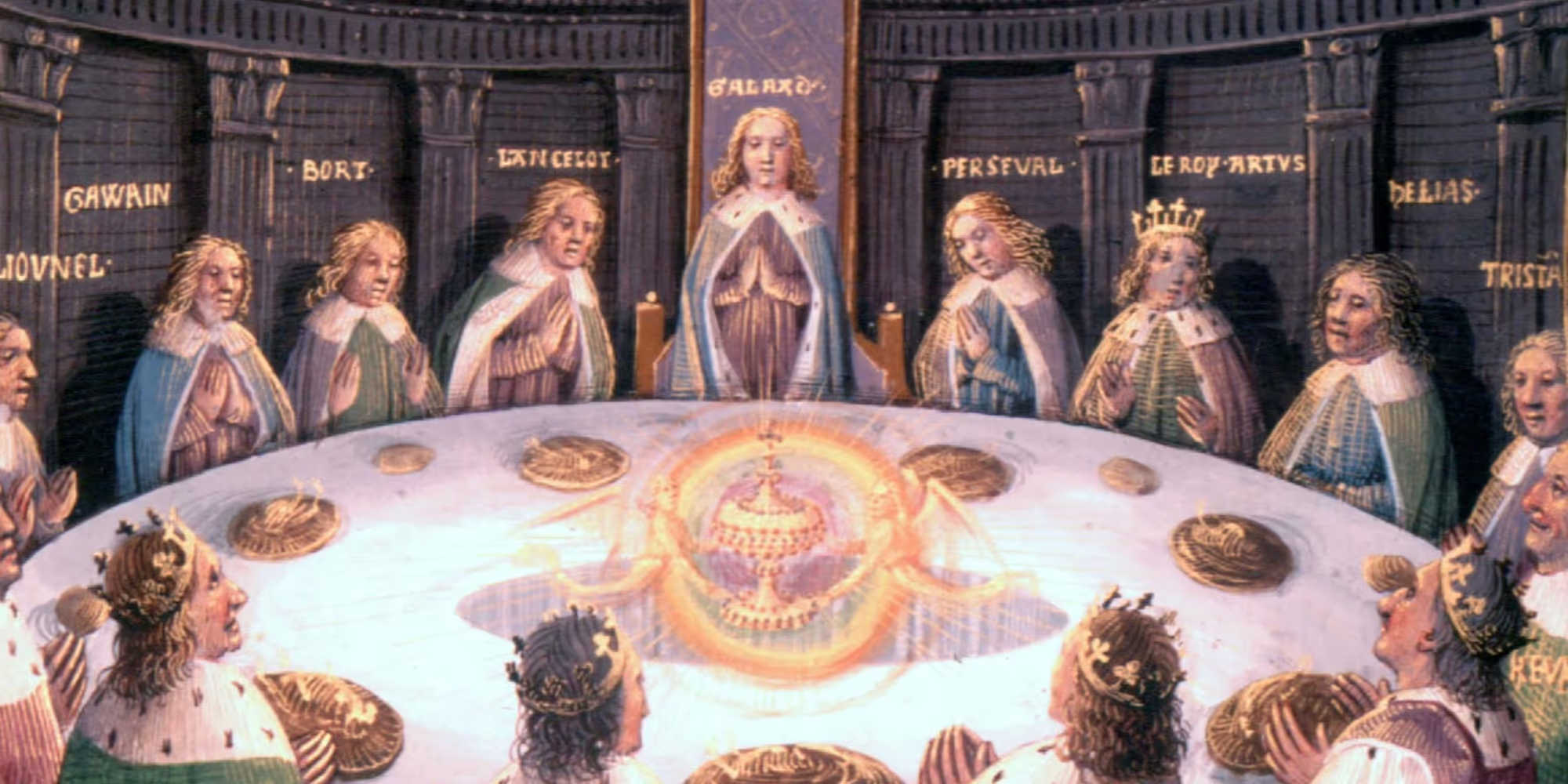
The origins of the Holy Grail legend are historically painful, stemming from the Fourth Crusade, the Holy Mackerel, and the Shroud of Turin, and are rooted in a sense of ruptured communion and debates surrounding the very concept of communion itself.
While many later versions of the Grail story, popularised by works such as Sir Thomas Malory's Le Morte d'Arthur, incorporate elements often associated with modern adventure narratives, the earliest known Grail romance is Chrétien de Troyes' Perceval, the Story of the Grail. This initial narrative is the most symbolically insightful, and fundamentally structured according to the pattern of the Divine Liturgy.
Chrétien's Perceval and the Liturgical Framework
Chrétien's romance interweaves two primary narratives: one concerning Percival and the other Gawain. The Percival portion of the story, in particular, demonstrates a deep liturgical structure that guides the protagonist's journey of self-discovery and spiritual ascent.
Percival's Initial State and Loss of Identity
At the outset of the tale, Percival possesses no defined identity. He knows himself only through his mother, who calls him "dear son," or his servants, who refer to him as "dear master". He is a bastard - he lacks knowledge of his father - a knight who succumbed to a grave injury in the loins during battle.
His mother deliberately conceals his paternal identity and discourages him from knighthood, fearing he will meet the same fate. Percival's appearance is rustic, described as being dressed "like a Welshman". His primary activity, throwing a javelin in all directions, symbolises his scattered and unfocused identity. This initial state corresponds to the pre-synaxis stage of the liturgy, where individuals are scattered and dissolved before congregating for communal worship.
First Encounters and Imperfect Learning
Percival's journey begins in the savage forest, a wasteland where he encounters knights for the first time. Mistaking them for demons, his limited understanding of God (derived from the Creed, the Our Father, and making the sign of the cross) is immediately challenged.
He initially plans to strike them, only to revise his perception and mistake the most beautiful knight for God. The knights correct his misapprehension, identifying themselves simply as knights. Percival's engagement with their gear, the lance, the shield, the armour, is marked by a fundamental ontological inquiry: "what is that and what's it for?" and, for the armour, "how does that serve?". This questioning represents a crucial step in ascending the ontological hierarchy, as discerning the purpose of things allows one to comprehend higher levels of reality.
Upon returning to his mother, Percival learns about his crippled knight father, who could not defend his lands. Realising she cannot dissuade him from pursuing knighthood, his mother provides a set of initial instructions. These include:
- Offering aid to any lady, accepting a token up to a kiss, but no more.
- Asking the name of any man offering hospitality, as "it is by the name that we know the man". This instruction is particularly significant given Percival's own lack of a name.
- Stopping to pray at any church or chapel, described as a place filled with relics treasures holy wherein they offer up the body of Jesus Christ, thus foreshadowing the Grail's nature.
Percival's early encounters highlight a recurring theme: as he attempts to ascend the ontological hierarchy, he consistently lacks the necessary information or manners for the new level. This reflects the initial stages of catechesis, where one takes the first step up the spiritual mountain.
The Chivalric Initiation and a New Mentor
Percival's first forays into the world of chivalry are clumsy. He misinterprets his mother's instructions, taking a maiden's ring and a kiss, which inadvertently causes distress for her jealous lover. He also encounters the Red Knight, who has stolen Queen Guinevere's favourite cup, plunging King Arthur's court into silence.
This act of theft, causing a breach of communion, is a pivotal moment. Although Percival accidentally kills the Red Knight with his javelin, he is unable to remove the armour, requiring assistance and demonstrating his continued inexperience. The beginning of Percival's chivalric career is therefore marked by a "rupture of communion around a stolen cup". He reluctantly dons the Red Knight's armour over his original garments of skin, signifying a partial, imperfect transition.
This stage is accompanied by the crossing of a river, a recurring symbol of moving to a new tier in the ontological hierarchy. Percival meets a new mentor, Sir Gornamont, also known as the worthy man, who further initiates him into the ways of chivalry. Gornamont teaches him to ride, fight, and use weapons, with the question "how does this serve, who does this serve?" being applied to each.
Percival is also given new garments, finally shedding the garments of skin from his mother, and a new set of instructions, some repeating earlier advice and others new. Crucially, he is advised to be taciturn and avoid asking too many questions, lest he be perceived as a peasant or child. This shift marks his maturation and initiation, akin to a baptism, moving him from the narthex to the nave of the church. His initial state of perpetual questioning, is a feminine space at the bottom of the hierarchy, must evolve into a more engaged, higher-level understanding.
The Desolate Church and Missed Opportunities
During his adventures, Percival encounters a minster (a monastery church) under siege. Despite having been instructed to pray in churches, he finds it desolate: its walls cracked, towers roofless, and buildings exposed to the elements. No monks or nuns are present, having abandoned the maintenance of the house of God to survive the siege.
Percival, sad and confused by this unexpected desolation, departs. This scene is highly symbolic, reflecting the denuding of traditional Christian beauty and the experience of finding the "house of God vacant and empty and crumbling". It warns against leaving when confronted with brokenness and scandal within the church.
The Fisher King and the Grail Procession
Deciding to return home, Percival crosses a third river, another liminal moment. This time, he struggles to find a way across and encounters a man fishing, who directs him to a nearby castle. This is the castle of the Fisher King, a figure with a wound in his loins that confines him to his bed, mirroring Percival's own father's injury. Percival is unaware that the Fisher King is his maternal uncle, a relationship signifying a strong, loyal bond without the threat of usurpation.
Within the castle, Percival witnesses a mysterious procession. First, a squire enters bearing a lance, its tip not merely bloodied but actively bleeding, evocative of Christ's wounds. Percival suppresses his urge to ask "how does it serve?" remembering Gornamont's advice to be silent. Next, two young men carry tapers and candelabra, followed by a maiden bearing the Grail itself.
In Chrétien's version, the Grail is described as a wide, shallow, covered dish, large enough to serve a fish, clearly a eucharistic symbol. It emits its own bright light, outshining the candelabra. Again, Percival desires to ask "how does this serve? Who is it serving?" but remains silent.
He also fails to ask the Fisher King's name, which would have revealed their kinship and potentially saved him much trouble. He plans to ask his questions later, but upon waking, finds the castle empty, having lost his opportunity. Percival's failure to ask the crucial question is revealed by the maiden whose ring he had taken earlier. She recounts the Fisher King's story, which precisely matches his father's, and distraughtly mocks Percival for his silence. It is in this moment of deeply painful self-knowledge that Percival's true name is finally revealed.
The third river and the Grail procession symbolise the veil to the holy of holies, mirroring the Great Entrance in the Divine Liturgy, where the paten and chalice are carried, accompanied by tapers, incense, and a lance (used to divide the body of Christ).
Percival's naivete and inability to ask stem from his lack of a father to confer identity and teach him the use of arms. To ascend, he needed to ask the fundamental ontological question about purpose and being. His silence, born of embarrassment rather than wisdom, prevents him from healing the Fisher King and brings ruin upon his family and the land. He fails because he cannot revert to the mindset of a child and ask the foundational questions at that specific level.
Percival's Redemption and the True Grail
After this failure, Percival spends five years wandering aimlessly, a "lost and broken man". He forgets God, the laws of chivalry, and even his own name. He neglects the instructions from his mother and Gornamont, never stopping to pray or aiding ladies. His spiritual amnesia culminates on Good Friday when he encounters knights and ladies who remind him of the day's significance and direct him to a hermitage via knotted branches, symbolising a spiritual progression akin to a prayer rope.
At the hermitage, Percival meets a hermit who turn out to be his uncle and the brother of the Fisher King. This hermit, also referred to as the worthy man, embodies the culmination of all the thresholds and mentors Percival has encountered.
The hermit begins by catechising Percival, explaining the entire Creed, which Percival had previously been taught but never understood. He then reveals Percival's true name and his father's identity. Crucially, the hermit discloses the reason for Percival's past failure: his sin of leaving his mother when she died.
The hermit explains the true nature of the Grail: it does not contain salmon or pike, but a single sacred wafer, the eucharistic host, which is the sole sustenance for the Fisher King due to its holiness. Chrétien's Grail is not the cup of the Last Supper, that idea was introduced in later romances.
The hermit instructs Percival to "stay with me for the next three days and eat what I eat", to fast through Good Friday until Easter. Percival puts on a hair shirt, reversing the symbolism of the original garments of skin, transforming death into life through penitence.
Percival's success is achieved on Easter Day, when, after being catechised and fasting, he received communion with a pure heart. The narrative clearly states: "Here the tale says no more of Percival". This is the completion of his quest. Percival finds the Grail by coming to it broken, totally emptied, and as a little child, ready to receive knowledge and healing.
Receiving communion represents the ultimate self-knowledge, finding oneself in Christ, healing the wound of Adam, and bestowing upon him a new, true name. The healing of Percival, as a microcosm, signifies the healing of all the people and elements in the story that had been externalisations of his fragmented identity. Communion is the highest mystery, fulfilling Percival's entire spiritual journey.
Misinterpretations and Gawain's Quest
The common belief that Percival fails to find the Grail in Chrétien's romance is a misreading. The narrative, through its liturgical structure and explicit mention of Percival receiving communion, clearly indicates his success.
Historically, interpretations by certain English occultists and theosophists, such as A.E. Waite, sought to reconstruct a lost Celtic liturgy through the Grail story. These interpretations, tied to Celtic romanticism and nationalism, viewed the Grail legend as a hidden memory of pre-Latin Mass Christianity in the British Isles, allegedly corrupted by continental romances.
While these figures possessed an intuition about the Grail's liturgical connection, they misread the core mystery, often seeking an esoteric initiation beyond the Christian mystery itself. This tendency of a modern flattened cosmology, can lead to a misunderstanding of traditional veneration and a susceptibility to idolatry.