
Book by Fr. Seraphim Rose
The Orthodox Survival Guide is a comprehensive overview of the historical development of Western thought and its deviation from Orthodox Christianity, it argues this divergence paved the way for modern societal crises, through the eleventh-century Schism between East and West, highlighting the West's increasing emphasis on rationalism, subjective philosophy, and a changing concept of sanctity.
This shift, culminating in the Enlightenment's focus on human reason and progress, eventually led to philosophical dead ends and the rise of destructive ideologies like Nihilism, Communism, and Nazism.
The text further explores the evolution of scientific thought, particularly Darwinism, and its impact on religious understanding, concluding with a warning about the modern world's search for a "new Christianity" that is, in essence, anti-Christian, driven by a desire for a man-made, deified reality.
Vol 1: The Orthodox Worldview
This perspective aims to provide a clear understanding of contemporary global events, each of which possesses a profound philosophical undercurrent.
In any major city, a multitude of churches and doctrines abound, each offering a distinct viewpoint. One might encounter divergent teachings from Catholicism, Mormonism, Seventh-Day Adventists, Fundamentalists, liberal Protestants, and Theosophy.
Individuals searching for truth often move from one to another, sometimes finding a particular teaching that clicks for them. For instance, I was once a student of Alan Watts and was deeply impressed by his lectures on Zen Buddhism.
I found Western philosophy quite uninspiring, and his presentation of Zen as not a philosophy but "just the way things are" resonated profoundly. However, with the perspective of many years, it becomes apparent that Watts was a very clever man, attuned to the contemporary mind-set. He capitalised on a particular intellectual channel, building a career and following.
While he offered some true observations, particularly regarding the flaws of modern civilisation, his ultimate offering was a meagre shred of truth interwoven with personal opinions, culminating in a significant system of falsehoods that undoubtedly harmed many souls, including his own.
Orthodoxy stands apart from these various currents and systems of thought; it is not merely one option among many. Many newly converted individuals often wonder why Orthodoxy is not more prominent in media, unlike other colourful sects such as Mormonism or Seventh-Day Adventism.
When Orthodoxy is occasionally featured in the press, it is typically adapted to the readers' perceptions, often described in exotic terms – Amid clouds of incense and flowing robes and long beards, reducing it to a mere Christian philosophy characterised by its exoticness. This, however, fails to capture the true essence of Orthodoxy.
When individuals commit themselves to other Christian or non-Christian teachings – all of which are, in essence, sects, including Roman Catholicism – they receive a philosophy of life that purports to answer many questions. Acceptance of these answers is influenced by personal background, psychological inclinations, and education. Once one's heart and soul are given to such a teaching, one begins to adopt its doctrines and shape oneself accordingly.
An outsider observing these individuals might be astonished by their responses, which often resemble a party line,"quoting scriptures with interpretations that appear far-fetched yet are considered logical within their framework. For example, Seventh-Day Adventists hold that the commandment concerning Saturday is paramount, distinguishing the "real church" from others, despite Christ's resurrection occurring on Sunday. They may even construct a tradition to support their unique view, failing to provide a comprehensive worldview, but rather a sectarian view.
The Nature of Sectarianism
A sectarian view, as the name implies, is something "cut off". It offers a fragmented piece of reality based on a specific interpretation. When faced with complex issues, sectarians tend to provide overly simplistic answers that are unsatisfying to a discerning mind. Any information that might contradict or obscure their position is often dismissed as Devil's work or simply evil.
Their interpretation of Scriptures is often strictly literal. To accept such views, one must already be aligned with that particular channel of thought. This leads to adherents becoming isolated, forming a group cut off from the rest of society, preserving their own viewpoint, and believing they possess the sole truth.
Such a mindset, however, lacks a true philosophy or worldview that enables genuine comprehension of global events or the explanation of phenomena without doing violence to reason or resorting to whimsical scriptural interpretations. It disrespects the reason God has given us and presents an oversimplified view of the world, labelling those who disagree as devils or deceived. In contrast, Orthodoxy acknowledges that many things in the world possess power; ideas, political systems, even art movements – because they contain a seed of truth.
Without understanding this seed of truth and how it becomes intertwined with error, discerning the genuine from the fake becomes impossible, hindering one's ability to live effectively in the world. A Christian must live in the world, whereas a sectarian attempts to save themselves by isolating others from reality.
Such sectarian views are often implausible when exposed to the broader world and its questions, requiring one to maintain faith in a confined corner of society. True Orthodox Christians are currently few in number, leading some modernisers to view Orthodoxy as outdated and out of step with contemporary pluralism. However, Orthodoxy is not merely a narrow path, but God's religion, and it does not deny our God-given faculties, especially reason, the faculty by which we understand Truth.
Because it is the true religion, Orthodoxy offers answers to all that happens in the world, though not necessarily instant, simplistic answers like those characteristic of a sectarian mentality. Instead, Orthodoxy encourages open minds and open hearts, allowing us to examine science, philosophy, writers, and artists without fear, discerning what is valuable, beneficial, or harmful. An Orthodox worldview means understanding why things are the way they are, not just dismissing them as evil.
While some things must be avoided due to their flagrant incitement to sin, a deeper understanding of their nature is still necessary. Our current era is often termed "post-Christian" and "post-philosophical". Western philosophy, once a vibrant current, reached a dead end in the mid-19th century with the rise of radical subjectivism, where the individual was seen as creating their own universe, leaving no room for objective truth. This led to dangerous conclusions, such as Max Stirner's assertion, "I am alone in the universe trampling on the tomb of humanity". Such thought, unrestrained by tradition, inevitably leads to a dead end.
With the decline of philosophy, political systems became the dominant force. Today, even in universities, the mind's critical faculties are often neglected, reducing art criticism to subjective taste without objective criteria. New, dangerous philosophical beliefs are no longer presented as truths to be debated but as new outlooks, such as the claim that drugs uncover "new areas of reality" or "deeper areas of the mind".
An Orthodox understanding necessitates the ability to evaluate the underlying meaning and implications of such statements to provide reasoned guidance, rather than simply dismissing them as evil. Similarly, advances in science, such as evolution or the ability to genetically engineer human traits, pose complex questions that require careful consideration, not simplistic rejection based on literal interpretations of Scripture.
A sectarian might dismiss evolution as being "against Genesis", but an overly literal interpretation of Genesis leads to absurdities. Orthodoxy offers a robust framework for critically evaluating such concepts, distinguishing between scientific explanations of "how" things work and the essential "what" of reality. The scientific theory of heliocentricism, for instance, does not refute the daily observation of the sun appearing to go around the earth; it merely explains the complex movements that create this effect.
Orthodox thought, unlike Scholastic rationalism, carefully distinguishes between truths of faith (dogmas) and outward phenomena open to various interpretations and speculations. The religious views of man being "dethroned and alone in a cold and infinite universe" that arose with the Copernican revolution are not inherent to the scientific facts but stem from a religious impulse seeking a new faith in the outward world.
In essence, while sectarian views offer a very narrow and often deceptive "plain truth" that claims to be simple and universally applicable, leading millions astray with subjective interpretations, the Orthodox worldview is far from a two-dimensional, simplistic understanding of the world.
It is a profound, comprehensive approach that acknowledges the power of ideas, even those mixed with error, and seeks to discern the truth amidst the complexities of history and human thought. This worldview is indispensable for navigating a world shaped by constant revolutionary forces, ultimately striving to understand the underlying spiritual battle between God and the devil, with humanity's heart as the battlefield.

Vol 2: The Middle Ages
The intellectual history of the modern age commences with the period directly following the Schism of Rome, a pivotal event that gave a distinct direction to the subsequent thousand years of Western thought. This era, often termed the classical age of modern Europe, is characterised by profound shifts in fundamental principles, marking a deliberate departure from Orthodoxy. These developments have not been incidental; rather, they reveal enduring underlying philosophies that have shaped global events and our present-day outlook.
The Enlightenment: An Age of Reason
The late seventeenth and early eighteenth centuries ushered in the Enlightenment, a period where science largely replaced theology as the standard of knowledge, and the study of nature and its laws became the paramount intellectual pursuit. A certain equilibrium and harmony were achieved, with Christianity adapting itself to this new spirit, especially in England, France, and Holland.
The enlightened individual of this time believed in a God whose existence could be rationally demonstrated, embraced natural religion, and was tolerant of others' beliefs, convinced that modern science could explain everything.
The world was perceived as a vast machine, a uniform mathematical system, beautifully articulated in Newton's Principia Mathematica. This era also saw the rise of the encyclopaedia, a novel concept embodying the desire to systematise all knowledge in one place. Unlike earlier, hierarchically organised compilations, such as those in China, the new encyclopaedias flattened all knowledge, making it fragmentary. One could become an expert on a single page without understanding the whole, leading to a fragmented understanding of reality.
The central idea during this time gradually shifted from God to Nature. Thinkers like Holbach worshipped Nature as the "great whole" encompassing all existence, where everything that exists presents only matter and motion. While some, like Newton's disciples, still saw natural science as a path to knowing the "Author and Governor of the universe," the emphasis was clearly on understanding God through His "workmanship" in the outward world.
This impulse led to a "religion of reasonableness", where complex doctrines of faith were considered irrational and unnecessary for good citizenship. Lord Herbert of Cherbury, for example, reduced Christianity to five basic articles of faith, appealing to common sense rather than mystery.This simplified faith, rooted in reason, became a mere rational philosophical system.
The Crisis of Knowledge:
Hume and the Dissolution of Reality
The movement of reason, once begun, could not be stopped. From Scholasticism's attempt to make faith logical, through the Reformation's critique of Medieval Catholicism, reason eventually led to the rejection of all mysteries and the attack on religion itself.
David Hume, a pivotal figure of this period, systematically demolished the concept of miracles, arguing that no testimony could conclusively establish a supernatural event. He further undermined the rational basis for faith, even questioning the existence of an all-wise and all-good Creator, asserting that order could be as natural as chaos.
Hume extended this skepticism to all knowledge, claiming that we can only know our "impressions" – immediate sensations – and "ideas," which are derived from these impressions. Our reason, he concluded, is a subjective faculty with no necessary relation to "facts," and our senses only perceive images, not things "in themselves".
Thus, knowledge itself was dissolved, leaving only "action, and employment, and the occupations of common life" as a means to navigate existence. This philosophical chill heralded a profound instability, demonstrating that the world was no longer seen as stable or objectively knowable.
In response to this dissolution, Immanuel Kant initiated a "Copernican revolution" in philosophy, positing that it is the mind that structures reality. We cannot know the "thing in itself," but only how reality appears to us through the mind's categories, such as space and time.
While this salvaged a form of knowledge, it ultimately led to a dangerous subjectivism where the individual creates their own universe, leaving no room for objective truth. This marks the beginning of the worship of the Self as a new deity, replacing the old God who was perceived as "preparing for death".
The "Death of God" and Its Consequences
Later in the nineteenth century, Friedrich Nietzsche gave powerful expression to the "death of God". He proclaimed a new gospel, the "Superman," arising from the earth, rejecting Christianity as a principle of weakness that failed to satisfy either the mind or the heart. For Nietzsche, when the idea of God's death permeates the common people, it would lead to an unprecedented upheaval, overturning the whole of society.
This nihilistic outlook permeated contemporary art and literature, reflecting the absurdity and meaninglessness of a God-less existence. Franz Kafka's stories, for instance, depict a world where individuals are hounded for unknown crimes, suggesting guilt simply for existing, devoid of sense or logic.
Eugene Ionesco's plays portray people turning into rhinoceroses, symbolising the degeneration of humanity, while Beckett's characters "wait for Godot" in a garbage pail, signifying a world devoid of divine presence. Albert Camus's philosophy of rebellion as the sole meaning in life further exemplifies this profound departure from faith.
Dostoyevsky's Counter-Narrative
In stark contrast, Fyodor Dostoyevsky, having been deeply infected by revolutionary ideas in his youth, later became a profound critic of the modern mentality. He foresaw the destructive implications of a world without God and offered a Christian answer.
In Crime and Punishment, he explores the idea that if there is no God, then everything is permitted. His protagonist, Raskolnikov, attempts to become a Superman by killing an "useless old lady" but is tormented by his conscience, demonstrating that the conscience planted by God and developed by the Christian Church cannot be silenced.
Dostoyevsky shows that without God, individuals become tools for revolution, used as "things," in direct opposition to Christian principles.
In The Brothers Karamazov, the character Ivan Karamazov articulates the chilling philosophy of the Grand Inquisitor. This figure, embodying the Roman Church's deviation, seeks to control humanity by denying Christ's freedom and providing "bread and circuses". The Grand Inquisitor argues that humanity cannot bear true freedom and, therefore, has humbly laid its freedom at the Church's feet in exchange for security and happiness provided by miracle, mystery, and authority.
This manipulative system, rooted in the idea of human weakness and a desire to "improve on Christianity," ultimately leads to a satanic theology that despises true faith and seeks to establish a universal ant-heap.

Evolution: A New Dogma
The Theory of Evolution gained immense popularity in the nineteenth century, becoming a central dogma for advanced thinkers. It presented a new scale of values, identifying the desirable with modern, up-to-date, and progressive, valuing the most recent development over sound reasoning or tradition.
While evolution is widely accepted, a critical examination reveals a lack of conclusive scientific proof. The common "proofs," such as homologous structures or fossil records, are often interpretations based on a prior philosophical commitment to evolution, rather than objective evidence.
The concept of "variation" within species is distinct from "evolution" of one species into another, and scientific experiments on mutation largely demonstrate harm rather than beneficial change. Dating systems, often cited as proof of Earth's antiquity, frequently fit into an already accepted presupposition of millions or billions of years, rather than providing revolutionary new data.
Theistic evolution, an attempt to reconcile Christian belief with evolutionary theory, often results in a reinterpretation of core Christian doctrines. Figures like Pierre Teilhard de Chardin and Theodosius Dobzhansky, though respected, represent a departure from traditional Orthodoxy.
Teilhard's "Christian evolutionism" redefines the "cosmic role of Christ" and the Church, viewing salvation not as individual transformation but as humanity's collective evolution towards an "Omega Point". Dobzhansky, while Orthodox by background, views natural selection as a "blind and a creative process" and denies a "foreordained plan," effectively removing God's providence from creation. These interpretations tend to treat Genesis as symbolic and dismiss the concept of Paradise, struggling to reconcile evolutionary theory with fundamental Christian truths.
The Rise of Spiritualism and the "New Religion"
The vacuum created by the self-destruction of rationalism and the "death of God" led to a search for new forms of belief, particularly in spiritualism and occultism. This marked a shift from a "Christianity without mystery" to a "non-Christianity with mystery".
Individuals, having abandoned traditional faith, became susceptible to any phenomenon that suggested something "supernatural or preternatural," without discerning its true source. The late nineteenth and twentieth centuries saw a proliferation of new cults and movements, all rooted in a similar spirit of individual revelation and self-worship.
Mormonism, Christian Science, Seventh-Day Adventists, Jehovah's Witnesses, and even movements like Hari-Krishna exemplify this trend, where individuals believe themselves to be "like a god who has a new revelation" or literally become "god" through meditation. This self-centered, pampered mentality culminated in the human potential movement, which asserts that humanity is good, human potential is unlimited, and "persons in essence become God".
This movement, pervasive in modern society, advocates for self-transformation and the creation of one's own reality, often through psychological therapies that assume all right values are inherent within the individual, leading to a rejection of external authority and a belief that "everything's just fine the way it is".
This cult of self-worship permeates modern culture, from art and music to advertising, constantly arousing emotions and passions, subtly drawing individuals away from Christ.
The Culmination: The Kingdom of Antichrist
The logical progression of modern thought, once Orthodoxy was abandoned, culminates in a vision of the Antichrist and a new world order. The "death of God" is seen as a poetical way of describing this apostasy, where "all is permitted" and demons gain greater sway in the human world.
Vladimir Solovyov, a profound Russian thinker, envisioned the end of modern history as the coming of Antichrist. In his story "A Short Story of the Antichrist," he depicts a superman who is a brilliant thinker, writer, and social worker. This figure, a "plenipotentiary chosen Emperor of Europe and ruler of all its forces", proposes a universal programme that reconciles all traditions and symbols with radical demands for social and political change. He offers universal peace and aims to unite all cults in a single "world-museum of Christian archaeology," while subtly demanding allegiance to himself rather than Christ.
The Antichrist is a synthesis of modern aspirations: boundless freedom of thought, deep understanding of mysticism, absolute Individualism, and ardent devotion to the common good. This is the ultimate deception, where humanity, having denied God and sought a new revelation, will accept a false Christ who promises a worldly paradise.
The "death of God" leads to the rise of the Superman, who is in reality a "sub-man," culminating in the worship of oneself and the idea that man and the world become divine. This trajectory, which began with the Schism and the exaltation of human reason, logically leads to the ultimate spiritual battle for humanity's heart, ushering in a temporary, false millennium.

Vol 3: The Renaissance
The intellectual history of the modern age, which began with the Schism of Rome, unfolds as a consistent progression of ideas, each development logically following from the principles established in previous eras. The period immediately following the Schism, specifically the High Middle Ages, laid the groundwork for the Renaissance and the Protestant Reformation, initiating profound shifts that continue to shape contemporary thought and society.
The Renaissance: The Elevation of Humanity
The Middle Ages were profoundly influenced by Scholasticism, a system that elevated human reason, even subordinating Christian teaching to it. This rationalism, however, ultimately turned against traditional Christianity, planting the inevitable seed of the Reformation in the very fabric of the Western Church.
This intellectual current fostered a spirit of continual questioning and a desire to improve upon existing Christian tenets, leading to a period of intense innovation. The Renaissance, understood as a rebirth of antiquity, ushered in the era of Humanism.
This new cultural epoch marked a decisive shift towards worldliness and the glorification of human achievement. Admiration, previously reserved for saints and heroes, was now showered upon individuals like Petrarch, revealing a profound desire for earthly renown and posthumous worship. This era was characterised by a boundless ambition and a relentless thirst for greatness, pursued often without regard for means or consequences.
The philosophy of figures such as Niccolò Machiavelli, who asserted that "actions which are great in themselves... always seem to bring more glory than blame," exemplifies a worldview that I find to be disturbingly demonic in its detachment from moral considerations.
A crucial philosophical reversal occurred during this time: man unequivocally replaced God as the criterion of truth. Human feelings and logic became the ultimate arbiters, with man presuming to elevate himself above divine tradition. This radical self-assertion is vividly demonstrated in the figure of Francis of Assisi, who, I observe, essentially placed himself alongside Christ. This human-centric paradigm was a direct precursor to the full "religion of man" that would emerge in later periods.
The impact of this shift was particularly evident in art. The authentic understanding of an icon, which for Orthodox Christians represents a Saint as they are in heaven, was gradually eroded. Instead, religious art began to depict Saints as earthly figures, adorned with "picturesque quaint elements". This transformation transmuted religious art into a vehicle for an "entirely different religious understanding.
The Protestant Reformation: A Rationalist Offshoot
The Protestant Reformation stands as the second major movement of the Renaissance period, and, despite its outward appearance of difference from Humanism, it is intrinsically part of the same underlying intellectual current. It was, at its core, another manifestation of reason turning against the established order of Scholasticism. The reformers sought to devise a "simpler Christianity" that any believer could interpret for themselves.
The insight that Luther could be seen as a logical consequence of Scholasticism, and subsequent rationalists as inheritors of Luther's spirit, highlights a continuous thread of intellectual development. This very spirit of unchecked rationalism, which challenged traditional authority, ultimately led to the internal erosion and eventual destruction of Protestantism itself.
Luther's removal of the "idea of struggle" from Christianity rendered it weak and unsatisfying, leaving it either totally dry and rational or totally sentimental. This perceived weakness, coupled with its inability to satisfy the human mind's quest for truth or the heart's deeper yearnings, led Nietzsche to conclude that the whole of Christianity was a "monstrous farce, a deception practised upon humanity" suitable only for the "herds".
The New "Scientific" Faith
This period also witnessed significant developments in science, which, surprisingly, harboured a profound religious impulse of their own. The Copernican theory, for instance, challenged traditional geocentric views. While a scientific theory like heliocentrism explains complex movements on a technical level, it does not, in my view, refute the observable reality of the sun moving around the earth.
It is crucial to distinguish between a scientific explanation and direct everyday experience. The Orthodox tradition, unlike the Scholastic Western mind, carefully separates dogmas of faith from outward theories that are open to interpretation. This distinction was lost in the West, where scientific theories were elevated to the status of dogma, as exemplified by the controversy surrounding Galileo.
The scientific discoveries of this age led to new "religious views" of man as dethroned and alone in a cold and infinite universe. These views were not direct deductions from the new facts but rather reflected a deeper human yearning for a new faith—a faith to be found by scrutinising the outward world. Men, seeking a new spiritual foundation, readily used the facts they discovered to construct this nascent faith.
Chiliastic Visions and Social Revolution
The revolutionary undercurrents of the modern age can be traced back to the chiliastic visions of earlier periods, such as those of Joachim of Fiore. His ideas about a "third age," which would supersede the existing Church and see the "liquidation of preaching and sacraments," were later appropriated by figures like the Franciscan Spirituals. They envisioned St. Francis as a "new John the Baptist" or "new Christ," and sought to establish a community of the Holy Spirit, without pope, clerical hierarchy, sacraments, Holy Scripture, and theology.
These millenarian concepts resurfaced powerfully in movements such as the Taborites in the fifteenth century, who advocated for a return to a golden age of equality and communal ownership. Figures like Thomas Müntzer, who preached the mass extermination of those opposing his doctrine and the common holding of all things, are rightly recognised as forerunners of Communism.
The Anabaptist movement in Münster further illustrates these radical social aspirations. Their efforts to abolish private money and enforce communal living were steps towards a state where "everything would belong to everybody and the distinctions between Mine and Thine would disappear".
The Anabaptist leaders, such as Matthys and Bockelson, exhibited a revolutionary zeal, even banning books other than the Bible and imposing strict austerity while living in luxury. Their call to "kill all monks and priests and all rulers" underscored their aim to establish a new order where only their chosen leader held legitimate authority.
These historical movements, with their radical social and religious aims, bear a striking resemblance to twentieth-century phenomena like Nazism and Communism. This suggests that the "fantasies" of these earlier chiliastic movements provided a foundational inspiration for later, more technologically advanced, revolutionary ideologies.
Enduring Legacy
The intellectual and spiritual changes originating in the period after the Great Schism, particularly the Renaissance and Reformation, were not isolated events but rather the initial manifestations of a "natural process" that unfolds once Orthodoxy is abandoned.
The emphasis on human reason, the desire to "improve upon" Christianity, the search for a new faith, and the recurring chiliastic visions of a perfect earthly order all converge to form a distinct modern mentality.
These principles, developed in the Middle Ages, have been continuously worked out, reaching increasingly advanced forms that continue to shape our present world. Understanding these historical and philosophical undercurrents is, in my assessment, essential for Orthodox self-defence against the prevailing anti-Christian philosophies of our time.

Vol 4: The Enlightenment pt 1
A New Harmony and a New Standard
The Enlightenment, generally encompassing the late seventeenth and eighteenth centuries, represents what I view as a classical age of modern Europe. It was a period where, following the preceding era's intellectual shifts, a certain equilibrium and harmony appeared to be established in Western thought.
Christianity, rather than being overtly overthrown, adapted itself to a new spirit, and the inherent contradictions of modern naturalistic and rationalistic ideas had not yet fully manifested. This age believed in a God whose existence could be rationally demonstrated and in a natural religion, fostering tolerance for diverse beliefs and a profound conviction that modern science could explain all phenomena.
Science, in this era, unequivocally replaced theology as the standard of knowledge. The universe was conceived as a vast, harmonious machine, whose every movement could be mathematically described. Isaac Newton's Principia Mathematica, for instance, epitomised this new gospel, completing a sketch of the universe that would remain the fundamental scientific verity for the eighteenth century.
This marked a significant departure, as scientific theories, which for Orthodox Christians are secondary explanations of observable phenomena, were elevated to the status of dogma, as illustrated by the un-Orthodox persecution of Galileo.
This period also gave birth to a novel concept of knowledge embodied in the Encyclopaedia, particularly in France through the efforts of Diderot. The very idea of compiling all human knowledge into a single, comprehensive work, arranged alphabetically, reveals a flattening of hierarchical understanding. Unlike earlier encyclopaedias, which implicitly or explicitly ordered knowledge according to higher principles, this new approach fragmented understanding, allowing one to be an expert in a single page without grasping the totality - a highly dangerous form of knowledge, leading to intellectual atomisation.
Crucially, in this new synthesis, the idea of Nature effectively replaced God as the central organising principle. While the concept of God was not entirely discarded until later, Nature became the object of veneration, as expressed by thinkers such as Holbach, who asserted that man is entirely a work of Nature, bound by her laws, with nothing existing beyond this "great whole". Voltaire, too, conceived of Nature as the "art of God," a deistic God who created the world but then withdrew, leaving it to operate according to its own immutable laws.
This Deism became a hallmark of the age, rendering God largely irrelevant to the unfolding of the world. Miracles and prophecy were increasingly dismissed as mere superstition. Rational theologians of the time grappled with the age-old problem of evil, often resorting to the faith that a rational order must inherently be a moral one, epitomised by Leibnitz's assertion that this is "the best of all possible worlds".
Such facile optimism, however, was keenly challenged by others, like Voltaire, who, through works such as Candide, satirised the notion of inherent goodness in the face of widespread suffering and injustice. An overwhelming belief in the progress and perfection of humanity pervaded the Enlightenment.
It was confidently asserted that humanity was on an inexorable path towards greater physical, intellectual, and moral perfection, poised to reach heights that future generations would struggle to maintain.
A message inscribed in a German church steeple in 1784 perfectly captures this optimistic spirit, proclaiming an age where emperors were humane, religion appeared in its "divine essence," enlightenment made great strides, and love of man and freedom of thought gained supremacy. This vision is disturbingly naive, failing to account for the deeper spiritual realities.
The Arts and the Crisis of Reason
Despite the philosophical changes, the Enlightenment witnessed a great flourishing of the arts, particularly music. Composers like Handel, Bach, and Vivaldi created works of extraordinary refinement. While their religious music often conveyed deep piety, I distinguish it from true Orthodox church music. It is, what some Russians call duchevni, music of the soul's lower part, rather than the spirit, leading one to contemplate and enjoy, rather than to contrition or a direct ascent to heaven.
However, underlying this apparent equilibrium lay a profound crisis of faith. Religion itself became subject to the same standard as science: the outward study of the outward world, governed by reason. This continued the process initiated by Scholasticism, where reason was ultimately placed above faith and tradition.
Men dreamed of a "religion of reasonableness," stripping Christianity of its mysteries and complexities. Diderot, for instance, questioned the necessity of doctrines like transubstantiation or the Trinity for good citizenship, effectively reducing religion to a practical moral code. Lord Herbert of Cherbury exemplified this trend by proposing five universal articles of faith, all deemed "reasonable," reflecting a rationalistic synthesis of Christian tenets.
This movement of reason, once set in motion, could not be halted.
The Scholastics, who initially sought to systematise Christian teaching logically, were followed by reformers who discarded more and more elements, ultimately attacking the very idea of religion itself. Pascal, in his profound observations, rightly noted that proving Christianity by reason was futile due to its inherent mysteries, suggesting that Islam, with fewer mysteries, might be more easily "proven".
The culmination of this trajectory of reason was the work of David Hume, whom I consider profoundly significant for our contemporary philosophy. Hume, building upon the rationalistic methods, definitively sought to demolish the concept of miracles, arguing that no testimony could ever sufficiently establish a supernatural event.
His arguments, though seemingly logical, ultimately led to the destruction of all certain knowledge, even of the outward world. Hume demonstrated that reason is a subjective faculty, limited to the relations of ideas, and that our senses only perceive images, not things-in-themselves. This left nothing but uncertainty, a "chill" running underneath the solid ground of common sense.
Hume's answer to this dissolution of knowledge was "action, and employment, and the occupations of common life". While this suited a comfortable English gentleman like Hume, for those who truly sought truth through reason, it led to despair and the destruction of their universe. I observe that for many, such "action" would translate into revolution and violence, burning down buildings to find something "real".
The Revolutionary Theology and Its Outburst
This intellectual trajectory, from the exultation of reason to the destruction of objective knowledge, left a void that would be filled by new, often irrational, forces. The "modern mentality," which culminates in the Revolution, possesses a distinct belief system – a theology of revolution – that profoundly shapes history.
Modern history, far from being a chance interplay of forces, reveals a definite pattern and philosophy. Astute figures like Nietzsche and Heinrich Heine, whom I recognise as having a deep insight into the spirit of their age, foretold the monumental upheavals to come, understanding that thought precedes action, and that philosophical changes would inevitably lead to social revolution.
Without modern philosophy, there would have been no revolution. This philosophy, once it inspires action, continues to consolidate gains and push activists further.
Revolutionary acts, often the work of small, organised groups, succeed because they tap into the "common mind" or the "spirit of the times," which is willing to excuse excesses. The pervasive secret societies of the era, though elusive in their precise influence, represent this underlying philosophical unity.
The French Revolution, therefore, stands as the first great outburst of modern ideas. Contrary to naive historical interpretations that view it as a well-meaning experiment gone awry, I believe it was a deliberately planned event.
The works of the Abbé Barruel confirm that a "single thread" runs through the Revolution, demonstrating that its crimes and atrocities were a necessary result of its principles. Voltaire, with his lifelong vow to destroy Christianity and replace it with Deism, serves as a significant philosophical precursor to this revolutionary zeal.
The revolutionary mind is a fusion of two dangerous philosophical strands: the belief that one's own reason can perfectly order society, and the conviction that one's feelings can guide to truth. This absence of divine revelation, tradition, and the Church, I perceive, opens the way for Satan to enter, manipulating thoughts and feelings and directing revolutionary outbursts.
Illuminism aand the Illuminati, founded by Adam Weishaupt in 1776, exemplify the conspiratorial nature of this period. Weishaupt, borrowing methods from the Jesuits he despised, sought to achieve a radical program: the abolition of monarchy, all ordered government, private property, patriotism, the family (including marriage and morality), and all religion.
His system aimed to replace these with communal education and a society of perfect liberty and equality, where "man is not bad except as he is made so by arbitrary morality". The Illuminati employed "pious fraud," presenting Christ as an early Illuminist to deceive novices, and demanded absolute obedience from their initiates.
The 1782 Congress of Wilhelmsbad, I note, effectively sealed the alliance between the Illuminati and Freemasonry, with the explicit aim to overthrow existing monarchies and the Church. Though the Bavarian authorities later exposed Illuminati documents, revealing their "diabolical nature," their schemes were dismissed as unbelievable by Europe's rulers, a tragic underestimation of the coming storm.
Revolutionary violence, I conclude, was not incidental but a deliberate and systematic tool.
The Great Fear of 1789, a coordinated panic engineered to arm the populace against established order, demonstrates this calculated agitation. The revolutionary "sect," as I term it, ruthlessly extinguished natural affections, demanding mass extermination as a means of "depopulation". This chilling logic, where the "end justifies the means," is a defining characteristic of the revolutionary mind.
Babeuf's Communism, emerging from the spirit of Weishaupt, further illustrates these radical aims. He advocated for "common happiness" through the abolition of individual property, even viewing depopulation as the "immense secret" of the Terror. His vision included an absolute State that would control all necessities, and he admired Robespierre's methods of "mowing down" all opposition to achieve revolutionary goals.
The plan for his "Great Day" of revolution involved seizing resources, butchering resisters, and imposing a system of state serfdom. The people were deliberately kept ignorant of these true aims, manipulated by appeals to self-interest and covetousness.
The French Revolution ultimately left France in ruins, demoralised, and consumed by hatred. Its de-Christianisation efforts were profound: the abolition of religious ceremonies, the secularisation of daily life, the renaming of months, and the imposition of a ten-day week to eradicate Sunday observance.
Notre Dame Cathedral was transformed into a "Temple of Reason," symbolising the triumph of philosophy over fanaticism. I find the detailed accounts of these "Festivals of Reason" in places like Chalons-on-the-Marne, with their rationalistic symbols, processions, and anthems to liberty and hatred for tyrants, to be chillingly artificial, a triumph of the abstract mind over living faith.
The Revolution, despite its rationalistic language, reveals itself as a secularised form of the chiliastic sects of earlier periods, such as those inspired by Joachim of Fiore. It is an expression of that same fervent desire for a new order and the culmination of history on Earth, albeit stripped of overt religious terminology. This underlying chiliastic strain runs deep within the modern man and continues to shape our world.
Thus, the Enlightenment, as a period of intellectual and social transformation, was not a mere philosophical interlude. It was a crucial stage in the unfolding of a logical progression from the initial abandonment of Orthodoxy.
The relentless application of reason, the subsequent crisis of knowledge, and the emergence of revolutionary ideologies were inevitable consequences that continue to manifest in ever more advanced forms in our contemporary world.
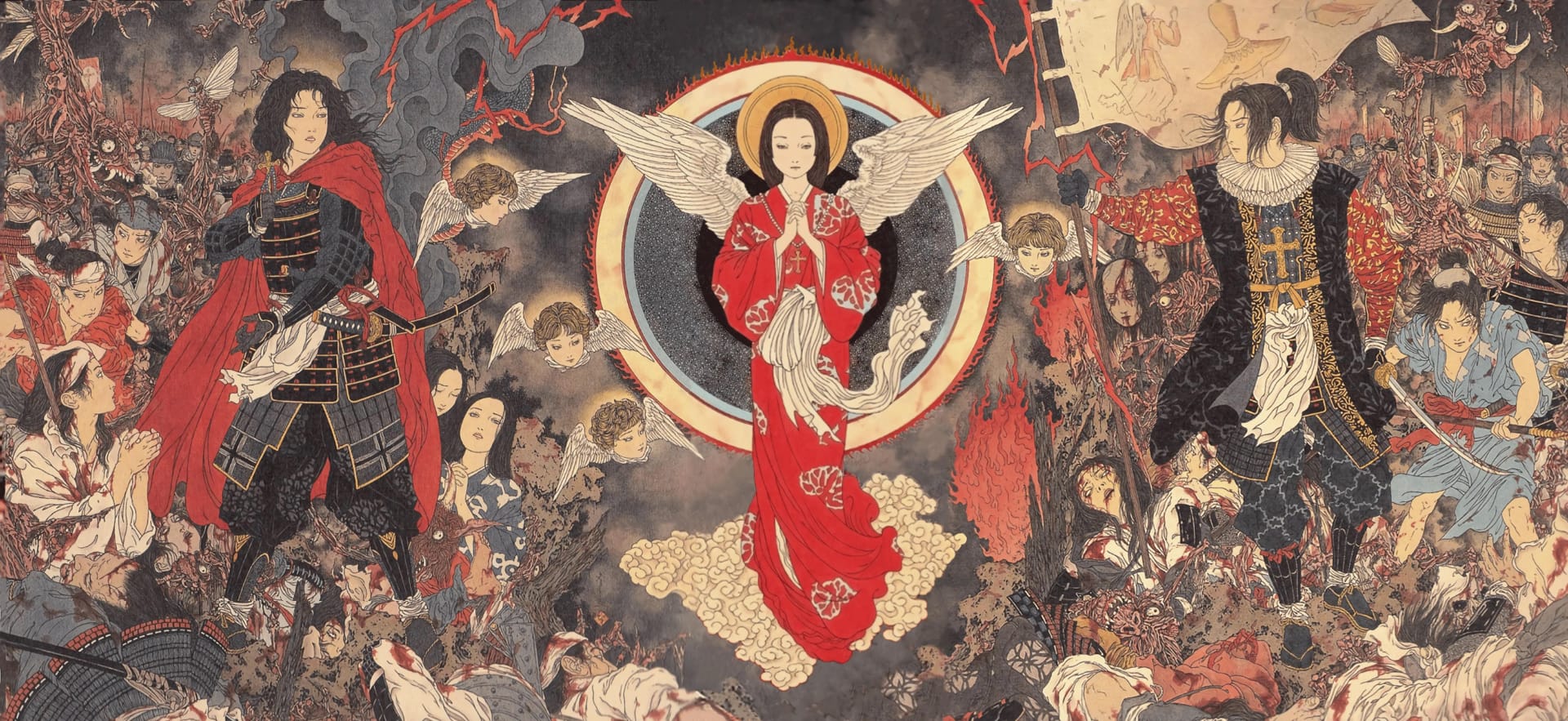
Vol 5: The Enlightenment pt 2
The nineteenth century marked a pivotal period in the ongoing revolutionary movement, building upon the foundations laid in the Enlightenment and the French Revolution. This era saw the emergence of various ideologies, many of which, despite their apparent differences, shared a common underlying "theology" or philosophy that profoundly shaped world history.
The Nature of Revolution and its Ideological Roots
Revolution, far from being a random series of events, is understood as a definite historical process driven by specific philosophical and theological undercurrents. These ideas, originating with philosophers, gradually permeate the masses, leading to significant societal changes. The French Revolution, specifically, served as the initial major manifestation of these modern revolutionary ideas. It demonstrated the deliberate application of rationalistic concepts to transform society and the established order of life.
The Abbé Barruel, an eyewitness to the French Revolution, observed that its acts were not accidental but the necessary outcome of underlying principles and systems, forming a continuous thread throughout revolutionary events. This "devouring sect" aimed to undermine existing structures, with its conspiracies extending across nations.
A crucial element of the revolutionary mind is the rejection of divine revelation and tradition, replacing it with reliance on human reason and feelings as guides to truth. This opens the way for destructive forces, as seen in the revolutionary outbursts, which appear to be directed by sinister inspiration. The exaltation of reason above faith and tradition, initiated during Scholasticism, inherently leads to its own self-destruction, progressively eroding established beliefs.
Revolutionary Figures and Their Philosophies
The period following the French Revolution, particularly the first half of the nineteenth century, was largely shaped by Romanticism, a reaction against the one-sidedness of Enlightenment rationalism, yet it retained and often intensified many of its core tenets, especially the emphasis on feeling and a sympathy for the mysterious.
Key thinkers and movements of this period include:
Metropolitan Anastass offered a profound insight into the French Revolution, characterising it by the "light-minded character" of its participants, their striving for "posing," and "beautiful phrases and gestures inspired by vainglory". He noted their lack of accountability before God, history, or conscience, portraying them as mere "puppets in a play". This shallow and posing nature was especially evident in the nineteenth century, an "age of egotists".
Tzar Nicholas I, the Russian Tsar, stands as an exemplary monarch representing the pure tradition of Russian absolutism and a conscious bulwark against revolutionary ideas. His reign began with the Decembrist rebellion, which he decisively suppressed, demonstrating both boldness and Christian compassion towards the conspirators. He believed his duty was to defend Russia's autocratic rule and uphold faith and morality, standing firm against liberal encroachments. His life exemplified a deep rootedness in Orthodox tradition, distinct from the Western rationalistic atmosphere that influenced even conservative thinkers.
Metternich, the Austrian foreign minister and leading conservative statesman in Western Europe, exhibited a deep reverence for tradition and contempt for "mob-democracies". He advocated for a "European society founded on Latin civilisation consecrated by Christian faith". He resisted the "presumptuous men" – the revolutionaries – who sought to remake society with their egotistical theories.
Edmund Burke, an English conservative, argued against the destructive nature of revolution, emphasising the importance of preserving and reforming society according to the "pattern of nature". He believed that true statesmanship involved a "disposition to preserve, and an ability to improve". However, as an Anglican, his conservatism was seen as inherently limited and prone to further evolution towards democracy and utopianism, lacking a truly unshakeable underlying principle.
Donoso Cortes, a Spanish philosopher, offered a profound critique of the Revolution, viewing Socialism as a satanic theology and liberalism as a weak, "anti-theological and sceptical" halfway measure. He identified revolutionaries as "self-worshipping men" who, unlike liberals, held definite dogmas. He predicted that the end of religious influence in politics would lead to an unprecedented and destructive despotism, seeing the coming of Antichrist on the horizon.
Josef de Maistre, a radical conservative from Sardinia, was a staunch apologist for the divine right of kings. He uncompromisingly rejected the Enlightenment and Revolution, famously stating that the answer lay in "the Pope and the executioner". He viewed Catholicism as the ultimate bulwark against revolution and was a key figure whose ideas led to the doctrine of papal infallibility, seeing it as a necessary, new standard to protect against revolutionary thought. He controversially believed that the Pope himself embodied Christianity.
Chiliasm and the Rise of Secular Ideologies
The revolutionary ideas of the period often carried a chiliastic (millenarian) strain, envisioning a new age or earthly paradise. This was evident in the Enlightenment's "religion of reasonableness" and its deistic outlook.
The French Revolution itself, with its festivals of Reason and attempts at de-Christianisation, manifested this spirit, replacing traditional religion with a new "national religion" based on abstract reason and human constructs. This chiliastic impulse was deeply embedded in early socialist thinkers, often termed "Utopian Socialists," such as Robert Owen, Charles Fourier, and Henri de Saint-Simon.
Robert Owen (1771-1858) pursued secular communitarian experiments, influenced by religious millennial sects. He sought a "science of man" and envisioned idyllic communities, though his radical ideas, including the end of the family system, often led to the failure of his projects like New Harmony.
Charles Fourier (1772-1837) proposed fantastical prophecies of a future earthly paradise, where the sea would turn to lemonade, and humans would achieve extraordinary physical and intellectual feats. His communities, like Brook Farm, ultimately failed.
Henri de Saint-Simon (1760-1825) was a pivotal figure who saw the need for a new religious worldview to guide society, synthesizing politics, science, and religion into a "New Christianity". His followers, the Saint-Simonians, established a hierarchically organised "church" that gained considerable influence and foreshadowed later "Religion of Humanity" concepts. They believed in the "emancipation and sanctification of the flesh" and aimed to transform the existing church into a "community of the Holy Spirit".
These movements, while varied, shared a common thread: the belief in an impending historical transformation leading to an earthly paradise, often necessitating the overthrow of existing institutions and the reordering of human nature.
The explicit ruthlessness and desire for "universal destruction" became increasingly evident in later revolutionary figures like Bakunin and the ideas encapsulated in The Protocols of the Learned Elders of Zion, leading towards a vision of global control and a single world monarch.
The failures of the 1848 revolutions, despite raising the "Red Spectre," prompted Karl Marx to advocate for a more organised and "scientific" approach to revolution. Marx’s philosophy, rooted in atheistic dialectical materialism, aimed to develop class consciousness and incite workers to overthrow the bourgeoisie, viewing history as an inevitable march towards Communism.
This era thus set the stage for the intense ideological struggles and transformative events of the twentieth century, driven by the profound philosophical shifts of the preceding centuries.
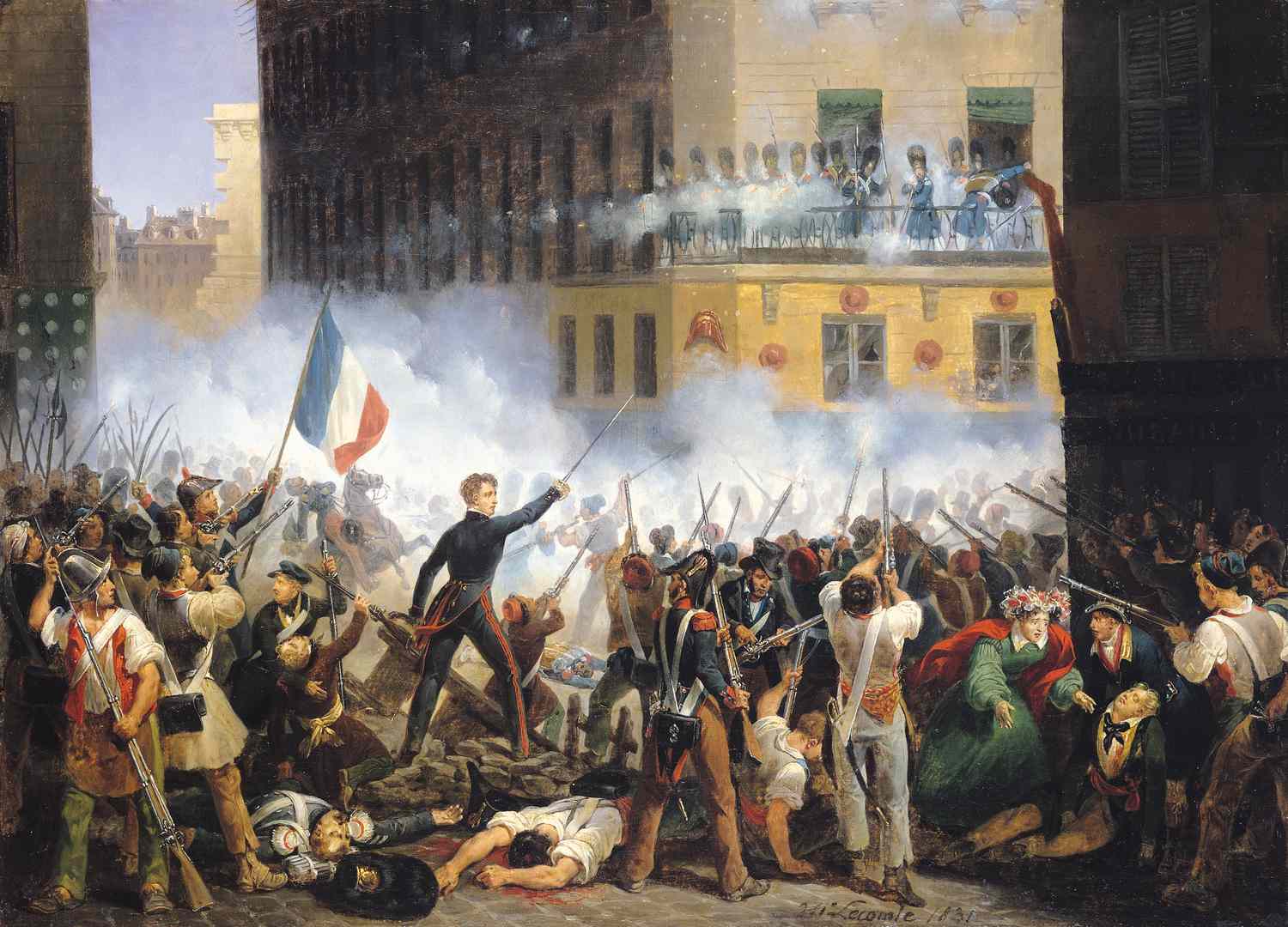
Vol 6: The French Revolution
The intricate tapestry of modern history is not a haphazard collection of events but a definite historical process, shaped by a distinct philosophical and, indeed, theological undercurrent.
This underlying "theology" of revolution, with its own dogmatic structure, subtly infiltrates and transforms every facet of human existence, profoundly moulding the course of history. It is a grave error to perceive modern history as merely a chance interplay of conflicting forces; a definite pattern and philosophy are unmistakably at work.
The Genesis of the Revolutionary Mindset
The French Revolution stands as the initial profound manifestation of these modern revolutionary doctrines. It demonstrates the deliberate application of rationalistic concepts to fundamentally alter society and the established order of life.
A careful study of this epoch reveals that its acts were not incidental but the necessary outcome of underlying principles and systems, forming a continuous thread throughout revolutionary events - a "devouring sect" aimed to subvert existing structures, extending its conspiracies across nations.
Central to this revolutionary mind is the rejection of divine revelation and tradition, supplanted by an exclusive reliance on human reason and individual feelings as the ultimate arbiters of truth.
This abandonment of established spiritual foundations, I believe, opens the floodgates for destructive forces, suggesting a sinister inspiration behind revolutionary outbursts. The relentless exaltation of reason, a process originating even in Scholasticism, inexorably leads to its own undoing, steadily eroding long-held beliefs.
A key figure in preparing the ground for this upheaval was Voltaire, who famously dedicated his life to the destruction of Christianity, coining the phrase "Ecrasez l'infâme" ("blot out the infamous thing") to refer to the religion of Christ, which he sought to replace with Deism.
The Architects of Universal Revolution: The Illuminati
It is crucial to understand the emergence of groups like Illuminism, founded on 1 May 1776 by Adam Weishaupt. Weishaupt, though professing to despise the Jesuits, admired their organisational efficiency and adopted their methods for diametrically opposed ends: to destroy altars and empires.
The Illuminati's core tenets were shockingly radical:
- Abolition of Monarchy and all ordered Government.
- Abolition of private property.
- Abolition of inheritance.
- Abolition of patriotism.
- Abolition of the family -(including marriage and morality, instituting communal education of children).
- Abolition of all religion.
This programme, it is evident, was unprecedented in civilised history, aiming to destroy everything upon which civilisation rests. The Illuminati employed deception and secrecy, initiating novices step-by-step into "higher mysteries," where the true, anti-religious aims were revealed.
Christ Himself was deceptively portrayed as the "first author of Illuminism," whose mission was to restore original liberty and equality, encouraging the community of goods. Their infamous maxim, "the end justifies the means," explicitly guided their actions.
A pivotal moment was the Congress of Wilhelmsbad in 1782, where Illuminism and Freemasonry forged an alliance, with the Illuminati taking the lead among their three million members worldwide. The "tragic secrets" revealed at this congress, according to one honest Freemason, Comte de Virieu, indicated a conspiracy so well-conceived that it would be "impossible for the Monarchy and the Church to escape from it".
Bavarian authorities, upon seizing Illuminati documents in 1785, exposed their "diabolical nature," revealing plans for poisons, counterfeiting, and widespread discord, aiming to "rule the world".
Napoleon: The Revolution's Executor
Napoleon Bonaparte, despite bringing order to the chaos, was himself a fateful executor of a command unknown. He saw the Revolution as having a "moral regeneration" effect, believing its "sublime truths" would become the religion of all nations.
His preference for equality over liberty reflected the spirit of the times. His aspiration for a universal monarchy, even dreaming of being proclaimed a god, clearly marks him as a forerunner of Antichrist. The entire revolutionary trajectory, from the rights of man to massacres and the ambition of a world ruler, is, in my view, a rehearsal for a future kingdom of this world.
The Enduring Force of Revolutionary Ideas
Following Napoleon's demise and the superficial restoration of monarchies, these revolutionary ideas did not wane but grew increasingly potent, permeating the European intellectual class. The revolutionary movement, therefore, is not a self-contained historical event, but a continuing process of apostasy and the unfolding of a "Mystery of Iniquity" that has since penetrated deeply into the lives of people worldwide.
The progression from the Middle Ages through the Renaissance, Enlightenment, and Romantic Age to the present day follows a definite logical progression, demonstrating that once Orthodoxy is abandoned, a specific natural process unfolds, often influenced by the insidious work of the devil, whose inspirations are mistakenly perceived as revelations by those unaware of his subtle influence.
Vol 7: The Revolution in the 19th Century
The nineteenth century marks a crucial period in the unfolding of the pervasive theology of revolution, a distinct philosophical and theological current that continues to shape human history. Far from being a series of unconnected events, the age reveals a definite pattern and philosophy at work, illustrating how a profound shift in worldview inevitably leads to a cascading series of consequences.
The French Revolution, itself a prime example, had merely established the initial groundwork, and by this later era, revolutionary ideas had become deeply ingrained within the intellectual fabric of Europe, setting the stage for subsequent global transformations.
The Continuing Revolutionary Spirit
The early nineteenth century, contemporaneous with and following the French Revolution, saw the emergence of numerous conflicting revolutionary ideas. It is clear that the underlying dynamic was a shift from superficial political upheaval to a more profound, internalised transformation of the human soul.
This period, often termed Romanticism, represents a reaction against The Enlightenment's perceived one-sidedness, particularly its cold rationalism. However, while rejecting Enlightenment absolutism, Romanticism inadvertently retained many of its core tenets, re-casting them in an emotional, mystical, and often irrational guise.
There was a notable sympathy for the mediaeval past and the unique national character of various countries, a departure from the Enlightenment's internationalism. This era also witnessed a strong revival of Catholicism, albeit one imbued with a worldly atmosphere, alongside a significant upsurge in occultism. This illustrates a pervasive search for a new form of Christianity that could harmonise with the Enlightenment's philosophical legacy, effectively trying to improve upon the Christian faith by human efforts.
The Illusions of Utopian Socialism
The chiliastic dreams that had simmered beneath the surface of earlier revolutionary movements now found fertile ground in Utopian Socialism, manifesting as secular attempts to create an earthly paradise.
Robert Owen, for instance, experimented with industrial communities built on benevolent capitalism, such as New Lanark, which, despite its initial success, ultimately failed to provide the ideal environment he sought. His subsequent efforts, like the New Harmony community in America, further revealed a secular continuation of established religious communitarianism, even being influenced by spiritism. Owen’s vision was of a "science of man" that would lead to a perfect society, including the radical notion of ending the family system, a concept shared by other early socialists.
Charles Fourier, another prominent figure, held equally fantastic prophecies for the future, envisioning a world where the sea would turn into lemonade, humans would grow to colossal heights, and enjoy extended lives filled with free love. Though his attempts to establish communities based on his ideas quickly failed, his influence spread, even reaching figures like Dostoevsky.
Henri de Saint-Simon, a product of both the Old Regime and the Enlightenment, sought to apply scientific methods to social organisation. His disciples formed a hierarchically structured "Saint-Simonian church", promoting a "Religion of Humanity".
This movement, though initially focused on scientific and industrial interests, gradually developed a stronger religious and political emphasis. It notably advocated for the emancipation of women and free love, which ultimately led to internal schism and legal persecution.
Saint-Simon's "New Christianity" was a thorough attempt to complete the process initiated in the Middle Ages: the effort to improve Christianity through human endeavour, recognising that any new worldview must ultimately be religious.
The Futility of Western Conservatism
The period after Napoleon's overthrow in 1815 saw a concerted conservative reaction across Europe, exemplified by figures like Metternich and Edmund Burke. However, their attempts to resist the revolutionary tide were ultimately limited by their own underlying philosophical frameworks.
Klemens von Metternich, the leading statesman of the time, championed tradition and order, viewing revolutionaries as "presumptuous men" driven by egotistic theories. His contempt for "mob-democracies" and his faith in a "European society founded on Latin civilisation consecrated by Christian faith and embellished by time" highlight his profound reverence for the old order. Yet, his efforts were eventually swept away by the new wave of revolutions in 1848.
Edmund Burke, an earlier voice against the French Revolution, articulated sensible arguments against destructive innovation, advocating for a balance of preservation and improvement. He understood that "Rage and frenzy will pull down more in half an hour than prudence, deliberation and foresight can build up in a hundred years".
However, his English brand of conservatism, rooted in an Anglican tradition that had already departed from Catholicism, lacked a sufficiently deep, unchanging principle to resist the relentless logical progression of revolutionary ideas. Such a conservatism, I believe, was bound to evolve into something quite different, even utopian, over time.
Juan Donoso Cortes, a Spanish philosopher, offered a more profound critique, recognising that socialism was a system of theology - a satanic theology, because it offered definitive solutions to fundamental human problems, thereby usurping the role of true religion.
He saw Liberalism as merely a halfway house, lacking the dogmatic conviction of socialism. Cortes accurately predicted that the "ending of religious influence on politics," leading to an "Atheist revolution," would produce the "most gigantic and destructive despotism ever known", even foreseeing the rise of Antichrist in the coming century.
Joseph de Maistre, a radical anti-revolutionary, starkly rejected any compromise with the spirit of the eighteenth century. For him, the answer to revolution lay in the Pope and the executioner.
His absolute Catholicism, though rationalistic in its own right, led him to advocate for a new kind of rationalist absolutism – the infallibility of the Pope – a novel doctrine, in my view, developed specifically to provide a tangible standard against the revolutionary spirit. He critically observed that Russia, by missing the development of Western civilisation (which he believed had led to revolution), lacked the idea of universalism, symbolised by the Pope.
The Orthodox Russian Counterpoint
In stark contrast to the Western experience, the Russian tradition, embodied in its Tsars and thinkers like Dostoevsky, presented a unique and distinct anti-revolutionary stance, rooted deeply in Orthodox Christianity.
Tsar Nicholas I stands as an exemplary monarch of this tradition, an "autocrat" who reigned supreme without a constitution or parliament. His reign began with the Decembrist rebellion, an uprising inspired by revolutionary ideas, which he swiftly suppressed, not with weakness, but with a combination of boldness and Christian compassion. He famously told the rebels that "The law dictates punishment for them, and I will not make use of the right of mercy that belongs to me regarding them. I will be unwavering, I am obliged to give this lesson to Russia".
Yet, in private, his heart was filled with profound compassion, demonstrating that true authority does not preclude mercy, but applies it at the appropriate time to prevent societal harm. His piety, sense of duty, and unwavering faith, as revealed in his personal reflections and the observations of his contemporaries, paint a picture of a ruler profoundly aware of serving a higher purpose, viewing himself as a "splinter of wood" in God's hands.
Foreign observers also acknowledged the unique integrity of Russian diplomacy under Nicholas, contrasting it with the self-serving intrigues of Western powers. His death, marked by profound faith and a conscious absence of consciously committed evil, underscored his deep Orthodox conviction.
Tsar Alexander III, guided by the anti-liberal education of Konstantin Pobedonostsev, similarly resisted the siren song of liberalism after the assassination of his father, Emperor Alexander II.
Pobedonostsev powerfully urged him to "embark vigorously upon the matter of governance, hoping in Divine Providence, with faith in the power and truth of autocratic rule", declaring that only by fighting the "evil seed" of revolution with "iron and blood" could Russia be saved.
Alexander III's subsequent manifestos echoed this resolve, proclaiming that the "voice of God commands us to embark vigorously upon the matter of governance" and to uphold "autocratic rule" for the good of the people.
Fyodor Dostoyevsky, a figure of immense significance, offers the most profound insight into the revolutionary mentality. Having himself been "deeply infected by revolutionary disease" in his youth, participating in Fourierist discussion groups, and even facing a death sentence commuted to Siberian exile by Nicholas I, his personal experience transformed him into a staunch "Tsarist, Orthodox Christian". His literary masterpieces, such as The Possessed and Crime and Punishment, dissect the psychological and spiritual roots of revolution.
In The Possessed, the character of Shigalov articulates a chilling vision of absolute despotism arising from "unlimited freedom," proposing the division of humanity into a privileged "one-tenth that enjoys absolute liberty and unbounded power over the other nine-tenths" who are reduced to a herd through boundless submission. This "earthly paradise" is presented as the only possible solution, even if it entails "cutting off a hundred million heads", a notion terrifyingly echoed by the novel's characters.
The ultimate goal is the deliberate lowering of the level of education, science, and talents to achieve complete equality through slander and murder and the stifling of every genius in its infancy.
This is the essence of Shigalovism: "Slaves are bound to be equal. There has never been either freedom or equality without despotism, but in the herd there is bound to be equality. Kirillov, another character, exemplifies the terrifying conclusion of Nihilism, asserting that if there is no God, "I must be god, and therefore, I must kill myself to prove absolute self-will and new terrible freedom". This self-worship, when carried to its logical extreme, culminates in self-destruction.
In Crime and Punishment, Raskolnikov embodies the Nietzschean idea that "if there is no God, then everything is permitted". He seeks to transcend conventional morality and become a "Superman" by committing murder, viewing his victim as a "hateful," "insect-like" creature. However, Dostoevsky masterfully reveals the inescapable operation of conscience, showing that the human spirit, imbued with a Christian understanding of good and evil, cannot find peace or freedom through such acts. His eventual repentance, influenced by the Orthodox faith embodied in Sonya, points to the only true path to regeneration.
The Grand Inquisitor episode in The Brothers Karamazov represents, in my understanding, Dostoevsky's most profound analysis of this revolutionary "theology." Ivan Karamazov's "poem" depicts Christ's return to Earth and His immediate arrest by the Grand Inquisitor, a figure who asserts that the Church has "corrected" Christ's work by relieving humanity of the burden of freedom, which men feared and could not bear.
The Inquisitor contends that Christ rejected the three temptations of the devil – turning stones into bread (material security), performing miracles (supernatural authority), and accepting "all the kingdoms of the earth" (universal power) – thereby offering humanity a freedom it did not desire. Instead, he claims, the Church has taken these powers – miracle, mystery, and authority – to provide happiness and unity, even if it means deception and control. This system of theology is ultimately a satanic theology, creating a counterfeit paradise of earthly happiness without God, a "universal state" where mankind is reduced to a "unanimous ant-heap".
The Grand Inquisitor argues that man "seeks not so much God as the miraculous," and if denied true miracles, will create "new miracles of his own" and worship "deeds of sorcery and witchcraft". This chilling portrayal, I believe, directly prefigures the totalitarian systems of the twentieth century and the underlying drive to achieve a unified, controlled world without divine intervention.
Thus, the nineteenth century, in its Romantic and Socialist movements, further developed and secularised the chiliastic impulse, while its conservative thinkers, though astute, largely failed to grasp the deeper, theological roots of the revolution. It was in Russia, particularly through the spiritual and intellectual struggle of its Tsars and the profound insights of Dostoevsky, that the true nature of this ongoing "Mystery of Iniquity" was most acutely perceived and articulated.

Vol 8: Meaning of Revolution
The Genesis of Modern Revolutionary Thought: Romanticism and Early Socialism
The French Revolution, while outwardly appearing as a pursuit of liberty and equality, in reality reflected the frivolous and vain nature of the French people.
Its prominent figures, from heroes to ordinary activists, behaved like actors on a stage, concerned solely with how their contemporaries and descendants would perceive them. They engaged in orgies on the eve of their executions as a fabricated display of manliness, and many even sought to be painted in the carts taking them to the guillotine, treating it as their final "scene". This profound judgment reveals that these revolutionaries lacked any true sense of responsibility before God, history, or their own conscience. The shallow and posing character observed in these early revolutionary agents continues to manifest in those of the nineteenth century.
The revolution is not an aimless sequence of events; it is the fundamental historical process that has shaped the modern world. Those caught within its currents often act as puppets, driven by a senseless fever without comprehending the true origin or ultimate destination of their actions. Ultimately, they serve merely as "manure" for the revolution's progression. To understand this phenomenon deeply, one must delve into the underlying ideas and philosophies that animate it.
The nineteenth century emerged as an unprecedented age of egotists, where individuals, brimming with a profound sense of freedom, endlessly proposed new, fantastic theories, often presenting them as personal revelations. The core ideas of this revolution can be discerned by examining Communist ideas, the dominant revolutionary force of today, and the broader philosophical and spiritual landscape of the contemporary world.
This period, spanning the late eighteenth and early nineteenth centuries, is fundamentally the Age of Romanticism. Romanticism marked a decisive rejection of the Enlightenment's emphasis on reason, humanitarianism, and cold, logical deductions, criticising their inherent one-sidedness. However, it often retained many of the Enlightenment's more positive aspirations, such as humanitarian ideals and opposition to absolutism.
From Jean-Jacques Rousseau, Romanticism inherited an irrational and sentimental approach to religion, fostering a profound sympathy for mysterious elements and mysticism, albeit often confined to the earthly realm. This era also saw a renewed appreciation for the Middle Ages and national histories, a direct counterpoint to the Enlightenment's internationalist outlook.
Alongside a notable revival of Catholicism, there was a concurrent surge in occultism. Crucially, this period witnessed a widespread quest for a "new Christianity" – a spiritual framework that could harmonise with the positive aspects of Enlightenment philosophy while discarding its anti-Christian and atheistic tendencies. This search for a "new Christianity" was deeply intertwined with a chiliastic mentality – the belief in a coming golden age or perfect society on Earth. This is evident in the works of several influential Utopian socialists:
Novalis, the German Romantic poet, embodied this chiliastic vision, anticipating a future where European states would achieve an intimate and varied connection," ultimately forming a single, unified entity.
Robert Owen, an early utopian Socialist, derived his ideas from the communitarian principles of millennial religious sects like the Shakers and Rappites. His New Harmony experiment sought to establish an idyllic agricultural commune that included radical social changes, such as the abolition of the family system. Owen aspired to create a "science of man" and was notably influenced by spiritism.
Charles Fourier proposed a new societal organisation that included the abolition of the family and made extravagant prophecies of an earthly paradise. His visions included phenomena like the sea turning into lemonade, humans growing to seven feet tall and living to 144 years, and the prevalence of free love. He even imagined a future with thirty million scientists as great as Newton and thirty million poets as great as Shakespeare.
Saint-Simon, a transitional figure influenced by both the Old Regime and the Enlightenment, developed ideas centred on the scientific method, industrialism, and the application of science to social organisation.
His concept of a "New Christianity" promoted a religion of human fraternity. Saint-Simonianism evolved into a hierarchically structured church with a pronounced religious and political focus, foreshadowing Auguste Comte's "Religion of Humanity".
This movement gained substantial traction across Europe, attracting over 40,000 adherents. However, it fractured due to a schism over the "question of woman," with a radical faction advocating free love and viewing the "emancipation" and "sanctification" of the flesh as the culmination of history.
Saint-Simon profoundly understood that any new world view must be fundamentally religious, proposing a synthesis of politics, science, and religion as essential, a insight that highlighted the inherent flaw in Marxism's irreligious approach. His "New Christianity" represented a comprehensive effort to "improve upon Christianity" itself.
Vol 9: Revolution
An Unfolding of Apostasy
The history of the modern age is not merely a sequence of random events, but a purposeful, definable process, often termed "the Revolution". This profound historical trajectory, particularly prominent since the Schism of Rome, represents a departure from ancient Christianity and an unfolding of the "Mystery of Iniquity". It is a continuous, universal movement with a discernible philosophical and theological undercurrent, leading to a world increasingly estranged from God.
The Philosophical Genesis of the Revolutionary Mind
The seeds of this modern mentality were sown in the High Middle Ages with Scholasticism, which inadvertently initiated the process of subordinating Christian teaching to logic.
This shift, observed by Kireyevsky, placed reason above faith and tradition, reducing living faith to a systematic framework and fostering a human-centric approach to truth. The Renaissance, marked by a "rebirth of antiquity" and the rise of Humanism, further solidified man's displacement of God as the criterion of truth.
This period witnessed a striving for individual fame and greatness, independent of moral consequence, reflecting a "demonic" ambition. Protestant Reformation, though ostensibly a rebellion against Roman Catholicism's complexities, was fundamentally part of the same rationalistic movement, seeking a simpler Christianity interpretable by individual reason.
The Enlightenment brought this rationalisation to its zenith, subjecting religion itself to the standard of reason. Religious belief was simplified, stripping away complex dogmas such as transubstantiation and the Trinity, retaining only a few "reasonable" articles of faith like God's existence, morality, and an afterlife. Deism became the characteristic religious view of the 18th century, conceiving of God as a remote "Grand Architect" who created the universe but then withdrew, rendering miracles and prophecy irrelevant.
Figures like Diderot and Voltaire vehemently rejected traditional Christianity, advocating for a "natural religion" based on common sense and the "great book of Nature". David Hume, a pivotal figure, conclusively demolished the concept of miracles through rational argument, asserting that the falsity of a witness was always more probable than a violation of natural laws.
The relentless advance of reason, once unleashed, proved unstoppable, progressively dismantling faith until only an extreme subjectivism remained, epitomised by Kant, where the individual became the creator of their own universe, leaving no room for objective truth.
Beyond overt philosophical trends, the revolutionary spirit was deeply influenced by chiliasm, the expectation of an earthly paradise, which began to permeate secular thought. Movements like the Brethren of the Free Spirit proclaimed a new age of the Holy Spirit where individuals were divine and immune to sin. The Taborites in the 15th century, advocating Communism, sought a return to a golden age of equality, foreshadowing later revolutionary movements.
The French Revolution: The First Great Outburst
The French Revolution, beginning in 1789, served as the first major manifestation of these modern ideas in the public sphere. It was not a spontaneous uprising but a meticulously planned event, orchestrated by various interconnected forces. The revolution aimed to overthrow the "altar, throne, and civil society".
Secret Societies played a crucial role in this orchestration. Freemasonry, initially conceived in England as a brotherhood of goodwill, became radicalised on the Continent. Illuminism, founded by Adam Weishaupt in 1776, adopted Jesuit methods to achieve diametrically opposed goals: the abolition of monarchy, private property, patriotism, the family, and all religion. Weishaupt declared that "the end justifies the means" and advocated "pious fraud" to deliver humanity from religion. Christ himself was reinterpreted as an Illuminist.
The Jacobins, effectively the public face of Illuminism, were a highly organised party that seized control, implementing policies agreed upon beforehand in secret. They deliberately employed violence and terror, including planned massacres and depopulation, to advance their agenda. The concept of "The Great Fear", where false rumours of brigands incited the populace to arm against law and order, exemplifies this calculated agitation.
The Revolution also engaged in a profound de-Christianisation, replacing traditional religious ceremonies with secular festivals honouring "Reason" and "Liberty". Churches were desecrated and repurposed as "Temples of Reason," symbolising the triumph of an abstract mind over sacred truth.
Napoleon Bonaparte emerged as the "fateful executor of a command unknown," giving order to the chaos but fundamentally embodying the Revolution's spirit.
He sought to consolidate a universal monarchy, aiming for a "religion of all nations" based on revolutionary principles, and even convened the Jewish Sanhedrin to proclaim him emperor, thereby serving as a forerunner of Antichrist. His belief that "liberty is the need of the few elect... but equality is pleasing to the majority" reveals a profound revolutionary insight.
The Nineteenth Century: Evolution of Revolutionary Thought
After Napoleon's defeat, the "Restoration" of 1815, represented by figures like Metternich, attempted to re-establish traditional order. However, revolutionary ideas persisted, deeply embedded in the "spirit of the age". The 19th century witnessed a complex interplay of revolutionary zeal and conservative reaction.
Romanticism emerged as a counter-movement to Enlightenment rationalism, valuing feeling, mystery, and a renewed interest in the Middle Ages and occultism. This era saw the search for a "new Christianity" that would harmonise with Enlightenment philosophy while rejecting its excesses.
Utopian Socialists such as Robert Owen, Charles Fourier, and Henri de Saint-Simon, while seemingly disparate, continued the chiliastic impulse of the Revolution.
Owen envisioned secular communal living, believing in a "science of man" and advocating for a radical reorganisation of society, including the end of the family system. Fourier dreamed of an earthly paradise, where human passions would be indulged to achieve harmony, predicting fantastic transformations of the world.
Saint-Simon, whose disciples later formed a "church" and advocated for the "sanctification of the flesh," saw the necessity of a new world-view that synthesised politics, science, and religion, consciously seeking to "improve on Christianity".
Conservative thinkers attempted to resist this revolutionary tide. Edmund Burke championed preservation and gradual reform, arguing against the destructive innovation of the revolutionaries. However, his English conservatism was ultimately limited by its own historical and religious context, unable to offer a universal, unshakeable principle against the encroaching revolutionary spirit.
Juan Donoso Cortes, a Spanish thinker, uniquely perceived the Revolution as fundamentally "theological," a "satanic theology" that directly opposed God. He foresaw that the abandonment of religious influence in politics would inevitably lead to unprecedented despotism and the advent of Antichrist.
Joseph de Maistre, an extreme anti-revolutionary, advocated for the Pope and the executioner as the means to combat the Revolution's spirit. His rigid rationalism, however, led him to an absolutism of the Pope, contributing to the novel doctrine of Papal Infallibility, a defensive innovation against the revolution that was itself a departure from ancient Christianity.
In stark contrast to these Western figures, the Russian Tsars Tsar Nicholas I and Tsar Alexander III stood as bulwarks against the revolutionary current, rooted in Orthodox tradition.
Tsar Nicholas I, despite facing revolutionary ideas among his own officers, demonstrated profound Christian compassion mixed with unwavering strictness necessary to maintain order. He saw his role as serving God, not self, and recognised the deep-seated spiritual illness that drove revolutionary movements.
This Russian anti-revolutionary stance, uncorrupted by Western rationalistic compromises, stemmed from a unique Orthodox worldview.
Dostoyevsky, a former radical who experienced the "revolutionary disease" firsthand, provided unparalleled insights into the revolutionary mentality. In The Possessed, he vividly portrays the logic of Nihilism which, starting from "unlimited freedom," inevitably leads to "unlimited despotism," where genius is suppressed and humanity reduced to a compliant "herd".
His novel Crime and Punishment explores the "Superman" ideal, demonstrating the futility of attempting to live "beyond good and evil" as the conscience, divinely implanted, cannot be silenced by rationalistic thought.
Most profoundly, in The Brothers Karamazov, the "Legend of the Grand Inquisitor" reveals how a distorted Western Christianity, having sacrificed freedom for control through "miracle, mystery, and authority," becomes a precursor to the Antichrist. Ivan Karamazov's poignant rejection of a "higher harmony" that would demand the suffering of innocent children exposes the moral bankruptcy of revolutionary utopianism.
From Theory to Totalitarianism: The Twentieth Century
By the late 19th and early 20th centuries, revolutionary theories progressed from abstract ideals to ruthless, bloody implementation. Marxism, evolving into "scientific socialism," posited a "dialectical materialism" that gave its adherents an unshakeable confidence in their historical inevitability.
It fostered class warfare, advocating for the "alteration of men on a mass scale" through violent revolution, with the explicit goal of creating a "new man" devoid of past "muck".
Anarchists like Mikhail Bakunin openly embraced "implacable destruction" as a "creative passion," seeing the proletariat as "the modern Satan" destined to overthrow the old order.
His disciple, Sergei Nechayev, epitomised ruthless Nihilism, advocating for deception, espionage, and the severing of all personal ties to serve the revolutionary cause.
Pierre-Joseph Proudhon, while contributing the famous phrase "Property is theft," proclaimed the revolution to be "anti-theistical," eliminating God and consciously embracing Satanism. He even suggested maintaining the outward rites of Catholicism while imbuing them with revolutionary meaning, foreshadowing the convergence of socialism and certain religious forms.
The controversial document, The Protocols of the Learned Elders of Zion, is highly symptomatic of this revolutionary philosophy. It details a plan for absolute ruthlessness, control of information and finance, depopulation, and the establishment of a "one king over all the earth" who would unite nations under a universal super-government. This document, notably, posits atheism as a transitional stage towards a "new religion" of the "One God" and the "Chosen People".
The 20th century saw the full, horrifying realisation of these ideas in Totalitarian systems like Bolshevism and Nazism. Bolshevism, under Marx and Lenin, achieved an unprecedented scale of destruction, leading to tens of millions of deaths and demonstrating the revolutionary desire to create a "new man" by any means necessary.
Hitler and the National Socialists was fundamentally Bolshevism adapted to a racial rather than a class war, aiming for a "Thousand Year Reich". These regimes, rooted in the destruction of traditional values and the worship of power, embody the "demonic" aspect of the revolutionary drive.
The New Religion and the Coming of Antichrist
The relentless progress of Rationalism, culminating in Hume's and Kant's philosophies, ultimately led to the "death of God" as a cultural phenomenon. This is a poetic expression for apostasy, signifying the abandonment of Christianity and the irruption of demonic forces into human affairs.
As traditional knowledge and objective reality dissolve, man is left with only his self-awareness, leading to the worship of the "Self". This manifests in movements like the human potential movement, which posits humanity as inherently good with unlimited potential, seeking self-transformation from within.
The void left by discarded faith is increasingly filled by a "new revelation". This includes a resurgence of spiritualism and occultism, where "mystery" re-enters the secularised world, often under a scientific guise.
Movements like Christian Science, Seventh-Day Adventism, and the Hare Krishna movement exemplify new religions based on individual revelations or self-deification, adapted to a self-centred, sensuous mentality.
The ultimate culmination of the revolutionary process is the coming of Antichrist. This figure, as foreseen by Soloviev, will be a universal monarch offering a deceptive peace and unity to a humanity weary of chaos.
He will reconcile conflicting ideologies and religions, presenting a "new Christianity" that appears all-embracing but is, in reality, a profound deception, ultimately leading to the "suicide of reason" and the transformation of the "Superman" into the "sub-man". The consistent thread throughout modern history reveals a deliberate, patterned apostasy, preparing the world for this final, anti-Christian reality. Therefore, understanding this profound process is essential for true Orthodox self-defence.
Vol 10: The New Religion
The period following The Enlightenment, marked by a profound crisis of knowledge, ushered in a new era where the pursuit of truth underwent a radical redefinition.
As rationalism, exemplified by thinkers like Hume, systematically dismantled traditional certainties, it eventually led to the destruction of all objective knowledge, even concerning the external world.
Hume concluded that all that can be known are "impressions" and "matters of fact". This philosophical trajectory left a vacuum, as the external world became unknowable "in themselves", and all knowledge dissolved into subjective perceptions. This despair at ever being able to know anything objective prompted a search for new foundations.
This intellectual shift, which began to take hold from the mid-19th century onwards, resulted in a chilling realisation: if external reality is unknowable, the last hope for knowledge resides in self-awareness.
This is precisely what Kant achieved, orchestrating a "Copernican revolution" by positing that the world revolves around the mind, not the other way around. Knowledge, therefore, became possible only as reality appeared to the individual mind, organised by its innate categories. This profound subjectivism penetrated deeply into philosophy and religious thought.
The Rise of the Self as God and the Death of God
In this new intellectual landscape, a new deity began to form: the Self. The world, previously revolving around God, now commenced its orbit around the individual self. This fundamental reorientation gave rise to the pivotal concept of the "death of God".
The phrase "God is dead" first appeared in the early 19th century in the writings of Josef De Maistre, used to articulate the immense rebellion against God during the French Revolution.
He observed that those rebelling against society, Christianity, monarchy, and God were philosophically rooted in the idea that "God is dead" and were seeking to create a new god. This signified the dying of Christianity and the birth of a new religion.
Later in the century, Nietzsche, a key figure in this intellectual development, gave this idea its most potent expression. Nietzsche, perceiving Christianity as a doctrine of weakness and a "herd mentality," believed it failed to satisfy either the rational mind or the emotional heart. He concluded that Christianity was a "monstrous farce," full of superstition and unable to provide genuine truth or emotional fulfilment.
A direct consequence and corollary of the "death of God" is the radical notion that "everything is permitted" . As Nietzsche declared, "There is no God: therefore everything is permitted". This very idea was also expressed by Ivan Karamazov in Dostoevsky's novel, stating, "If there is no immortality, everything is permitted".
This means that with the absence of God and objective truth, a completely new order of the universe emerges, paving the way for the irruption of demons into man's world. Traditional morality and values are dismissed as belonging to a bygone era, with the proponents of this new outlook seeing themselves as the "first-fruits" of a new human transformation, entitled to act as they please.
The Superman and the Transformation of Human Nature
Central to this emerging "new religion" is the concept of the Superman and the transformation of human nature. This belief posits a fundamental change in human essence, transcending traditional notions of morality and values.
Figures such as Teilhard de Chardin exemplify this idea within a so-called "Christian evolutionist" framework, suggesting a continuous evolution of man towards a higher state, often termed the "Omega Point". This vision implies that the individual is no longer concerned with merely saving their soul but participates in a natural process of universal evolution .
This belief in the divinisation of man and the world is a critical aspect of the final deception of the devil. It manifests in a pantheistic view where matter itself is considered divine, and the world is seen as an "alive breathing of God".
This outlook invests the world with a spiritual significance it cannot possess from an Orthodox perspective, which holds that the world was created from nothing and will ultimately vanish, to be recreated by God.
Manifestations in Art, Spiritualism, and New Cults
The profound shifts in philosophical and religious thought are vividly reflected in modern art and music. The absence of a dominant style in 19th-century art, with new styles emerging every decade, is indicative of a lack of common belief in society.
These artistic movements, from Futurism to Surrealism, are seen as a "flight from the higher reality" and expressions of underlying forces that deny human nature.
Modern religious art, in particular, becomes a vehicle for an entirely different religion, portraying saints "as he is on earth" rather than as they are in heaven.
Furthermore, the failure of rationalism to provide answers led to a resurgence of spiritualism and occultism. These phenomena offer a perceived "spiritual reality" that becomes attractive to a society suffering from a spiritual sickness. However, this engagement with "otherworldly" phenomena is not true mysticism or a genuine connection with God; instead, it is interpreted as contact with demonic forces.
Such spiritual experiences thrive in an environment where belief in traditional Christianity has diminished, and the distinction between divine and demonic phenomena has blurred. This is seen in the development of "parapsychology" in some countries, aiming to exploit extra-sensory perception.
This period also witnessed the proliferation of new cults and Eastern influences. Movements like Mormonism, Christian Science, and Seventh-Day Adventism are rooted in the idea of individuals receiving new revelations, acting as if they themselves are gods.
Hindu-influenced groups like the Hari Krishna Movement exemplify the fusion of self-centred Western philosophy with Eastern concepts where the self can become divine through meditation and chanting. These movements, with their emphasis on sensuous experiences, exotic costumes, and self-centred gratification, are seen as being adapted to the specific "needs" of modern Western mentality.
Chiliasm and the Revolutionary End-Goal
Underlying these diverse manifestations is a powerful chiliastic impulse, the expectation of a new age or millennium on Earth. This idea is not new, tracing back to Joachim of Flores' concept of the "Third Age of the Holy Spirit" in the 13th century, which became the foundation of modern philosophies of progress and the New Age movement.
This secularised chiliasm, whether expressed as a "religion of reason" in the Enlightenment or the "religion of humanity" in later thought, views history as progressing towards a definitive consummation within historical time .
The goal is to found a "Republic of the Equals" or a "new golden Period, with heavenly features", where society is fundamentally transformed, and older forms of Christianity are deemed imperfect or superseded.
This vision often involves the abolition of traditional institutions, such as the papacy, clerical hierarchy, and even sacraments, in favour of a direct spiritual order. This aspiration for a "new Christianity" that improves upon the Christianity of the Holy Fathers, given by Christ, is a central driving force.
Forerunners of the Antichrist and the Universal Monarchy
The culmination of this "new religion" is the appearance of forerunners of the Antichrist. These figures, such as John of Leyden, Napoleon, and Hitler on WW1, are seen as setting themselves up as a "new Christ" or universal rulers. The ideal of a world monarchy or world theocracy, though sometimes an underground current, steadily gains strength, capable of moving entire populations.
This ultimate "new religion" is not atheistic in its final form; rather, Atheism is merely a transitional stage to discard previous religious views. The goal is to establish a one-world religion centred on a singular, powerful leader who will offer universal peace and happiness.
This figure, the Antichrist, will present a substitute for Christianity that denies its very essence. The ultimate outcome, as depicted in prophetic visions, is a world where humanity, having abandoned God and truth, faces extreme suffering and chaos, leading them to embrace a new leader who offers an illusion of peace and order, in what is effectively a dictatorship under the guise of an earthly paradise. This leads to the absolute loss of individuality, with humanity becoming a "herd" under an "unlimited despotism," believing they have found perfect freedom.
Vol 11: Evolution
Evolution: A Central Dogma of the Modern Age
Evolution stands as a key concept of our times, an exceedingly intricate idea that permeates both religious and secular thought, serving as a central dogma for advanced thinkers and those attuned to the contemporary spirit. It is, fundamentally, a philosophical question, not merely a scientific one, influencing how individuals interpret the very nature of existence.
Historical Foundations and the Shift from a Static Worldview
Prior to the rise of evolutionary thought, The Enlightenment period generally upheld a stable view of nature. This perspective, exemplified by calculations dating the world's creation to 4004 BC, conceived of God creating the world in six days, leaving all species as they appear today. However, as the 18th century drew to a close and a revolutionary fever emerged, this stable worldview began to fragment.
Early inklings of various Theory of Evolution (theories) emerged, such as Erasmus Darwin’s hypothesis of all life originating from a single primordial filament, a concept strikingly similar to modern evolutionary theory. Lamarck also proposed an evolutionary theory based on the inheritance of acquired characteristics, though this was later disproved.
A more significant impetus came from Charles Lyell’s theory of Uniformitarianism in the early 19th century. This theory posited that geological changes occurred not through catastrophes but through continuous processes at the same rate over vast spans of time. This concept, though a mere hypothesis lacking proof, paved the way for the idea of an Earth far older than a few thousand years, mentally preparing society for Darwin's later ideas.
In 1859, Charles Darwin's _Origin of the Species_ introduced the influential concept of natural selection. This idea, which suggested that variations within species allowed some to survive and reproduce while others perished, resonated profoundly with the consciousness of the era. It gained acceptance not necessarily because it was definitively proven, but because the intellectual climate was already primed to receive it.
Examining the "Proofs" of Evolution
When scrutinising the purported "proofs of evolution," one finds that many of them rely more on a pre-existing philosophical conviction than on conclusive scientific evidence.
- Morphology and Comparative Anatomy: Similarities in the skeletal structures of diverse creatures – such as wings, flippers, and human fingers – are often presented as evidence. However, these similarities can equally be interpreted as a basic master-plan of creation by God, where creatures share a common design. Such evidence, therefore, offers no definitive proof either for or against evolution.
- Comparative Biochemistry: The likeness in blood crystals or other biochemical components across species is also cited. Yet, like morphological similarities, this can be seen as evidence of God creating similar creatures with similar biological characteristics. Calculations based on these similarities for dating evolutionary divergence are controversial and can conflict with other dating methods.
- Comparative Embryology: The "gill-slits" observed in human embryos were once a powerful argument, suggesting a recapitulation of ancestral forms. However, modern evolutionists themselves no longer accept this theory, recognising these structures as developmental preparations for the human neck, rather than remnants of fish-like ancestors. This "proof" has largely been discarded.
- Vestigial Organs: Organs like the human appendix, which appear to have no current function, have been considered leftovers from earlier evolutionary stages. Yet, as research progresses, more and more of these organs are found to have subtle uses, demonstrating that a lack of immediate understanding of an organ's function does not prove it is vestigial.
- Paleontology and Fossils: The geological strata, with seemingly more primitive creatures found in lower layers, provides a framework for evolutionary interpretation. However, this evidence is not without flaws: new creatures frequently appear quite suddenly in strata with no intermediary types.
Furthermore, advanced animals are occasionally found in geological layers where they "should not be" according to evolutionary timelines, such as advanced squid in pre-Cambrian levels. The rarity of fossilisation also suggests that conditions must be very specific (e.g., sudden burial), arguing against a purely gradual process.
Darwin himself was greatly troubled by the conspicuous absence of the millions of intermediary species his theory predicted. Moreover, many ancient species remain exactly the same as living ones, while others are theorised as "reprobate" species that simply didn't evolve.
Artistic interpretations, such as the bent posture of Neanderthal man, often inject subjective philosophical ideas rather than objective scientific proof. Startling discoveries, like human and dinosaur tracks found together in Texas, directly challenge the established evolutionary timeline, forcing evolutionists to either deny the evidence or invent ad-hoc explanations.
- Mutation: Serious scientists concede that the primary "proof" for evolution lies in mutations. However, it is explicitly acknowledged that the origin of new species through mutation is a matter of "scientific faith," not strict knowledge. Laboratory experiments, even after decades, have only produced varieties within an existing species (e.g., a fruit fly with no wings is still a fruit fly) and have not created new creatures.
Critically, 99% of mutations are harmful, and all experiments indicate a stability of species rather than a continuous transformation. Ultimately, there is no conclusive scientific proof for evolution, nor is there conclusive proof against it, as its acceptance often hinges on philosophical presuppositions.
- Dating Systems: Systems like radio-carbon, potassium-argon, and uranium decay are presented as proving the Earth's immense age. However, these dating systems were developed to fit an already accepted, pre-existing view that the Earth was millions or billions of years old, rather than revolutionising dating.
They rely on assumptions, such as uniform decay rates and no contamination, which must be taken on faith. Carbon-14 is only reliable for a few thousand years, and other systems are imprecise for shorter geological timescales. The Earth's age, whether billions or thousands of years, remains dependent on initial suppositions rather than definitive scientific proof.
The Philosophical Undercurrents of Evolution
Evolution is not merely a scientific theory; it is a philosophical construct that has profoundly shaped modern thought. It introduces a new scale of values, where concepts like "modern," "up-to-date," "advanced," and "progressive" are inherently positive, while "antiquated" or "outgrown fossil" are terms of disdain. This perspective bolsters humanistic and naturalistic worldviews.
From an evolutionary standpoint, humanity is seen as _ascending_ from savagery, often depicted as ape-like creatures, which directly contradicts the Orthodox understanding of man's Fall from paradise.
This framework leaves no room for Adam's supernatural state or a "paradisaical" existence. Attempts to reconcile Christianity with evolution frequently lead to compromising Christian tenets, often reducing biblical narratives like the Fall to mythical or symbolic expressions of "cosmic immaturity".
The idea of polygenism – that humanity originated from multiple pairs – arises from efforts to fit Christian theology into an evolutionary model.
Furthermore, evolution, particularly in its philosophical aspect, is seen as a "naturalistic heresy". It posits a single, evolving material continuum throughout creation, thereby dissolving the concept of distinct, fixed "kinds" or species.
This perspective blurs the natural distinctions between the rational, irrational, sentient, and insensate, negating the traditional hierarchy of beings. This specific error, absent in ancient heresies, is a unique characteristic of modern thought.
The Orthodox Counter-Narrative of Creation
In stark contrast to evolutionary philosophy, Orthodox teaching presents a clear and detailed understanding of creation that cannot be reconciled with evolutionary theory.
The Holy Fathers consistently teach that creation was a unique event, distinct from the ongoing laws of nature. The six days of creation were literal 24-hour periods, a point affirmed by Holy Fathers like St. Ephraim the Syrian and St. Basil the Great. Man was created on the sixth day and placed into an already prepared world, directly formed by God's hand from the dust, not evolved from lower creatures.
The soul and body of man were created simultaneously, rejecting any notion of a pre-existing body awaiting ensoulment. Attempts to "add God" to evolutionary theory ultimately fail to resolve its inherent scientific difficulties or reconcile its philosophical contradictions with Christian doctrine. Holy Fathers also clearly distinguish between literal and figurative interpretations of Genesis, condemning attempts to allegorise passages that would destroy faith.
"Christian Evolutionists" and their Deviations
Several "Christian evolutionists" have attempted to bridge the gap between Christian theology and evolutionary theory, but their efforts ultimately lead to profound deviations from Orthodox Christianity:
- Lecomte du Nouy: A scientist who considered man's concept of God a "formidable fiction," viewing Christianity as a mere "useful tool" for the moral and ethical evolution of the human race, devoid of objective truth. He believed evolution continued on a "spiritual and moral plane" towards a "superior race" and interpreted Genesis as a "highly symbolical and cryptic description of scientific truths". His "Omega Point" represents a chiliastic new age rather than salvation.
- Fr. Anthony Kosturos: An Orthodox priest who suggested humanity's origin is an unknowable "mystery" and that "man appeared in clusters" (polygenism), allowing for "speculation" on such matters. This contrasts sharply with the patristic teaching of a singular Adam and Eve.
- Karl Rahner and Stephanus Trooster: These Catholic theologians, in their efforts to reconcile original sin and Adam's preternatural gifts with evolutionary theory, proposed polygenism and vague, undeterminable timelines for the Fall. Their approach necessitated reinterpreting traditional Christian doctrines, effectively discarding the "paradisaical existence" as an "actual reality".
- Theodosius Dobzhansky: A Russian Orthodox scientist, he posited that natural selection is a "blind and creative process" without a "foreordained plan," directly contradicting the concept of God's providence. He deemed God's creation of species _ex nihilo_ as "senseless" and argued against viewing creation and evolution as mutually exclusive. He saw evolution as "God's Method of Creation" while simultaneously denying divine plan and the true nature of creation.
- Teilhard de Chardin: This Jesuit scientist-mystic is considered a "prophet" for his "new universal revelation" centred on evolution, which he called "a light which illuminates all facts". He proposed a "unitary view of reality," merging God and the world into a single evolutionary process leading to an "Omega Point," which he equated with the Kingdom of God. In this view, Christianity shifts from individual salvation to a universal, natural evolutionary process, and the Church is redefined or even superseded. His vision of the "earth evolving into God" represents a "cosmic Liturgy" that fundamentally reinterprets Christian tenets.
The pervasive acceptance of evolution reflects a deeper philosophical current in modern thought – the loss of objective reality, the elevation of the Self as a new deity, and the abandonment of traditional Christian understanding.
This creates a vacuum that "new revelations" and "new religions" fill, whether through occultism, spiritualism, or various cults that emphasise self-divinisation. The constant striving for "newness" and "progress" within an evolutionary framework ultimately leads to a continuous process of rejecting the past and a perpetual search for new foundations, reflecting a deep spiritual dis-ease in modern humanity.
Vol 12: Modern Art and Spiritualism
Over the past two centuries, Western art and culture have witnessed the emergence of entirely new phenomena, indicative of profound underlying shifts. This period is marked by the absence of a dominant artistic style, a symptom of society's lack of a common, unifying belief. Unlike historical epochs, such as the Middle Ages, where art was devoted to singular ideals like cathedrals, modern art serves no such shared purpose.
The Descent into the Irrational in Art
The art of this era increasingly reveals the irrational, often deriving directly from the depths of dreams and madness. Artists have begun to give visible form to these internal visions, moving beyond mere instruction or political commentary.
A pivotal moment for this artistic shift occurred around 1792, coinciding with the climax of the French Revolution, when several artists appeared to be possessed by demoniac powers. Examples include a sculptor repeatedly portraying his own face as a hideous, grimacing mask, and an artist's ice-cold work showing unmistakable hallucination.
The rise of occultism and Mesmerism during this period suggests that a "door had opened in man," leading to a subhuman world that threatens madness and is connected to a "frightful, impersonal silence".
The Rise of Caricature and Distortion
Caricature, which was not widely recognised in previous epochs, became a pervasive and clearly defined branch of art from the late eighteenth century, and by the nineteenth century, it became the main field of activity for artists of the highest rank.
This elevation of caricature to a respected art form signals a deliberate process of distortion in artistic representation.
This distortion manifests in two primary ways:
- Negative Method: This method strips humanity of its dignity and form, portraying individuals as ugly, misshapen, wretched, and ridiculous. It debases and dethrones man while still retaining his fundamental human identity.
- Positive Method: This approach transforms man into a wholly different, subhuman creature, reminiscent of historical portrayals of Hell. Human features become grimaces, turning figures into monstrosities, freaks, animals, beasts, skeletons, apparitions, idols, dolls, sacks, or automatons. Their actions appear nonsensical, absurd, insincere, comic, or brutal.
Modern painting, as seen in the works of artists like Cézanne, Seurat, Matisse, and the Cubists, further illustrates this trend. Cézanne's art, described as a "borderline affair" between Impressionism and Expressionism, prepares for the eruption of the "extra-human" by placing man on the same level as all other things.
Later artists reduce the human form to mere patterns or engineering models, reflecting a dissolution of reality where human experience is no longer the central focus. This type of "pure painting" can border on the pathological, revealing the mind's inability to connect with others or the external world, making everything appear dead and alien.
This inherent "extra-human, inhuman character" is a defining feature of modernist art, driven by an "ungovernable urge to pass beyond the limits of the 'merely human'". Consequently, normal artistic themes take on an extreme aspect, depicting humanity as surrendering its essential nature and seeing the world through the lens of delirium, nightmare, drugs, or incipient madness.
The visible world becomes alien, distorted, and horrible; form disintegrates into chaos. Themes of horror, night, disease, death, decay, crassness, obscenity, perversion, and mechanical anti-spirit elements pervade art, transforming man into a ruin, automaton, mask, or phantom, sinking to the level of an insect.
Surrealism, for instance, fully embraces "absolute chaos," drawing from dreams, hallucinations, and the "deranged" character of ordinary life, ultimately presenting a "chaos of total decay". This attraction to the "extra-human" and "extra-natural" has the qualities of an enchantment, driving artists "ever deeper towards the ultimate ground of things".
The Retreat of God and the Rise of Self-Worship
The deism and pantheism that emerged in the eighteenth century created a profound separation between man and God. As the concept of a personal God evaporated into nature, the idea of man also changed, losing its "theomorphic element" and being reduced to the level of an automaton. This isolation renders individuals strangers to God, to each other, and to nature, contributing to a "tendency towards the inorganic".
The philosopher Holderlin's worship of the divine in nature illustrates a form of pantheism where figures like Christ, Heracles, and Dionysius merge into a nebulous, "pre-divine or super-divine" entity. This "great holy thing" in nature is impersonal, infinite, and silent, requiring man to "destroy himself" and "go to his death" to approach it.
Historical art also reflects these underlying forces. Early demonic elements appeared in late Romanesque art, with sacred figures resembling corpses and ghosts, and Christ depicted as an "Asiatic idol" or "despot". Images of demons and chimaeras invaded churches, foreshadowing the later full expression of Hell in art when it abandoned Christian principles, as seen in Hieronymus Bosch.
The Disintegration of Music and the Search for a New Spirituality
Twentieth-century Western music is viewed as having diverged entirely from traditional principles, with composers exploring new systems and atonality, leading to music that aims to disorient and provoke rather than inspire contrition or spiritual ascent.
Such music, often described as "screeching" or intended to induce madness, reflects the expressionistic feelings of the period. However, some speculate that from these experiments may emerge a new "Golden Age" of music, capable of expressing the feelings of the people and serving the Antichrist, a theme explored in the novel _Doctor Faustus_.
The Human Condition in the Modern Age
Thomas Mann's novels, such as _The Magic Mountain_, serve as allegories for the "sickness" of modern European history, depicting a world where individuals become ill upon contact with Western civilisation. Mann also observed the abnormal nature of film, which captures and externalises the sacred human image, creating a sense of helplessness as a part of the soul seems to be taken away.
His experiences with séances and spiritualism led him to believe in a pervasive "power at work" that produces phenomena, a belief that becomes attractive to a Europe lacking its own philosophical foundation. _Doctor Faustus_, his last novel, portrays a musical genius who achieves his masterpiece, "The Apocalypse," through what appears to be demonic inspiration, suggesting a Faustian pact for his talent.
Art in this period, bursting forth before political revolutions, is not merely inspired by historical events but by the same underlying forces, which are undoubtedly demonic.
Spiritualism and the Blurring of Realities
Spiritualism emerged prominently around 1848, coinciding with major European revolutions, suggesting a simultaneous outbreak of demonic power in various forms.
This movement, particularly prevalent in Anglo-Saxon culture, involves contact with "another world" not dependent on personal transformation but on the development of "mediumistic faculties". For spiritualism to take hold, a prior disbelief in or a vague understanding of Christianity is necessary, leading to an inability to distinguish between divine and demonic phenomena.
Phenomena include tappings, voices, apparitions (from full ghosts to isolated hands), and "automatic writing". These practices are condemned as dangerous because they involve spiritual realities too potent for human beings.
While demons traditionally attacked saints overtly, in modern times they appear in "civilised guises," offering philosophies that are often stupid, contradictory, and merely reflect prevailing popular ideas.
The shift towards a "scientific" approach to religion has led to the formation of societies for the study of spiritual phenomena, such as the Society for Psychical Research in England and extensive parapsychological research in Communist countries.
This development, driven by the pragmatic mind's attraction to any perceived "spiritual reality" once traditional understanding is lost, results in a "non-Christianity with mystery". Figures like Annie Besant exemplify this blend of socialist and occultist mentalities, even attempting to raise a "messiah". Rudolf Steiner's "scientific spiritualism" sought to reconcile science and religion, postulating a "higher" spiritual reality verifiable through personal experience, epitomised by the call to "Try it yourself".
This approach, however, fundamentally opposes the freedom of Christian faith, which rests on free choice and faith in God, not compelled belief from external proofs. The fragmentation of modern art mirrors the disjointed world resulting from these spiritualistic phenomena, where objects and apparitions materialise in defiance of normal material reality.
The New Deity: The Self
The philosophical shift initiated by Kant, which posited the Self as the centre of the universe, has led to a profound cult of self-worship. T
his manifests in numerous religious movements (e.g., Mormonism, Christian Science, Seventh-Day Adventism, Jehovah's Witnesses), where founders claim new revelations, believing themselves to be akin to gods. Hinduism, particularly movements like Hare Krishna, readily integrates with this Western self-centred philosophy, promoting the idea of becoming God through meditation and chanting, often presented with sensuous aesthetics.
The human potential movement, drawing from psychoanalysis and Eastern/occult concepts, explicitly challenges the traditional Christian view of humanity as limited and separate from God. Its core tenet is "all is one," dissolving distinctions between matter and spirit, implying that reality is an illusion and that each individual is a manifestation of God.
This perspective suggests that individuals create their own reality and can achieve "god-like transcendence" or "oneness with all things" through self-discovery. Therapists, acting as modern shamans, facilitate this process by providing a "climate of acceptance," implying that all right values originate from within the individual, whose potential is unlimited.
This humanistic psychology, with its presuppositions of human goodness and the relativity of external values, fostered the flowering of countless therapies and practices, including "sexual experimentation".
The Precursor to Antichrist
The spiritual state of modern people, even if not directly influenced by occultism, reflects a "flight from God" and reality, particularly evident in urban life. Modern architecture, with its towering, featureless skyscrapers, embodies a lack of God and a "blindness," while accompanying art often features "crazy paintings" or works by apes and primitive peoples.
Post-1945 art, such as that of Francis Bacon and Giacometti, depicts distorted, "subhuman" figures, often with religious themes, implying a demonic "resurrection" or a "crucifixion by demons". Science fiction also frequently engages with these chiliastic themes, portraying superior races and Supermen from outer space.
D.H. Lawrence's neo-paganism provided a philosophical basis for uninhibited sexuality and an embrace of "earthiness," viewing Christianity as weak and effeminate. Henry Miller, a follower of Lawrence, further pushed this anarchic spirit, advocating for the unleashing of all passions, believing it would lead to a paradise of self-expression.
However, this "absolute anarchy" can lead to the dissolution of self and reality, as observed by other thinkers. The sexual revolution, driven by a search for love outside traditional bounds, contributes to this "millennium" where people, enlightened and free from external standards, ultimately worship themselves. The widespread presence of sexually explicit content in modern media is a result of this filtering down of the self-worship cult, originating from Kant's ideas.
The New Religion of the Revolution
Dostoyevsky observed that men, having rejected God, began to worship "Humanity," deifying and adoring it, valuing the Bible not for its divine meaning but for its historical benefit to mankind. This reflects a deep "thirst for prayer, for worship," even among atheists, leading to a "funeral procession in lieu of a live, serene life". Such fantasies, where orphaned humanity finds solace in itself and transforms its love for God into an irresistible love for nature and life, illustrate the emergence of an "atheists' Church".
The world is moving towards a new spirituality and mysticism, free from asceticism, predicting a "new outpouring of the Holy Spirit" and a resolution of modern life's contradictions into a deeper mysticism that aims to unite all religions. This encompasses the chiliastic hopes of figures like Joachim of Flores and Berdyaev, who sought a new age. Soloviev's "sophiology," interpreted as the worship of man, is another manifestation of this new spirituality.
Soloviev foresaw the end of modern history as the coming of the Antichrist, who would be a universally acceptable figure. This figure, as described in _The Open Way to Universal Peace and Welfare_, combines noble reverence for ancient traditions with radical social demands, boundless freedom of thought, mystical understanding, absolute Individualism, and ardent devotion to the common good.
He would be so palatable that "every one-sided thinker or reformer could easily see and accept the whole entirely from his own particular point of view, without sacrificing anything for the truth itself". Though Christ would not be mentioned, the book would be "permeated by a truly Christian spirit of active love and all-embracing benevolence".
This world leader, elected as "life-long president of the United States of Europe" and "Roman emperor," would proclaim universal peace and secure it with "invincible and all-conquering power". He would respect traditional religious forms, endowing a "world-museum of Christian archaeology" and discussing Conformity to Orthodox tradition, while ultimately standing against Christ. His appearance would be accompanied by mysterious light, luminous forms, strange music, and subterranean calls for release from "children's or devils' " voices.
The Doctrines of the New Theology
The new religion, which is preparing for the reign of Antichrist, is characterised by several core doctrines:
- The 'Death of God': This is a poetic expression for apostasy, the falling away from God that began in the eleventh century. If God is dead, "everything is permitted," leading to a new cosmic order and the intrusion of demons into the human world.
- The Irruption of Demons: The absence of God allows for the direct influence and manifestation of demonic powers.
- The 'Superman' Becomes the 'Sub-man': The worship of oneself leads to humanity's debasement.
- Man and the World Become Divine: This represents the devil's ultimate deception, where the material world and humanity are elevated to a divine status.
- World Monarchy and New Revelation: A global ruler emerges, offering a new revelation and leading to a temporary millennial reign, a rehearsal for a future kingdom of this world.
Vol 13: The Antichrist
The New Religion and the Coming of Antichrist
The spiritual state of modern humanity, whether directly influenced by occultism or modern art, reflects a profound shift away from traditional religious understanding. This phenomenon is vividly described as a comprehensive flight from reality and from God, particularly evident in the urbanised existence of modern people.
This pervasive background sets the stage for a new religious revelation, a new spirituality, which, though appearing positive to some, is ultimately a deception. This new religion is a central theme of the modern age, deeply intertwined with the concepts of revolution and chiliasm.
The Doctrines of the New Theology
The new religion that is preparing the world for the reign of Antichrist is founded upon several key doctrines:
- The Death of God: This is the first dogma of the new religion, a phrase that first appeared in the early 19th century in the writings of Josef DeMaistre, a conservative who saw it as an expression of the enormity of the French Revolution's rebellion against God. The "death of God" signifies the apostasy – the falling away from true Christianity, which began in the 11th century. This idea permeated the consciousness of European humanity, indicating a perceived deprivation of God.
- All Is Permitted: The logical consequence of God's perceived absence is that all moral restraints are removed, leading to the irruption of demons into human life and the world. This implies a complete overthrow of the previous order of the universe.
- The Superman (Sub-man): With God 'dead,' humanity elevates itself. This doctrine entails the worship of oneself. The Superman is envisioned as one who transcends traditional human nature and Christian morality, feeling free to commit any act, including violence and conquest, without compunction. This concept, deeply influenced by Nietzsche, represents a new morality that claims to be beyond Christianity, as if humanity has undergone a transformation that permits unprecedented actions.
- Divinisation of Man and World: This represents the devil's final deception, where man and the world itself become divine. This is a profound chiliastic vision where the world achieves spiritual importance, and man seeks to become a god. Figures like Francis of Assisi, with his feeling of being divine, foreshadowed this concept. The concept of the "Noosphere" culminating in the "Theosphere" suggests a future where mankind achieves a higher consciousness and becomes God.
- World Monarchy and New Revelation: The revolutionary philosophy leads to the establishment of a world monarchy and the emergence of a new revelation. This involves a universal state and a unified world religion, albeit one that is anti-Christian. This is a temporary millennium.
The Figure of Antichrist
The culmination of this new religion and its doctrines is the figure of the Antichrist, as portrayed in prophecies and allegories. Soloviev's "Story of Antichrist" presents a remarkably realistic picture of a potential future.
The Antichrist is depicted as a remarkable man, often referred to as a "superman," possessing extraordinary intellect and heart. He is characterised by his genius, beauty, nobility, lofty asceticism, disinterestedness, and active philanthropy. His inordinate pride is justified by his exceptional gifts, leading him to regard himself as uniquely favoured by God, even considering himself as the son of God in a unique way. He perceives Christ merely as a predecessor, believing himself to be the perfect and final saviour who comes at the end of history to complete Christ's preparatory mission.
This figure authors a famous work titled "The Open Way to Universal Peace and Welfare." This book is described as all-embracing and all-reconciling, possessing an unprecedented power of genius. It masterfully combines reverence for ancient traditions and symbols with radical social and political demands, boundless freedom of thought with a deep understanding of mystical things, absolute Individualism with ardent devotion to the common good, and lofty idealism with thoroughly practical measures.
It is crafted with such art that every one-sided thinker can accept it from their own perspective without compromising their views or seeking higher truth. This book is accepted by all as a revelation of all-embracing truth, a non-utopian ideal and a tangible plan for the future. It is noted that Christ is not mentioned in the book, yet Christians accept it, believing it to be permeated by a truly Christian spirit of active love and benevolence.
Following the publication of this work, the author gains immense popularity and is elected life-long president of the United States of Europe, and subsequently Roman Emperor. He proclaims universal and eternal peace, asserting a central, invincible, and all-conquering power over all nations.
In his attempts to unite Christians, he proposes to establish a world museum of Christian archaeology in Constantinople and to make present customs conform to Orthodox tradition.
However, when challenged by an Orthodox Elder to confess Jesus Christ as the Son of God, the emperor becomes pale but remains calm. A miraculous fire then strikes down his opponent, leading the ecumenical council of all Christians to unanimously recognise him as their supreme leader.
Subsequently, a magician is elected Pope, who proclaims himself a true Orthodox, Catholic, and Protestant, embracing unity under the emperor's influence, amidst mysterious phenomena and sounds seemingly from invisible beings and subterranean forces.
This vision represents a very realistic potential future for a millennium, where the "death of God" leads to the unchaining of demonic forces, the rise of a self-worshipping "superman," and the divinisation of humanity and the world, all culminating in a temporary world monarchy and a deceptive new revelation.
The True Answer
In contrast to this unfolding deception, the answer to the challenges of the modern age is simply to save oneself.
We must remember that God is with us, and ours is the truth.
This means adhering to the true Orthodox mentality and teaching, rising against all false ideas and formations.
The spiritual reality that emerges from this apostasy, where mysteries are no longer believed in, is one where man has no value system or religion of his own and is susceptible to accepting any new revelation that presents itself.