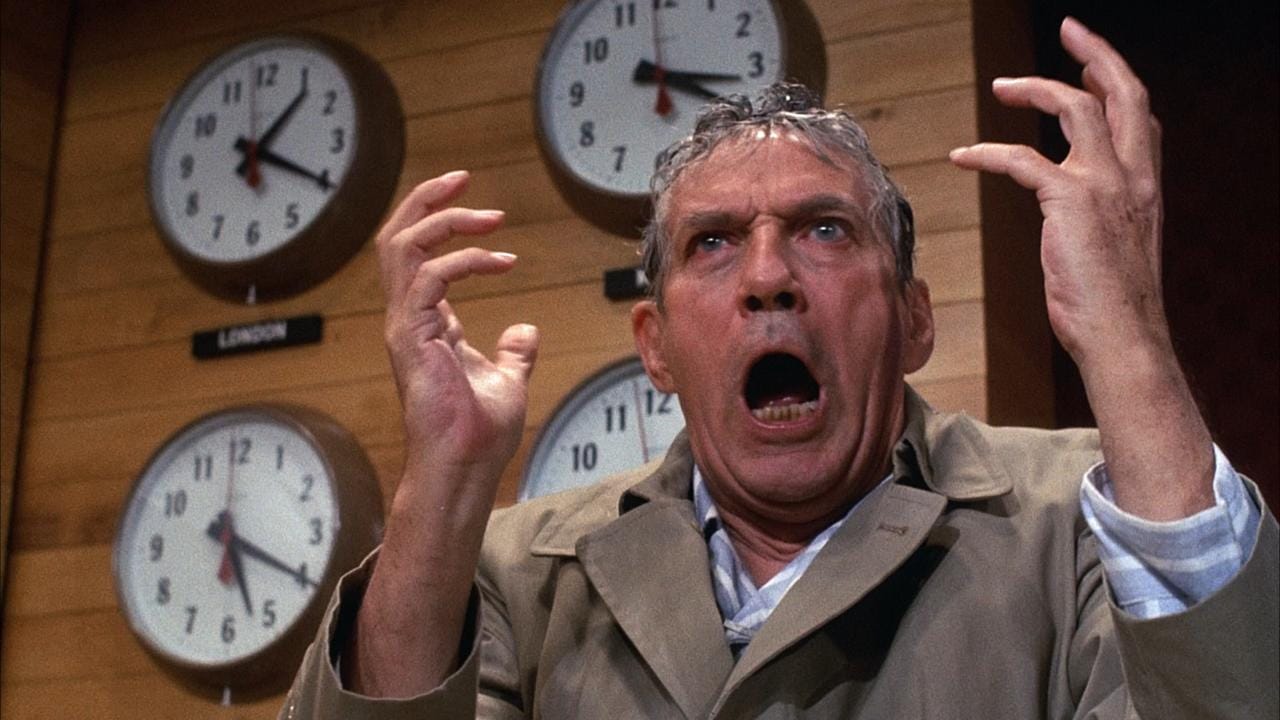
1976 Movie by Sidney Lumet
Network, is an American classic, satirical and prescient depiction of media and society. Interconnected themes of media manipulation, corporate power, and societal Nihilism. It is frequently cited as a conspiracy classic for its insights into control mechanisms operating within the global landscape.
The (Media) Engineering of Society
Television Networks have always been a cornerstone of the elite’s power structures. They were created and managed by elites and Deep State actors from the very beginning. Even today, broadcasting remains heavily restricted and tightly controlled. But when Network was made — in a pre-digital, pre-cable, pre-satellite era with only a handful of channels — public attention was far more centralised, making television an extraordinarily powerful instrument of influence.
In the film, news anchor Howard Beale, decides that as a last hurrah he will go on air and be honest with his viewers, exposing the pervasive deception behind media and television, "we just lie to you all the time". Beale - and the film - perfectly illustrates how audiences are blinded by the illusion of truth, and objectivity.
This control over the masses is contextualised by the real-world Operation Mockingbird, a CIA initiative to influence major media outlets.
Narrative and Satirical Scope
The narrative begins with Howard Beale’s announcement that he will commit suicide on the evening news to improve ratings. This event is used by the network to transition the news division into the era of the soft news cycle. Hard news reporting is replaced by human interest stories, sensational violence, and car chases. Beale is recast as a mad prophet of the airwaves, articulating the collective anger of the American public.
The network replaces the traditional news hour with the Howard Beale Show, which functions as a religious spectacle. Beale enters through stained glass doors and delivers sermons to an audience that chants responsively. His mental breakdown is measured in rating points, and his prophecies are used to sell advertising. The film demonstrates that authenticity and pain are commodities within a profit-driven media landscape.
Commodification of Dissent
The film satirises the use of dialectics, to co-opt the counterculture and the capture of revolutionary or dissident movements by the establishment. The Network develops a series featuring the Ecumenical Liberation Army, a radical group that takes films of their own bank robberies. The revolutionaries abandon their ideological purity to negotiate contracts and profit shares for their television series. A shift that demonstrates that every form of resistance is absorbed, monetised and ultimately controlled by the system it opposes.
The image of being anti-establishment becomes an establishment cash cow. Revolutionary rage is packaged as a prime-time entertainment hour. Dissent is not suppressed by force. It is turned into content to be sold back to the public as a brand. This process ensures that activists serve the engagement metrics of the systems they claim to overthrow.
Media and the Algorithmic Age
Network predicted the rise of reality television and the 24-hour news cycle. Its portrayal of outrage-driven media anticipates a world where human attention is the ultimate commodity. The film identifies the emergence of a networked reality where algorithms dictate human worth. Characters are constantly responding to metrics and adjusted their behaviour to suit ratings.
This systemic pressure destroys the possibility of thoughtful journalism and meaningful relationships. Diana Christensen is a person thoroughly merged with the medium, incapable of genuine human connection. She views people as viable properties and her own emotions as content to be packaged. The film presents this isolation as a systemic effect of a hyper-connected media environment.
Global Corporate Dominion
A central tenet of Network is that traditional nation-states are eroding, superseded by a singular, overarching corporate system.
The character Arthur Jensen articulates this, declaring, "there are no Nations, there are no peoples... there's only one holistic system of systems. One vast and a main, interwoven, interacting, multivariate, multinational Dominion of dollars. Petro dollars electrode".
The world is recast as a collage of Corporations inexorably determined by the immutable bylaws of business. This corporate structure aims to implement a Brave New World scenario of global socialism, wherein individuality is sacrificed for a collective identity under a single corporation.
The international system of currency determines the totality of life on the planet. Humans are reduced to biocurrency, valued by their capacity to be engaged as consumers or users. This corporate structure seeks to create a collective identity where all necessities are provided and all anxieties are tranquilised. The world is presented as a business, and every aspect of human existence is subject to financial measurement.
Cast and Production
The film features Faye Dunaway as program director Diana Christensen and William Holden as news division president Max Schumacher. Peter Finch portrays Howard Beale and was posthumously awarded the Academy Award for Best Actor for his performance. Robert Duvall appears as Frank Hackett, a corporate executive who translates the imperatives of capital into network policy. Ned Beatty plays Arthur Jensen, the chairman of the Communications Corporation of America.
Sidney Lumet utilised a rigorous two-week rehearsal process before filming. The cast read the script repeatedly to internalise the operatic rhythms and biblical cadences of Chayefsky’s dialogue. This preparation grounded the heightened performances in recognisable human emotions and systemic forces. The repetition allowed the actors to find the pain beneath the rhetoric of characters who are victims of the systems they serve.