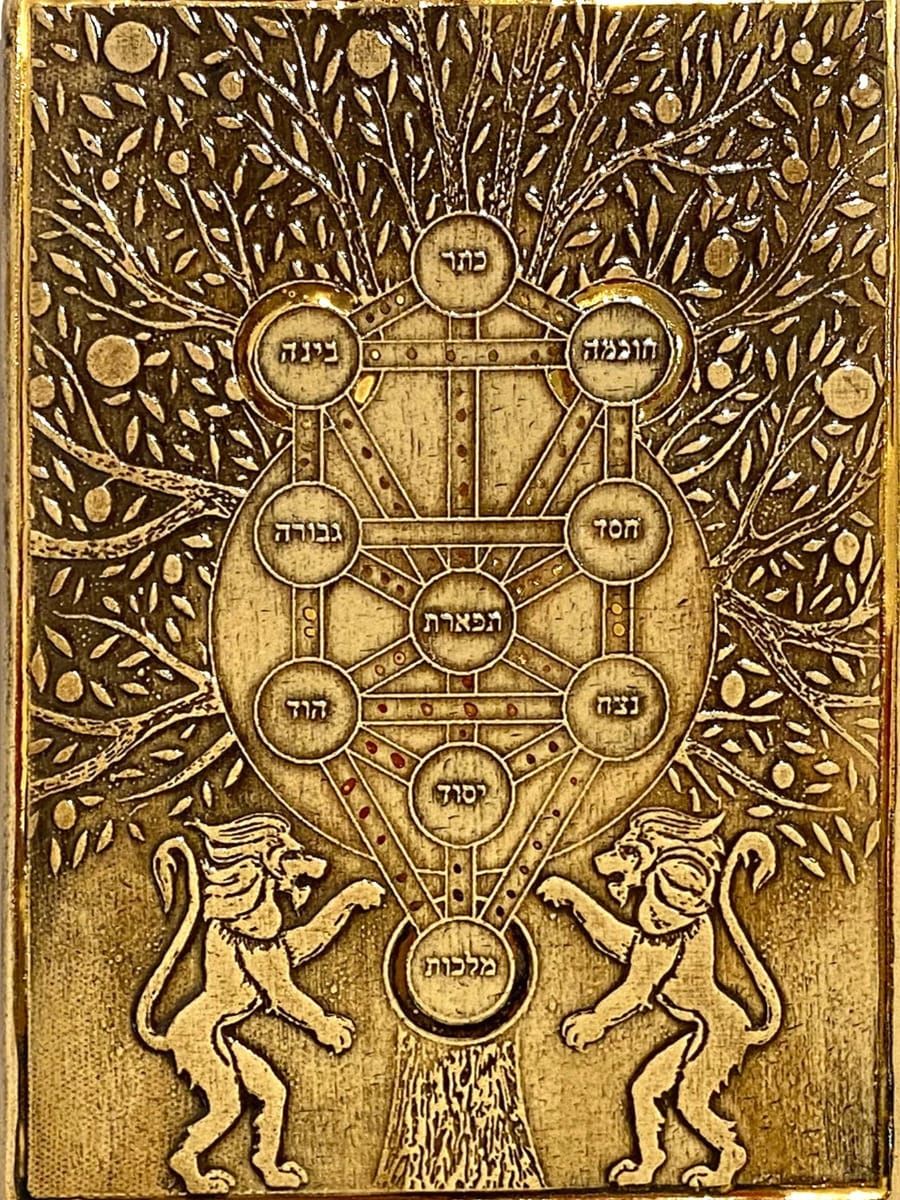
Kabbalah is an esoteric and mystical tradition associated with Rabbinic Judaism that emerged in its established form during the 12th and 13th centuries AD in Spain and France.
While its practitioners assert ancient origins dating to Israel and the era of the prophets, historical analysis confirms that the movement post-dates the establishment of Christian dogma by several centuries.
The tradition is characterised by a complex system of theosophical speculation, numerology, and magical practices that are fundamentally incompatible with Christian theology, who regard Kabbalah as an uninspired and objectively opposed religious framework that borders on the pagan.
Theological Incompatibility and Dualism
The central deity of Kabbalah, known as Ein Sof, is a dualistic and ultimately unknowable entity that bears little resemblance to the God of the Holy Scriptures. This concept claims God possesses two sides, embodying both good and evil.
Clearly, such heresy is entirely at odds with the Christian confession of a God who is entirely good and in whom there is no darkness, and evil being an absence of God. Kabbalah invests significant effort in rationalisations about this unknowable essence, whereas the Orthodox Faith is centred on the Person of the uncreated Godhead who became human in Jesus Christ.
The system of the ten Sefirot, or divine emanations, is often incorrectly compared to the Palamite distinction between the divine essence and uncreated energies. However, the Sefirot are often treated as distinct masculine and feminine divine energies, a plethora of ideas that are antithetical to the apostolic deposit maintained by the Saints and Church Fathers. The Orthodox know man can know - and love - the three divine Persons who share one nature, rather than engaging in the imagination and unreality of Kabbalistic enumeration.
Anthropology and the Transmigration of Souls
A decisive rupture between Kabbalistic doctrine and Christian truth exists in the teaching of Gilgul, or the transmigration of souls. Kabbalah holds to reincarnation, which is a concept that can never be reconciled with the Christian hope of the resurrection.
Holy Scripture teaches that there is one body per person. Christ will transform the human body to be like His own resurrected body, whereas the Kabbalistic gulf of reincarnation suggests a cycle of soul-movement that denies the definitive nature of the Last Judgement.
Kabbalistic anthropology also posits that the human spirit is an innate extension of a transcendent God. This leads to a form of pantheism where the universe is identified as a dream in the mind of God or a series of divine emanations. Orthodox Christianity maintains that while God is everywhere present and fills all things, the creation remains distinct from the Creator. The Kabbalistic emphasis on unity between God and creation frequently obscures this necessary boundary.

Apotheosis versus Theosis
The goal of the Kabbalist is often described as a form of self-apotheosis. This is a ritual and magical effort to become one's own god, repeating the original deception of the serpent in Genesis. In this framework, the human trajectory is viewed from man to God through the manipulation of secret knowledge, technology, or magic. This is exemplified in the medieval Jewish myth of the Golem, where magical incantations are used to create living beings. Modern Kabbalistic interpretations often link this concept to Artificial Intelligence and robotics, viewing these as versions of the Golem.
In contrast, Theosis is a process of participation in the uncreated energies of God through grace. It is an ontological reality facilitated by the Church, the Sacraments, and the shedding of passions. In Theosis, the human being never becomes God in an identity sense or as a replacement for the Creator.
The difference between these two positions is categorical: one is a magical working for self-deification, while the other is a humble participation in the life and love of the Holy Trinity.
Scriptural Interpretation and Numerology
Kabbalah relies heavily on Gematria, or numerology, and the meditative pronunciation of Hebrew letters to access divine power. The Torah itself is seen as a collection of mystical symbols to be unravelled through esoteric methods.
This allegorisation of Scripture often puts Kabbalistic texts, such as the Zohar, on an equal status with the Holy Scriptures themselves. A heretical idea that eventually became the Talmud and Kabbalah.
The Kabbalistic framework often includes antinomian assertions, which are the rejection of moral laws in favour of mystical experience. This is evidenced in the radical Sabbatean and Frankist movements of Eastern Europe, which indulged in ritual violations and sexual taboos under the guise of "redemption through sin".
These movements demonstrate the spiritual peril inherent in departing from the established traditions and moral boundaries of the Apostolic Church.

Secular and Philosophical Influence
The influence of Kabbalah extends beyond the religious sphere and has shaped various secular and atheistic philosophies. G.W.F. Hegel utilised Kabbalistic structures of thesis, antithesis, and synthesis to understand reality.
This framework was later adapted by Karl Marx into dialectical materialism, which represents a form of atheistic Kabbalah. The trajectory of these ideas often leads to a global hive mind or a grand supra-consciousness, an "omega point" that is central to modern transhumanist thought. Figures such as Ray Kurzweil express a belief in an emergent deity arising from technological systems, which is a secularised version of the Kabbalistic trajectory from man to God.
In the contemporary period, Kabbalah has been packaged for Western consumption through celebrity endorsements and the Los Angeles Kabbalah Centre. This popularised version often involves the use of red strings and amulets for personal gain.
Historically, Christian leaders like Saint Irenaeus of Lyon have argued that the spirits invoked in such magical rituals are delusions or demons posing as benign forces. The Orthodox Christian view maintains that these practices do not unite man to Christ nor do they produce Saints.
Orthodox Christianity lacks nothing with Christ and has no need for the integration of a different religious framework. The adoption of Kabbalistic frameworks creates dilemmas of imagination and unreality that distract from the experienced relationship with the divine Persons.
The pieces of the Kabbalistic system do not fit with the Gospel as delivered in the apostolic deposit. While Kabbalah attempts to enumerate aspects of the divine, the One Holy Orthodox Church remains the definitive repository of the truth once delivered to the Saints.
Those who seek the direct experience of God must do so through the established pathways of the Church, avoiding the demonic entanglements and logical frameworks of Jewish mysticism.