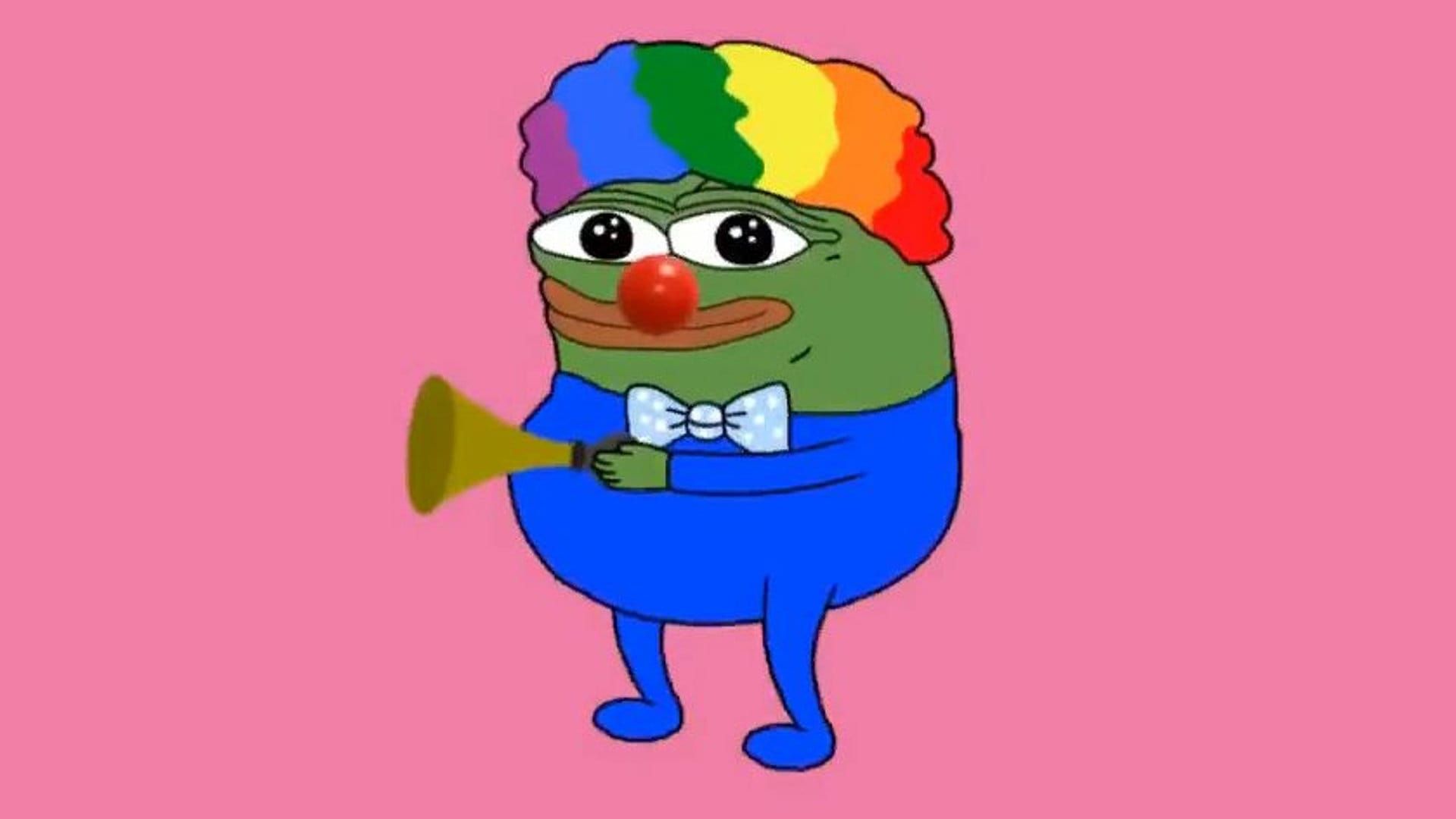
Clown World, popularised by the internet meme of Pepe the Frog, signifies a world where the exception has become the rule. It does not present as mere incoherence but as a series of pervasive, petty tyrannies.
The foundational element of Clown World is the breakdown of hierarchies of meaning. This erosion has accelerated considerably with the rise of Postmodern thought, which often criticises hierarchy itself and champions diversity.
The collapse of hierarchy leads to a perception of accelerated time. This is evident in rapid fashion cycles and frenetic news cycles, where attention is fleetingly held before quickly moving on. The phenomenon of content achieving widespread virality serves as a distorted reflection of humanity's innate drive to focus attention within a structured hierarchy. Akin to a virus, which disrupts the body's natural order by monopolising its energy, viral content briefly seizes collective attention before being swiftly discarded.
The absence of meaningful hierarchy renders every voice equal, leading to a pervasive inability to discern truth or genuine intent. This chaotic equality allows for the arbitrary construction of narratives by cherry-picking voices, fostering division and internal conflict. As societal hierarchies and collective purpose erode, so too does collective memory. Significant events and scandals are rapidly forgotten, as society perpetually shifts focus to the next sensation.
A pervasive feature of Clown World is the loss of individual identity, culminating in a state of nihilism. Nihilism, being inherently unaligned, results in widespread societal frustration.

The Clown Figure
In Clown World, the clown is King, standing in as a central, paradoxical figure, embodying the topsy-turvy nature of this inverted state. A clown’s actions are exaggerated parodies of normal behaviour. Their aesthetic often features ill-fitting garments, such as oversized shoes and trousers, symbolising a fundamental lack of fit or coherence.
Actions like falling or throwing a pie in the face represent a breakdown of meaning; the pie, traditionally food for internalisation, becomes an external assault that humiliates and makes one appear silly. The characteristic honk-honk noise made by clowns signifies the interruption of normal discourse and the irruption of chaos into established meaning.
The film The Joker is a powerful depiction of Clown World, as it fundamentally shatters prevailing political narratives as well as the Overton Window. Its perceived threat to mainstream sensibilities and the establishment arises not primarily from its violence, but from its systematic deconstruction of cultural narratives.
The Redemptive Aspect of the Clown
Despite the chaos it embodies, the clown figure holds a potential for redemption. When the world is already inverted, the clown's inherent role as an inverter can lead to a "double inversion," effectively restoring order.
Holy clowns and holy fools exist across diverse cultural traditions, deliberately demonstrating the limitations of established systems and hierarchies. By consciously embodying inversion, they paradoxically reinforce order by pointing towards a higher, all-encompassing mystery that transcends human conventions. Jesters historically fulfilled a similar function in royal courts, permitted to articulate truths that others could not, owing to their position outside the conventional system.
Kanye the Clown
Ye exemplify the fool articulating profound wisdom in an upside-down world, where such truths are otherwise unspoken. His call for the United States to unify under God, though perceived as radical or absurd by some, is a return to the fundamental structure of reality necessary for building a cohesive future.
His chosen political party name, The Birthday Party, symbolises a move towards celebrating national origin and unifying under God, thereby transforming the chaotic carnival into a celebration of existence's very source. His seemingly wild statements, such as describing the coronavirus vaccine as the mark of the beast or Planned Parenthood's origins as "the devil's work," are both hyperbolic yet indicative of underlying, unmentionable truths and reasonable fears.
His emphasis on returning to God to resolve societal issues like disease, murder, and suicide is a fundamental truth, addressing the spiritual crisis underlying modern societal fragmentation and meaninglessness.
The medieval romance of Silence features Merlin’s uncontrollable laughter as a catalyst for a double inversion. Merlin, upon being captured and brought back to court by Silence (whom he believes to be a man, but is actually a woman in disguise), laughs at various seemingly illogical situations.
His laughter is not derision but a revelation of hidden truths and the inversion of appearances: a poor man with new shoes is about to die, beggars are unknowingly sitting on hidden treasure, and a mourning father is unknowingly burying the priest’s child.
Ultimately, Merlin’s laughter exposes the king’s queen as having a male lover disguised as a nun, and reveals Silence’s true identity as a woman. This dramatic unveiling, initiated by the fool's laughter, re-establishes normal order, leading the king to allow women to inherit land and Silence to become queen, thereby resolving chaos into order.
The Carnival
The concept of Clown World has historical roots in the tradition of carnivals, which are universal feasts of excess or inversion rituals. The term carnival itself, meaning "feast of flesh," refers to the period preceding Lent, a time of indulgence before abstinence.
Carnivals are characterised by upside-down behaviour, garish costumes, mask-wearing, grotesque figures, noise-making, acrobatics, and sometimes inappropriate conduct. Historical examples include the medieval Feast of the Ass, where a donkey was led into a church and participants mimicked braying, and the Feast of Fools, where a "lord of misrule" or mock bishop performed actions contrary to ecclesiastical norms.
These festivals typically occur at the end of cycles, signifying moments where conventional logic yields to a "little death" or "little chaos". They are connected to the idea of an ultimate end, as seen with Ash Wednesday's reminder of mortality or the Orthodox Meat Fare preceding the Last Judgment.
Carnivals are a necessary release valve for chaotic tendencies, preventing societal explosions by allowing a controlled, temporary inversion. During the Enlightenment, particularly in Protestant countries, efforts were made to outlaw these festivals, neglecting the inherent human need for such periodic releases of chaos.
Modern manifestations of this carnival aesthetic are evident in county fairs and circuses, which serve as microcosms perceived from the periphery. These events feature ubiquitous spinning rides, symbolising pointless or entertaining turning, and games designed to hit a distant, often rigged, centre, reflecting a disconnection from the core.
In essence, Clown World describes a society undergoing a profound and widespread inversion of its values and structures, yet it simultaneously presents the inherent possibility of a restoration of order through the very figures that embody its chaotic nature.