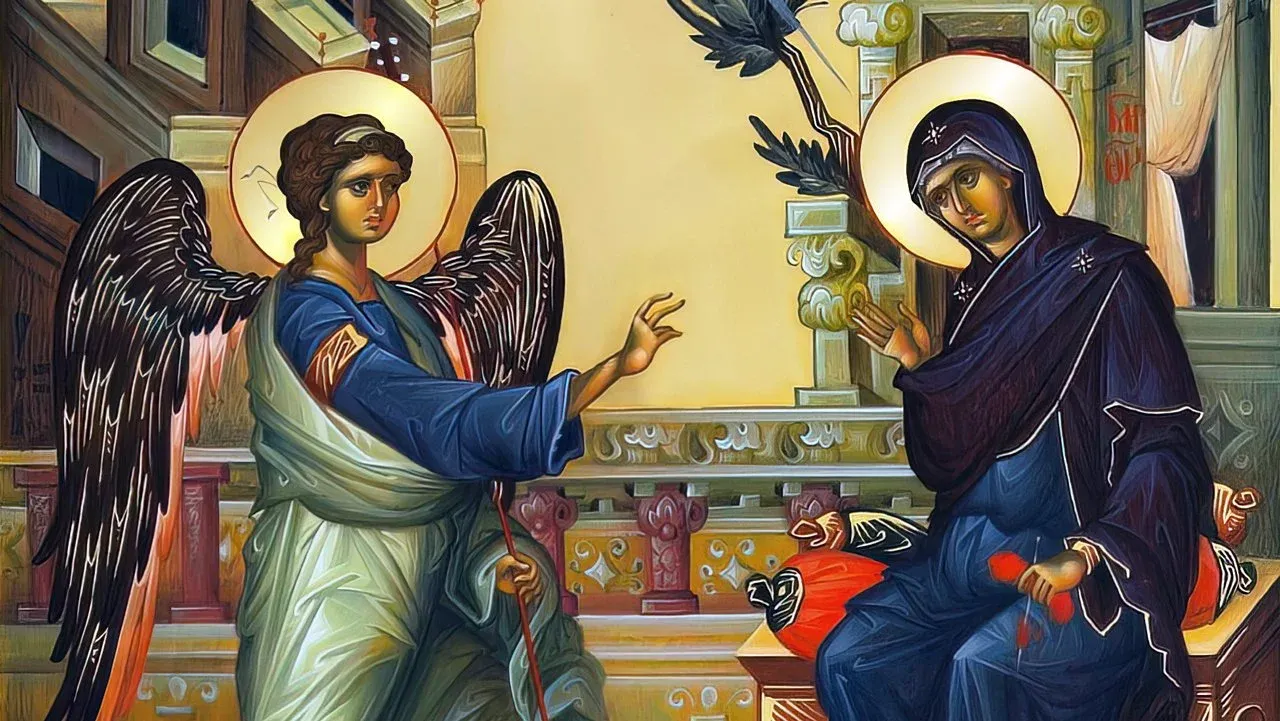
The Annunciation is the declaration by the Archangel Gabriel to Mary that she would bear the Son of God. This event is celebrated annually on 25 March. It marks the moment of the Incarnation, when the Word became flesh. The initiation of the salvation of humanity.
The scriptural foundation is the Gospel of Luke. Gabriel appeared in Nazareth to a virgin betrothed to a man named Joseph. He addressed her as the highly favoured one. The message indicated she would conceive a son named Jesus.
This child would be called the Son of the Highest and would inherit the throne of David. Mary questioned how this was possible as she had no husband. Gabriel explained that the Holy Spirit would come upon her and the power of the Most High would overshadow her. Mary responded by identifying herself as the handmaid of the Lord.
Scriptural Narrative and Historical Context
The Annunciation occurred in the sixth month of the pregnancy of Elizabeth. Elizabeth was at that time pregnant with Saint John the Forerunner. Gabriel was sent by God specifically to the town of Nazareth in Galilee. The dialogue between the angel and Mary reveals the fulfilment of ancient prophecies regarding the Messiah.
Mary was a descendant of the house of David. Her initial reaction to the angelic greeting was one of trouble and contemplation. Gabriel provided consolation by telling her not to be afraid. He described the future kingdom of her son as one that would have no end.
The announcement of the birth is the fulfilment of the promise made after the fall of Adam and Eve. This promise is known as the proto-evangelion or the first gospel. The word annunciation itself denotes a good notification or announcement. It serves as the correction of the events at the beginning of human creation in Eden.
The Dogma of Theotokos
The term Theotokos means God-bearer or Mother of God. This title is a confession of faith concerning the nature of Jesus Christ. It indicates that Mary gave birth to the Son of God in his human nature. The earliest written use of the title is found in the works of Origen in the third century AD.
The Council of Ephesus in 431 formally affirmed the title Theotokos. This decision followed a dispute with Nestorius, the Patriarch of Constantinople. Nestorius proposed the title Christotokos, meaning Bearer of Christ. He maintained that Mary gave birth only to the man Jesus and not to the eternal Son of God.
The Council condemned this teaching and affirmed that Christ is one person in two natures. This union is called the hypostatic union. Because the divine and human natures are inseparably united, Mary truly bore God incarnate. The title is therefore a statement of Christology as much as Mariology.
Theological Concepts of Synergy and Redemption
The event demonstrates the intersection of divine initiative and human response. Salvation required the free and active consent of a human being. This cooperation between God and humanity is termed synergy. Mary was not a passive instrument but a willing participant in the divine plan.
Mary is the new Eve. The disobedience of the first woman in Paradise is corrected by the obedience of Mary. Through Eve, humanity was separated from God; through Mary, humanity is reunited with God. Her response signifies the submission of human logic to the divine will.
Deification, or theosis, is the ultimate goal of this redemptive process. Theosis is the participation of the human person in the divine nature. Mary reached this state through a life of stillness and noetic prayer in the Temple. Her state at the Annunciation was superior to that of Adam and Eve before the fall.
Liturgical Practice and the Akathist Hymn
The feast of the Annunciation is one of the Great Feasts of the Church. It is celebrated with the Divine Liturgy of Saint John Chrysostom. If the feast falls on a weekday of Great Lent, the liturgy is served in the evening with Vespers. This is the only instance where this specific Eucharistic liturgy is permitted on a Lenten weekday.
The Akathist Hymn is a central liturgical element associated with the celebration. Its name derives from the Greek word for non-sitting, as the faithful remain standing during its chanting. The hymn was likely composed in the fifth or sixth century. It consists of a prelude and twenty-four stanzas, each corresponding to a letter of the Greek alphabet.
The first half of the Akathist covers the historical events from the Annunciation to the meeting with Saint Symeon. The second half is a theological elaboration on the mystery of the Incarnation. The odd-numbered stanzas contain sets of double addresses beginning with the word rejoice. These are known as the Salutations or Hairetismoi.
Iconographic Representation and Symbolism
The iconography of the Annunciation contains specific symbolic elements. The Archangel Gabriel is typically depicted on the left side. He is shown in motion to symbolise the swift delivery of the divine message. His right hand is extended in a gesture of blessing or announcement.
Mary is positioned on the right side of the icon. She is often shown seated or standing in a posture of receptive attention. Her head is sometimes slightly inclined towards the angel to indicate listening. Her hand may be raised in a gesture of prayerful acceptance.
A semicircle at the top of the icon represents the divine sphere. Rays of light descend from this area towards Mary. A dove is often present within these rays to represent the Holy Spirit. In some versions, Mary holds a spindle of scarlet yarn, prefiguring the blood of Christ and his future passion.
Cultural and National Identifications
The feast of the Annunciation coincides with Greek Independence Day. This national holiday commemorates the beginning of the war against the Ottoman Empire in 1821. The shared date of 25 March links religious faith with national heritage. The themes of liberation and hope in the religious feast resonate with the aspirations for national freedom.
The Mother of God is regarded as the protector and patron of the Greek nation. Her intercession was sought throughout the years of Ottoman domination. The celebration includes both religious services and military parades. This duality reinforces the connection between cultural identity and Orthodox Christianity.
In the Ukrainian tradition, the Annunciation is understood as a component of the Paschal mystery. It is the first feast of the Incarnation and a manifestation of the mystery from all eternity. The liturgical services emphasize that God becomes man so that Adam may become deified. This feast serves as a preparatory period for the celebration of the Resurrection.
Theology of the Incarnation
The conception of Christ occurred at the moment of Gabriel's greeting. It was a direct act of the Holy Trinity. The Father favoured the event, the Son worked his own incarnation, and the Holy Spirit effected it. The conception was creative and did not involve the use of seed.
Christ assumed a human nature that was perfect and pure. This nature was deified immediately upon its union with the divine nature in the womb. The physical properties of human nature were not abolished by this union. The child developed naturally over nine months while remaining fully God.
The birth of Christ did not corrupt the virginity of Mary. She is therefore identified as being a virgin before, during, and after the birth. This is represented in icons by three stars on her forehead and shoulders. Her life is viewed as a total consecration to the divine will.