
“The truth is so fragile that it needs a bodyguard of lies to protect it.”
Winston Churchill
Churchill was not the hero presented in our history books. On the contrary, it was he who saw the destruction of the British Empire and the bankruptcy of the nation.
A Degenerate Man
While born directly into the highest tier of British aristocracy, Churchill actually inherited very little, yet by age 25, he had made equivalent to a modern million dollars today through books and war journalism. His income could not keep up with his lifestyle however. He maintained a massive appetite for luxury goods, running up staggering, unpaid debts to his wine, champagne, and cigar merchants, and was a compulsive gambler, regularly losing large sums at the casinos in Monte Carlo
He bought a country estate, Chartwell, in 1922. The endless renovations and maintenance cost him a fortune, continuously draining his bank accounts, and after the 1929 New York stock market crash, Churchill experienced severe financial difficulties.
He earned a parliamentary salary of £500 per year. This income was insufficient to support his country house, Chartwell, which required forty-two gardeners, secretaries, and other staff.
He generated additional funds by painting oil works under the pseudonym Charles Morin. These paintings were sold in Paris to increase their market value. President Franklin D. Roosevelt became aware of this practice and used it to establish a psychological advantage over Churchill.
Churchill also produced short digests of classic literature for the Chicago Tribune Syndicate. He received $1,000 for each ten thousand word summary of works such as War and Peace and Crime and Punishment.
The Focus
In 1936, a secret pressure group known as the Focus was established with Churchill as its centre. This group consisted of dissident politicians and was funded by the Board of Deputies of British Jews.
Sir Bernard Waley Cohen organised a dinner on 29 July 1936, where Jewish financiers provided £50,000 to the group. This funding was contingent upon Churchill aligning his political efforts exclusively against Nazi Germany.
In February 1938, Churchill faced financial ruin when his American stock holdings lost their value. He owed £19,600 to his brokers and placed Chartwell on the market for £25,000.
Sir Henry Strakosch, an Austrian Jewish financier, paid off this entire debt to prevent Churchill from leaving politics. Strakosch later left Churchill an additional £20,000 in his will to ensure the loan was never reclaimed. The Czech government also provided significant sums to Churchill and the Focus. In July 1938, the Czech Ambassador Jan Masaryk received £2 million to facilitate subversive work among British Members of Parliament.
"The Drunken Bum"
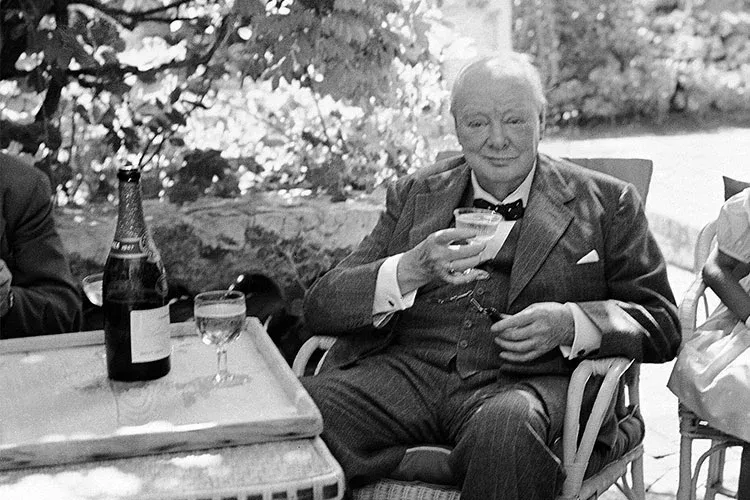
Churchill was clinically an alcoholic throughout his political career. He conducted Board of Admiralty meetings and Cabinet meetings in a state of intoxication. This condition was recorded in the private diaries of his staff and colleagues.
President Roosevelt frequently referred to Churchill as a drunken bum in private conversations. In March 1940, United States Under Secretary of State Sumner Welles found Churchill blind drunk at the Admiralty with a nearly empty bottle of whiskey. Churchill displayed extreme rudeness when alcohol was not served during state functions.
The famous wartime broadcasts attributed to Churchill were often recorded by a voice actor named Norman Shelley. Shelley was a BBC performer known for his work in the Toytown series. Churchill was frequently in no condition to broadcast in the evening due to his alcohol consumption.
Official government publications censored records of Churchill's drunkenness to preserve his public image. His habitual intoxication led to military failures, including the mismanagement of the Norwegian campaign. Guns and men were landed on the wrong ships and at different parts of the coast.
Admiral Saint Andrew B. Cunningham recorded that Churchill was in no state to discuss strategy in July 1944. He described the Prime Minister as talking mostly nonsense for hours. Churchill's staff often had to change the wording of their diaries before publication to hide his excesses. This systematic sanitisation ensured the public remained unaware of his true condition.
Deception and Suppression
Churchill employed a strategy of systematic deception to maintain the justification of the war effort. He famously said "the truth required a bodyguard of lies to protect it".
He falsely promoted the claim that Adolf Hitler intended to destroy the British Empire, yet secret records show Hitler intended to preserve the British Empire as a force for global stability. In June 1940, Hitler offered peace terms that guaranteed the sovereignty of the British Empire.
Half of Churchill’s six-man War Cabinet wished to accept these terms. Churchill initially inclined toward the peace offer but ultimately rejected it to avoid personal political oblivion. He subsequently suppressed all records of these negotiations in official archives.
Churchill held a deep, lifelong conviction that he was a man of destiny chosen to save Britain. At 16 years old, he told his school friend London would be attacked and that he would be called upon to lead the empire and save the country.
This warped sense of manifest destiny gave Churchill a reckless belligerence. He committed a war crime by ordering the sinking of the French fleet in Mers-el-Kébir during July 1940. This action, targeting an incapable enemy, and attack without a declaration of war, resulted in the deaths of 12,000 French sailors. Because it occurred before modern legal frameworks like the 1949 Geneva Convention were established, it was never formally tried in a court of law.
During the Dunkirk evacuation, Churchill ordered the British Army to withdraw without notifying his allies. These orders were removed from British files but survived in the papers of French Prime Minister Paul Reynaud.
Churchill maintained that Nazi Germany was the only target that justified his political survival. He used his formidable power of language to bring public opinion against any peace movement. He simultaneously refused to allow his ambassadors to listen to any German peace emissaries. This included the mission of Rudolph Hess in May 1941. Hess flew to Scotland to establish contact with peace proponents but was imprisoned.
The Provocation of the Blitz
Churchill in-fact wanted the bombing of London to consolidate public support for the war. He aimed to draw the United States into the conflict through the spectacle of German air raids.
Hitler had issued orders that no British towns were to be bombed in the summer of 1940. Churchill was aware of these orders through the interception of German codes at Bletchley Park. He expressed despair that the lack of raids was hindering the prosecution of the war. On 24 August 1940, a single German aircraft accidentally dropped bombs on the East End of London.
Churchill used this accident as a pretext to order a retaliatory raid on Berlin. He bypassed the Cabinet and the Air Ministry to telephone Bomber Command directly on 25 August 1940. This provocation succeeded in forcing Hitler to lift the embargo on bombing British cities. When the Blitz began on 7 September 1940, Churchill used it for propaganda purposes. He toured bombed areas while Ministry of Information officials placed Union flags in the rubble. Churchill himself took refuge in a bunker with seventeen feet of concrete.
In November 1940, Churchill received advance warning of a major air raid on Coventry. He initially believed the target was London and cleared his schedule to escape to the country. Upon learning the target was Coventry, he returned to London to stage a public display of solidarity. He allowed the citizens of Coventry to be bombed without warning to protect the secret of British codebreaking. He claimed he was sharing the trials of the citizens of London while knowing they were in no danger.

Chemical Warfare
In July 1944, Churchill ordered the preparation of a chemical and biological attack on German cities. In one of his drunken moments, he demanded the dropping of poison gas and the release of two million Anthrax bombs on Germany.
Churchill argued that morality was irrelevant and that such weapons were a matter of changing fashion. His Chiefs of Staff argued against the order on strategic grounds rather than moral ones. They feared a German retaliation with superior nerve gases such as Sarin and Tabun. Churchill eventually yielded to these military objections.
Throughout the war, Churchill maintained unconstitutional secret communications with President Roosevelt. These messages were sent through the British Secret Service and Bletchley Park.
The head of the Secret Service, known as C, delivered these messages in blue folders called Black Jumbos. These channels were used to coordinate policy behind the backs of their respective governments. United States State Department officials were unaware of these top secret code messages. Churchill also used a radio telephone link that was intercepted by German intelligence.
The Germans possessed thousands of transcripts of these private conversations for four years. Churchill and Roosevelt discussed strategic plans and preemptive strikes against Japan. These conversations included the imposition of the oil embargo that triggered the attack on Pearl Harbor.
George Marshall expressed anger at Churchill’s loose talk on these radio lines. President Harry S. Truman later issued an executive order to keep these transcripts sealed in perpetuity. Churchill remains the primary architect of the historical narrative that obscures his own conduct.
Suppression of Historical Records
Churchill and his American editors at Time Life Corporation collaborated to suppress sensitive information regarding Jewish involvement in European politics. A 1937 letter from former German Chancellor Heinrich Bruning to Churchill detailed the financiers behind the Nazi party. Bruning identified two large Berlin banks as the primary contributors to the Nazi party from October 1928.
One of these bank managers was a prominent leader of Zionism in Germany. Bruning requested the omission of this letter from Churchill’s war memoirs in 1947 to avoid pain and embarrassment. Churchill complied with this request and the correspondence remained hidden in private archives.
The official history of World War II was constructed to reflect Churchill’s political narratives. He described the truth as requiring a bodyguard of lies for its protection.
Wartime Leadership and the Surrender of Power
Churchill assumed the prime ministership on 10 May 1940, at a moment of national disaster, as German forces swept through Western Europe, driving the British army towards Dunkirk. From the outset, his primary, indeed sole, mission was the defeat and destruction of Adolf Hitler at any cost. This fixation led to a series of decisions that progressively dismantled British power.
Churchill immediately recognised that American involvement was vital for Britain's survival, a stark reversal of his 1927 assertion that Britain must never be in America's power.
He sought to establish a close telegraphic relationship with President Franklin D. Roosevelt, whom he had met only once before in 1918. Churchill famously remarked, "no lover ever studied the whims of his mistress as I did those of President Roosevelt," indicating a submissive and manipulative approach to the relationship.
His strategy throughout the war involved adopting a submissive junior partner role, attempting to seduce Roosevelt into providing support. Roosevelt, conversely, was a shrewd chess player, consistently outmanoeuvring Churchill from a cold, realpolitik perspective. While Churchill focused on the immediate tactical move, Roosevelt planned 20 moves ahead, playing for position rather than merely material gain.
Initially, Britain sought aid from American industry, such as Lockheed, for bombers before the Neutrality Act could halt supplies. When the Neutrality Act was triggered by Britain's declaration of war on Germany in September 1939, it embargoed the sale of armaments.
Roosevelt, despite popular American support for neutrality (85% of the public opposed entering the war), implemented "Cash and Carry," forcing British customers to collect planes from American soil. This led to absurd scenarios where British planes were flown by American pilots to the Canadian border, dragged across by Canadian farmers with horses, and then flown on by Canadian pilots, circumventing the embargo. This naked and blatant circumvention demonstrated the underlying intent of American and British elites for the US to eventually get involved in the war.
Churchill's desperate pleas for American destroyers in mid-1940 were initially refused by Roosevelt, who viewed Britain as on the verge of defeat. However, Roosevelt was sympathetic to Britain's cause, believing that successful British resistance would spare America the need to fight. He adopted a cautious approach, remaining a bit ahead of public opinion while encouraging pressure groups like the White Committee to push for American intervention.
The Battle for American Public Opinion
American isolationism was strong, led by figures like Charles Lindbergh and the America First movement, which garnered mass support against involvement in a foreign war. Lindbergh argued that these European conflicts were "struggles within our own family of Nations" and that entering to fight for democracy abroad might lead to its loss at home.
Roosevelt, seeking re-election in 1940, explicitly promised to keep the US out of the war, a barefaced lie that allowed him to secure office. Once re-elected, Roosevelt was politically secure enough to respond directly to Churchill's pleas for financial aid.
He proposed Lend-Lease, a scheme to supply Britain with war materials, with payment suspended until after the war. To sell this to the American public, Roosevelt resorted to dramatic tactics, including framing non-intervention as aiding the Nazis and accusing opponents like Lindbergh of doing exactly the kind of work that the dictators want done. Opponents correctly saw Lend-Lease as a measure that would take us into war in spite of the Constitution.
The Mortgaging of the Empire
Lend-Lease negotiations highlighted Britain's desperate financial state. Roosevelt insisted Britain prove its poverty, leading to humiliating demands. Britain was forced to give up her gold reserves.
In a dramatic step, the US sent a cruiser to South Africa to collect £60 million worth of Britain's last imperial gold reserves, a humiliating act that demonstrated Britain's complete financial dependence.
Churchill's government ordered the Courtaulds company to sell its profitable American Viscose subsidiary to US bankers at a knockdown price, effectively a fire sale of British holdings in America. This was necessary to secure Lend-Lease, a choice of life or death for Britain.
Lend-Lease itself was far more punitive for Britain than for the Soviet Union, which received weapons for free, no strings attached.
Churchill, heavily indebted in his personal life, never had any intention of paying back his debts, similarly believed that two years of bloodshed ought to cancel any money for Lend-Lease. This was a completely delusional attitude for an international agreement, as Britain would indeed have to pay back the money. The overall effect of these financial concessions was to destroy every single last vestige of British power.
Dismantling of the British Empire
Roosevelt explicitly sought the disintegration of the British Empire after the war, promoting a new world order based on self-determination and the end of Colonialism. This American anti-colonial stance, deeply ingrained in the Washington mindset, was not a new doctrine but a fundamental part of US policy.
The clash over empire came to a head in India, then a last bastion against Japanese expansion and embroiled in a nationalist independence campaign.
When American troops arrived in 1942 to reinforce the British, they made it clear they were there to fight Japan, not bolster Britain's colonial rule. Roosevelt believed India should be an independent nation. Despite Churchill's defiant declaration that he had "not become his Majesty's first minister to preside over the disintegration of the British Empire," he reluctantly bowed to American pressure and offered a form of independence to India after the war.
This was a capitulation by Churchill, demonstrating the direction of travel for the Empire. The process of Indian independence was arguably encouraged from the inside, with British ruling classes appearing to be traitors who facilitated the dissolution of the Empire, despite Churchill's stated goal to preserve it.
Post-War Conferences: Tehran and Yalta
The emergence of Russia as a third major power after the Battle of Stalingrad radically altered the Anglo-American relationship. Roosevelt sought to deal directly with Stalin, believing he could handle him better than Churchill.
At the Tehran Conference in late 1943, Churchill was completely outplayed, completely humiliated, and sidelined. He was overruled by Roosevelt and Stalin on war strategy, as his proposal to advance through southern Europe was rejected in favour of a second front in northern Europe, agreed for summer 1944.
Churchill felt excluded from the key decisions and worried about the implications of Russia's entry into Europe, a concern he had previously dismissed by claiming "we don't look into The Mists of the future".
By 1944, as the D-Day landings progressed, it became clear that America was undoubtedly in the driving seat, with an apparently inexhaustible supply of American GIs compared to exhausted British forces. American dominance was explicit: "we Americans are winning the war... this is an American-made Victory and the peace must be an American peace".
At the Bretton Woods Conference in July 1944, Britain was forced to admit defeat and Seed her place as the financial center of the world to the United States. Churchill accepted that Britain's day was over, acknowledging to Roosevelt: "You will have the greatest Navy in the world, you will have the greatest trade, you will have all the gold".
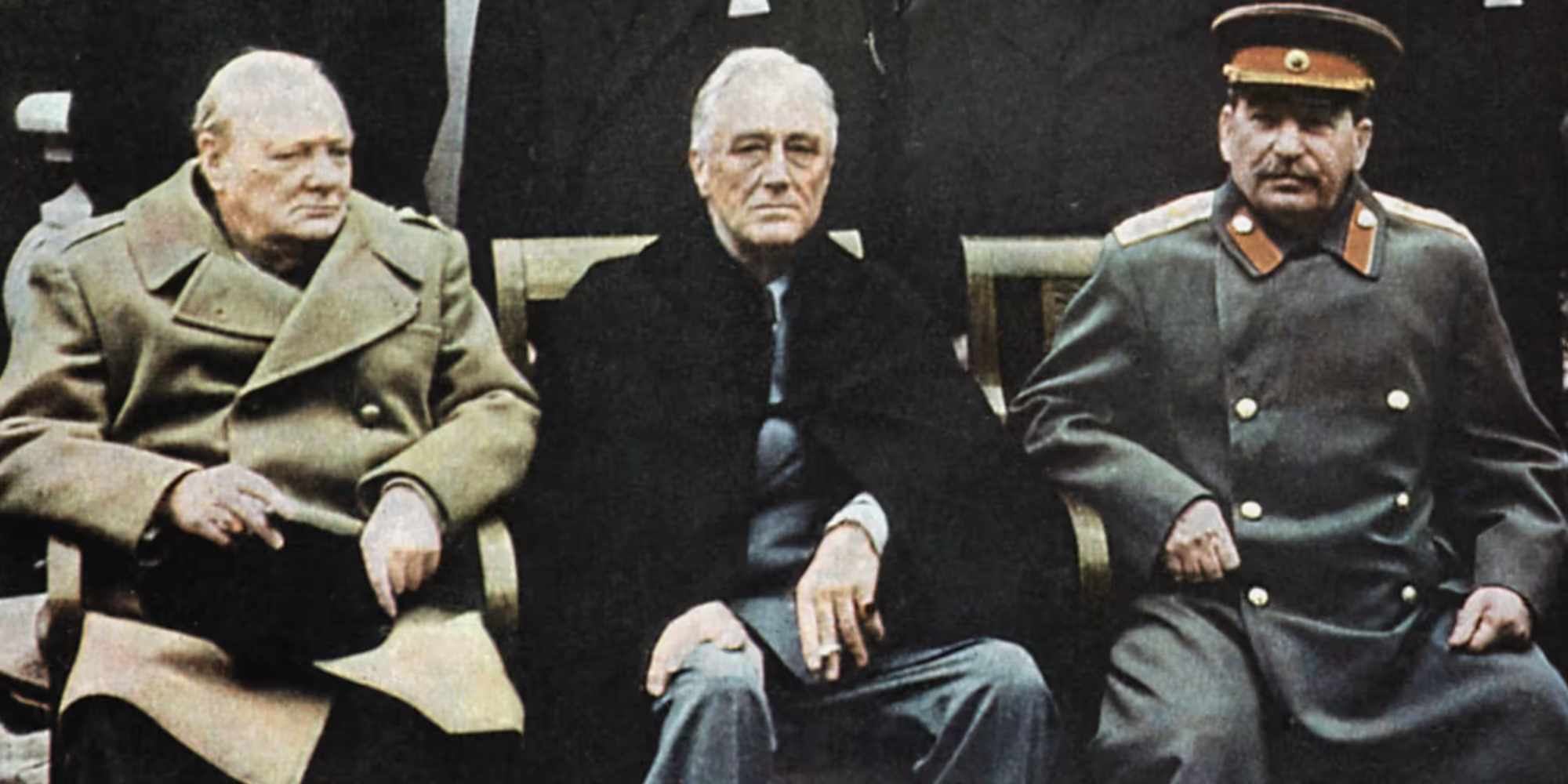
At the Yalta Conference in early 1945, Churchill made a final attempt to restore the old relationship, but he was firmly the number three among the Big Three.
Roosevelt maintained his distance, wary of Britain's imperial intentions, even criticising Churchill for dispatching troops to Greece to prevent a Communist takeover. Roosevelt often sided with Stalin, ignoring Stalin's own imperialist aims. In a particularly humiliating moment, when Churchill stood up in anger at the table, it was Stalin who had to calm him down. Churchill, despite initial doubts, left Yalta believing Stalin would honour his word regarding free elections in Eastern Europe, a belief that proved to be an illusion.
Winston Churchill's leadership, from 1940 onwards, systematically led to the humiliation and destruction of British power. Almost every major decision he made, with the minor exception of the North Africa campaign, weakened Britain and fortified the United States.
His delusional beliefs in American benevolence and his short-sighted, belligerent focus on defeating Hitler at any cost, without considering the post-war implications, resulted in Britain mortgaging its empire and accepting a subordinate role on the global stage. Churchill, despite his stated goal to preserve the Empire, effectively presided over its dismantling, with his government overseeing the process from 1951.
His actions are those of a moron who continually made poor decisions that left Britain in a significantly weaker position than it could have been. His legacy, therefore, is not one of preserving British power but of fundamentally undermining it.