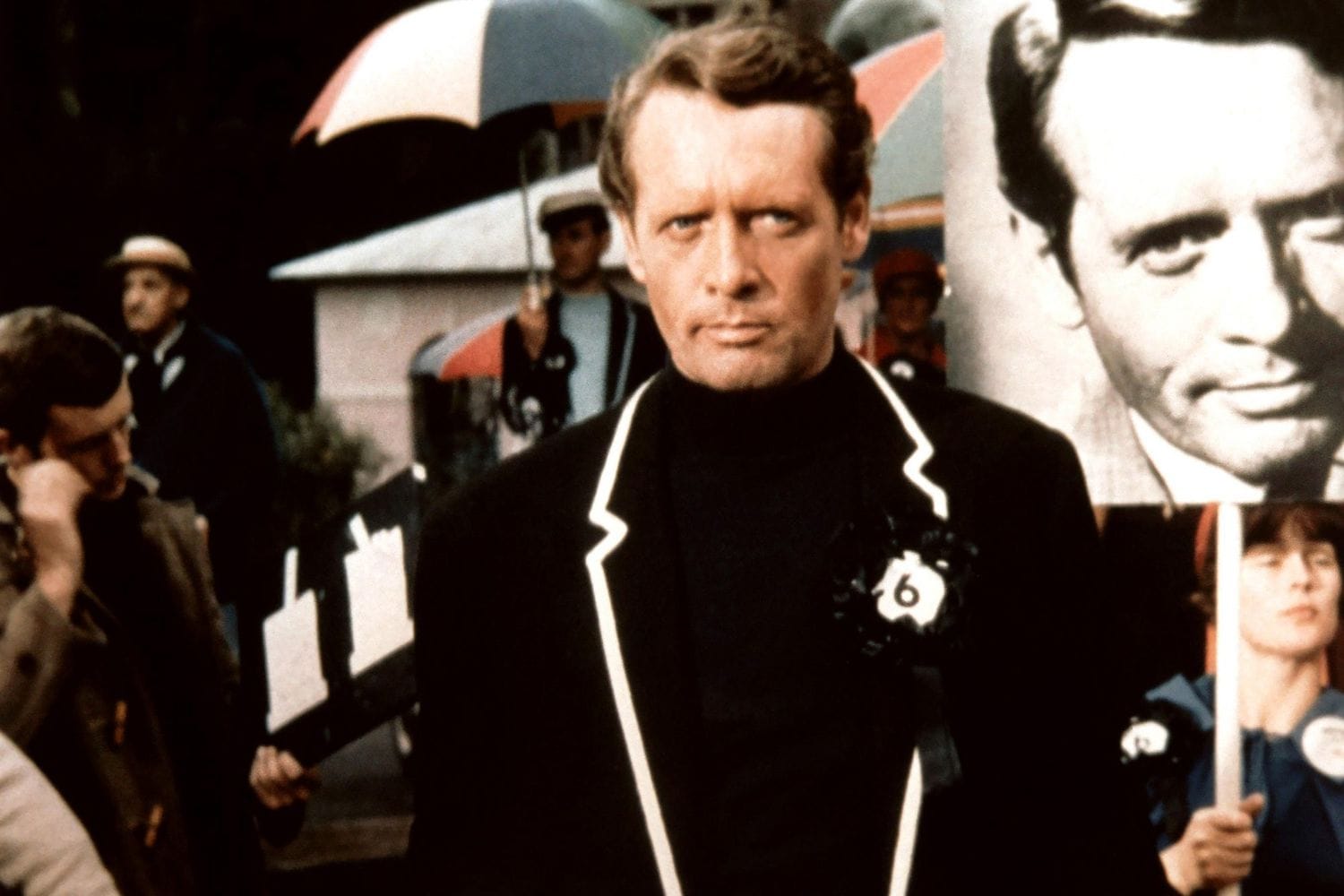
TV Show, 1967
Conception and Production
The genesis of The Prisoner began with Patrick McGoohan, a prominent television leading man who was offered the role of James Bond, but refused seeking to produce something deeper and more counter-cultural, and something that addressed the relationship between the state and the individual.
McGoohan discussed his ideas with script editor George Markstein, who claims to have conducted research into the Special Operations Executive and a curious establishment in Scotland called Inverlair Lodge.
This lodge served as a luxury prison camp for spies between missions, holding agents who knew too much to be allowed free in the outside world. This concept formed the core idea for The Prisoner: what happens if a secret agent, much like McGoohan himself, decides to quit.
Lou Grade, a highly influential figure in television production, readily acquiesced to McGoohan's concept, commissioning the new series following a meeting in 1966. The production was marked by McGoohan's intense personal involvement; he served as executive producer, wrote and directed several episodes, and was widely regarded as the series' originator.
McGoohan was known for his energetic and often confrontational personality, which could be challenging on set; he was described as having a "volcano about to erupt" and an "underlying explosiveness". This personal intensity and clear vision led him to take over directorial duties on several occasions, sometimes under the pseudonym Joseph Serf. Early production saw Leslie Gillot brought in as a producer, but he was soon replaced due to his skepticism about the show's unconventional nature.
The Village
The series' premise is established concisely in its opening sequence: a man angrily resigns from an unspecified institution in London, is gassed in his home by rogue undertakers, and awakens in a mysterious, isolated settlement known only as The Village.
The Village allows its residents freedom in most aspects of their lives, except for their ability to leave.
The protagonist is never named and is instead depersonalised - designated Number Six, but Number 6 just refuses to conform to The Village.
In his persistent attempts to escape, he never can be sure whether his captors are, whether they are from his "own side", seeking to silence him, or the "other side," aiming to extract information without clear explanation or consent.
The Village is an interesting choice as a prison, not at all brutal or dreary. On the country on the outside everything is well - an active and friendly community, abundant food and water, work is optional, comfortable and modern accommodation is provided - it's a functional society where all your material needs are met. All Number 6 is asked to do is just relax and be part of it.
An outwardly pleasant environment conceals a threatening edge, making it feel more familiar (especially to the British, who exemplify this surface deep pleasantry). Yet like Carl Jung's shadow, a monster lives under this surface.
The problem is conformity here is mandatory. By how much should one conform?
That's an eternal question for this earthly realm to balance, but without knowing who The Village are, and what their motives are then Number 6 will not conform.
And while his material needs are all met, one notable omission from The Village is the presence of the church. Spiritual needs tellingly are left unmet, which lends to the Globalist, Materialistic, Progressive worldview where metaphysics are absent and unwanted.
The Portmeirion Location
The Village itself is a distinct character in the series. Filmed largely in Portmeirion, Wales, a unique architectural village designed by Sir Clough Williams-Ellis, it provides an otherworldly ambiance was considered tailor-made for the series.
Williams-Ellis built Portmeirion from 1925 to 1976 as a physical demonstration of how naturally beautiful places could be developed without defilement, drawing inspiration from Italian coastal villages.
Themes and Symbolism
Totalitarianism - it just works if you let it, if unlike Number 6, you would just conform and integrate into society. Number 6 resists offers to cooperate, provide information, and embrace the Village’s amenities, which he's told would even lead to a position of authority, inside the totalitarian system.
Themes of Totalitarianism and Control The Village functions as a microcosm of a controlling system, embodying several facets of totalitarianism and modern social manipulation:
Assigned Identity and Dehumanisation:
Number Six’s designation by number rather than name symbolises the stripping away of individual identity. Like when the Canadian Prime MinisterJustin Trudeau pronounced that ‘there is no core identity' to Canada' and pronounced Canada to be 'the first post-national state'. These tactics are used by authoritarian regimes designed to enforce Conformity and systemic control.
If, like the Rainbow Cult, you (incorrectly) believe that Existence precedes Essence - the notion of Postmodernism notion our identity doesn't arrive from God (or our nature), but rather is assigned by society, then there's another layer of meaning - but there is an aspect from society, like the Overton Window that does determines how we can express ourselves.
Manufactured Consent and Performative Democracy:
Authority in the Village, or to be precise the public face of the authority, comes through Number Two. A title, like a head of state, that is a revolving door, held by several different individuals throughout the series. While their methods may vary, the power behind the curtain remains in place, these leadership changes do not alter fundamental objectives and Number 2 is just another cog in the machine..
The electoral process itself is presented as a means to co-opt and diffuse defiance, as exemplified in the Episode (4) Free for All, where Number Six is encouragement to run for Number Two. Such elections are depicted as performative, pre-designed to prevent genuine change. Power resides not with figurehead leaders but in the system itself, which defends the status quo. This process serves to manufacture consent, illustrating how modern politics can manipulate individuals into believing things contrary to their own interests.
Psychological Warfare and Gaslighting:
Number Six is frequently subjected to methods designed to disorient and undermine his sense of reality.
Surveillance and Counter-Surveillance:
The Village operates under constant surveillance, with residents' lives monitored. However, the series also illustrates how this system can be disrupted by flooding it with meaningless or deliberately misleading information, forcing the security apparatus to chase its own shadow and fostering paranoia within the controlling authority.
Medical Coercion and Pathologising Dissent:
A particularly insidious form of control involves the medicalisation of opposition. Dissent is framed as a mental disorder, with "treatments" applied to non-conformists.
This echoes the Soviet practice of declaring political dissidents mentally ill, a method used to discredit individuals and their ideas while presenting repression as benign medical intervention. Such tactics are still observable in contemporary society, where political opponents may be framed as mentally unwell, negating the need for reasoned argument.
Mind Control / MK Ultra
As well as using drugs to coerce Number 6, torture, hypnosis and implied scientific means of brainwashing, implanting thoughts and values.
Show Trials and Public Conformity:
Public displays of Conformity are enforced through events like mandatory celebrations, show trials, and the ubiquitous presence of informers. Number Six endures a show trial where he is announced as guilty, highlighting the predetermined nature of such proceedings.
Erosion of Trust and Community:
The Village fosters an environment where genuine interpersonal bonds are blocked. Residents are identified by numbers, not names, and mutual suspicion pervades, preventing any collective resistance or escape. The impossibility of trust means that individuals are isolated, even amidst crowds, perpetually viewing others as potential threats.
Deception and False Hope:
Escape attempts are frequently portrayed as demoralising ruses. A significant example involves Number Six and a new arrival attempting to smuggle themselves to London, only to discover upon arrival that their old colleagues are complicit, and they remain trapped within the Village. This recurring pattern of false liberation crushes hope and reinforces the system’s pervasive control.
In the End, is Number 6 Truly Free?
The Prisoner ought be put in context of when the show was made. A society in upheaval, revolutionary Progressivist forces pushing against what came before.
A society divided along lines of 60's hip and 50's squares. Each side with their feet on opposite sides, pre and post Hippie Movement, each with very different notions of Individualism and collective duty.
Number Six until the final episode, Like Don Draper in Mad Men, could be said to be a better fit for the 50's than the 60's, all until that final episode, in which Number 6 discovers it is he who has been repressing and jailing himself.
Six takes off his 50's square mask and puts on a hip 60's one, bursting out of his self-imposed confines, and in to the swinging 60's world of Individualism.
As well as being the time of peak individualism, the Boomer Truth Regime was beginning to take hold - the counter culture became mainstream.
It's likely that most viewers saw the 'smash the patriarchy and be free' reading of the ending - that Individualism will set you free, and 'All you need is Love'. But is he truly free?
The open ended subjectivity of the show leaves space for another meaning - that in Number Six's embrace of Individualism he was actually conquered by the Village.
For all the Hippie Movement's promise of progress, Individualism did not set us free - on the contrary, individualism became the homogeneity. We are atomised, rootless and easier to manipulate.
The rebellious mantra of the Hippies can be summed up as 'Do what thou wilt'
(a phrase popularised by Aleister Crowley), a sentiment which goes back to the Snake in the Garden of Eden - a Satanic rebellion, which, as shown time and time again, leads to Sin, Nihilism and Degeneracy.
The Prisoner explores the fundamental conflict between individual freedom and the desire for security and comfort. Number Six values freedom above all else, yet many Village residents appear content, prioritising comfort and security, perceiving the rules as non-constraining.
This highlights a societal divide: those who desire genuine freedom, with its attendant responsibilities and discomforts, versus a majority who may prefer the illusion of freedom coupled with security and comfort.