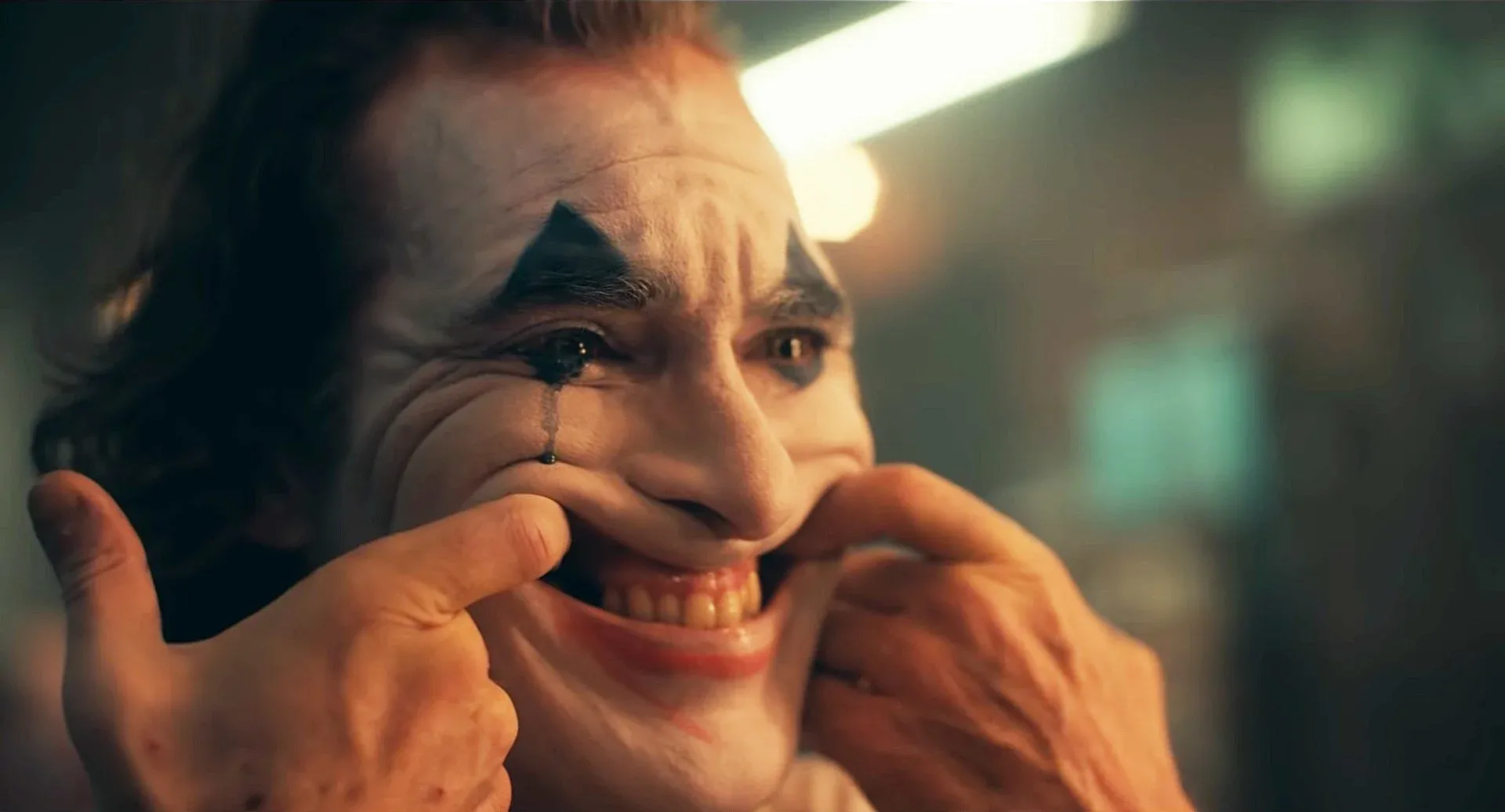
2019 film by Todd Phillips
The Shattering of the Overton Window
The visceral anger the film generated among critics and the mainstream media was not driven primarily by its violence, which is commonplace in cinema, but by its capacity to dismantle prevailing political narratives and shatter the Overton Window.
Joker functions as a mirror, reflecting and breaking down current cultural dogmas, a process that proved deeply unsettling for the establishment.
Origins and Identity: The King of Dust
The protagonist, Arthur Fleck, bears a name heavy with symbolic duality. "Arthur" evokes the legendary King, while "Fleck" signifies a speck of dust, a piece of debris. This combination is crucial. Like King Arthur, Fleck’s origin is initially presented as ambiguous and potentially royal—the illegitimate son of the billionaire Thomas Wayne.
However, the film brutally deconstructs this fantasy. The notion of noble, albeit illegitimate, lineage is revealed to be the delusion of a mentally ill mother. Fleck is not a hidden prince; he is an adopted child of unknown origin, raised in abuse.
This systematic stripping away of identity, from the fantasy of being Wayne’s son to the dream of connecting with a talk-show host, leaves him with no defined self. He becomes a vessel of pure Nihilism, transforming into a kingly figure only when he embraces total chaos.
Symbolism: Everything Must Go
The film opens with a garbage strike, with refuse piling up across a pre-flood Gotham. This is a direct visual metaphor: "everything must go." It is a mantra for the dismantling of all narrative structures in contemporary culture.
The character is rooted in Dionysian symbolism. Opposed to the Apollonian ideals of logic, order, and hierarchy (represented by Thomas Wayne), the Joker embodies the Dionysian forces of licentiousness, abandon, and chaos. The clown army that rises around him represents the forces of garbage, the losers, the street folk, the outcasts, rising in anarcho-syndicalism against the Apollonian overlords.
This tension is a recurring dialectic: dark vs. light, elite vs. poor. While these tensions are not inherent in a pre-fall state, they are pervasive in the modern world, often exploited through a "problem-reaction-solution" paradigm.
The Joker’s nihilism is not a political stance; it is a complete disengagement. This frustrates critics who demand he fit into a Left or Right box for easy dismissal. His romance with a Black woman and his embodiment of class struggle prevent easy right-wing categorisation, while his nihilism alienates the left. He is shapeless, embodying the cosmic joke of a fraudulent system.
The Systematic Deconstruction of Narratives
The film’s most subversive element is its bait-and-switch deconstruction of contemporary political narratives. It establishes familiar tropes only to shatter them.
Gun Ownership: A character presented as an archetypal big nasty White guy gives Arthur a gun, aligning with the liberal narrative of toxic gun culture. However, Fleck uses this weapon to execute three elite Wall Street types. The gun transforms from a symbol of reactionary oppression into a tool of revolutionary justice against the elite.
The Revolutionary Myth: On the subway, Fleck is beaten by three wealthy men harassing a woman. The audience is primed for catharsis when he shoots them. However, the narrative breaks when he executes the third man who is fleeing - in cold blood. This disrupts the fantasy of the justified revolutionary, exposing the uncomfortable reality of murderous intent.
The "Incel" Threat: Fleck is simultaneously a sympathetic victim of abuse and the "boogeyman" incel feared by modern media. The film forces the audience to hold these two contradictory realities at once.
The "Mean Rich White Man": The film sets up Thomas Wayne as the villain who abandoned Fleck’s mother. It’s a perfect narrative of patriarchal abuse. This is then shattered by the revelation that the mother is delusional and Wayne is innocent of that specific sin (though still a jerk). The justification for vengeance is undermined.
The Gatekeepers: The talk-show host (Robert De Niro) represents the modern political commentator, the arbiter of acceptable humour. Joker explicitly challenges this gatekeeping, exposing the cruelty masked as moral superiority.
The Clown and the Cannibalistic Revolution
Clown World: the clown’s function is to invert the norm. The Joker’s chosen name for his act, Carnival, implies a time where the hierarchy is thrown into the air. This is best understood through the lens of the bank heist in The Dark Knight, where clowns murder each other for a larger share of the split.
This is the nature of the upside-down hierarchy: the revolution eats itself. It echoes the myth of Saturn, who castrated his father to gain power but then devoured his own children to prevent them from doing the same.
Cancel Culture is the modern manifestation of this cycle. Revolutionary identities compete for marginal kingship. Western feminists accuse Western men; minority feminists accuse Western feminists; trans activists accuse feminists.
It is a purity spiral where the only way to survive is to purge the person next to you. The Joker stands at the top of this pyramid not because he has a plan, but because he is the King of the Margin, the ultimate embodiment of the void.
The "Joker Curse"
The character carries a metaphysical weight. Jack Nicholson warned of a curse attached to the role, a warning seemingly validated by Heath Ledger’s death. In our current Clown World, a term used to describe a reality of nihilistic absurdity, the clown mask has become a potent symbol.
However, like the Guy Fawkes mask or F-Society in Mr. Robot, there is the spectre of managed dialectics. Elites often co-opt or invent revolutionary symbols for their own ends. The chaos is rarely as organic as it appears.
The Sequel: A $200M Scolding
The establishment was horrified by the first film’s success. The wrong people identified with the wrong aspects of the character. The audience sympathised with the nihilist rather than rejecting him.
Todd Phillips produced a sequel, Joker: Folie à Deux, that seems designed not to entertain, but to chastise. As noted in The Observer, the film challenges the audience to grapple with their support of the character. It puts Fleck, and by extension the fans on trial.
The sequel strips Fleck of his power, denies his identity as the Joker, and subjects him to humiliation, rape, and death. It is a deliberate deconstruction, a musical designed to murder the franchise and dismantle the notion that Fleck could ever be a heroic or sympathetic figure. It was a $200 million penance paid to the establishment for the sin of the first film.