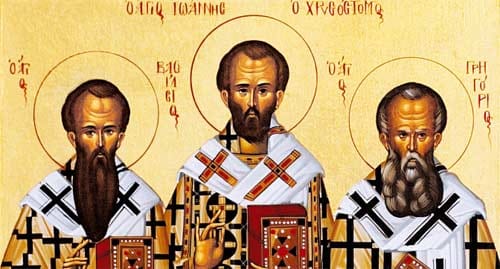
Feast of the Three Holy Hierarchs: Saint Basil the Great, Saint Gregory the Theologian and Saint John Chrysostom on 30 JAN.
The Three Hierarchs: A Conflict of Icons
During the reign of Emperor Alexius Comnenus (1081–1118 AD), a heated intellectual civil war broke out in Constantinople. The city’s brightest minds—men obsessed with virtue and the finer points of theology—found themselves locked in a bitter debate over which of the three great Church Fathers was truly the greatest.
The Great Debate
The city split into three factions, each championing a different titan of the Faith:
- The Basilians: They stood for Saint Basil the Great. To them, he was the peerless architect of the monastic life and a cold, disciplined warrior against heresy. He was seen as an angelic figure, distant from earthly weakness, and superior to those who were "too soft" on sinners.
- The Johannites: These were the partisans of John Chrysostom. They argued that the "Golden-Mouthed" archbishop was the ultimate shepherd. His eloquence wasn't just beautiful; it was practical. He turned the complex Gospel into a roadmap for daily life and showed a mercy toward the repentant that Basil lacked.
- The Gregorians: This third group preferred Saint Gregory the Theologian. They were moved by the sheer majesty and purity of his language. Having mastered the wisdom of ancient Greece, Gregory had climbed the heights of divine contemplation, expressing the mystery of the Holy Trinity with a precision no one else could touch.
What began as a scholarly disagreement soon spiralled into a public grievance. Instead of inspiring devotion, the rivalry bred resentment, ego, and endless arguments throughout the capital.
The Vision of Unity
The deadlock finally broke one night in a vision granted to Saint John Mauropus, the Metropolitan of Euchaïta.
The three Hierarchs appeared to him—first one by one, then standing together as one. Speaking with a single, harmonious voice, they delivered a clear rebuke:
"We are with God, and there is no rivalry between us. We each taught what was necessary for salvation, guided by the same Holy Spirit. There is no 'first,' 'second,' or 'third' among us. If you call upon one, the other two are already there."
The Saints urged John to tell the people to stop creating divisions in their names. They instructed him to merge their three separate commemorations into a single feast, a unified service that would reflect the unity they had fought for while they were on earth.
An Earthly Trinity
As the vision faded into a blinding light, Saint John immediately gathered the citizens. Because he was so widely respected for his own integrity, the three factions finally laid down their arms. Peace returned to the Church.
Today, these three luminaries—the Earthly Trinity—stand as a testament to the Heavenly Trinity. They didn't just write about God; they lived the truth of the Faith, enduring persecution to leave us a legacy of light. By celebrating them together, the Church effectively honours the entire cloud of witnesses who have ever defended the Truth with their lives.
30 January was chosen to celebrate them, for it would set the seal to the month in which each of the three Hierarchs already had a separate commemoration (Saint Basil – January 1; Saint Gregory – January 25; Saint John – January 27).