1977 film by Dario Argento
Suspiria is a classic Italian horror Gallo film released in 1977. For its time, it was considered to be pushing the limits of the horror genre. The director, Dario Argento, is known as the "Italian Hitchcock" and was significantly influenced by Alfred Hitchcock's use of shock techniques.
Argento's creative process involved writing down his nightmares, which would then become the script for his films, a method likened to that of David Lynch. The film's soundtrack was composed by the band Goblin, which served as Argento's regular house band for many of his movies.
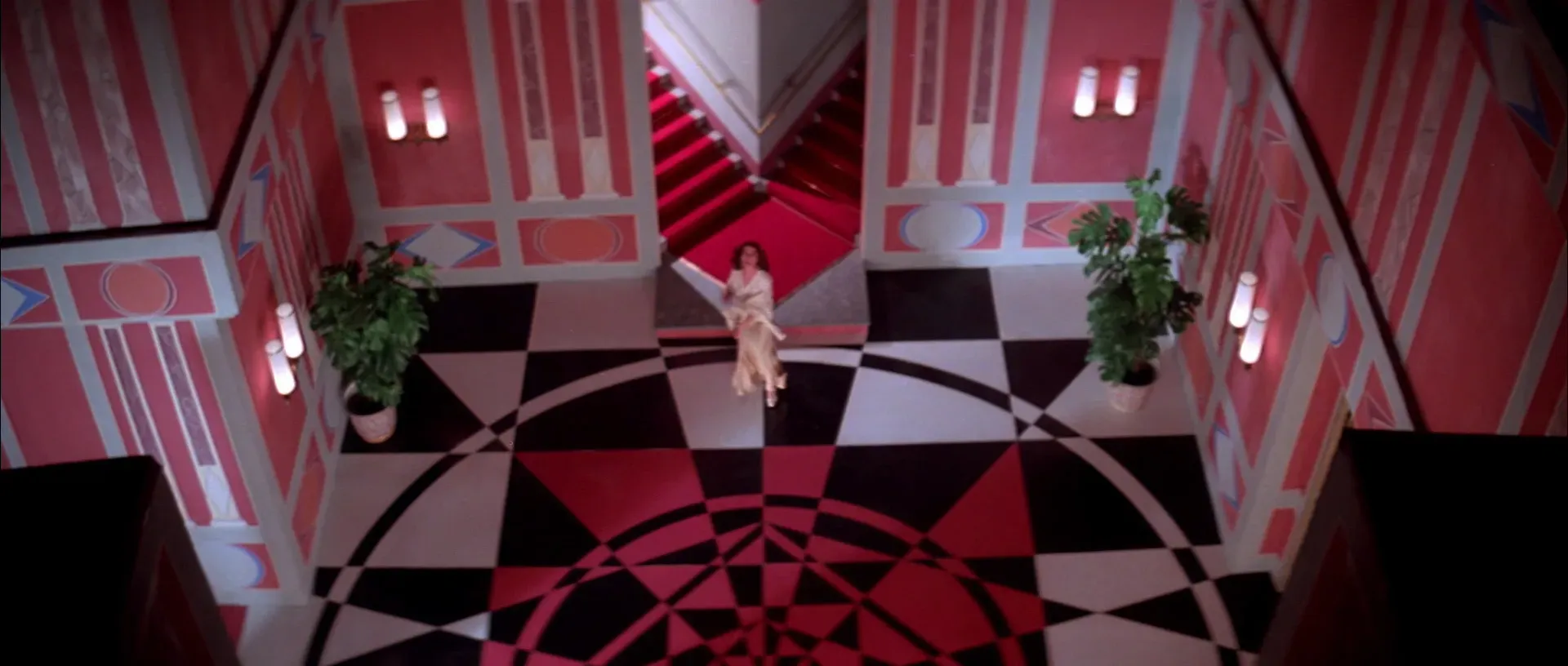
Aesthetics & Symbolism
A distinctive feature of Suspiria is its vibrant neon colour palette, which changes with almost every scene, creating a psychedelic effect. The director claimed to have aimed to mimic the colour palettes seen in Walt Disney's Snow White, suggesting a satanic Snow White aesthetic.
The film's geometries are unsettling, evoking a Lovecraftian style. Examples include fractal stained-glass windows in the ballet room, where floors appear as walls, contributing to a surrealistic atmosphere. Door handles are placed at shoulder height, making adult characters appear child-like.
Argento's films are frequently described as non-logical, exhibiting a dream logic similar to the surrealism found in David Lynch's works. In one scene, the discovery of secret rooms within the school reveals murals resembling the art of M.C. Escher, whose works also inspired scenes in the film Labyrinth.
Further emphasising this connection, the ballet school itself is located on Escher Street. Escher's artwork, primarily black and white pencil sketches or ink drawings, consistently explores the notion of duality and plays with two-dimensional and three-dimensional imagery on a two-dimensional surface. This is interpreted as hinting at the possibility of other dimensions.
The inclusion of Escher's art in _Suspiria_ is significant because the idea of other dimensions is an occult or esoteric teaching. Certain hermetic groups include Edwin Abbott's novel Flatland, which explores the concept of other dimensions, in their reading lists.
This idea is also present in Kabbalah, with its notions of different worlds (Sephiroth) and pathways between them, which are thought to roughly correspond to different dimensions.
The film's art and architecture feature geometric forms, such as boxes within boxes, which are intended to signify other spiritual realities. Specific visual motifs include a staircase appearing as a large golden serpent and Chinese dragons in other rooms, contributing to an eclectic mix of reds, blues, pinks, and dragons. The film is considered to prioritise form over content, focusing more on imagery and the shock experience than on its storyline, which is described as somewhat "silly". Its creepy imagery directly relates to surrealism.
Surrealism itself is deeply permeated by occult ideas, a fact often overlooked by art historians. The movement's antinomian (lawless) stance can be traced to the influence of 19th-century Magi like Eliphas Lévi, whose "Dogma and Ritual of High Magic" was widely read by Surrealists.
Many Surrealists and their predecessors were immersed in magical concepts, including Vasily Kandinsky (Theosophy), Salvador Dalí (sorcery), Pablo Picasso (alchemy), and Max Ernst and Leonora Carrington (shamanism). Thus, surrealism, as exemplified in Argento's Suspiria, originates from esoteric and occult traditions. The film also uses classic horror tropes like mirror imagery, with "smashing of the mirror, broken mirrors, broken minds" hinting at themes of mind control.
Plot and Occult Themes
The central premise of _Suspiria_ revolves around a ballet school that is secretly operated by a cult of a covenant of witches. The film is set in Freiburg, the birthplace of Desiderius Erasmus. Human sacrifices are a key element of the narrative. The film draws on the long tradition of German witchcraft, particularly associating it with the Black Forest region.
The cult employs mind control techniques, drugging and depriving the girls of food to weaken them and prevent resistance. In a notable scene, the heroine seeks help from Dr. Mandl, who had previously counselled a murdered girl. Dr. Mandl dismisses the heroine's fears about the occult as hysteria and mental illness, famously stating that "bad luck isn't brought by broken mirrors but by broken Minds". The film's release preceded the satanic panic of the 1980s in America, a period marked by numerous news reports of ritual killings and occult practices.
The False Memory Syndrome Foundation, established in 1992 by a couple accused of sexual abuse, had Dr. Martin T. Orne, a hypnosis expert and senior CIA Navy researcher, as an original board member, and was purportedly created to deny the existence of ritual abuse, being staffed by psychiatrists connected to the CIA.
The cult's objective is not always immediate killing but rather to traumatise the victims to the fullest extent. This psychological warfare and torture is evident in a scene where a girl is chased into a room filled with barbed wire, deliberately frightening her without directly harming her. The film's storyline ultimately sees the heroine escape and the academy burn down.
The narrative reveals that the head witch was previously expelled from other nations centuries ago. She is depicted as very old, maintaining her life through human sacrifice rituals.
A secret hallway within the school, where the coven secretly worshipped, features a mix of Hebrew, German, Greek, and English text, including terms such as "Elohim, metamorphosis, and interior secrets. A Rosicrucian rosy cross symbol is also present, suggesting ceremonial or high ritual Magic.
The witches appear to consume a 'Sacrament', which has been likened to the cakes of light used in Aleister Crowley's Gnostic Catholic Church, reportedly involving menstrual blood, semen, and flour. Dario Argento himself experienced similar fears to those depicted in the film, famously imagining terrifying things behind doorways in a hallway in his own house.
A recurring theme in the film is the portrayal of witches as having been persecuted and forced to flee, thereby becoming new martyrs. At the climax, in the grand witch's chamber (referred to as the "Mother of Sighs"), a large, colourful peacock is observed. This peacock is considered a secret symbol of Lucifer, specifically linked to Melek Taus, the Peacock Angel of the Yazidi tribe in Iraq.
Melek Taus, who fell from God's grace due to his independence, is believed by the Yazidis to have redeemed himself and become a Demiurge who created the cosmos from a cosmic egg. The Yazidis' beliefs are a syncretic blend influenced by Zoroastrianism, ancient philosophy, indigenous magic, Gnosticism, and biblical elements.
The heroine ultimately slays the head witch, an act likened to "cutting the head off a snake," leading to the destruction of the other witches as they burn. This highlights the hierarchical structure of witchcraft, which is as oppressive as any patriarchal religion.