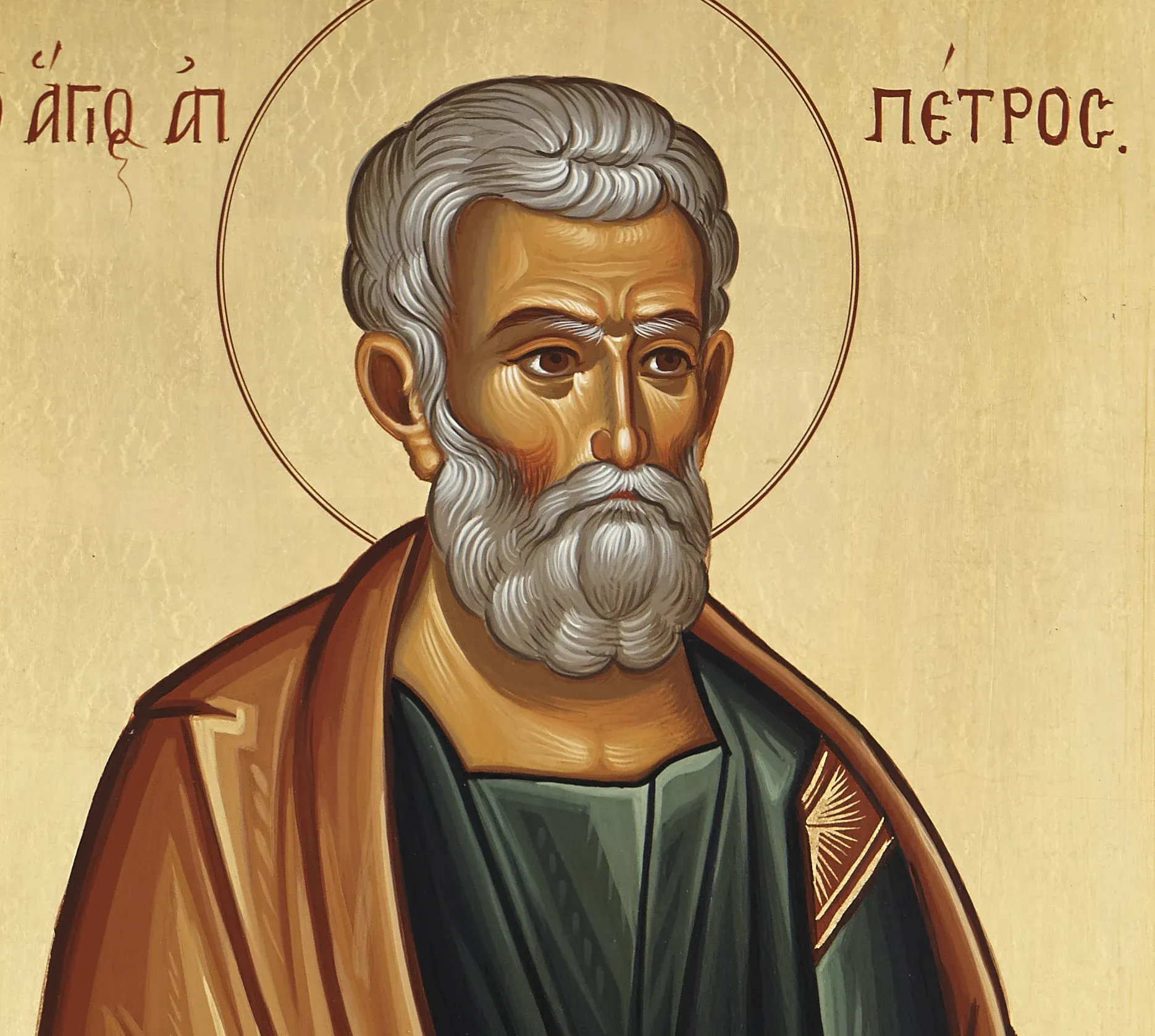
Apostle Saint Peter, originally named Simon, holds the primary position among the twelve apostles of Jesus Christ.
He was a fisherman from Bethsaida in Galilee and the brother of Saint Andrew. Peter was the most influential member of the apostolic college during the ministry of Christ and the formation of the early Church.
He witnessed the major events of the life of Christ, including the Transfiguration, the Last Supper, and the Resurrection. His residence in Capernaum served as a base for many of Christ's activities.
The Petrine Confession and Name Change
Jesus gave Simon the new name Cephas in Aramaic, which is rendered as Petros in Greek and translates to rock. This name change denotes a transition in status similar to the biblical renamings of Abraham and Israel. In ancient Koine Greek, the terms petros and petra functioned as synonyms.
At Caesarea Philippi, Peter confessed Jesus as the Messiah and the Son of the living God. Jesus identified Peter as the foundation upon which the Church is built following this confession. The foundation is interpreted in patristic tradition as the person of Saint Peter, his confession of faith, or Christ himself.
The relationship between the person of Peter and his faith is inseparable in early Christian thought. Peter is the first confessor of the messiahship of Jesus. He acts as the representative and spokesman for the other apostles during Christ’s earthly ministry.
Apostolic Authority and the Power of the Keys
The power of the keys constitutes the spiritual authority granted by Jesus Christ to govern the Church through the acts of binding and loosing. This mandate originates in the Gospel of Matthew where Jesus promises the keys of the kingdom of heaven to Saint Peter following his confession of the divinity of Christ. The exercise of this office includes jurisdiction, the proclamation of the gospel, the administration of the sacraments, and the forgiveness of sins.
Scriptural Foundations and the Apostolic College
While Jesus Christ addresses Saint Peter individually in Matthew 16:19, the authority to bind and loose is extended to all the apostles in Matthew 18:18.
Following the Resurrection, Jesus breathes on the entire apostolic college and grants them the power to remit or retain sins. Saint Peter serves as the representative person or spokesperson for the Church. He is not a monarch over the apostles.
The apostles receive equal partnership in both honour and power. The Gospel of John confirms this shared mission when Jesus sends the apostles as the Father had sent him. This equality ensures that the foundation of the Church rests upon the entire apostolic college.
Typological Significance of the Keys
The imagery of the keys derives from the Old Testament appointment of the master of the royal palace. In Isaiah 22:22, the key of the house of David is placed upon the shoulder of Eliakim, granting him the authority to open and shut in the absence of the king. This office represents a stewardship over the household of God.
The power to bind and loose corresponds to the rabbinic authority to give authoritative teaching and to impose or lift the ban of excommunication. These keys unlock the mysteries of the Holy Trinity through the interpretation of the divine Word. This authority is a gift from the Holy Spirit intended for the edification of the community.
The Confession of Faith
The keys are linked to the specific confession that Jesus is the Christ, the Son of the living God. This confession of faith serves as the foundation of the Church. Every person who shares this faith receives the keys in a certain sense as they become a participant in the nature of God.
The authority committed to Saint Peter was tied to his belief. It was independent of his personal rank. The faith of the confession conquers Hades and ensures the permanence of the Church.
Episcopal Succession and Authority
All bishops are successors of the apostles and hold the keys of the kingdom within their respective dioceses. Every bishop participates in the Petrine office through his ordination and his proclamation of the true faith. This charismatic equality ensures that no individual bishop possesses a position superior to all others.
Primacy within the Church functions as a service to unity based on love. It excludes jurisdictional supremacy. The primate acts as the first among equals within a conciliar structure where the Holy Spirit leads the whole assembly.
Deciding dogmatic matters requires a conciliar context. The primate serves as a moderator to facilitate consensus through the convocation of synods. This vision anchors the Church in the apostolic faith handed down through centuries. Authority remains declarative of the will of God and is exercised for the salvation of the faithful.
Leadership in the Early Church
Following the Resurrection, Christ reaffirmed Saint Peter's leadership by commanding him three times to feed his sheep. Peter was the primary witness to the Resurrection and the first to receive an appearance of the risen Lord. At Pentecost, he was the first to address the crowds, an act which led to the conversion of thousands.
Peter performed the first public miracle of the apostolic era by healing a lame man at Solomon's Temple. He inaugurated the mission to the Gentiles by baptising Cornelius and his family after a divine revelation. Peter was responsible for maintaining discipline in the early community, as seen in the punishment of Ananias and Sapphira.
During the Council of Jerusalem, Saint Peter’s testimony was central to the decree that Gentiles were not required to follow Mosaic Law. He occupied a mediating position between different theological tendencies in the primitive Church. Peter visited numerous regions to preach the Gospel, including Pontus, Galatia, and Cappadocia.
Missionary Activity and the See of Antioch
Antioch served as a significant centre for Saint Peter's missionary activities. He is recognised as the founder and first bishop of the Church in Antioch, where he worked for several years. The Syrian Orthodox Patriarch of Antioch claims the throne of Antioch through the legitimate succession of Saint Peter.
Saint Peter eventually travelled to Rome, which became the site of his final ministry and martyrdom. His presence in Rome is consistent with the New Testament and is explicitly affirmed by early Christian writers such as Clement of Rome and Irenaeus of Lyon. Irenaeus records that Peter and Paul founded the Church in Rome and appointed Saint Linus as its first bishop.
The status of Rome as the capital of the Roman Empire contributed to the recognition of its Petrine see as the first among equals. This precedence was based on both the city’s political position and its apostolic character. The Eastern tradition distinguishes between the personal ministry of Peter and the administrative development of his succession.
Liturgical and Iconographic Tradition
The Feast of Saints Peter and Paul is observed annually on 29 June.
This date is of ancient Christian origin and corresponds to the anniversary of their martyrdom or the translation of their relics. In the Eastern Orthodox tradition, this feast is preceded by a seasonal fast that begins after Pentecost.
West Syriac liturgical tradition commemorates Saint Peter alongside Saint Paul as the exalted chiefs of the apostles. There is no separate feast for Saint Peter in ancient Syriac calendars, which emphasises his place within the apostolic college. He is frequently contrasted with Judas Iscariot in Holy Week hymns to illustrate themes of fall and repentance.
In iconography, Saint Peter is portrayed as an elder with wavy grey hair and a short beard. He possesses coarse facial features signifying his background as a fisherman and a strong stature.
He is usually depicted wearing a blue or green chiton under a yellow or ochre himation. He often holds the keys of the kingdom or a cross, and his image is placed at the right hand of Christ in the Deesis tier of the iconostasis.
Martyrdom and Historical Commemoration
Saint Peter died in Rome during the reign of Emperor Nero. According to tradition, he requested to be crucified upside down because he did not feel worthy to die in the same position as Christ. His execution is viewed as the culmination of his service to the Church and an imitation of his teacher.
Emperor Constantine the Great built the original Saint Peter's Basilica over the apostle's tomb in the 4th century. Saint Peter is recognised as the intercessor for voyagers by sea and for those seeking repentance. His two epistles included in the New Testament provide instructions on maintaining good conduct and escaping world corruption.
The letters of Saint Peter contribute to the development of Christian anthropology and the process of deification. He identifies the Church as a chosen race and a royal priesthood. His legacy remains foundational for the identity of the universal Church, marking the transition from a simple fisherman to the firm rock of faith.