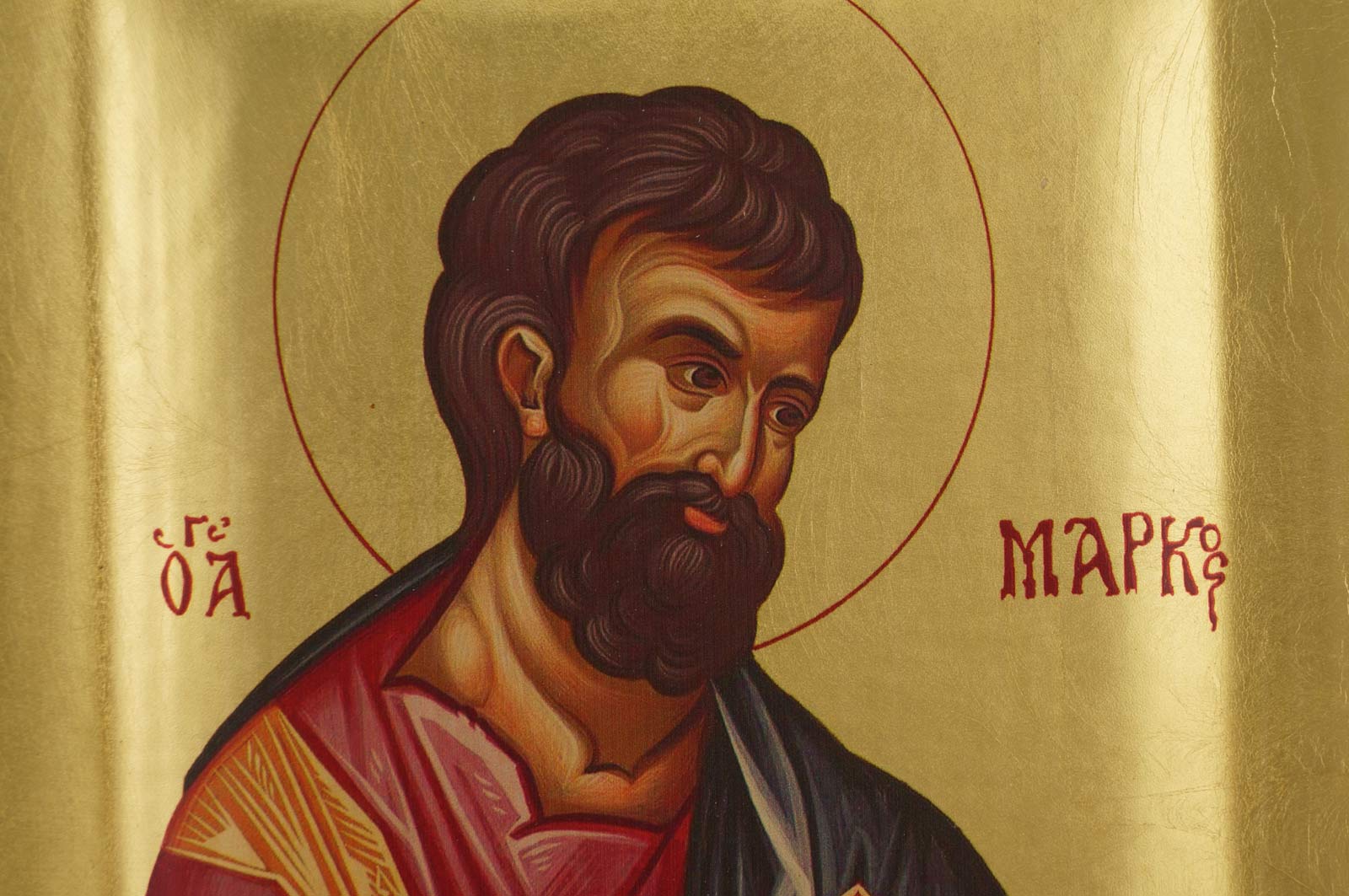
The Apostle Saint Mark, also known as John Mark, was an apostle, evangelist, and the foundational figure of the Church of Alexandria.
He is the author of the second Gospel and is traditionally numbered among the seventy disciples sent out by Jesus Christ. As the first bishop of Alexandria, he is venerated as the first pope and founder of the Coptic Orthodox Church.
His ministry extended across North Africa, Asia Minor, and Italy, establishing him as a universal figure in early Christian history.
Early Life and Apostolic Association
Saint Mark was born in Cyrene, one of the five western cities of the Pentapolis in North Africa, to Jewish parents of the priestly tribe of Levi. His father, Aristopolus, and mother, Mary, were wealthy and educated him in Greek and Hebrew cultures.
The family immigrated to Jerusalem during the time of Christ’s public ministry, where they became prominent members of the early Christian community. His mother was one of the women who followed Christ and provided her home for the gathering of the faithful.
The home of Saint Mark is recognised as the first Christian church in the world.
This residence served as the site for the Last Supper, where Christ celebrated the Passover and instituted the Sacrament of the Eucharist. Following the crucifixion, the disciples sought refuge in its upper room, which later became the scene of the descent of the Holy Spirit on the day of Pentecost.
Saint Mark maintained close familial and ministerial ties with several prominent apostles. He was a kinsman of the Apostle Barnabas and accompanied him and Saint Paul on their initial missionary journeys to Antioch, Cyprus, and Perga.
He also formed a particularly deep bond with Saint Peter, who referred to him as his son in his epistles. Historical accounts describe him as a translator for Saint Peter during his preaching in Rome, where he recorded the apostle’s teachings to produce his Gospel.
Foundation of the See of Alexandria
Following the Apostolic Council in Jerusalem, Saint Mark travelled to Cyprus and then to the Pentapolis in North Africa, where he preached the Gospel for several years.
In approximately 61 AD, he entered Alexandria, which was then the cultural and intellectual capital of the Roman world. His arrival is marked by the traditional account of Anianus the cobbler, who was the first convert in the city.
While Anianus was repairing Saint Mark's torn sandal, the cobbler’s awl pierced his finger, causing him to shout a phrase acknowledging the one God. Saint Mark miraculously healed the wound with clay and spittle and used the occasion to preach the Christian faith. Anianus and his household were subsequently baptised, forming the nucleus of the Alexandrian church.
The rapid growth of the Christian community in Alexandria drew the hostility of the pagan population. Saint Mark ordained Anianus as the bishop of Alexandria, along with three priests and seven deacons, to lead the church before he temporarily departed to preach in the western cities.
Upon his return two years later, he found a flourishing community and constructed a church at a site known as Baucalis on the eastern sea shore.
The Gospel and Iconographic Tradition
The Gospel according to Saint Mark is considered the earliest of the four canonical Gospels. It was written primarily for a Gentile audience, specifically the Roman world, which is evident from the author’s tendency to explain Jewish customs and translate Aramaic terms.
The narrative focuses on the power and authority of Christ, portraying him as a mighty conqueror of sin, sickness, and demonic forces.
The symbol of Saint Mark as one of the four evangelists is the lion. This designation stems from the opening of his Gospel, which describes a voice crying in the wilderness like the roar of a lion.
The symbol is also linked to a tradition regarding his youth in North Africa, where he and his father encountered a lion and a lioness near the Jordan River. Saint Mark prayed to Christ for protection, and the beasts fell dead, leading his father to embrace the faith.
In art and architecture, particularly in Venice, the winged lion became the distinctive mascot and symbol of the saint. Venetian artists frequently depicted the lion as a tamed and quiet beast, representing how the saint eliminated the animal’s cruelty while preserving its courage. This imagery pervades the architectural decoration of Saint Mark’s Basilica in Venice and other monuments dedicated to his memory.
Martyrdom and Relics
Saint Mark suffered martyrdom in 68 AD during the reign of the Roman Emperor Nero. On the day of the Christian celebration of the Resurrection, which coincided with a pagan festival for the god Serapis, a mob attacked the church at Baucalis.
The pagans seized Saint Mark, bound him with ropes, and dragged him through the streets of Alexandria until his flesh was torn.
After being cast into a dark prison for the night, Saint Mark received a vision of an angel and then of the Lord Christ, who granted him peace. The following morning, he was again dragged over rocks and stones until he delivered up his soul. A severe storm prevented the pagans from burning his remains, allowing the faithful to collect his body and bury it in a secret tomb within the church.
In 828 AD, Venetian merchants stole the body of Saint Mark from Alexandria and transported it to Venice. According to legend, the merchants bypassed customs by covering the relics with pork, an act intended to deter Muslim officials from inspecting the cargo.
The head of the saint remained in Alexandria and was later placed in a cathedral named in his honour. In 1968, a significant portion of his relics was returned from Rome to Egypt, an event that led to the construction of a new Saint Mark's Cathedral in Cairo.
The influence of Saint Mark is preserved through the Divine Liturgy that bears his name, also known as the Liturgy of Saint Cyril. This liturgical form is one of the oldest in the Christian tradition and was originally learned by heart until it was put into writing in the fourth century. Its structure is unique among primitive liturgies for placing the great intercession for the living and the dead before the words of institution.