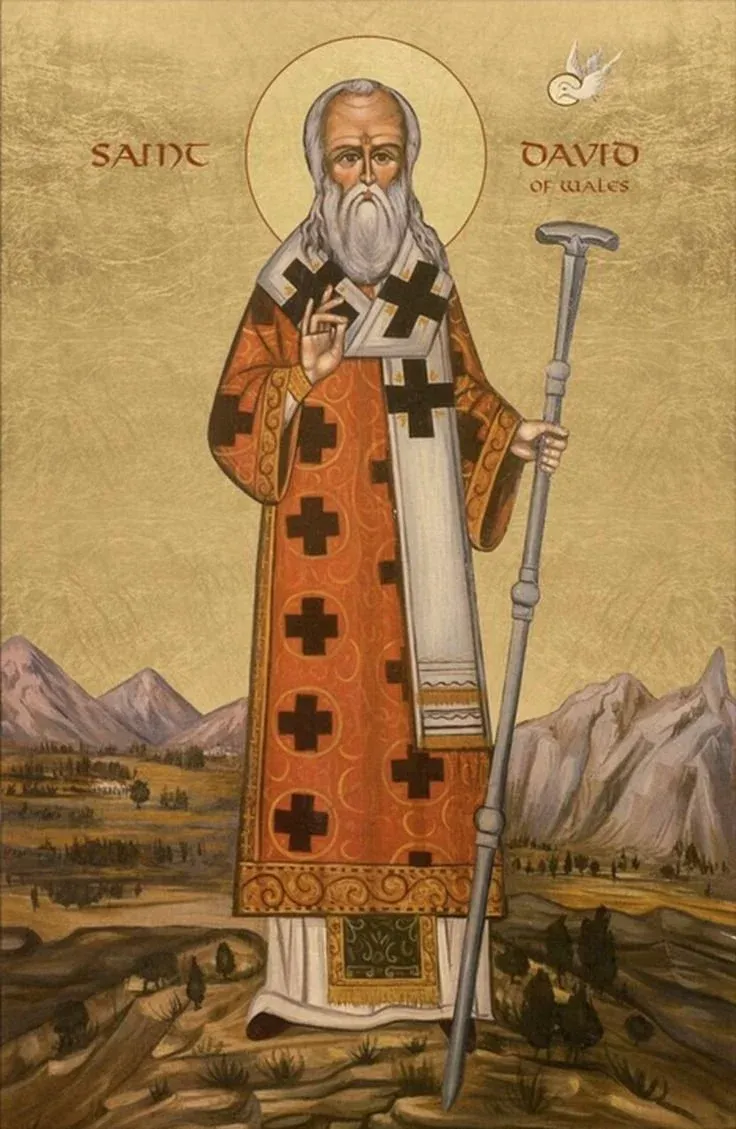
Saint David, the patron saint of Wales, lived during the 6th century AD. He is unique among the patron saints of the United Kingdom for being a local man celebrated in his own land over a millennium after his death.
His ministry was prophesied over a century in advance by Saint Patrick, who foretold that a saint from Welsh shores would lead the country to Christ. Saint David was born to Saint Non, a faithful woman and niece of King Arthur.
His birth occurred in a cave during a fierce thunderstorm, an event that provided divine protection by preventing a pagan ruler from reaching the site to kill the infant. The location of his birth was illuminated by radiant holy light, and the physical intensity of the labour was such that a large rock was split in sympathy with Saint Non.
Early Education and Miraculous Works
Baptism for the young Saint David was performed by Saint Elvis of Munster. During the sacrament, holy water splashed into the eyes of a blind monk named Movi, resulting in an immediate restoration of his sight.
Saint David received his theological education from the blind monk Saint Paulinus. His aptitude for learning was matched by a deep spirituality, evidenced when he cured Saint Paulinus of blindness by making the sign of the Cross over his tutor’s eyes. Following his education, he was sent as a missionary to convert the pagan populations of Britain.
The Ascetic Rule and Monastic Foundation
Saint David established twelve monasteries throughout Wales and England, including the restoration of the ancient site at Glastonbury. His primary community was founded at Mynyw, known today as the city of Saint David’s.
The monastic routine was modelled on the desert fathers of Egypt and was characterised by extreme simplicity and self-denial. Saint David was famously known as the Waterdrinker because he abstained from wine and beer, consuming only water, bread, and vegetables.
The discipline at his monasteries required the monks to engage in strenuous manual labour. Saint David insisted that they pull the ploughs themselves rather than employing cattle or oxen. In addition to their work and prayer, the monks provided hospitality to travellers and cared for the poor. Saint David frequently practised penance by standing neck-deep in the cold sea while reciting the entirety of the psalms.
A miracle at the monastery involved the Irish monk Modomnoc, whose bees followed him whenever he attempted to return to Ireland. After Saint David blessed the insects, Modomnoc was permitted to take them, which resulted in the introduction of honeybees to Ireland.
Battle with Paganism
During his missionary efforts, Saint David encountered resistance from pagan Irish chieftains who had settled in Wales. A chieftain named Boia attempted to drive the monks away, but his warriors and cattle fell as if dead when Saint David offered a prayer of petition. Although Boia briefly converted, his wife remained opposed and attempted to tempt the monks with naked bathers in the local river.
When this failed, she sacrificed her Christian stepdaughter in a pagan ritual, an act that resulted in the emergence of a miraculous healing spring and her own descent into madness. The settlement of the chieftain was eventually destroyed by fire from heaven, allowing the monks to continue their work in peace.
Saint David is also credited with establishing the leek as a national symbol of Wales. He encouraged Welsh soldiers to wear the vegetable in their uniforms during a battle against pagan Saxons to distinguish friends from foes. This tradition persisted through the centuries, being part of the Welsh national identity and mentioned in the literature of Shakespeare regarding King Henry V.
The Synod of Brefi
Saint David travelled to Jerusalem on a pilgrimage to visit the sites of the life and death of Christ. During this journey, the Patriarch of Jerusalem was so impressed by his holiness that he consecrated him as a bishop. His reputation as a preacher was solidified during the Synod of Brefi in 545 AD. As he addressed the large crowd, many of whom could not see or hear him, the ground beneath his feet rose to form a small hill. A dove descended from the heavens and rested on his shoulder while he spoke, remaining there until the conclusion of his sermon. At this synod, he was elevated to the rank of Archbishop.
Repose and Lasting Legacy
Saint David reposed in the Lord on 1 March 589, reportedly at the age of over one hundred years. In his final sermon, he exhorted his followers to remain steadfast and to keep the faith. His last advice was for the people to do the little things they had observed him doing, a phrase that remains a common colloquialism in Wales to this day.
The city of Saint David’s was built around his original monastery, and his relics are kept within the cathedral there. Throughout history, the site has been a major centre of pilgrimage, with two visits to the shrine being equal in value to one journey to Rome. Three visits were considered equivalent to a pilgrimage to Jerusalem.
Saint David is remembered as the figure who brought Christianity fully to Wales, creating a rich heritage of devotion that continues to unify the Welsh people.