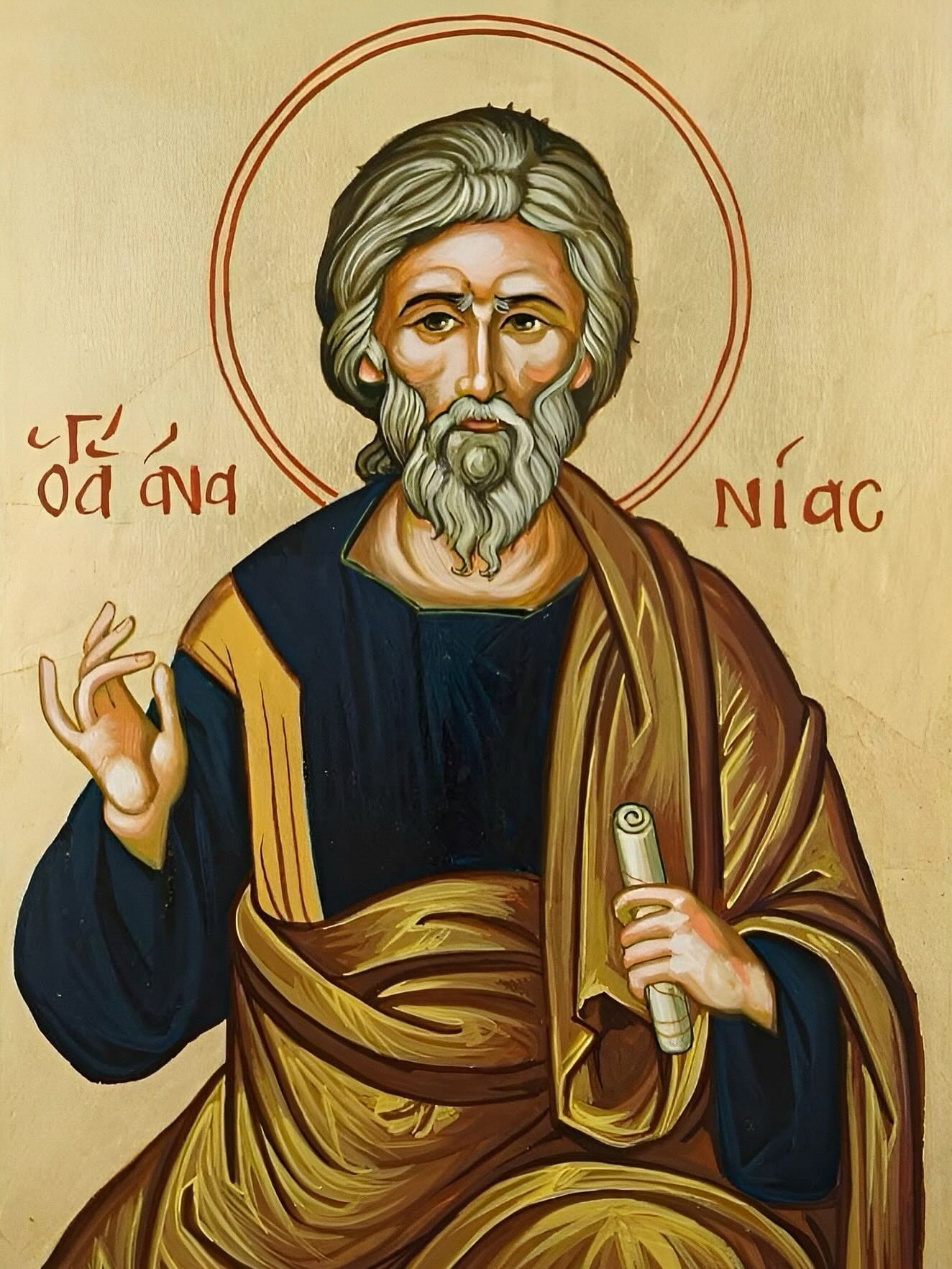
The holy and glorious Apostle Ananias is a foundational figure of the first century whose obedience facilitated the expansion of the Gospel from the Jewish community to the Gentile world.
He is numbered among the Seventy Apostles chosen by the Lord and served as the first Bishop of Damascus. His life represents a crucial intersection of Divine intervention and human cooperation in the economy of salvation. He is commemorated by the Church as a fearless preacher and a crown-bearing martyr.
Biography and Ecclesiastical Office
Saint Ananias was an original disciple residing in Damascus approximately three years after the Ascension of Christ. He was consecrated to the episcopate by the original Apostles to oversee the nascent Christian community in Syria.
It is essential to distinguish this Saint from the figure of the same name mentioned in the fifth chapter of the Acts of the Apostles. While the husband of Sapphira suffered immediate death for attempting to deceive the Holy Spirit, the Apostle was a vessel of truth and a dedicated servant of the Word of God.
His tenure as bishop was characterised by a commitment to the apostolic tradition and the public articulation of the faith. He resided in a house at the end of the Straight Street near the eastern gate of Damascus, which remains a site of pilgrimage.
Archaeological evidence supports the ancient origin of this site, confirming a Byzantine ecclesiastical presence as early as the 5th century. He exercised his ministry during the transition from the earthly ministry of Christ to the global mission of the Church.
The Enlightenment and Baptism of the Chosen Vessel
The primary significance of the Saint in sacred history involves the restoration of sight to Saul of Tarsus. Saul was a notorious persecutor of Christians who had been blinded by a Divine light on the road to Damascus.
In a Christophany, the Lord appeared to the Saint and commanded him to seek out Saul at the house of Judas. Despite initial hesitation due to Saul's reputation for violence against the Saints in Jerusalem, he obeyed the Divine command.
He laid his hands upon Saul, causing scales to fall from the eyes of the former persecutor and restoring his vision. This act was not merely physical healing but a spiritual illumination that transformed Saul into the Apostle Saint Paul.
The Saint then baptized the new convert, marking the beginning of the most significant missionary career in the history of the Church. This event demonstrates how God uses specific human mediators to fulfill the Divine dispensation for the salvation of the world.
Missionary Labours and the Preaching of the Word
Following the conversion of Saint Paul, the Saint embarked on extensive missionary journeys to expand the borders of the Church. He preached with great boldness before both Jewish and Gentile populations, ignoring the inherent physical dangers.
His ministry was validated by numerous signs, wonders, and healings, which led many pagans to renounce their idols. From Damascus, he travelled to the city of Eleutheropolis to proclaim the kingdom of God.
His preaching focused on the Unity of the Trinity and the reality of the Incarnation. He acted as a true hierarch, guiding his flock into the waters of life and establishing churches to the glory of God.
The success of his mission drew the negative attention of the civil authorities, who regarded his influence as a threat to the established order. He remained a faithful observer of the new covenant, demonstrating that holiness is acquired through the synergy of Divine grace and human response.
Martyrdom and the Witness of Truth
The Saint’s commitment to Christ culminated in a heroic struggle against the pagan governor Lucian. Lucian attempted to persuade the Apostle to offer sacrifices to dead graven images, but the Saint refused to worship unclean demons. Consequently, he was subjected to harsh torments, including being beaten with the sinews of oxen and having his sides lacerated. His flesh was burnt with flaming torches, yet he remained an unshaken witness of the Truth.
The governor finally ordered the people to lead the Saint beyond the city walls to be stoned. While being covered with stones, he emulated the Master by praying for his executioners. He finished his course and kept the faith inviolate, entering the heavenly chambers as a victorious athlete. His death was not a defeat but a final confession of the consubstantial Trinity.
Relics and Liturgical Veneration
The sacred remains of the Saint were originally interred by his compatriots and later translated to Constantinople.
Portions of his relics are preserved today in the Basilica of Saint Paul Outside the Walls in Rome, the Kykkos Monastery in Cyprus, and the Ypsilos Monastery in Lesvos. The Church celebrates his feast day annually on October 1. He is also commemorated during the Synaxis of the Seventy Apostles on January 4.
In the divine liturgy, he is addressed as a fervent advocate in intercession and a swift hearer of those who pray. The hymnography for his feast, composed in Tone IV, identifies him as a bearer of light who delivered many from the graves of vanity.
He is magnified for having transformed the wolf Saul into a lamb and shepherd. His life continues to serve as a rule of faith and a model of courageous witness for the global Christian community.