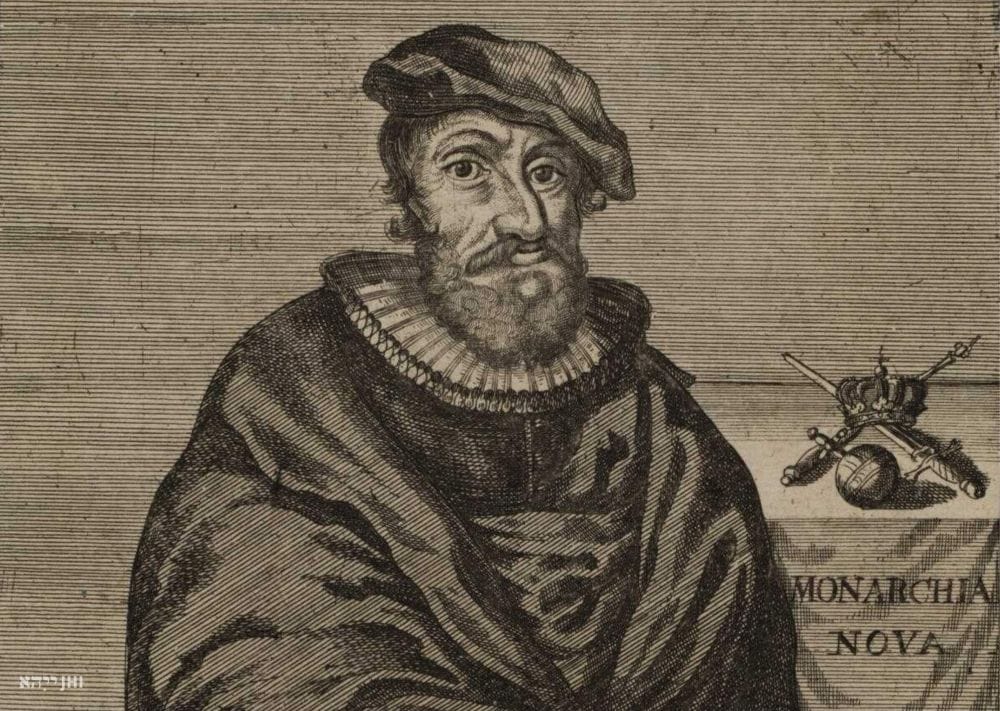
The Messianic Movement of Sabbatai Zevi
The trajectory of Jewish history in the early modern period was irrevocably altered by the emergence of Sabbatai Zevi, a mystic from Smyrna who declared himself the Messiah in 1648.
This declaration, bolstered by the promotional efforts of his prophet Nathan of Gaza, ignited a mass movement that swept through Jewish communities across Europe, North Africa, and the Middle East.
The fervour culminated in 1666, a year imbued with apocalyptic significance. Zevi travelled to Constantinople, where he was arrested by Ottoman authorities. The Sultan offered him a choice between death and conversion to Islam. Zevi chose the turban, taking the name Aziz Mehemet Effendi.
This apostasy did not dissolve the movement but rather transformed it.
Nathan of Gaza constructed a theological framework to explain the Messiah’s conversion, positing that the act was a necessary descent into the realm of evil, or kelipot, to liberate the trapped sparks of the divine light.
This paradox suggested that the Messiah had to become a traitor to his people and religion to effectuate tikkun, or repair, from within the heart of darkness. The apostasy was viewed not as a betrayal but as a heroic, sacrificial act, a Trojan Horse strategy against the forces of impurity.
Consequently, the Sabbatean movement split. While many followers returned to traditional Judaism, a dedicated core followed Zevi into conversion, believing that the new messianic era rendered the old laws obsolete.
The Dönmeh and Crypto-Judaism
The adherents who converted to Islam while secretly retaining their Sabbatean beliefs became known as the Donmeh, a Turkish term meaning turncoats or converts. Among themselves, they referred to their community as _ma’aminim_, or believers.
Concentrated primarily in Salonica until the population exchange between Greece and Turkey in 1924, the Donmeh maintained a distinct, secretive existence. They publicly practiced Islam but privately adhered to a syncretic blend of Jewish mysticism and antinomian rituals. They maintained their own cemeteries, refused to use Turkish courts, and practiced strict endogamy.
The Donmeh liturgy and festivals inverted traditional Jewish practices. The most controversial of these was the Festival of the Lamb, celebrated in the spring, which involved the consumption of lamb meat followed by the extinguishing of lights and orgiastic rites, including wife-swapping.
Children born from these unions were regarded as sacred. This practice reflected the theological conviction that in the messianic age, the restrictions of the Torah were annulled, and the violation of taboos, particularly sexual prohibitions, became a holy obligation.
Following the collapse of the Ottoman Empire and the establishment of the Turkish Republic, the Donmeh ascended to positions of significant influence.
They were heavily represented in the Young Turks movement and the Committee for Progress and Union, which overthrew Sultan Abdulhamid II in 1909. Historical analysis indicates that the Donmeh formed a substantial portion of the secular elite in modern Turkey, influencing the judiciary, education, and politics, while maintaining a wall of secrecy regarding their origins.
This elite status allowed them to advance a proto-secular agenda, instrumental in laying the ideological infrastructure for modern Turkish nationalism.
Jacob Frank and the Radicalisation of Heresy
In the eighteenth century, the Sabbatean torch was taken up by Jacob Frank, born in Podolia in 1726. Frank claimed to be the reincarnation of Sabbatai Zevi and the biblical patriarchs. Under his leadership, the antinomian tendencies of Sabbateanism were systematised into a radical theology often termed Frankism.
Frank rejected the Torah and the Talmud entirely, teaching the heresy that the true God was hidden and could only be revealed through the destruction of existing laws and moral boundaries.
Frankism advocated a doctrine of redemption through sin, or purification through transgression. Frank preached that one must descend into the abyss to rise again, a concept manifesting in the ritual violation of sexual taboos and social norms.
In 1759, mimicking Zevi’s apostasy, Frank and thousands of his followers converted to Roman Catholicism. This conversion was strategic and superficial; the Frankists remained a cohesive group, practicing their distinct rituals behind the veneer of Christianity.
The Frankists were characterised by their integration into the European nobility and their accumulation of wealth. They operated as a secret society within Christendom, much as the Donmeh did within Islam.
Their ideology was explicitly nihilistic and revolutionary, seeking to overthrow the established social and religious order. Frank’s followers believed that by breaking the rules of the material world, they could acquire power and dominion, effectively hacking the system of reality.
Revolutionary Politics and Secret Societies
The influence of Sabbatean and Frankist ideology extended beyond religious heresy into political subversion. The organisational structures and conspiratorial methods of these groups intersected with the rise of Freemasonry and revolutionary movements in Europe.
The Rite of Mizraim, a Masonic order founded in Milan in 1805 and introduced to France in 1816, is cited as having Jewish and Sabbatean roots. This order, along with other secret societies, provided a blueprint for political organisation that was utilised by revolutionaries throughout the nineteenth century.
There is a direct lineage traced from the Frankist doctrine of creative destruction to the revolutionary fervour that swept Europe.
The Frankist rejection of traditional morality and their embrace of chaos as a means of redemption found secular expression in movements that sought to dismantle the ancient régime.
The involvement of Frankists and their descendants in the French Revolution and later in the Bolshevik Revolution suggests a continuity of the Sabbatean revolutionary spirit. The operational mode of these groups involved operating within established institutions, whether religious, political, or social - all while working to subvert them from within, a tactic derived from Zevi’s original apostasy.
Zionism and the Modern Era
The legacy of Sabbateanism and Frankism is deeply intertwined with the origins of political Zionism. While traditional Rabbinic Judaism awaited the Messiah to restore the Jewish state, Sabbatean theology introduced the idea of forcing the end times through human agency.
The secular Zionism that emerged in the nineteenth and twentieth centuries, while ostensibly atheist or agnostic, retained the messianic drive and the dismissal of traditional religious law characteristic of the Sabbatean-Frankist heresy.
Scholars have noted that the founders of the State of Israel and the architects of Labour Zionism shared the Sabbatean impulse to negate the Diaspora and create a new Jewish identity through the seizure of land and power.
The transition from the passive awaiting of redemption to the active, often violent, pursuit of political sovereignty reflects the Frankist imperative to conquer the material world.
The influence of this theology is part of the ideological framework of certain modern political factions. The Neoconservatism movement in the United States, with its origins in Trotsykist thought and its advocacy for creative destruction in foreign policy, parallels the Frankist doctrine of redemption through chaos.
The concept of "redemption through sin" has been adapted into a political theology where the violation of international law and moral norms is justified by the ultimate goal of security and dominance for the Jewish state.
The Holocaust and Collective Identity
The Sabbatean-Frankist paradigm also informs the modern Jewish conceptualisation of the Holocaust. The notion of redemption following a catastrophic descent into the abyss aligns with the historical narrative where the Holocaust serves as the traumatic prelude to the establishment of the State of Israel.
This worldview elevates the Holocaust to a central, sacred event, creating a secular religion of victimhood that justifies the actions of the state. The Sabbatean influence suggests that the catastrophe itself was a necessary stage in the messianic process, a view that fundamentally alters the understanding of Jewish suffering and survival.
In the modern era, the distinction between the religious and the secular has been blurred by these undercurrents. The Sabbatean and Frankist movements, by breaking the vessels of traditional Judaism, released forces that have shaped modern secularism, nationalism, and revolutionary politics.
The Donmeh in Turkey and the Frankists in Europe acted as agents of modernisation and secularisation, undermining traditional religious authorities and promoting a universalist, albeit often nihilistic, vision.
Their legacy persists in the elite structures of the modern world, where the boundaries between the sacred and the profane, the moral and the immoral, continue to be challenged and inverted.