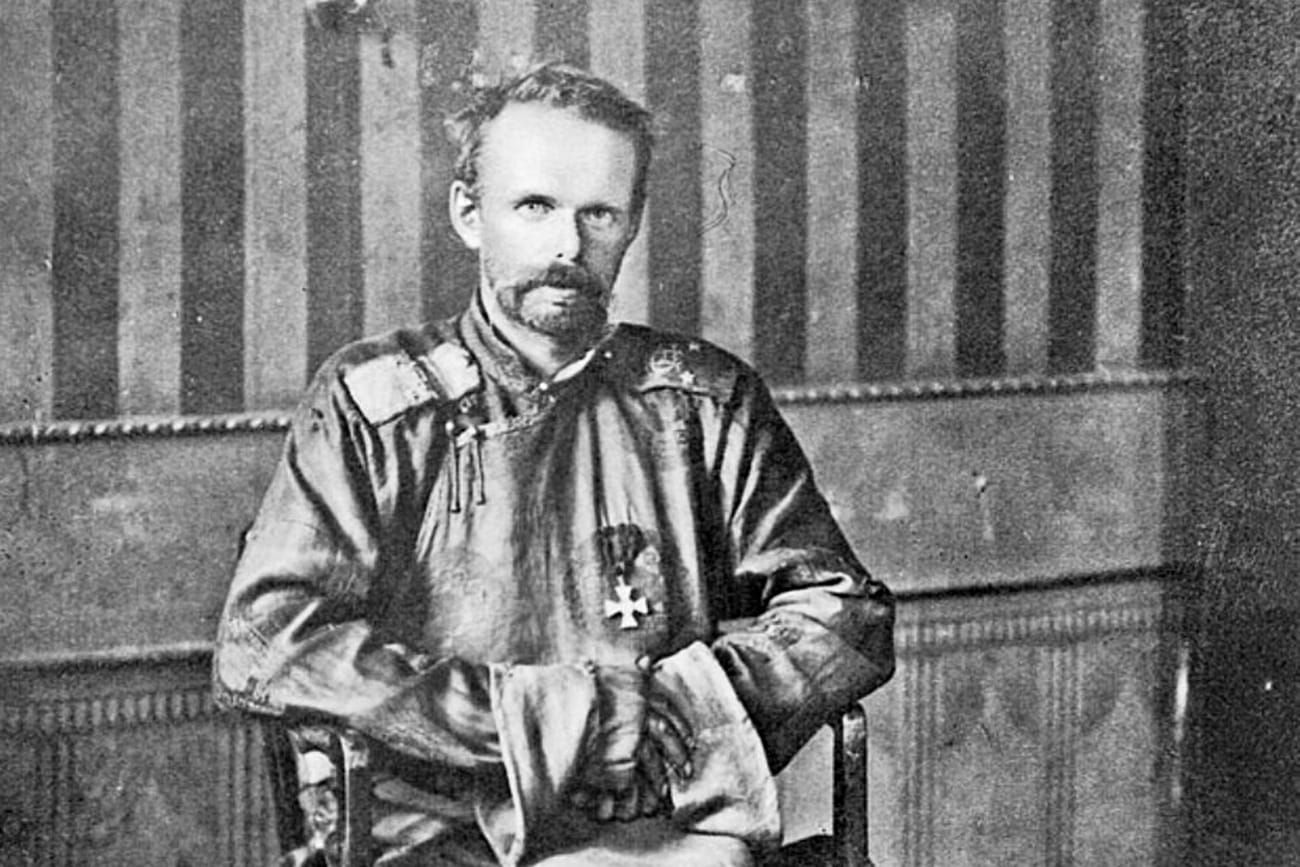
Nikolai Robert Maximilian Freiherr von Ungern-Sternberg was born in Graz, Austria, on 10 January 1886. He descended from an ancient aristocratic family that settled in Estonia during the Middle Ages.
His lineage included Teutonic knights, crusaders, and privateers. He spent his boyhood years in the Governorate of Estonia at the Hoyningen-Huene estate in Jerwakant. The destruction of his family estate by peasants during the Russian Revolution of 1905 produced a permanent contempt for the masses, while deepening his belief in monarchy and the superior virtue of the nobility
He entered the College of Naval Cadets in Saint Petersburg in 1903 but suffered expulsion for lack of discipline. He subsequently graduated from the Pavlovsk Military School in 1908. He specifically requested a posting to a Cossack regiment in Siberia to study Asian culture. Between 1908 and 1913, he served in the Transbaikal and Amur regions. He became an expert horseman and developed fluency in Mongolian and Buryat.
During World War I, Ungern-Sternberg fought on the Eastern European and Southern Caucasus fronts. He earned the Order of Saint George, the highest military decoration for officers. His superiors imprisoned him for two months in 1916 following a drunken physical assault on a fellow officer, but not wanting to waste his talent for war he was sent off to the Transbaikal region to combat the Red Army. He established headquarters at Dauria and formed the Asiatic Cavalry Division. Dauria functioned as a torture centre where suspected revolutionaries faced summary execution.
The White God of War
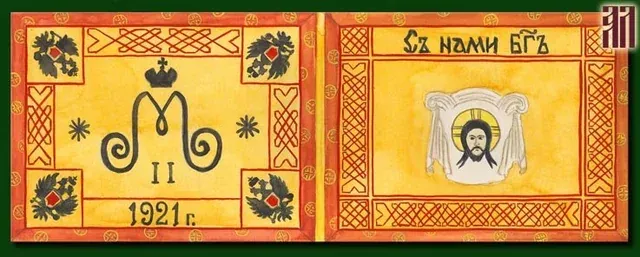
Ungern-Sternberg adhered to a syncretic ideology that combined Orthodox Christianity with Vajrayana Buddhism. He saw in the Russian Revolution a manifestation of the Antichrist, and vowed to restore the Romanov dynasty in Russia and the Qing dynasty in China. He saw himself as a prophesied White God of War and a reincarnation of the deity Mahakala.
He practiced an ascetic lifestyle that renounced worldly comforts and prohibited alcohol among his troops. He lived among his soldiers and shared their rations while enforcing discipline through corporal punishment. His goal was the creation of an order of military Buddhists in Russia to halt cultural decline.
He marked his occupation of Urga using pervasive violence and institutionalised terror. He established a secret police force led by Colonel Leonid Sipailov to purge suspected revolutionaries.
This bureau conducted purges of suspected revolutionaries, intellectuals, and foreigners, especially Jews - for whom Ungern-Sternberg despised as the enemies of Russia and the core agent of Bolshevism. He declares all Jews to be outside the protection of the law and ordered their total destruction. During his occupation of Urga, his troops conduct house-to-house searches to liquidate the Jewish communit
Victims faced ritualistic execution methods, including crucifixion and exposure to wolves on frozen rivers. He justified this violence as a means of assisting the weak to attain stronger forms in their next reincarnation. This culture of fear resulted in the execution of approximately 846 individuals during his stay in Mongolia. His secret police murdered approximately ten per cent of the foreign colony in Urga. He viewed these acts as spiritual purification rites against revolutionary decadence.
Ungern-Sternberg's actions were a drop in the ocean compared to Stalin's brutal purges spanning 1937 to 1939, where over 13,000 Buddhist lamas and monks were executed, and over 600 of the country's historic temples and monasteries were systematically destroyed, exactly what Ungern-Sternberg fought to prevent.
His Final Acts
The collapse of the military campaign in Siberia during the summer of 1921 led directly to the capture of Roman von Ungern-Sternberg. Red Army units launched a coordinated counteroffensive that fragmented the Asiatic Cavalry Division and forced its remnants to retreat toward Mongolia.
Exhausted by erratic behaviour and the prospect of a suicidal retreat to Tibet, senior officers within the division staged a mutiny in August 1921. Ungern-Sternberg escaped two assassination attempts by his own subordinates before fleeing to a detachment of Mongol soldiers.
The Mongol soldiers refused to harm the Baron because they accepted his status as a manifestation of the White God of War. They tied him up and left him immobilised on the ground where the approaching Red Army could find him.A Red Army patrol under the command of guerrilla leader Petr Shchetinkin captured him on 20 August 1921. At the time of his discovery, the Baron was reportedly covered in ants where his former allies had abandoned him to his fate.
The Bolshevik authorities transported Ungern-Sternberg to Irkutsk for preliminary interrogation at the headquarters of the 5th Red Army. He was later moved a thousand miles west to the railway town of Novonikolaevsk.This location served as the newly proclaimed capital of Red Siberia. The government selected this site to ensure the subsequent proceedings drew maximum public attention as an act of political theatre.
The trial of Roman von Ungern-Sternberg occurred on 15 September 1921. It functioned as a formal show trial designed to justify Soviet military intervention in Mongolia and discredit the White movement.
.The entire proceeding lasted six hours and fifteen minutes. Yemelyan Yaroslavsky directed the prosecution and accused the Baron of acting as a mercenary agent for Japanese imperial interests. The tribunal focused on his counter-revolutionary activities and his record of systematic violence during the occupation of Urga. Bolshevik authorities wanted to portray him as a villain who sought to reimpose the yoke of the aristocracy upon Russian workers.
Ungern-Sternberg remained calm and dignified throughout the judicial process. He refused to recognise the legitimacy of the tribunal, stating that it was as illegitimate as the Communist government in Moscow.
During his testimony, he openly acknowledged the charges of mass murder and the liquidation of Jewish populations. He informed the prosecutor that the Communist International had been organised three thousand years ago in Babylon. The Baron denied being an agent of the Japanese, asserting that his actions were driven by a personal mission to restore monarchical order. He maintained that his use of extreme discipline and executions followed established military precedents dating back to Frederick the Great.
The court found Ungern-Sternberg guilty of all charges and sentenced him to death by firing squad. The sentence was carried out on the night of 15 September 1921 in the prison yard at Novonikolaevsk. Before the execution, he reportedly swallowed his military medals, including the Order of Saint George, to prevent them from being defiled by his enemies. He refused to ask for mercy or beg for his life at any point during the proceedings.
Upon hearing news of the execution, the Bogd Khan ordered special services to be held in temples throughout Mongolia. The death of the Baron marked the definitive termination of organized White resistance in the region and facilitate the establishment of the Mongolian People's Republic