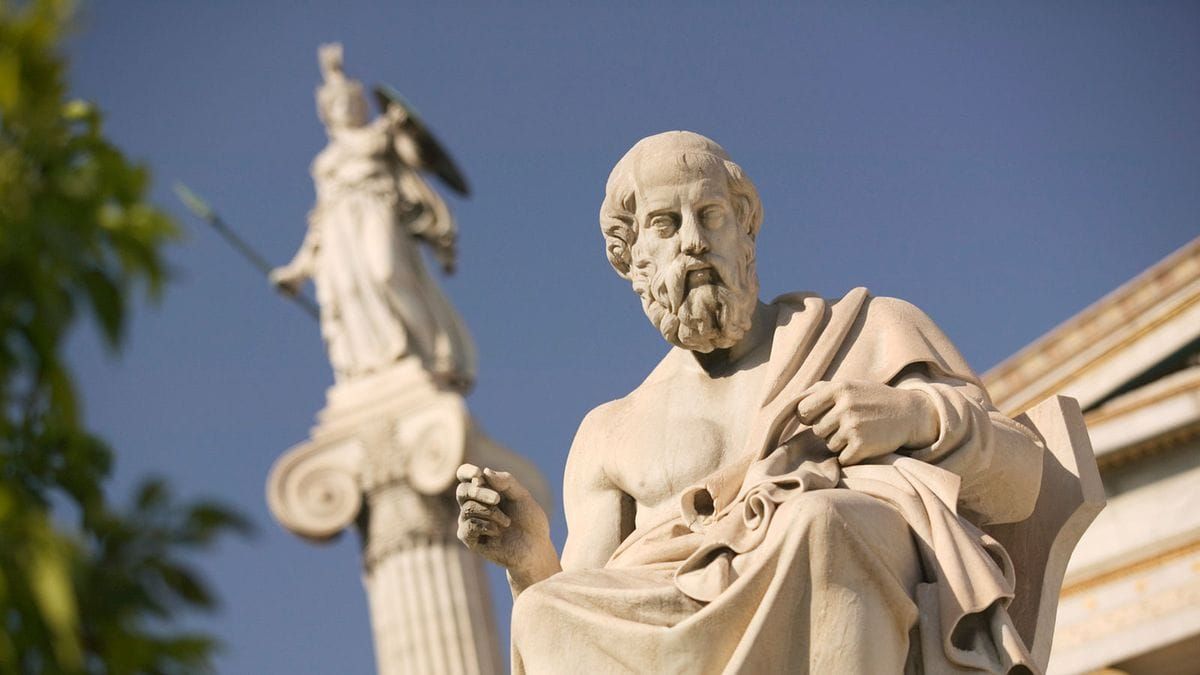
The Heritage and Tradition of Plato
Plato functioned as the bearer of an oral tradition rooted in ancient Egyptian thought and was potentially influenced by the sojourn of Moses in that region. His philosophical mission was largely defined by the elenctic method, a process of examination that sought unique and definite accounts for virtues such as justice, piety, and courage.
He saw ignorance as the primary defect of humanity and the fundamental cause of vice and ill living. Consequently, he advocated for a life of critical thinking and mathematical mastery as the only means to arrive at the truth. His work - Platonism - represents a significant stage of rationalisation within Greek thought, moving away from the primal narratives of Homer toward a system grounded in objective essences.
The Metaphysics of the Intelligible Order
The platonic system is constructed upon the belief in objective, invariant metaphysical principles that exist independently of human perception.
These principles are identified as the Forms, which are atemporal, extra-spatial, and necessarily existent. Plato argued that truth is eternal, as evidenced by the mathematical reality where the destruction of a physical representation of a number does not destroy the number itself.
This worldview maintains that the external world is highly structured and designed, possessing an inherent purpose or telos. The human intellect, or noose, is described as an inner eye capable of seeing through the transient phantoms of the physical realm to access these eternal truths. To facilitate the concrete instantiation of these Forms, he posited the existence of a receptacle, which serves as a medium for their manifestation.
The Soul and the Preparation for Death
Philosophy is defined by Plato as a preparation for death, requiring a noble courage to face the inevitable end of bodily existence. He saw the soul as a simple and non-composite entity that is more akin to the eternal Forms than to the composite and ever-changing material body.
The soul possesses a natural capacity to transcend the physical realm and enter into communion with the divine. This ascent requires the practice of apathythea, the state of becoming passionless and liberated from the dictates of greed, lust, and addiction.
Through this intellectual and moral purification, the soul anticipates a form of intellectual resurrection. While his system suggested the cyclical transmigration of souls, it simultaneously maintained that the ultimate goal is the return to the monad or the source of being.
The Mathematical State and the Noble Lie
His ideal Republic is a mathematical state constructed in a rational and coherent manner. This social order is structured triadically, corresponding to the tripartite division of the human psyche: the rational faculty, the spirited element, and the appetitive desires. These correspond to the three classes of the city, with the philosopher king residing at the apex of the hierarchy.
To maintain this order, Plato advocated for the implementation of a noble lie, or Phoenician story, which is a state-constructed Mythos designed to ensure that each citizen accepts their role within the social pyramid.
This includes the strict regulation of the arts and music, which must be censored to prevent the unleashing of irrational forces that could lead to social decay. Music can be understood as mathematics in time, and its harmony is essential for the cultivation of self-control within the guardian class.
Plato in the Context of Eastern Orthodoxy
The relationship between Platonism and Eastern Orthodoxy is characterised by a complex process of absorption and transfiguration.
Byzantine theologians identified the platonic Forms not as independent entities but as the divine thoughts and wills of God, known as logoi. This adaptation allowed for a theocentric anthropology where man is an open being naturally participating in divine grace.
The goal of the philosopher, to see the good in itself, is seen as a precursor to the Christian doctrine of theosis, or deification. There is a specific Orthodox tradition maintaining that Plato, despite his pagan status, was among those liberated from the underworld during the harrowing of Hades by Jesus Christ.
However, the Church remained consistently distrustful of specific platonic errors, such as the eternity of matter and the pre-existence of souls, which were formally condemned at the Fifth Ecumenical Council in 553 AD.
The Rejection of Materialism and Relative Knowledge
Platonism serves as a fundamental refutation of materialism and naive empiricism, which Plato rightly saw as a trap for those bound by the senses.
He argued that knowledge is not grounded in sensory experience alone, as the human mind is pre-conditioned to link similarly appearing objects through transcendental categories. This system maintains that the External world is rational and that human reason is a tool provided to interact with this inherent design.
The existence of objective truths, such as those found in geometry and mathematics, demonstrates that reality is grounded in a higher level of being that transcends the merely material. By exiting the mental prison of deceptive sensory perceptions, the philosopher king is able to step into the light of absolute and objective truth. This orientation ensures that the individual is not a slave to the passions but acts in accord with the eternal archetypes of goodness and justice.