1967
Beyond a mere children's tale, Pinocchio is a manifesto of occult secrets, encompassing Luciferian, Gnostic, Masonic, Kabbalism, and MK-Ultra themes, whilst also portraying the story of creation and The Fall of man.
The story of Pinocchio originated from Carlo Lorenzini, known by his pen name Carlo Collodi, an Italian author. Lorenzini was a theological student who transitioned into politics and journalism during Italy's wars for independence around 1850-1860.
He held strong political opinions and cultural visions for Italy, publishing a serial titled The Story of a Marionette in 1880, which later became The Adventures of Pinocchio in 1883.
As an initiated Freemason and an enlightenment-era revolutionary, Lorenzini utilised characters to express his convictions through allegory. His work was sometimes considered too inflammatory, leading to publications being banned.
He was a devoted follower of Giuseppe Mazzini, a figure associated with a conspiracy letter detailing three world wars. The narrative reflects Enlightenment ideals, suggesting a will to power over nature, yet also incorporating a romanticised return to nature and a transformation from darkness to light.
An Esoteric Intent
Pinocchio is not merely a children's tale but a parable, designed for initiates to discern its hidden meanings.
The Gnostic perception of the world is as an evil place of suffering and decay, which is akin to hell itself. In Gnosticism, creation itself is seen as fundamentally antagonistic to humanity's desire for eternal ascent, a stark contrast to the Christian view where God's creation is inherently good.
Within Gnostic belief, true God, known as the Pleroma, exists far beyond human comprehension, relationship, or care, akin to a detached watchmaker or a craftsman who simply initiates creation and allows it to proceed.
This Pleroma is the ultimate transcendent being, responsible for emanating all worlds, and is also referred to as the Numa, or the light, representing a pre-existent, uncaused, perfect entity. The maternal aspect of this light is known as the Protean, or first thought. Beings called Aons are brought forth from this light, existing as intermediaries between the ultimate God and humanity. When these Aons are in harmonious unity with the light, they form the Pleroma, or fullness, which stands in opposition to humanity's perceived state of emptiness.
An extraordinary Aon is Sophia, or wisdom, who is directly symbolised by the Blue Fairy. Sophia’s transgression involved her desire to reproduce without the consent of the light or her male Aon counterpart. Her offspring is described as an abortion, a flawed emanation known as the Demiurge, or the maker, or the architect, also identified as Yaldabaoth, which Gnostics equate with Yahweh. This perspective inverts the traditional creation story, characterising matter as evil and a product of a mutant birth.
Geppetto is identified as the Demiurge; a lesser god who crafts imperfect beings or puppets. His pervasive collection of clocks symbolises his role as Father Time, or Saturn, representing the significant limitations of time. He is the maker, but not the ultimate divine entity. Pinocchio represents man, created in an unperfected or imperfect state. His journey necessitates acquiring a divine spark to achieve the state of a real boy, an illuminated man, or a perfect Ashlar (a term from Freemasonry).
The Fox and the Cat are the Archons, depicted as watchmen or henchmen whose function is to tempt Pinocchio away from his path. The Blue Fairy is Sophia, the Gnostic wisdom. She descends to Earth to impart the divine spark to Pinocchio, and the tip of her magic wand overtly displays a pentagram.
Gnosticism seamlessly transitions into Luciferianism within this interpretation. The opening scene, where a wish is made upon a star, holds profound esoteric significance, as stars, pentagrams, and transmissions from outer space are central in Magic.
The concept of divine sparks is intrinsically linked to Kabbalah. In Kabbalism teachings, every human being is considered a fragmented portion, a tiny spark of God, and when these individual sparks unite, they collectively form God, an idea related to Adam Kadmon. This implies that the more individual lights merge, the greater the manifestation of divine presence.
Pinocchio’s journey is also the Fool’s Journey, a concept originating from tarot decks. The Fool card, depicting a figure about to walk off a cliff, is highly emblematic of Pinocchio’s initial state. Tarot itself, or Trochi, has its roots in Italy. Pinocchio's progression towards becoming a perfect Ashlar is a Freemasonic aspiration.
Narrative as Initiatory Path
The progression of Pinocchio’s story, from an occult perspective, functions as an initiatory path, revealing esoteric principles through its events and character development.
Jiminy Cricket, initially portrayed as homeless, symbolises a potential for conscience that must find its proper place and mature through worldly interaction. In the context of high magic, Jiminy Cricket represents the Holy Guardian Angel, which is interpreted as the higher self, serving as the guiding needle on life’s compass.
Pinocchio’s initial choice to abandon school and pursue fame and fortune with the Fox and the Cat symbolises the fall of Adam, representing an early succumbing to temptation. An actor's life, in this view, is a path of temptation.
Pinocchio’s subsequent capture by Stromboli, who locks him in a cage, illustrates that even when he believes himself free from strings, he remains under control, indicating that systems can integrate and contain those who believe they are rebelling.
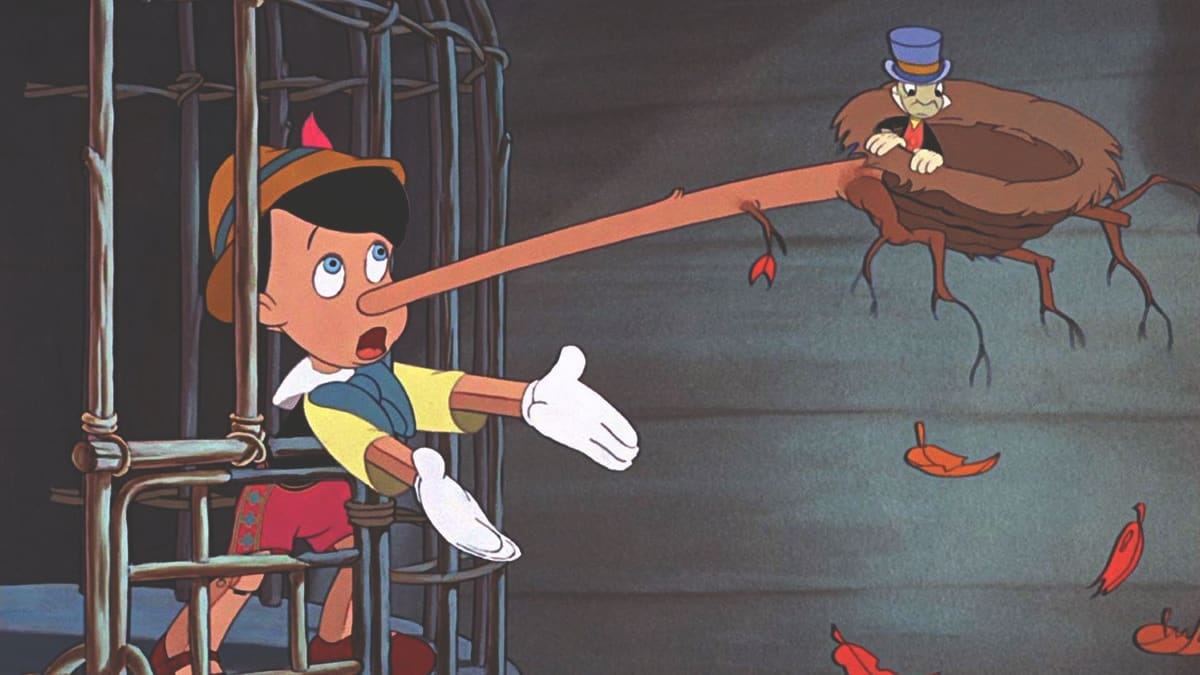
Pinocchio's act of lying, which causes his nose to grow, physically deforms his countenance. This visual transformation powerfully illustrates how deceit alters an individual's appearance and inner being, presenting a dark metamorphosis. Lying, especially during a moment akin to confession, impedes one's healing and progress.
Pleasure Island is a dark and insidious place of gluttony, fighting, and smoking. The more a boy engages in negative behaviour, the quicker he transforms into a donkey. This descent into degeneracy is symbolic of the inverted pentagram, where the aim is to regress humanity towards a more animalistic state, thereby trapping them.
The Coachman is a devil, a demonic entity and a child trafficker, accompanied by dark, oily, demonic figures. He conspires with the Archons (the Fox and the Cat) at a crossroads at midnight, a classic voodoo symbol for occult meetings to abduct young boys.
He explicitly states that boys taken to Pleasure Island never return as boys, and he physically transforms into the devil after detailing his sinister plan. Pinocchio's subsequent self-sacrifice, death, and return to life, facilitated by fire as a means of escape, mirrors a transformative, albeit not exclusively Christian, act of redemption.
A Jungian Interpretation
Pinocchio embodies Jungian archetypes, existing as a marionette, a quasi-animated entity lacking true volition, manipulated by unseen biological and cultural forces, akin to individuals swept up in broad ideological movements.
He is a half-formed wooden-headed puppet, possessing inherent potential yet subject to external control. His journey is one of transformation from this deterministic state to an autonomous, living being, a process that involves learning the distinction between good and evil and cultivating truthfulness in speech and action. His initial wooden head symbolises an unrefined or undeveloped consciousness.
The Good Father and Benevolent Culture
Geppetto is consistently portrayed as a kindly old craftsman, representing the positive archetype of the masculine and culture in its most beneficial manifestation. His profound wish for Pinocchio is for the development of his autonomy and for him to become real, not merely an obedient son or a subservient creation.
This wish reflects the ideal aspiration of a benevolent father for his child. Geppetto’s act of carving Pinocchio a mouth symbolises the bestowal of the Logos, the capacity to use language to manifest order from chaos—a spark of divinity inherent within human beings.
Allowing a child to possess and develop their own voice is essential for their autonomous growth. Geppetto’s genuine happiness at Pinocchio’s emerging autonomy reinforces his role as a truly good and supportive figure. His encouragement serves as a prerequisite for the emergence of individuality.
Benevolent Nature and Transformative Force
The Blue Fairy is intrinsically linked to the wishing star, serving as an avatar of a divine entity. She represents Mother Nature in her positive, aiding guise, acting as the primary transformative agent. Her animation of Pinocchio signifies the infusion of soul and his liberation from strings.
This intervention suggests that when cultural aims (symbolised by the father) are correctly aligned for a child, Nature will cooperate, facilitating their flourishing. The removal of Pinocchio’s strings by the Blue Fairy illustrates that the intervention of nature is what ultimately produces autonomy.
The Conscience and the Developing Self
Jiminy Cricket initially appears as a tramp, later evolving into Pinocchio's conscience, a nagging, still small voice that prompts awareness and self-correction. His name carries an implicit allusion to a messianic figure. Jiminy symbolises the Jungian Self, representing the potential for a fully developed human being that exists as a possibility within an individual.
He is the initial guide to profound knowledge, akin to an introduction to a significant text. The conscience, however, is not omniscient; it must learn and mature alongside the individual through dialogue and interaction with the world. Jiminy’s initial state as a homeless tramp highlights that this potential self seeks a specific manifestation and integration into the individual's life.
The World as Explored and Unexplored Territory
Existence is perceived as a dynamic interplay between explored territory (culture & order) and unexplored territory (chaos & potential). Unexplored territory is simultaneously the source of great opportunity and lethal peril.
Explored territory, or culture, compels individuals towards submission and Conformity to achieve civilisation. Human beings navigate this dual landscape, possessing both admirable qualities and malevolent aspects. Chaos embodies pure potential, the state of profound disorientation, and an eternal, terrifying predatory force.
Another fundamental principle is that aligning with truth ensures reality's support, whereas deceit invites reality's opposition, leading to adverse outcomes. Belief is understood not merely as intellectual assent to propositions but as a committed act or decision that one embodies in the world.
The Hero's Journey and the Integration of the Monster
The narrative depicts the universal hero's journey, which involves confronting the terrible unknown and strengthening oneself through this challenge. For true virtue, the hero must not be merely harmless but must integrate and control their show - or inner monster - the capacity for malevolence.
This integration grants the ability to assert oneself and say no effectively in negotiations. The successful integration of identity is vital for overcoming existential threats.
The concept of the wishing star signifies the importance of identifying and pursuing an ultimate, transcendent goal. This pursuit is accessible to everyone, irrespective of their background.
Aiming for one's highest possible self or ideal outcome generally leads to the most favourable results. Meaning in life is derived from the process of striving towards a goal, rather than solely from its attainment. An ultimately meaningful life necessitates embracing ultimate responsibility.
The story highlights the developmental period between two and four years of age, during which children integrate their motivations and emotions into a functional psychological unity, or ego, largely under social influence.
Parental guidance during this period is critical for a child’s proper socialisation, facilitating their transformation into a functional unity by age three or four. Rewarding compliant behaviour reinforces the ego’s ability to regulate underlying impulses.
Human society is structured by an implicit social contract, where individuals align their expectations and desires to mitigate conflict. This contract safeguards against both physical demise and psychological disarray.
The overarching meta-game of life is not about winning every individual competition but about being consistently invited to participate in all possible games, a state achieved by playing fairly. The human capacity to detect cheaters is an ingrained moral mechanism.