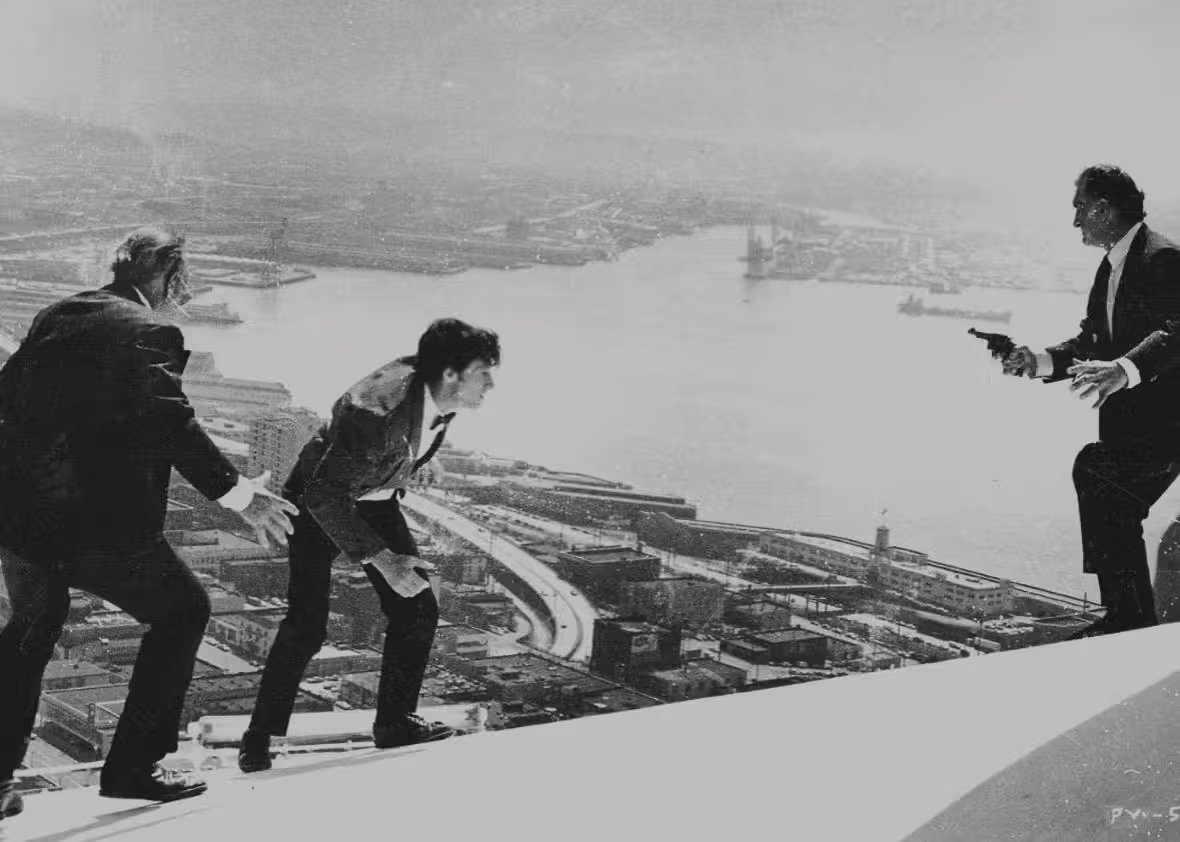
1974 film by Alan J. Pakula
The Parallax View, a 1974 American conspiracy thriller, holds significant status as a classic within its genre, often cited alongside other notable 1970s films such as Network. Emerging from the era of post-Vietnam and post-Watergate paranoia, it profoundly influenced the cinematic portrayal of conspiracy and public unease.
The film's production involved key creatives, including the director and cinematographer, who also contributed to several other acclaimed 1970s conspiracy thrillers, as well as iconic works such as The Godfather, The Godfather Part Two, and Apocalypse Now.
The cinematic approach of The Parallax View is characterised by its distinctive framing, which consistently depicts human subjects as minuscule against overwhelming structures, conveying the immense scale of the overarching system.
The narrative begins in Seattle, opening with a visually striking composition featuring a colossal totem pole juxtaposed with the Space Needle. The initial sequence unfolds at the Space Needle restaurant, where Senator Charles Carroll, a presidential candidate, is assassinated.
Three years subsequent to this event, the film introduces Joe Frady, a journalist portrayed by Warren Beatty. Initially, Frady dismisses concerns about the assassination as unfounded.
His perspective shifts dramatically following the death of a fellow reporter who was present at the original assassination, had expressed profound fear for her life, and believed that all witnesses to the event had been systematically eliminated.
Frady's investigation leads him to infiltrate a covert organisation known as The Parallax Corporation. He discovers information about this entity in a sheriff's desk, which motivates his deep undercover operation.
As part of his induction into The Parallax Corporation, Frady undergoes an unusual psychological assessment, displaying characteristics reminiscent of the Ludovico method, famously depicted in Stanley Kubrick's A Clockwork Orange.
During this process, Frady is exposed to a rapidly flashing sequence of still images and archetypal words, including concepts such as 'mother,' 'father,' 'home,' 'country,' and 'God,' intercut with disturbing imagery of war and political figures.
Unlike A Clockwork Orange, where the audience directly observes the subject's experience, The Parallax View positions the viewer to observe Frady from a distance, with the visual sequence appearing to directly affect the audience, suggesting a form of shared, unsettling manipulation.
This technique akin to a sanitised Ludovico method or a low energy MK-Ultra.
The film culminates in a large civic centre where another political figure is to be assassinated. Frady finds himself in the rafters, leading to a crucial revelation: he is positioned directly above the scene of the next assassination, where he discovers a rifle. The candidate is killed, and Frady, attempting to escape, is ultimately framed for the crime, having been unknowingly manipulated into becoming an unwitting patsy.
The film is stylistically bookended by scenes featuring a government commission, which bears a strong resemblance to the Warren Commission, which publicly declares the assassinations to be the work of a lone individual, effectively suppressing any notion of a larger conspiracy.
Underscoring the systemic control over public perception of reality.
Central Themes and Interpretations
Conspiracy and Statecraft
The film is a conspiracy classic that contains overt allusions toJFK Assassination theories, including suggestions of involvement by powerful individuals associated with oil interests and organised crime.
It critiques the pervasive "lone gunman" narrative as a fabricated official story, positing instead that covert corporate mercenary units are employed by front entities to execute such operations.
This intricate stagecraft is a pivotal element, with the film's climax meticulously orchestrated to position Frady as the designated assassin.
Assassinations throughout the film are depicted as commonplace, executed through various means such as vehicle collisions, plane crashes, poisonings, drug overdoses, and heart attacks, frequently disguised as accidents or the actions of isolated individuals.
This portrayal aligns with the increasing privatisation of intelligence operations from the 1980s onwards, shifting responsibilities from traditional agencies like the CIA, NGOs and other entities. This prophetic aspect anticipates the contemporary recruitment methods for mercenaries and assassins.
The Parallax Corporation and Perception Control
The clandestine organisation at the core of the narrative is a mega entity, likened to a Black Rock, exerting pervasive influence across various sectors.
Its name, Parallax, directly refers to the optical phenomenon where objects appear to shift relative to their background when viewed from different vantage points or perspectives.
The corporation's fundamental objective is to manipulate the perception and interpretation of reality, embodying the principle that controlling perception negates the need to control reality itself.
This entity operates a human engineering division, which specifically recruits individuals exhibiting antisocial sociopathic psychopathic tendencies, deeming them ideal for a privatised MK-Ultra programme.
The film suggests that these recruits are psychologically conditioned through flattery and affirmation of their uniqueness, making them believe they are perfect for this program due to their divergence from societal norms.
MK-Ultra and Unwitting Agents
A central thematic concern is the exploration of MK-Ultra and its application in manufacturing unwitting agents. Frady's psychological examination, with its rapid succession of images and words, manipulates archetypes rather than employing the more brutal physical and chemical methods portrayed in A Clockwork Orange.
This very low energy depressing MK-Ultra is depicted as subtly influencing individuals towards predetermined roles. The film's foresight extends to a technocratic future where a select elite manages humanity, akin to lab rats or monkeys playing video games.
Frady is implicitly profiled from an early stage; his personal instability and unusual personality are identified as assets for manipulation. His apparent lack of emotional response or self-preservation, evident when he calmly remains on a plane with a known bomb, further highlights his suitability as a programmed individual.
The Journalist as a Managed Asset:
The film critically re-evaluates the role of the journalist, contrasting it with the idealised image of the intrepid journalist of the 1960s and 1970s who was willing to risk everything for truth. Unlike the supportive editors in films such as All the President's Men, Frady's superior, Hume Cronin, is a handler.
Cronin offers financial incentives, delves into Frady's personal life, and labels him a "hostile misfit" with "blatant antisocial behaviour," suggesting a manipulative dynamic. The deserted newsroom where their meetings occur further implies that these interactions may be part of an elaborate charade.
Frady's initial apathy regarding the assassinations contrasts sharply with the archetype of the truth-seeking journalist, as his motivation appears to be primarily financial rather than a quest for exposé. This portrayal resonates with contemporary observations about the decline of traditional journalism.
Visual Language and Perceptual Distortion
The cinematography deliberately manipulates perspective. Shots frequently frame characters as insignificant figures against vast, encroaching backdrops such as immense dams or buildings, visually reinforcing the overwhelming power of the controlling system over individuals.
The film's opening shot, which makes a distant Space Needle appear similar in size to a nearby totem pole, exemplifies this deliberate distortion of visual perspective.
Scenes like the Space Needle assassination, initially viewed from within and then disorientingly from outside through glass, create a sense that events are simultaneously witnessed and obscured.
This visual ambiguity reinforces that our perspective is distorted by events, and despite clear visual evidence, only the officially sanctioned narrative is remembered. The strategic use of lighting to obscure a character's face, particularly the handler's, symbolises the protagonist's gradual loss of his own identity.