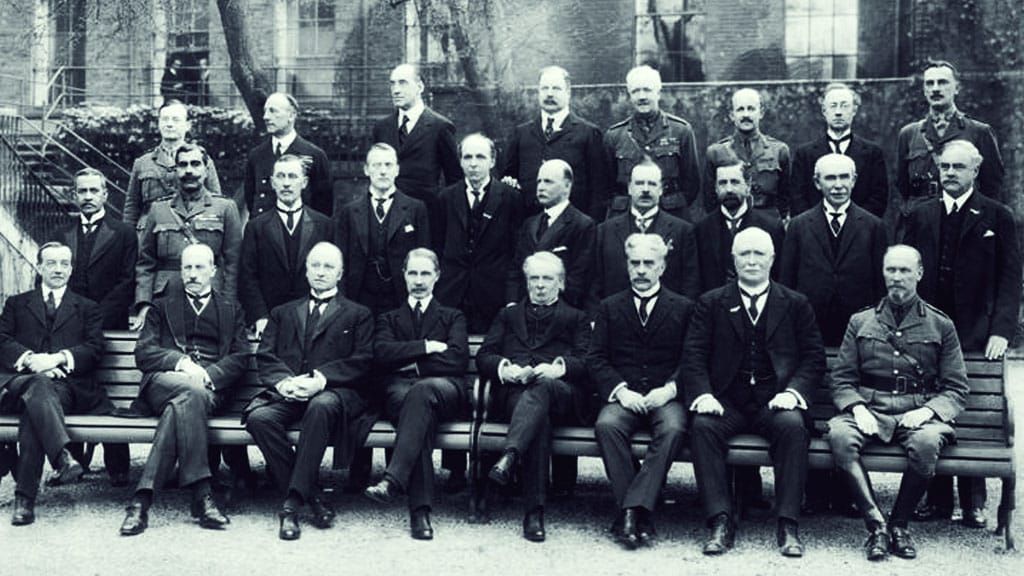
Members operated through a policy of secrecy, exercising power without public recognition, influencing major historical events through political penetration and media control.
The genesis of the group occurred at Oxford in the early 1870s around Arnold Toynbee and Alfred Milner. Cecil Rhodes, William T. Stead, and Reginald Baliol Brett formally established the society in London in February 1891. Rhodes served as the initial leader while an inner circle called the Junta exercised power.
Milner became the successor to Rhodes in 1901. The organisation adopted several names including Milner's Kindergarten and the Round Table Group. These terms referred to the Association of Helpers which formed the outer circle of the society.
The Society of the Elect constituted the inner core of the organisation. Membership recruitment relied on intellectual ability and social connections within the upper class. Oxford colleges including Balliol, New College, and All Souls served as the primary recruiting agencies.
Core Ideology
The Milner Group operated under an ideology derived from Toynbee and Balliol College. Members viewed the British Empire as a moral vehicle for the expansion of freedom and the rule of law. This vision necessitated the preservation and extension of Imperial unity to form a Commonwealth of Nations.
A sense of duty to serve the state through social and educational work was a primary conviction. The group preferred efficient administration by experts over unrestricted party politics and the parliamentary system. This approach reflected a belief in managerialism where unseen managers implemented policies for the public good.
Cultural outlook and educational background justified temporary exclusions from political participation. Members of the inner circle were not racially intolerant and advocated for the education of all groups within the Empire. They believed that these factors were more relevant than race or birth.
Instruments of Media and Academic Influence
The Round Table journal acted as the primary mouthpiece for the group after its foundation in 1910. Articles were published without names to conceal the small number of writers and their political status. The journal aimed to influence writers who provided content for the average reader.
The group controlled The Times newspaper directly from 1922. This media control enabled a mutual reinforcement mechanism with the Foreign Office. Influence extended to other periodicals including The Economist and The Spectator.
The group dominated the intellectual life of Oxford University in the fields of law and history. Control of the Rhodes Trust and the Beit Trust ensured that academic appointments served group objectives. George Parkin established selection methods to ensure Rhodes Scholars furthered the aims of the organisation.
Lionel Curtis established the Royal Institute of International Affairs to influence a broader audience. This institution served as the widest public aspect of the group. It operated alongside the Institute of Pacific Relations and the Council on Foreign Relations in the United States.
Leveraging Conflict
The group was responsible for causing the Boer War through the plotting of the Jameson Raid in 1895. Members dominated the war administration of Lloyd George from 1917 to 1919. They formed the British delegation to the Paris Peace Conference in 1919.
The group initiated a campaign to revise the Treaty of Versailles shortly after its completion. They sought to rebuild Germany as a barrier against Bolshevism and French militarism. Efforts within the League of Nations focused on limiting its power as an instrument of collective security.
Members consistently held cabinet posts and senior positions within the Colonial Office and Foreign Office. The group influenced King George V in the selection of Stanley Baldwin as Prime Minister in 1923. They played a secret role in the formation of the national government under Ramsey MacDonald in 1931.
Territorial Revision
The Milner Group pursued a consistent policy of appeasement toward Germany between 1920 and 1940. This strategy aimed to liquidate nations between Germany and Russia including Austria, Czechoslovakia, and Poland. The policy continued until the German occupation of Bohemia and Moravia in March 1939.
Early economic policy adhered to international banking principles including the gold standard and balanced budgets. Robert Henry Brand served as the economic expert of the group and leader after 1940. Milner advocated for national capitalism and government spending to isolate the British economy.
The group embraced Milner's vision of government encouragement and monopoly capitalism after the 1931 banking crisis. During World War II, the organisation was involved in controlling drug networks and black markets. Arnold J. Toynbee directed the research and intelligence department of the Foreign Office during this period.
Imperial Decline
In the Middle East, Lord Milner was the chief supporter of the Balfour Declaration of 1917. The group supported the partition of Palestine recommended by the Peel Commission in 1937. They also influenced the Irish Settlement of 1920 to 1923 by advocating for home rule.
The transformation of the British Empire into the Commonwealth of Nations resulted from group activities. Members shaped the Government of India Act of 1919 and advocated for Indian self-government. These policies contributed to the partition of India in 1947.
The group experienced an eclipse after the Labour government came to power in 1945. Older members retired and newer recruits lacked the same experience or social contacts. The outcomes of group policies included the dissolution of the British Empire and the outbreak of World War II.