Born in 1920 to Polish Jewish immigrants in the Bronx, he emerged from the mid-century New York intellectual milieu to function as a primary field officer in the international war of ideas.
During his youth, Lasky was briefly affiliated with Trotskyism before renouncing Stalinism decisively at the age of 22. This transition from revolutionary Communist dogma to the anti-Communist Left reflected a broader recalibration among Jewish intellectuals. These figures successfully fused anti-Stalinist ideals with the strategic priorities of American imperial expansion.
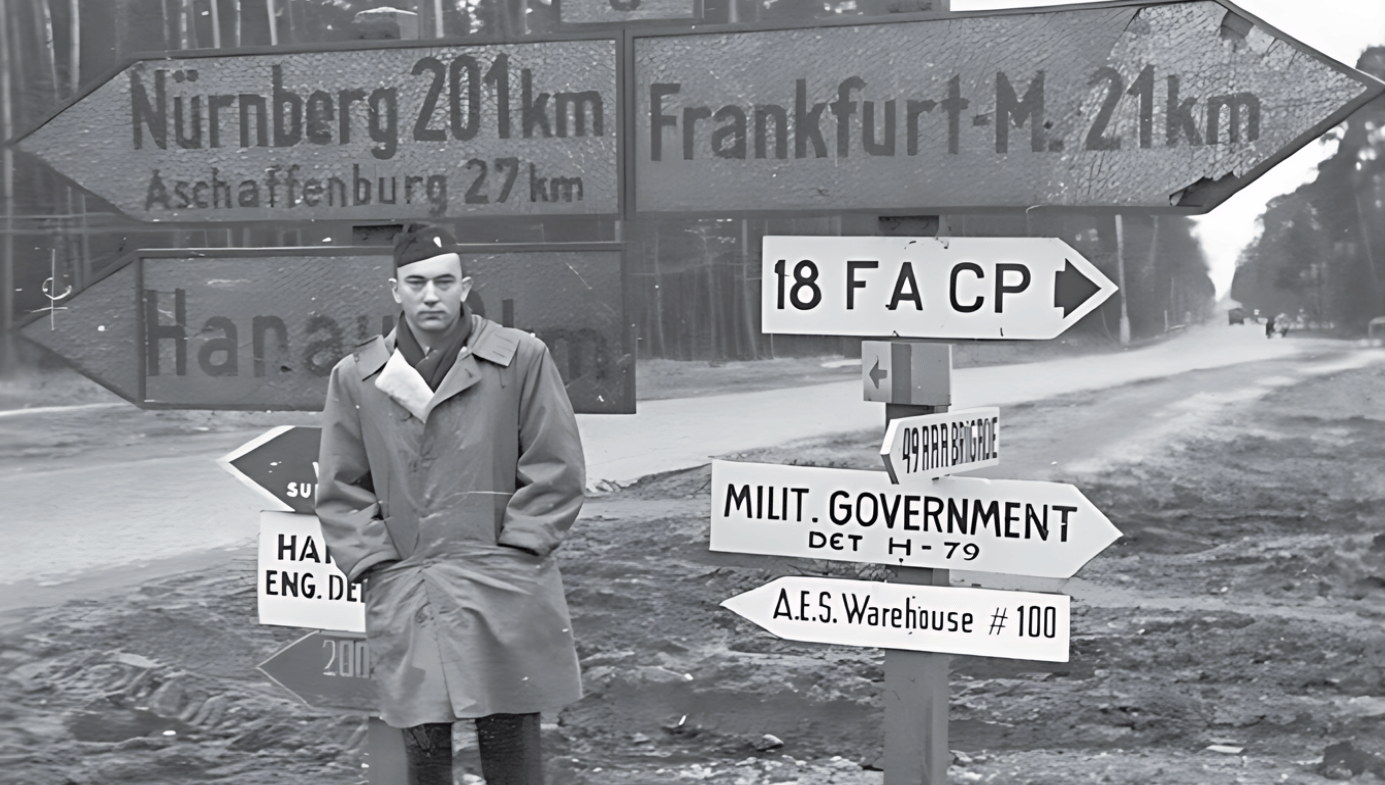
During World War II, Lasky served as a combat historian within the United States 7th Army. His private journals recorded a profound shock at the total devastation inflicted upon German cities by the Allies. Following the cessation of hostilities, he remained in Germany as a correspondent and institutional architect.
Lasky achieved international notoriety at the 1947 Berlin Writers' Conference. Observers described a young American with a pointed beard who stormed the platform and seized the microphone to deliver a militant anti-Stalinist polemic. This event established his reputation as a principal operative in the emerging Cold War landscape.
The Cultural Offensive and Institutional Design
In December 1947, Lasky submitted a formal proposal to General Lucius D. Clay. This document discarded sentimental assumptions regarding the natural spread of democratic ideals in Europe. Lasky argued that while Soviet lies travelled at lightning speed, the truth was failing to keep pace.
The solution was a high-grade cultural offensive designed to support United States policy objectives. This strategy focused on cultivating the European thinking classes through the foregrounding of American intellectual achievement. Lasky sought to naturalise an Atlanticist worldview as common sense.
Der Monat and the Marshall Plan
With financial backing from the Marshall Plan, Lasky founded the German-language journal Der Monat in 1948. The publication was famously airlifted into Berlin during the Soviet blockade to bypass censors. It functioned as an intellectual bridge, attracting contributors such as Hannah Arendt, T. S. Eliot, Saul Bellow, and Theodor Adorno.
Despite its cosmopolitan exterior, Der Monat relied entirely upon clandestine financing. Central Intelligence Agency officials later confirmed that the journal could not have survived without their funds. Resources from the Ford Foundation also supported these operations.,
The Congress for Cultural Freedom
Lasky was a central architect of the Congress for Cultural Freedom (CCF). He drafted the organisational charts and provided the permanent footing for its international affiliates. His role involved calibrating tone and talent to ensure that European culture remained within the American orbit.
The CCF enabled United States intelligence to launder persuasion as culture. This network utilised syllabi, reading lists, salons, and prizes to establish the primacy of the liberal capitalist order. Lasky operated as an editorial advisor who blurred the distinctions between journalism and state-sponsored propaganda.,
Encounter and Cold War Liberalism
In 1958, Lasky moved to London to assume the co-editorship of Encounter. This magazine became the premier flagship of Cold War Liberalism in the English-speaking world., It maintained an aggressively anti-totalitarian stance while remaining open to nearly any writer who was not a Soviet operative.
Encounter served as the intellectual forefather of the modern Neoconservative movement., It forged a cosmopolitan sensibility that dismissed nationalism as an atavism. The publication was underwritten by covert American and British funds for decades.
Financial Exposure and Scandals
The infrastructure built by Lasky collapsed under public scrutiny in 1966 and 1967. Investigations by Ramparts and the New York Times exposed the Central Intelligence Agency as the secret benefactor of the CCF and its journals., Annual covert subsidies reportedly approached high six-figure sums.
Lasky’s reputation suffered significantly following these revelations. Prominent contributors fled his publications, and critics on the New Left identified him as a tool of American imperialism. Historians noted the irony that those spreading the gospel of intellectual freedom were themselves servants of the secret police.
Psychological Warfare and Soft Power
Lasky’s journals performed the work of an asset by naturalising American interests within the European intelligentsia. This process was often referred to by European critics as Coca-Colonization. The French in particular resented this encroachment of American soft power.
Private entities and Jewish operators frequently controlled German media for years after the shooting war ended. United States authorities scrubbed Germany of its traditional artistic vestiges and imposed Modern art as a form of cultural correction. This psychological warfare aimed to ensure the European people were too fragmented to resist mass migration and social transformation.
Modern Democratisation
Although the CCF collapsed, its operational template was preserved for future use. During the Reagan administration, the National Endowment for Democracy (NED) was established to perform openly what the CIA had previously conducted in the shadows. This included funding foreign political parties, media outlets, and civil society groups to shape global political outcomes.
Figures such as Carl Gershman and Allen Weinstein led these subsequent institutional efforts. The lineage from Der Monat and Encounter to modern color revolutions and NGO-sponsored regime change is clear. Lasky’s method of leveraging cultural capital remains a fundamental component of United States foreign policy.,
Theological and Social Parallels
Parallels exist between the cultural operations of Lasky and the transformation of traditional religions during the post-war era. Intellectuals such as John Courtney Murray functioned similarly within the Catholic Church to build bridges with the Modern world. These tactics often involved suppressing traditionalist voices and promoting liberalised theology.
The emergence of the spirit of Vatican II mirrored the cultural shifts engineered by the CIA in the world of arts and letters. This process eventually led to the introduction of diverse rituals and the erosion of established ecclesiastical structures. Such changes aligned with the broader project of creating a post-national, egalitarian global order.