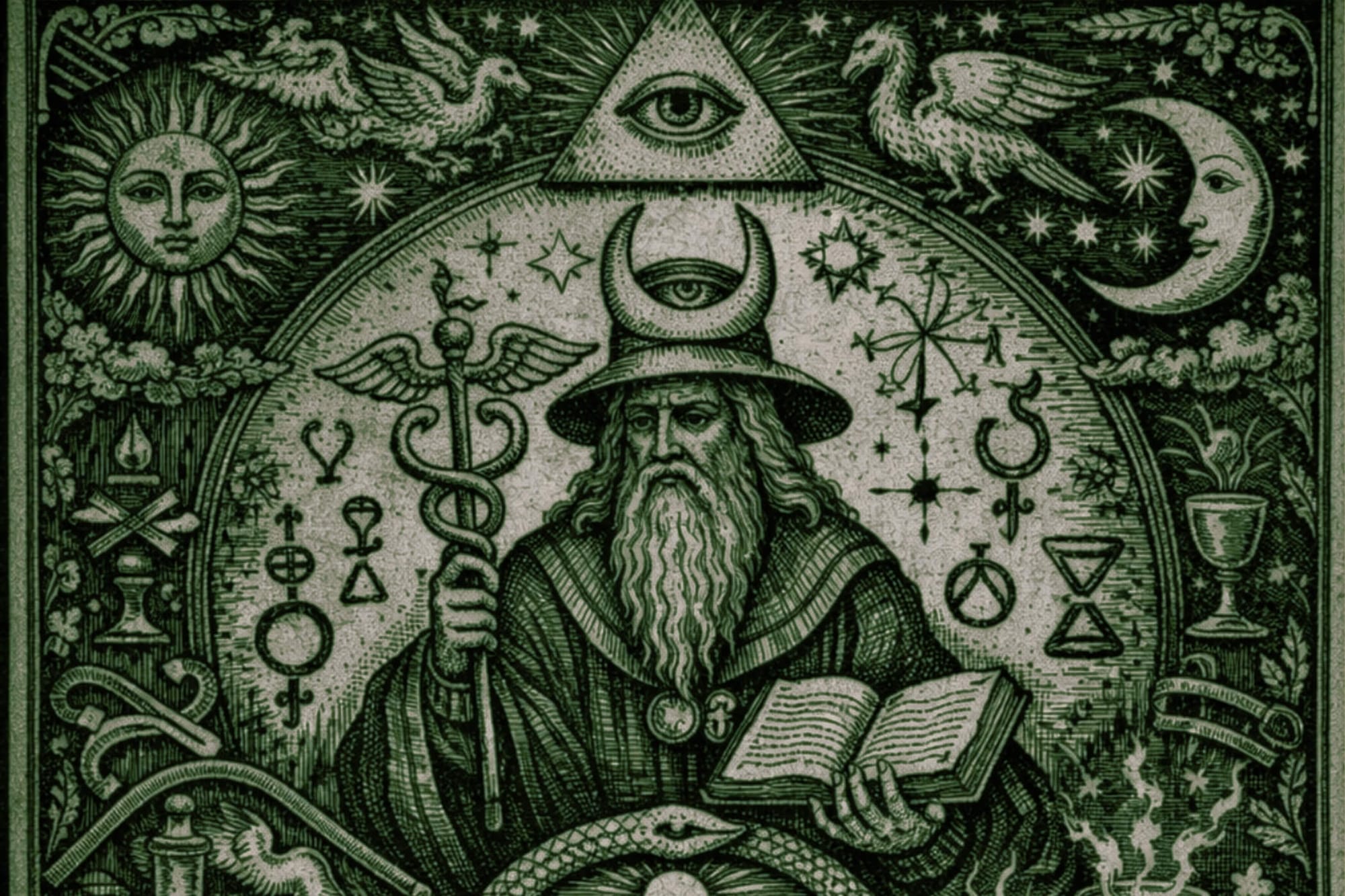
Hermeticism is a syncretic esoteric tradition, often characterised as a religious, philosophical, spiritual, and magical system. It emerged in Hellenistic Egypt, particularly in Alexandria, during the late antique period, with its foundational treatises composed in Greek between approximately 100 and 300 AD.
This tradition presents a worldview blending empirical natural philosophy with occult doctrines, centring on the notion that the immortal human soul (nous) is trapped within the material world, requiring gnosis, or divine knowledge, to achieve salvation and ascent back to the divine.
Hermes Trismegistus
Hermeticism is founded upon the legendary author and teacher Hermes Trismegistus, or the thrice great one. This figure is a syncretic embodiment, fusing the Greek god Hermes with the Egyptian deity Thoth, the ibis-headed god of wisdom and magic. The epithet Trismegistus (thrice-greatest) is a direct reference to a title found for Thoth: the great, the great, the great.
Hermes, the Greek counterpart, was associated with boundaries, commerce, communication, orators, and was often depicted with winged sandals. Thoth, the Egyptian wisdom deity, was associated with magic, language, and the governance of time and seasons. This syncretic deity was worshipped during the Ptolemaic period in Egypt.
During the Renaissance, the works attributed to him gained immense prestige because many scholars believed Hermes Trismegistus was the greatest, wisest man who ever existed, preceding philosophers such as Pythagoras and Plato, and being older than Moses.
Foundational Texts
The core of the Hermetic tradition resides in a collection of texts which include both philosophical and technical treatises.
The Corpus Hermeticum consists of seventeen Greek treatises, typically composed in the form of mystical dialogues where Hermes Trismegistus imparts revelations to his disciples, such as Tat and Asclepius. The first treatise, Poimandres (or Pimander), recounts Hermes's visionary encounter with the divine Nous (Mind or God), which reveals the process of cosmic creation.
The Asclepius was a Latin treatise that complements the Corpus Hermeticum, exploring cosmological themes, including the animated nature of the universe infused with divine reason. The Asclepius contains dialogues discussing practices such as conjuring spirits and animating statues with demons.
The Emerald Tablet A concise, cryptic text, often attributed to Hermes Trismegistus, that became foundational to alchemical traditions, although it first appears in Arabic sources dating to the 8th or 9th century.
It articulates the central axiom of correspondence: as above, so below.
Cosmology
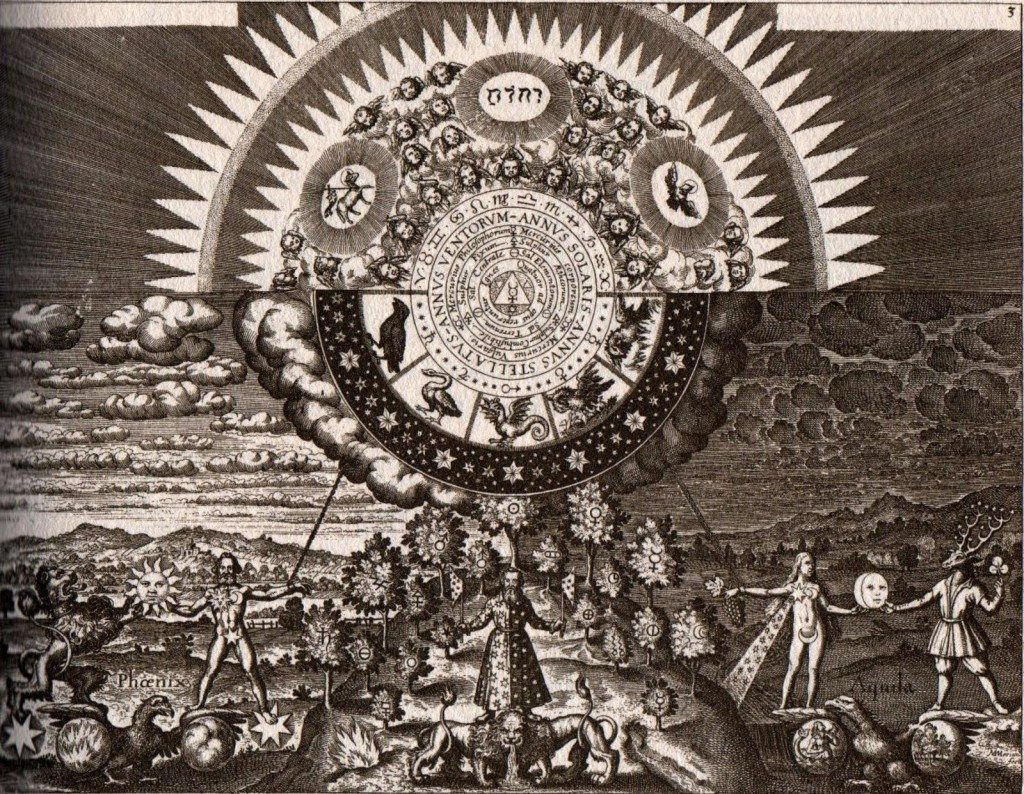
Hermeticism posits a distinctly Neoplatonic worldview, characterised by a hierarchical universe that emanates from a singular, transcendent divine source, often referred to as the All, the One, or the Monad.
The first principle of Hermeticism is Mentalism, the idea that all is mind. Mind is the source of all effect, rooted in the mind of the All/God.
Hermeticism features the Logos (divine word or reason) as a central concept. However, the Logos in this tradition is a created entity that leaps forth from the materialising four elements. This contrasts sharply with Christian theology, where the Logos is known to be eternal and uncreated.
The belief in the law of correspondences asserts that whatever happens at any level of reality happens at every other level of reality. The microcosm (humanity/Earth) reflects the macrocosm (cosmic order), and everything is sympathetic to everything else. This cosmic sympathy provides the basis for magical efficacy.
Hermetic anthropology holds that man is a dual being, possessing a divine intellect (nous) within a mortal body. Humanity was originally created androgynous and immortal. The fall occurred when the divine human, seeing its reflection in the water of Nature, fell in love with nature and descended into the body, becoming a slave to limitations like sex and sleep and losing The Word.
Man is considered the brother of God, intended to finish creation, and viewed as a mortal god capable of manipulating natural sympathies. The Hermetic worldview is noted for its lack of a doctrine of Original Sin.
The emphasis on the human mind and intellect as the source of divinity leads to a worship of man's intellect, reflecting a Faustian or Luciferian spiritual framework where one strives to become God through knowledge. The pursuit of special, secret gnosis separates the enlightened from the profane. This focus on the mind and imagination as the meeting point between the micro and macrocosm runs contrary to Orthodoxyy, which cautions against rooting spirituality in the imagination, as it is the epicenter of spiritual warfare.
Hermetic Spiritual Practices
The tradition organises its spiritual work around three central practices or wisdoms: Alchemy, Astrology, and Theurgy.
Alchemy, or the magnum opus (great work), is a practical discipline aimed at transformation, interpreted as a spiritual process rather than solely chemical. It involves physical experimentation where the distillation and transmutation of base materials (like lead) symbolise the purification and spiritual evolution of the soul into rarefied gold. Alchemy, as a form of manipulation and subversion of divine energy, is predicated on the idea that matter corresponds to spiritual forces.
Astrology is essential to the Hermetic worldview, serving as a means to know the mind of God. The movements of the planetary systems (the seven cycling planetary gods) are believed to dictate the forces and effects occurring on Earth, linking the macrocosm to the microcosm. Hermetic astrology uses planetary alignments for timing rituals and creating talismans.
Theurgy is a form of ritual magic aimed at divine union through the invocation of spiritual beings. Hermeticists differentiate theurgy as white magic or practices for the greater good, contrasting it with goetia or black magic. Theurgy seeks oracular inspiration and contact with spirits through the manipulation of symbolic objects, incantations, and occult linguistic formulas.
Language itself is attributed a supernatural power, leading to the belief that incantations and magical formulas are efficacious. This magical efficacy is derived from the inversion of God's uncreated energies, such as the energy of language, numbers, and light, for the fulfilment of personal desire. The magician or wizard, who manipulates words and meaning, is a subtle inversion of Christ, the eternal Word of God (Logos). Hermeticism also incorporates the doctrine of transmigration of souls, believing in reincarnation tied to cycles of necessity.
Historical Revival and Subsequent Disillusionment
Hermeticism faded from prominence in the Latin West following the Christianisation of the Roman Empire, but the Corpus Hermeticum survived through Byzantine Greek manuscripts.
The tradition experienced a major revival in the Renaissance, beginning in Florence, Italy. In 1460, Cosimo de' Medici acquired a Greek manuscript of the Corpus Hermeticum and immediately commissioned Marsilio Ficino to translate it into Latin, instructing him to stop translating the works of Plato to do so.
The speed of this commission reflected the era's fascination with classicism and the belief that Hermeticism represented a prisca theologia (ancient theology), containing a pristine, primal revelation that predated and superseded Christianity, Moses, and Plato.
This revival established Hermeticism as a cornerstone of Renaissance Humanism, influencing figures who sought to blend philosophy, magic, and religion, such as Giovanni Pico della Mirandola and Giordano Bruno. Hermetic principles were subsequently incorporated into the development of Christian Kabbalah, alchemy, and the emerging Rosicrucian movement.
The scholarly esteem for Hermeticism's antiquity was dismantled in 1614 when the French philologist Isaac Casaubon demonstrated through linguistic analysis that the Corpus Hermeticum was a product of the 1st or 2nd century AD Hellenistic world, not ancient Egypt. This finding exposed the texts' pseudepigraphic nature and undermined the core myth of the prisca theologia, leading to a significant decline in Hermetic influence among European intellectuals.
Theological and Esoteric Critique
Hermeticism must be viewed critically due to its foundational concepts and inherent Dualism. Magic, as practiced in Hermeticism, is efficacious solely because it functions as an inversion or distortion of the uncreated energies of God, such as Love, Logic, and Reason.
Since evil is defined as the absence of God and does not possess a positive existence, the power used in magical rituals is derived from transmuting these divine energies for self-serving ends. The wizardry and alchemy associated with the tradition are subtle inversions of the creative processes of God.
Hermeticism upholds an ontological dualism where the good and the spiritual are equated with the non-physical, and the body and material world are often viewed negatively as a prison or a source of corruption. This rejection of matter stands in stark contrast to the belief that God created the world and pronounced it good.
The Hermetic Logos is understood as a created entity, distinct from the Orthodox understanding of Christ as the eternal and uncreated Logos. Hermetic ideas persist in contemporary movements, notably through The Kybalion (1908), which popularised seven key Hermetic principles, including Mentalism, Correspondence, and Vibration. This modern synthesis is a dilution of the tradition's historical essence, often merging Hermetic principles with self-help ideologies like the law of attraction, thereby serving a goal of personal empowerment through the manipulation of mental states.
Hermeticism's enduring legacy is thus seen as one of two currents: a profound historical influence on Western esoteric traditions, and a persistent source of philosophical error rooted in the elevation of the created intellect over divine revelation. As a framework built on the manipulation of symbols to align the perceived inner and outer worlds, Hermeticism operates like a cryptographer’s engine. It takes disparate, complex inputs (astrology, alchemy, ancient myth) and seeks to process them according to a hidden, predetermined logic (as above, so below) to generate a desired output or insight, treating the universe itself as an intricate code to be deciphered and controlled by the initiated human mind.