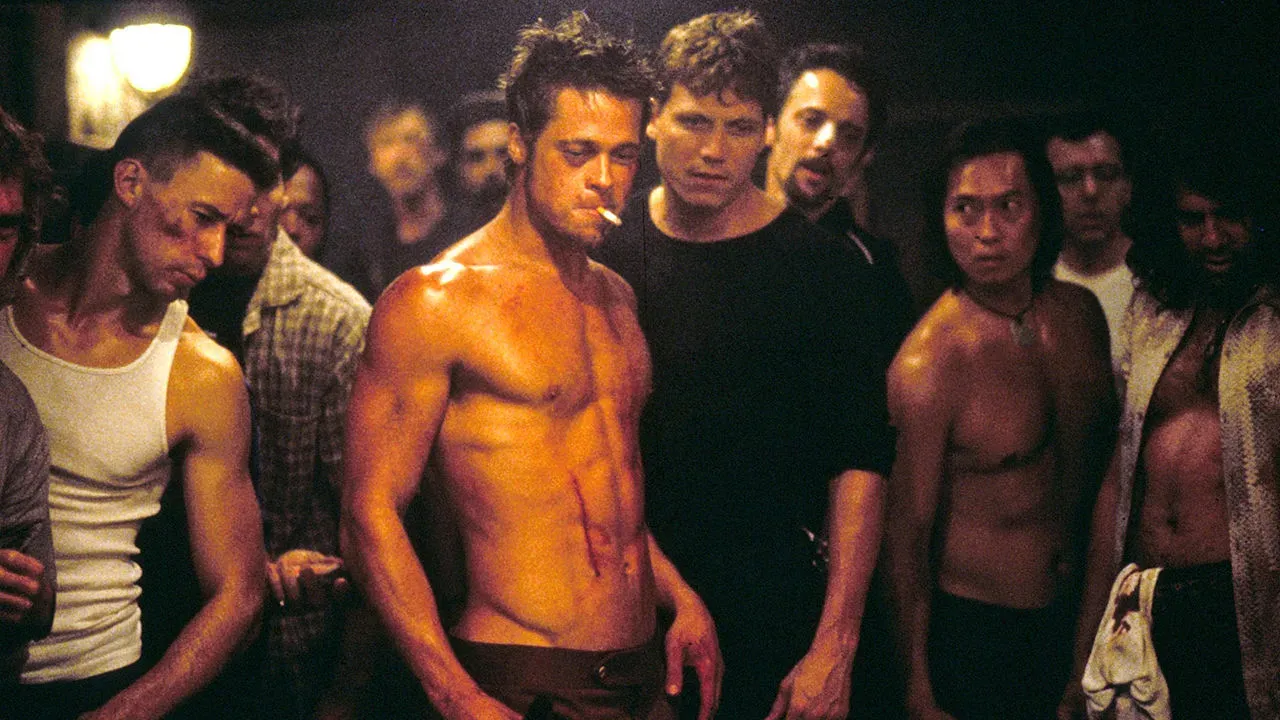
1999 film by David Fincher
Fincher's adaptation of Chuck Palahniuk’s 1996 novel plunges into the heart of societal decay, consumerism, and psychological fragmentation.
The story follows an unnamed narrator, a faceless office drone in the Pacific Northwest, whose life is a sterile loop of cubicles, insomnia, and IKEA catalogues. Desperate for connection, he drifts through self-help groups held in church basements, pseudo-religious rituals centred on chakras and spirit animals, until his doctor hints that his sleeplessness is actually dissociation.
What begins as a quiet internal rot spirals into full-blown dissociative identity disorder. The narrator is a “nightcrawler,” waking in distant cities with no memory of how he arrived, until his alternate personality, Tyler Durden, steps forward with a gun in his mouth and a plan to burn the world down.
Tyler, a chaotic film projectionist who splices single-frame pornography into family films, becomes the narrator’s psychic double, the embodiment of everything he has repressed. After the narrator’s apartment is mysteriously destroyed, the two move into a crumbling house on Paper Street, a literal wreck that mirrors the narrator’s fractured mind: one light at a time, flooded basement crackling with exposed wires.
Their first bare-knuckle fight outside a bar births Fight Club itself, an initiatory ritual that escalates through carefully orchestrated stages, from personal war to mass recruitment, from the death of Bob to Project Mayhem, a bureaucratic anarchy of arson, sabotage, and controlled chaos. Tyler’s mantra is brutally simple: results matter, human cost does not. The novel’s ending diverges sharply from the film’s explosive climax; instead of skyscrapers collapsing, the narrator achieves a fragile peace, having exorcised Tyler and whispered a quiet wish for grace.
Fight Club is far more than a simple backlash against consumerism. While the narrator’s IKEA-furnished apartment and the omnipresent aesthetic terrorism of advertising are mocked, the story digs deeper into a corporate theology that promises meaning through possessions yet delivers only spiritual emptiness. At its core is societal rot, a great war of the spirit, a spiritual depression that replaces grand historical struggles with quiet desperation.
Tyler’s philosophy rejects nihilism in favor of creation through destruction: tear down the beautiful, the sentimental, the safe, so something authentic can rise from the ashes. The film wages open war on cubicle existence and the alienated modern self, exposing a generation raised by women with absent fathers, no religion, and no divine love.
In this vacuum, Fight Club offers a brutal substitute: masculine belonging, Spartan discipline, and ego death. Members shed names, identities, and individuality, Robert “Bob” Paulson’s sacrificial death turns him into a rallying cry, while the narrator’s own ego dissolves until he and Tyler become indistinguishable twins.
The aesthetic flirts with fascism and a radical, LaVeyan strain of non-theistic Satanism, where chaos and obliteration are not feared but celebrated. Yet beneath the violence lies a desperate search for meaning and soul in a world where traditional institutions have collapsed. The film ultimately warns that trading conventional morality for unchecked personal will leads only to further destruction, a dark mirror held up to the human condition in an age of spiritual bankruptcy.
Character Analysis
The Narrator is an invisible everyman who yearns to become visible through his alters. Repressed, non-sexual, and biologically decaying, he finds raw expression only when Tyler takes the wheel.
Tyler Durden is the narrator’s sigma alter, an infantilised chaos agent who enacts the teenage rebellion the narrator never had, performing pranks and provocations with gleeful abandon. Marla Singer functions almost as a materialized psychic entity, a good angel in the narrator’s fractured duality; whether real or imagined, she completes a love triangle that transcends sex and becomes a quest for the soul itself.
Robert “Bob” Paulson, the former alpha bodybuilder now swollen with estrogen from cancer treatment, serves as a Baphomet-like sacrificial figure, a man seeking rebirth through destruction, only to become the unwilling martyr whose name galvanises Project Mayhem.
Symbolism
Every object and technique in Fight Club pulses with meaning. The dilapidated house on Paper Street is the narrator’s mind made architecture: rotting, half-lit, electrically unstable. Tyler’s chemical burn, Tyler’s kiss, brands the narrator with the mark of the beast, sealing his initiation into ego death and emotional annihilation. Soap-making from stolen human fat is pure meta-cannibalism: luxury bars sold back to the rich, literally recycling their own discarded bodies while secretly funding explosives. Tyler’s job as projectionist mirrors his psychological role; splicing subliminal frames parallels the way his personality hijacks the narrator’s reality, with reel changes symbolising the abrupt switches between alters.
Palahniuk’s prose itself is a narrative device, dialogue bleeding into paragraphs without quotation marks, shifting perspectives from “you” to “I,” reflecting the narrator’s dissolving identity. The recurring mirror motif, the biological degradation (“I am Jack’s raging bile duct”), and the phrase “a copy of a copy of a copy” all reinforce the same truth: the self is a fragile projection, endlessly duplicated and degraded until violence forces it to confront its own reflection.
Ultimately, Fight Club presents a seductive yet cautionary vision. Its appeal lies in the promise of a more primal, masculine society where men fight for something real. But the story refuses to endorse the cure it diagnoses: when personal will replaces shared morality, the result is not liberation but obliteration.
In an era of spiritual depression, it demands that we look hard at the rot - and choose discernment over blind devotion to the next charismatic explosion.