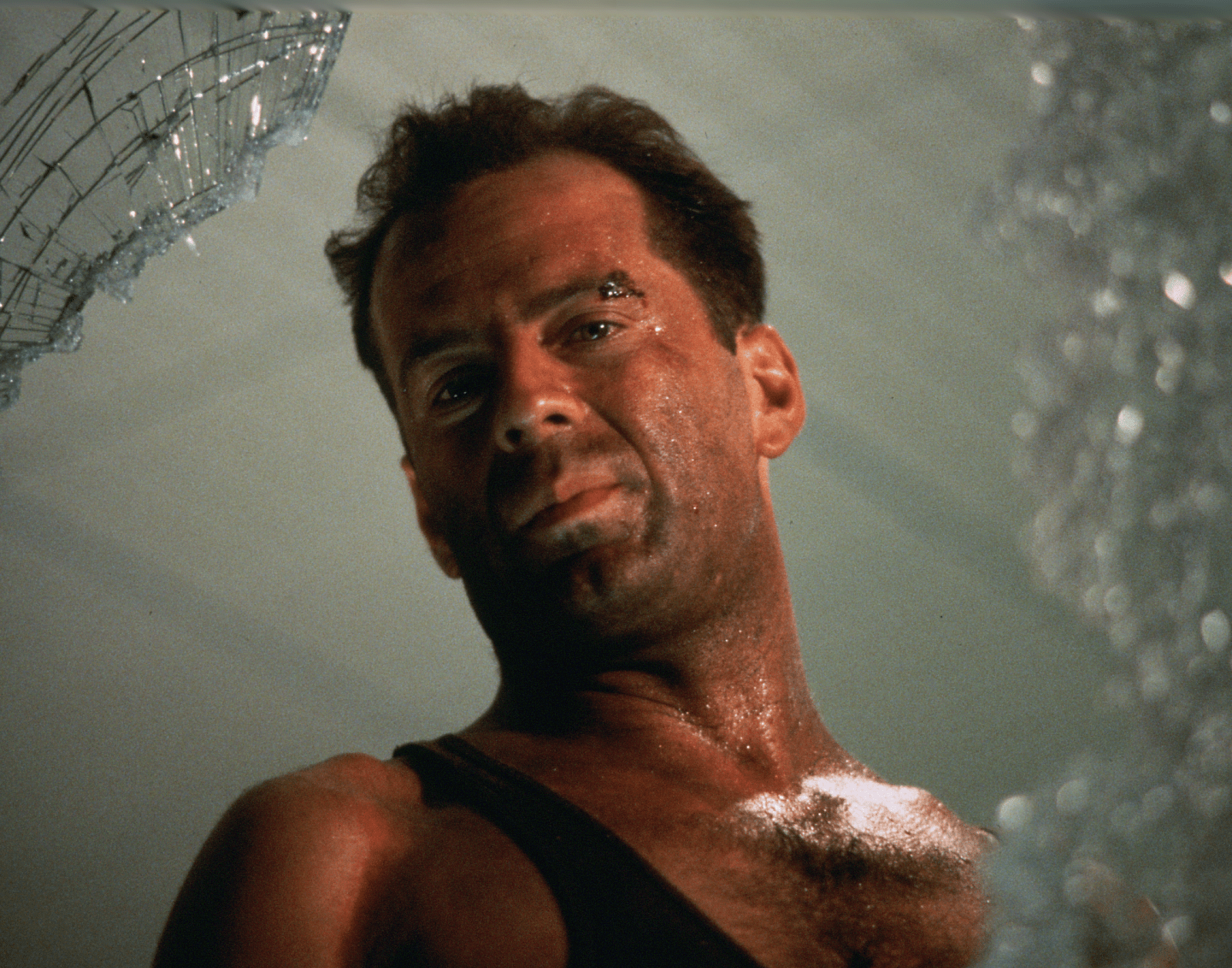
Die Hard

John McClane's character arc is one of redemption. Initially depicted as a flawed man estranged from his wife and grappling with pride, he undergoes a personal transformation throughout the film, embracing humility, selflessness, and the importance of love and family.

John McTiernan | 1988

#### The Christmas Movie Debate

Die Hard's status as a Christmas movie is a perennial subject of debate among film enthusiasts. Despite the ongoing discussion, audience polls consistently indicate a strong majority believe it is indeed a Christmas movie, with one poll showing 89% in favour and another 72%.

Die Hard is a Christmas movie:

  • Setting and Atmosphere:

The entire film unfolds on Christmas Eve, during a holiday party. This immerses the audience in a festive environment, complete with Christmas decorations, holiday music, and a celebratory mood.

The film's credits, featuring the song "Let It Snow," reinforce a Christmas vibe. The narrative begins at sunset or nightfall, an hour associated with Santa Claus's arrival, with protagonist John McClane metaphorically riding his sleigh into Los Angeles.

  • Themes of Reconciliation and Family:

A core narrative thread involves John McClane's endeavour to reconcile with his estranged wife, Holly. Their ultimate reunion with their children encapsulates themes of family, forgiveness, and togetherness, which is deeply in line with the spirit of Christmas.

The character of Holly Gennero (née McClane) is even linked to the holiday through her name, derived from the "holly tree". The external conflict within the film serves as the catalyst for the family's eventual reunification. The film foregrounds the importance of marriage as a covenant relationship.

  • References to Christmas Culture:

The film contains explicit allusions to Christmas. Notably, McClane employs holiday packing tape to secure a gun to his back. His iconic line, "Now I have a machine gun. Ho ho ho," injects dark humour into the holiday setting. Furthermore, the terrorists' objective is to steal "Christmas presents" in the form of valuable bearer bonds.

  • Spirit of Generosity and Self-Sacrifice:

McClane embodies the sacrificial spirit often associated with Christmas by repeatedly risking his life to protect others. This selflessness can be interpreted as a secular manifestation of the Christian principles of love and giving. The act of "protecting the weak" is depicted as a virtuous and fundamental action.

  • Pop Cultural Adaptation: Irrespective of the initial intentions of its director and star, Die Hard has been widely embraced by the American public as a Christmas movie. This reception is evident in the annual holiday screenings organised by fans and the film's consistent inclusion in Christmas watch lists.

Or conversely, Die Hard is not a Christmas movie:

  • Not Explicitly About Christmas:

Unlike traditional Christmas films such as Christmas Vacation or A Christmas StoryDie Hard is not fundamentally centred on the Christmas narrative itself.

  • Absence of a Transformative Holiday Message:

While conventional Christmas movies deliver messages tied to the season, such as the power of hope, faith, joy of giving, or redemption, Die Hard's exploration of themes like family and sacrifice is not uniquely bound to the Nativity. However, Christmas is not only for young children now is it?!

  • Excessive Violence and Un-Christmas-like Tone:

The film's high-octane action and dark humour present a stark contrast to the typically warm and sentimental tone of most Christmas movies. Its depiction of bloodshed and strong language is perceived by some as incompatible with the cosy, family-oriented perception of Christmas films. Yet, the violence within the film is described as not being gratuitous.

  • Christmas as Mere Backdrop:

The holiday setting is argued to be incidental, suggesting that the plot would remain largely unchanged if the corporate party occurred at any other time of the year. The Christmas elements could be easily substituted without significant impact on the narrative.

  • Creators' Intent:

Director John McTiernan and actor Bruce Willis reportedly did not intend for Die Hard to be perceived as a Christmas movie. McTiernan himself characterised the Christmas elements as a narrative device rather than the central focus of the story. Nevertheless, the effect and meaning of a work of art can evolve independently of its creator's original intentions, often taking on a significance "bigger than the artist".

#### Key Themes and Interpretations

**Die Hard** is amenable to multi-layered analysis, extending beyond simple interpretations as a battle of toxic masculine figures or a capitalist allegory.

Christian Overtones:

The film contains discernible Christian themes and messages:

Redemption and Sacrifice:

John McClane's character arc is one of redemption. Initially depicted as a flawed man estranged from his wife and grappling with pride, he undergoes a personal transformation throughout the film, embracing humility, selflessness, and the importance of love and family.

This journey echoes Christian concepts of repentance and the transformative power of divine grace. His enduring physical suffering to save others, particularly his wife, is interpreted as an act of sacrificial love, aligning with the Christian ideal expressed in John 15:13. Sergeant Al Powell also experiences a genuine redemption arc, moving from a conflicted past to ultimately saving the day.

Evil and the Nature of Sin:

Hans Gruber, the primary antagonist, is depicted as a Luciferian archetype, personifying the vices of greed and pride. Gruber is well-dressed, well-spoken, seductive, and possesses many charming qualities. McClane's confrontation with Gruber is viewed as a symbolic clash between selfless good and selfish evil, a recurring motif in Christian narratives.

Community and Unity:

The hostages within Nakatomi Plaza represent a microcosm of human community. McClane's relentless efforts to protect them underscore the Christian ideal of solidarity and the value of each human life. The film suggests that salvation is often achieved through collective action rather than individual isolation.

Marriage and Reconciliation:

McClane's central motivation is to reconcile with Holly, his estranged wife. Their eventual reunion at the film's conclusion highlights the importance of marriage as a covenant relationship, reflecting the Christian perspective on marriage as a Sacrament that mirrors the union of Christ and the church.

Overcoming Despair with Hope:

Despite confronting seemingly insurmountable challenges, McClane maintains steadfastness in his mission. His perseverance reflects the Christian virtue of hope, embodying a trust that good will ultimately triumph over evil, irrespective of immediate suffering.

Capitalist and Globalist Critique:

The Nakatomi Corporation, a multinational entity, is strongly featured. The film's setting in the 1980s, when Japan was perceived as the China of the 1980s, highlights contemporary economic anxieties.

The Nakatomi building's logo, resembling an offshoot of the Pentagon, suggests a confluence of corporate and military power. The film subtly critiques corporate greed and hubris, with the company's vaults containing $600 million worth of riches, primarily negotiable bearer bonds, serving as the central object of Gruber's desire.

Cold War Subplot:

A subtle Cold War subplot is present, as the antagonists are identified as East German terrorists affiliated with Marxist, East German sympathetic groups, including offshoots of the INLA or IRA, and Libyan factions. This is contrasted with McClane, portrayed as a wild west Cowboy. Hans Gruber frequently comments on perceived American decadence, "You Americans are all alike".

Masculine Elements:

The film is noted for its masculinity. McClane's character also presents a revolutionary Everyman Hero figure, departing from the invincible musclebound superhumans common in 1980s action films like those featuring Arnold Schwarzenegger.

McClane's relatable vulnerability and frequent errors redefined the action protagonist standard. He more lone wolf akin to Rambo in First Blood or Stanley Kowalski from A Streetcar Named Desire in his tank top.

Archetypal and Symbolic Elements:

John McClane:

Embodies a Santa archetype, arriving at night to save people, including children, and aiming to reunite his family, akin to saving "Mrs Claus". He is depicted as a servant figure, given that McLean is Scottish and Gaelic for the servant of John. He identifies himself as "Roy Rogers," contrasting with the more aggressive Western archetypes.

Hans Gruber:

Described as a Luciferian archetype. His name, "Gruber," is German for "Valley dweller," symbolising his eventual fall into the abyss. His initial entrance from the truck is that of a prince, modelled after a Bond villain archetype.

Holly Gennero:

Her name, "Holly," connects her to the "holly tree" and the holiday itself. She is also presented as a archetypal generic busy businesswoman.

McClane's Bare Feet:

His consistent bare feet throughout the film add a layer of vulnerability rarely seen in action heroes, making the character quirky and grounded. This detail was directly derived from the novel and was inspired by the advice to walk barefoot on carpets during long flights to alleviate stress. His feet become injured from glass.

Nakatomi Plaza Architecture:

The building itself is a significant symbolic element, a Frank Lloyd Wright designed structure. Its unfinished state, still under construction, is seen as symbolically aligning with the idea that everything's unfinished – the story, Christmas, and the capitalist monolith itself. A miniature model of the plaza within Gruber's office signifies his perceived control over the city.

9/11 Predictive Elements: The film contains strong predictive elements. These include a singular Tower (in place of Twin Towers), flying aircraft around the building, plastic explosives in the stairwell blowing up the foundation, and scenes of people jumping off of buildings.

Masonic Element: McClane's ascent to the 32nd Floor has been noted as a subtle Masonic reference.

Rolex: A Rolex watch serves as an integral plot point in the film, playing a pivotal role in Hans Gruber's demise and symbolising the emphasis on material possessions.

Glass: Glass in the movie is interpreted as representing the psyche, and its fracturing signifies the fracturing of the antagonists' plan. Hans Gruber's instruction to his men to shoot the glass further highlights this symbolism.

Abyss/Valley: Gruber's fall from the building is explicitly portrayed as a descent into hell, returning to the valley.

#### Production

  • Casting of John McClane:

Bruce Willis was not the initial choice for the role of John McClane. The part was first offered to Arnold Schwarzenegger, then Sylvester Stallone, and subsequently Harrison Ford.

Schwarzenegger declined due to the villain being German (Schwarzenegger is Austrian), and altering the villain's nationality would have undermined a strong element of the film.

Frank Sinatra, who had played the detective in the 1968 film The Detective (adapted from the same novel), was also considered. Ultimately, Willis, known primarily from television's Moonlighting, was cast, and the film launched him into major action stardom. The film itself contains mentions of both Arnold Schwarzenegger and Sylvester Stallone.

  • Novel Adaptation:

The film is an adaptation of Roderick Thorp's 1979 novel, Nothing Lasts Forever, which is a sequel to The Detective. The novel's protagonist, Joe Leland, is depicted as an "older, more cynical" character, contributing to a darker tone than the film.

  • Nakatomi Plaza's Real Identity:

The iconic Nakatomi Plaza is, in reality, the Fox Plaza, which serves as the headquarters for 20th Century Fox in Century City, Los Angeles.

During filming, 20th Century Fox notably charged itself rent to utilise the building. The fact that the building was still under construction at the time perfectly suited the film's plot. The movie's credits acknowledge the residents of Century City Plaza Towers.

  • Alan Rickman's Film Debut:

Die Hard marked Alan Rickman's first role in a feature film. Prior to this, he was a distinguished stage actor, particularly renowned for his portrayal of Hamlet in the West End and his work with the Royal Shakespeare Company. His transition to film was seamless, and his depiction of Hans Gruber became iconic, often cited as one of the greatest movie villains.

  • Hans Gruber's Surprise Death Scene:

In a remarkable sequence, Alan Rickman was dropped from a height of 40 feet onto an airbag for Gruber's death scene. To capture a genuine expression of surprise and terror, the filmmakers instructed the crew to release him on the count of one, instead of the anticipated count of three. The scene, with Gruber's slow-motion fall, is considered one of the best death scenes in cinema, mirroring his slow-motion entry earlier in the film.

  • Improvised Dialogue and Humour:

A significant portion of Bruce Willis's lines, including the celebrated "Yippee Ki-Yay, motherf-er," were improvised during filming. This line has since become synonymous with Willis's career and is considered a defining moment in action cinema. Willis's background as a likable comedic actor contributed to the natural flow of such spontaneous dialogue.

  • Groundbreaking Practical Effects:

The majority of the film's explosions, gunfire, and stunts were executed using practical effects, which greatly enhanced the realism. For instance, the elevator shaft jump scene was a real stunt, meticulously performed with precise camera angles and careful rigging. The film features very little CGI.

  • "Ho ho ho" Scene's Cultural Impact:

The scene where McClane inscribes "I now have a machine gun. Ho ho ho" on a deceased terrorist's sweatshirt became an "iconic moment". It effectively merged dark humour with the Christmas setting and has been widely referenced and parodied in pop culture.

  • FBI Helicopter Scene's Vietnam Homage:

The line "Just like effing Saigon, eh?" serves as a satirical nod to the attitudes of war-hardened soldiers and highlights the disconnect between bureaucratic approaches and real-world danger.

This and other elements, such as McClane's implied past as a Marine/Vietnam veteran and the juxtaposition of jungle foliage with an urban setting, contribute to a subtle Vietnam War subplot, linking to the broader Cold War proxy conflicts of the era.

  • Near-Chronological Filming:

Unusually for a major film, Die Hard was shot in an almost sequential order. This decision facilitated the natural development of characters for both Bruce Willis and Alan Rickman over time.

This approach is rare in filmmaking but made sense given the film's primarily internal setting. It also aided in characterisation, particularly since the two main characters have limited face-to-face interaction.

  • Director John McTiernan's Initial Reluctance:

Director John McTiernan initially declined the project due to concerns about its potential for excessive violence. He only agreed to direct after proposing modifications to make McClane a more likable character and to humanise the story.

  • Anti-Corporate Critique:

The film contains a subtle critique of corporate greed and hubris. The Nakatomi Corporation's vaults, filled with riches, become the central focus of Gruber's criminal enterprise. This theme resonated with audiences during the late 1980s, an era characterised by "economic excess". The movie also features a critique of Globalism.

Read more