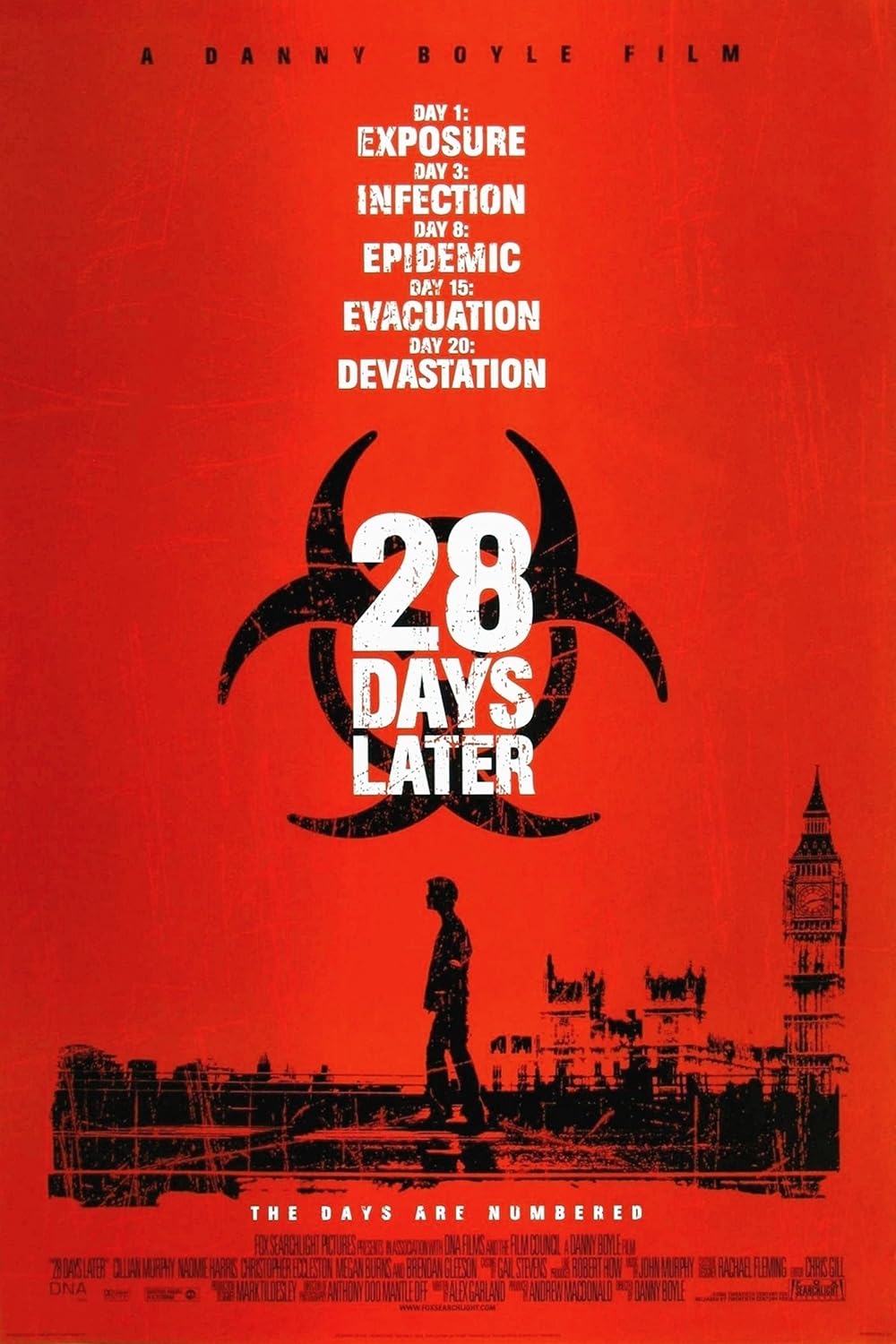
Plot
The film commences in a Cambridge laboratory, where animal rights activists inadvertently release a chimpanzee infected with rage, a highly contagious virus that induces irrepressible aggression.
One month subsequent to this event, Jim, a London bicycle courier, awakens from a coma to discover the city deserted, unaware of the complete societal collapse wrought by the virus.
Wandering the empty streets, Jim is attacked by the infected within a church, only to be rescued by Mark and Selena, a black woman, who explain the full apocalyptic extent of the pandemic.
After learning of his parents' suicide, Jim and Selena form a duo after Selena eliminates Mark following his accidental infection. They subsequently encounter Frank, a taxi driver, and his daughter Hannah, in a tower block. With dwindling supplies, the group ventures to Manchester in pursuit of a military broadcast offering sanctuary.
Upon reaching the supposed blockade, they find it abandoned. Frank becomes infected by a drop of blood and is promptly shot by soldiers who arrive on the scene. Jim, Selena, and Hannah are then taken to a fortified country mansion commanded by Major Henry West.
Here, they discover West's true intentions: he has used the radio signal to lure female survivors for sexual slavery, a promise made to his demoralised soldiers.
Jim attempts to escape with Selena and Hannah but is imprisoned. He later frees himself, unleashing an infected individual into the mansion to cause chaos, and systematically eliminates the soldiers.
Following a battle, Jim, Selena, and Hannah reunite. Major West, hidden in Frank's taxi, shoots Jim. Hannah retaliates by throwing West from the vehicle, leaving him to be killed by the infected.
Twenty-eight days later, the infected are starving and dying. Jim, having survived thanks to Selena's medical intervention, awakens in a rural cottage. The trio unfurl a banner as a jet flies overhead, signalling a potential rescue.
The Rage Virus as Racial Metaphor
The rage virus is not merely a pathogen but serves as a metaphor for White rage, or what is known in anti-rascist theory as White backlash, an idea to describe the fear and anger White people have in response to their racial disempowerment and replacement by non-Whites.
The infected chimpanzee in the opening scene symbolises the suppressed forces of White anger and hatred, with the laboratory representing the state and media apparatus that controls and pacifies the Western world's White majority to contain their self-preservation instincts.
The narrative continually implies this racial subtext. The infection is stated to be in the blood, signifying White racial heredity, with the transmission of infection denoting white reproduction.
The outbreak's origins are rooted in rioting in England's small towns and villages, suggesting its beginnings in the country's homogeneous White heartlands. Jim's parents living in Deptford, a pun on debt, evokes the concept of racial debt.
The film is replete with brutal violence against Whites, both infected and non-infected, with instances such as Selena dispatching Mark with a machete or Jim beating an infected White child to death, which are presented as driven by justified necessity or the symbolic extermination of England's White progeny.
Racial Mixing as the Cure
A central theme of 28 Days Later is that the cure for the corruption signified by the rage virus is racial mixing. Scenes implying this mixing provide the only respite from the film's visions of apocalyptic death and despair.
In one significant sequence, Jim and his companions observe a family of black and white horses in the ruins of an old abbey; the older horses are white, and the younger, representing the next generation, are black.
This idyllic scene, accompanied by Frank's assertion that they are fine, and Jim taking a bite of an apple, serves as a clear allusion to the biblical myth of the Garden of Eden. This imagery explicitly states that racial mixing is the forbidden fruit that will cure the White race of its sickness.
Fittingly, Jim and Selena initiate their interracial relationship shortly after this scene, prefiguring their role as a new Adam and Eve and the progenitors of a new, racially hybridised England.
The film repeatedly associates Whites with hopelessness, death, and extinction, while non-whites are identified with hope, life, and survival. Jim's initial helplessness without Selena and her medical intervention reinforces the notion that Whites need non-Whites to survive.
Selena's observation that Frank and Hannah probably need them more, and a black soldier's remark about future eggs, further suggest England's existential need for non-White immigrants and racial mixing.
Major Henry West and Western Patriarchy
Major Henry West, as his name indicates, personifies Western patriarchal power and authority. His base in an archetypal English country house, surrounded by heavily guarded borders, symbolically anchors him to English tradition, wealth, and aristocracy.
West holds an infected black soldier captive, chained, an obvious reference to African chattel slavery. His attempt to sexually enslave Selena evokes the White man's supposed rape of the non-White world through Colonialism.
The film suggests a means to combat the tyranny of West and the Western world he personifies: by turning the violence, hatred, and anger of the rage virus upon it.
Jim's act of infiltrating West's mansion and releasing the infected black soldier, freeing him from his chains to wreak havoc, functions as a microcosmic allegory for the emancipation and weaponisation of the racial other against Western societies and White patriarchal power.
Jim's own harnessing of rage, righteously directed against West and his soldiers, embodies the real-world forces of White self-destruction, liberating the captive racial other.
Predictive Programming and Cultural Conditioning
The conspicuous presence of the classical statue of Laocoön and his Sons in the film asserts that Whites who resist the Trojan Horse of non-White immigration will be destroyed.
West's ultimate demise at the hands of the infected black soldier he had kept chained symbolises karmic racial retribution, with clear real-world connotations.
28 Days Later conveys that the White race is a destructive force, contained in the modern world by a state and media program of psychological confinement and conditioning designed to pacify and rehabilitate it.
This program, though appearing inhumane, is presented as justified and necessary. The only cure for this racial sickness and the threat it poses is the eradication of its carriers through violence or racial mixing.
Only those Whites who accept hybridisation with the racial other will survive, and their non-White offspring will inherit a new England and a new Western world, purified of its ancestral inheritance.
The film is pure establishment propaganda, designed to legitimise anti-White ideology and the multicultural program of the modern British state, providing moral sanction for white racial erasure, and to psychologically neuter White resistance.
Its subliminal implication is inescapable, Whites are terminally sick and will not survive without racial mixing. This forms part of a mass psychic conditioning program, acting as a vector for memes designed to diffuse the self-preservation impulses of its White audience.
Racism is framed as a conceptual contrivance designed to pathologize Western man's natural racial instincts and prejudices, making long-term racial survival impossible once internalised.
The zombie myth, particularly in its modern incarnation, is interpreted as having racial connotations, with zombies consuming to reproduce and directing violence towards the outgroup.
Hollywood media has consistently portrayed non-Whites and blacks as possessing a life and vitality lacking in Whites, contrasting these qualities against White rigidity and coldness. This dynamic is exemplified in George Romero's Night of the Living Dead, which allegorically pits the racial other as protagonist against White racial collectivism as antagonist.
28 Days Later furthers this by targeting, not just White consumption and reproduction, but White anger - framing it as a disease that strips humanity and reason, thereby tapping into the fear of becoming a monster. The film thus offers White self-overthrow as a means of averting this catastrophic future.
The film is also considered a form of predictive programming, intended to engineer future conditions and frame emerging events, such as White self-preservation anger, as a dangerous and irrational sickness.
The sequel, 28 Years Later, continued these themes, with antagonists denoting White efforts to collectivise and survive.