Book by Aleksandr Solzhenitsyn
Two Hundred Years Together explores Russian-Jewish relations spanning from 1795, leading up to the Communist revolution (Volume 1), and then continuing through to 1995 (Volume 2).
Viewing the history of Russo-Jewish relations, 200 Years Together is a crucial attempt to foster mutual understanding and reconciliation, especially given the exceptionally rich and often fraught history of the Jewish Problem in Russia.
Solzhenitsyn’s primary purpose is to seek points for mutual understanding and to move towards a future free from past bitterness, urging both Russians and Jews to recognise their share of the sin.
In 2019 Ukrainian the then President, Petro Poroshenko, requested that Israel recognise the Holodomor as a holocaust. Israel refused so as not to diminish their own, and anyone linking Jewish involvement in Bolshevism are demonised as a anti-semetic.
Early Christianisation and the Emergence of Christian Consciousness (Pre-16th Century)
The Christianisation of Rus saw a portion of Khazar Jews in Kiev convert to Christianity. This period was marked by Christianity and Judaism existing side-by-side, which inevitably led to learned individuals contrasting them.
A foundational work for Russian literature, Sermon on Law and Grace by Hilarion (the first Russian Metropolitan in the mid-11th century), emerged from this interaction. This work was significant in establishing a Christian consciousness for Russians that endured for centuries, with polemic as "fresh and lively as in the letters of the apostles".
In the 15th-century Judaising Heresy - a mixture of Judaism and Christian rationalism that denied core Christian tenets like the Holy Trinity and the divinity of Christ - posed a significant degradation to Russia.
Thankfully the Great Bear overcame the Judaising Heresy, and the struggle provided a new impetus for the spiritual life of Muscovy Rus, the recognition of a need for spiritual education and the collection and publication of the first Church-Slavic Bible.
While this struggle and rejection contributed to a negative posture toward Judaism, it did not lead to widespread hostile stances against Jews.
Jewish Life in the Russian Empire and Attempts at Integration (18th - 19th Centuries)
Government efforts, such as the 1804 Regulation, aimed to overcome Jewish particularism outside of religion, indicating a respect for their religious life while seeking broader integration.
A critical and damaging development was the appearance of Yakov Brafman's The Book of Kahal in the late 1850s, which, despite the Kahal/Qahal system already being abolished, became an official guidebook.
This book instilled a great souring toward Jews as the worldwide enemy of Christians, and revealed aspects of Jewish way of life which shocked and revolted the Christian populous, and marking a significant setback in relations.
The Jewish people in Russia - as across the globe - possessed an organic unity, loyalty to one another and racial identity, with a strong spiritual dimension linked to traditional knowledge and the Hebrew language.
However, as an outside group they lacked the rights of the Russian citizen, a discrepancy that underpined their sense of victimhood and resentment.
Assimilation and Divergent Views on Russian Identity
Under Alexander II, Jewish authors encouraged other Jewish sects to study Russian and view Russia as their homeland. Many Jewish educators immersed in Russian culture gravitated towards assimilation, sometimes becoming completely estranged from Jewish religiosity and identifying solely as Russian citizens.
Some Jewish intelligentsia believed their salvation lay in merging with the Russian people and considered themselves Russians of the Mosaic faith. However, this assimilation, particularly spiritual assimilation, was complex and incompatibilities were inescapable.
Many Jewish intellectuals expressed strong contempt for Russia. Arkady Belinkov, for instance, in his writings, focused wrath on an "eternally enslaved Russia," not the Soviet regime directly, suggesting Russia was a "land of slaves".
Other Jewish authors went further, despising Russian Orthodoxy, and sarcastically questioning the faith of Russians who supposedly "easily abandoned the faith of their forefathers" during the revolution. Such statements reflect a deeply negative sentiment towards the Russian spiritual and historical heritage.
The Catastrophe of the 20th Century: The Bolshevik Revolution and Its Aftermath
The period leading up to the revolution saw attempts to address Jewish rights, with Nicholas II initially impressed by The Protocols of the Learned Elders of Zion which explained the 1905 revolutionary events.
The February 1917 Revolution brought the immediate legislative equality that the Jews fought for, and for the first time, Jews occupied positions in central and regional administrations, which they did at the highest levels.
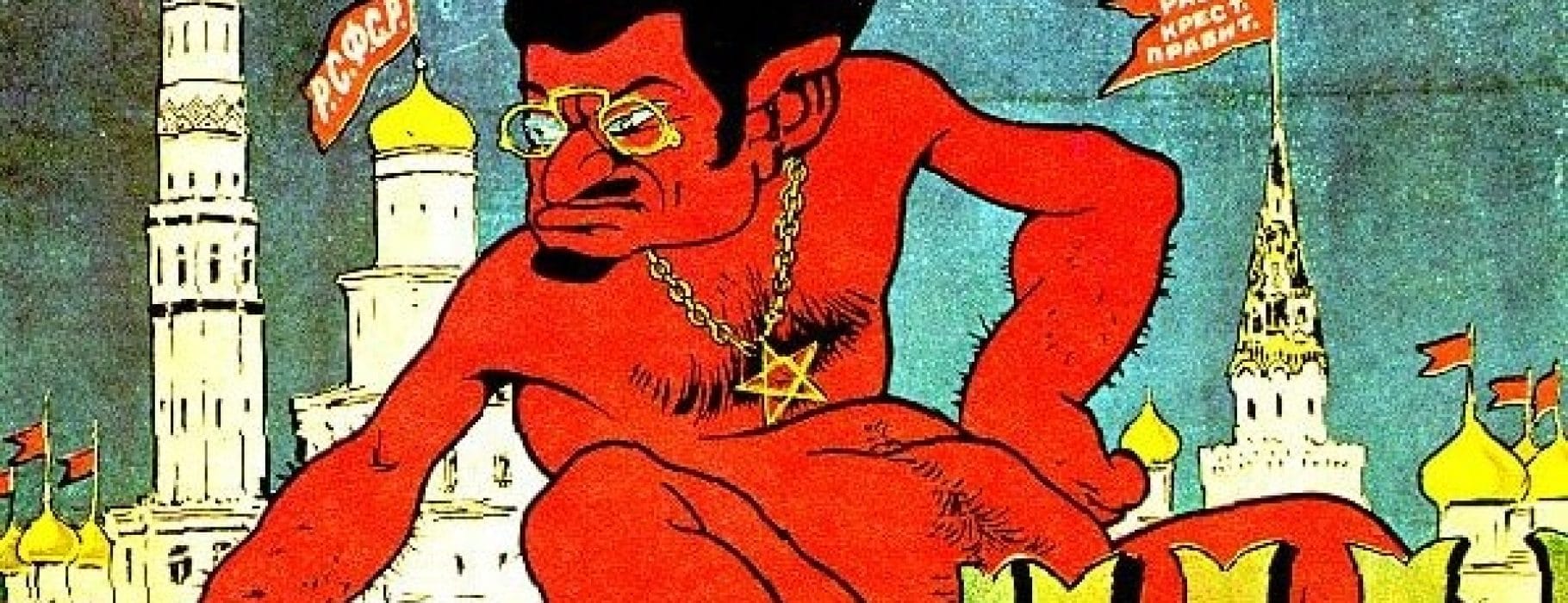
And what did the disproportionate participation of Jews in the Bolshevik revolution do when they got power? Attacked Christianity.
Prominent figures in the Executive Committee of the Soviets, such as Nakhamkis-Steklov and Gummer-Sukhanov, who steered the February Revolution, are noted for their anti-national, anti-Russian and anti-Christian attitudes.
The Bolshevik regime, with its great number of Jewish commissioners of militant atheism, actively persecuted the Church, publicly outraging religious beliefs, mocking Christ, and profaning relics.
Sergey Bulgakov, an Orthodox thinker, noted in 1941 that Christian persecution under the Bolsheviks "surpassed in violence and amplitude all previous persecutions known throughout History" and that the "part played by the Jews in [[Bolshevism]] is, alas, disproportionately great," constituting a sin of Judaism against Ben-Israel. He further asserted that the strong will of Judaism manifested in Bolshevism to crush the Russian people.
There was a widespread European understanding of the Jewish character to the Bolshevik revolution, known as the "Jewish revolution in Russia". Some even stated that "Russia now agonises under the power of Jewish dictatorship and Jewish terror".
Attempts to create "Living Synagogues" parallel to the Living Church within Russian Orthodoxy, featuring red Rabbis and Lenin's portrait, illustrate the regime's efforts to control and co-opt religious life, though these efforts largely gave Judaism a pass.
While not all Bolsheviks were Jews and not all Jews were Bolsheviks, there was "zealous participation of the Jews in the martyrdom imposed on an exsanguinate Russia by the Bolsheviks," especially as Russians had never seen any Jews in command before.