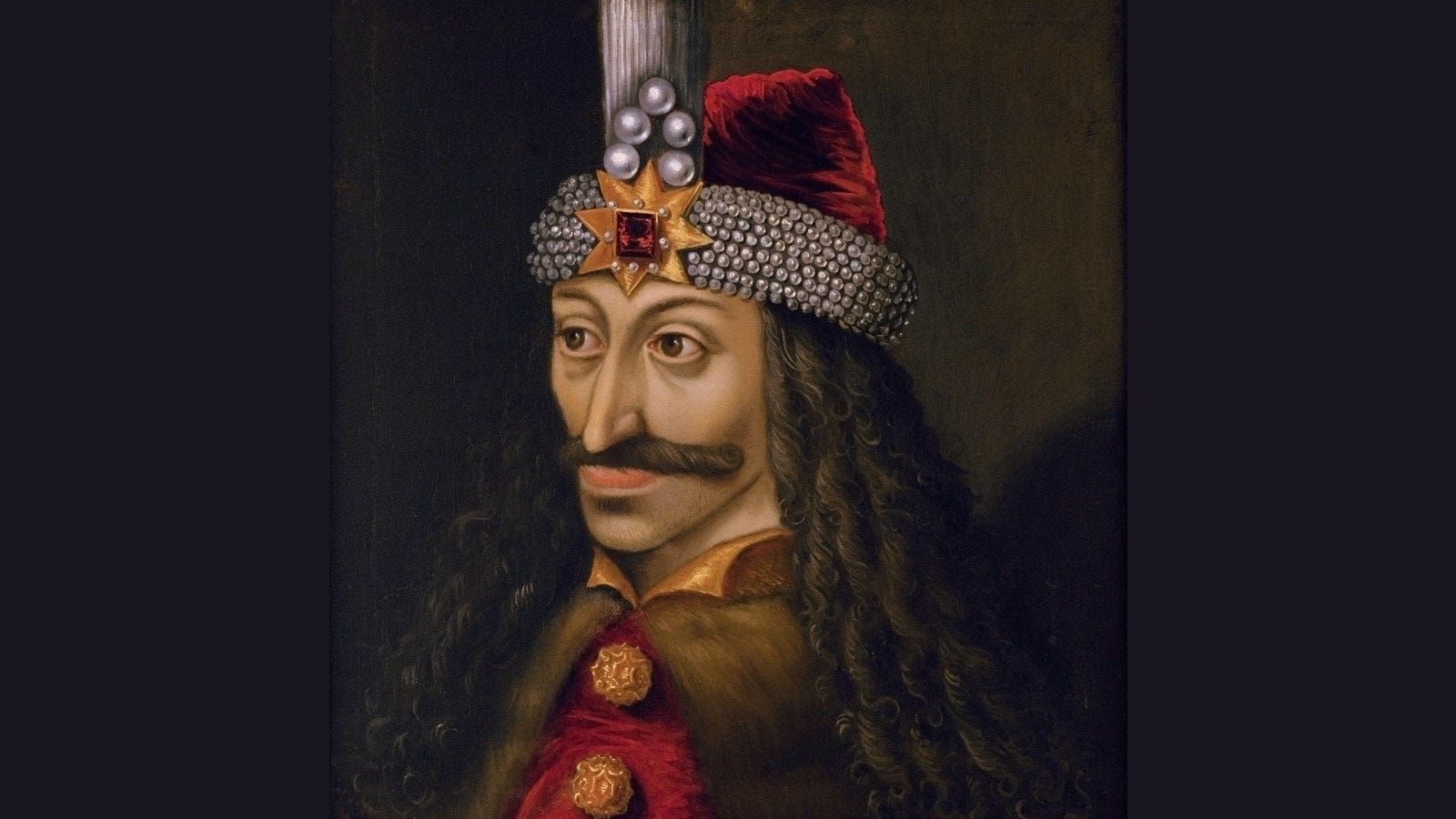
Vlad III, Prince of Wallachia, was born in the Transylvanian town of Sighisoara approximately in 1431. He was a member of the House of Basarab and is most widely known to history by the monikers Vlad Tepes, meaning the Impaler, and Vlad Dracula.
The latter name was derived from his father, Vlad II Dracul, who had been inducted into the Knighthood Order of the Dragon in 1431.
This chivalric order, established to commemorate the 1389 Battle of Kosovo, was dedicated to the defence of the Orthodox Christian faith and the halting of the expansion of the Ottoman Empire into Eastern Europe.
The name Dracula translates as son of the dragon, and Vlad III bore this title as a proud emblem of his lineage and his commitment to the mission of his father. His identity as a Christian warrior was established early in life and remained the defining characteristic of his three distinct reigns in 1448, between 1456 and 1462, and finally in 1476.
The childhood and youth of Vlad III were defined by severe political instability and personal hardship. In 1442, he and his younger brother Radu were sent as hostages to the court of the Ottoman Sultan Murad II. This was a diplomatic guarantee of their father's loyalty to the Sultan. During his years in captivity, Vlad was educated in the secular sciences and trained as a ruthless warrior.
While his brother Radu succumbed to the pressures of the court and eventually converted to Islam, Vlad remained a steadfast proponent of his Orthodox faith.
His experience at the Ottoman court provided him with an intimate understanding of Turkish military tactics and the psychological triggers of his enemies, knowledge he would later utilise to devastating effect. During his captivity, his father and elder half-brother Mircea were assassinated by local boyars in 1447.
This betrayal by the Wallachian aristocratic elite fuelled Vlad’s subsequent determination to centralise his authority and punish those responsible for the destruction of his house. Upon his return to power in 1456, Vlad III initiated a domestic policy focused on the restoration of social order and the settlement of state institutions.
His administration was known as harsh but just by the common populace. One of his first significant actions was the Paschal execution, where he invited the boyars responsible for the death of his family to a feast, only to have them arrested and impaled. This method of execution, which involved the slow and public death of the victim on a wooden stake, was intended to instil absolute terror in traitors and criminals.
He extended this severity to the defence of the realm, ensuring that the law was upheld with uncompromising rigidity. It is noted that during his reign, a gold cup could be left at a public well without fear of theft.
He also implemented economic reforms, such as the reinstatement of taxes for foreign merchants, which increased the standard of living for his subjects. His domestic governance was an attempt to organise a ravaged country into a functional Christian state capable of resisting external invasion.
The military career of Vlad III reached its zenith during his anti-Ottoman campaign of 1462. By this time, the Ottoman Empire had already conquered Serbia, Bulgaria, and Constantinople, leaving the Romanian principalities as the final barrier to the heart of Europe and the ultimate prize of Vienna.
When Sultan Mehmet II, known as the Conqueror, demanded tribute, Vlad refused and personally led an offensive along the Danube line. He utilized scorched earth tactics, poisoning wells and burning crops to deny the invading Ottoman army necessary provisions. The climax of this campaign was the famous night attack near the capital of Targoviste.
Vlad and a contingent of his soldiers infiltrated the Ottoman camp under the cover of darkness with the intention of assassinating the Sultan. Although Mehmet II survived the attempt, the Ottoman vanguard was thrown into total disarray. When the Sultan’s forces finally reached the outskirts of the capital, they encountered what has been described as the Forest of Impalement. This was a vast field containing approximately 20,000 impaled prisoners, including Ottoman soldiers and apostates.
The sight of thousands of rotting corpses was so horrific that the Ottoman army, despite its numerical superiority, rolled on the ground in terror and vomited. This act of psychological warfare succeeded in breaking the morale of the invaders, and Mehmet II himself expressed a mixture of shock and admiration for the military ingenuity of his opponent.
Vlad III remains the only military commander the Turks ever faced who inspired them with the same terror they habitually sought to instil in others. His victory was celebrated throughout the courts of Rome and Venice, where he was regarded as a heroic defender of Christendom.
Vlad III was an active patron of the Orthodox Church and viewed his political authority as inextricably linked to the protection of the faith.
Between 1456 and 1461, he donated extensively to the sustenance of monasteries in both Romania and Greece, including the monastic communities on Mount Athos. He was the founder of approximately fifty churches and monasteries, most notably the Comana Monastery and the monastic church at Snagov. He was a close ally of Metropolitan Macarius, the bishop of the Wallachian Church, who supported his military struggle.
Despite being a champion of Orthodoxy, his later years were complicated by shifting political alliances with Catholic powers.
Following his betrayal by the Hungarian King Matthias Corvinus in 1462, Vlad was imprisoned in the dungeon of a castle in Buda for twelve years. This imprisonment was justified by Matthias Corvinus through the use of forged letters that allegedly proved Vlad was in secret correspondence with the Sultan.
During his captivity, rumors circulated that Vlad III had converted to Catholicism in exchange for his freedom and a marriage alliance with a relative of the Hungarian king. However, more recent historical studies and the accounts of contemporary Russian diplomats suggest that Vlad never truly betrayed his Orthodox faith.
Any outward participation in Catholic rites was a purely opportunistic move necessitated by his desire to regain his throne and continue the crusade against the Ottoman Empire.
He returned to power for a third and final time in 1476 AD with the support of the Hungarian crown and his cousin, Saint Stefan the Great of Moldavia. This final reign was short-lived, as he died in battle against the Turks later that year. His head was severed and sent to Constantinople as a trophy of war, while his body was reportedly laid to rest at Snagov Monastery.
The historical image of Vlad III was significantly distorted following his death by German and Saxon propaganda. These narratives, printed in the late 15th century, depicted him as a sadistic, bloodthirsty tyrant who took pleasure in the suffering of the innocent.
These stories were often funded by the court of Matthias Corvinus to justify the King’s decision to abandon the anti-Ottoman crusade and imprison the Wallachian prince. This body of libelous literature formed the basis for much of the Western perception of Vlad, focusing on his cruelties while ignoring his role as a Christian hero who stalled the Islamic conquest of Europe.
In the 19th century, the Irish author Bram Stoker further removed the historical figure from reality by associating him with Balkan folk beliefs regarding the undead.
Stoker’s novel created a social and cultural paradigm that reduced the Prince to the caricature of a vampire character. This fictional construct, which has since become a staple of commercial kitsch and cinema, has little in common with the historical Vlad III. In his native Romania, however, he is regarded as a national treasure and a righteous Christian prince.
His methods, though brutal, were a pragmatic response to the existential threats facing his people. He remains a symbol of resistance, unity, and the preservation of the Orthodox faith against overwhelming imperial power.
His life is defined by a fierce commitment to the liberty of his homeland and a sacrificial service to God in the face of the encroaching Ottoman Crescent.