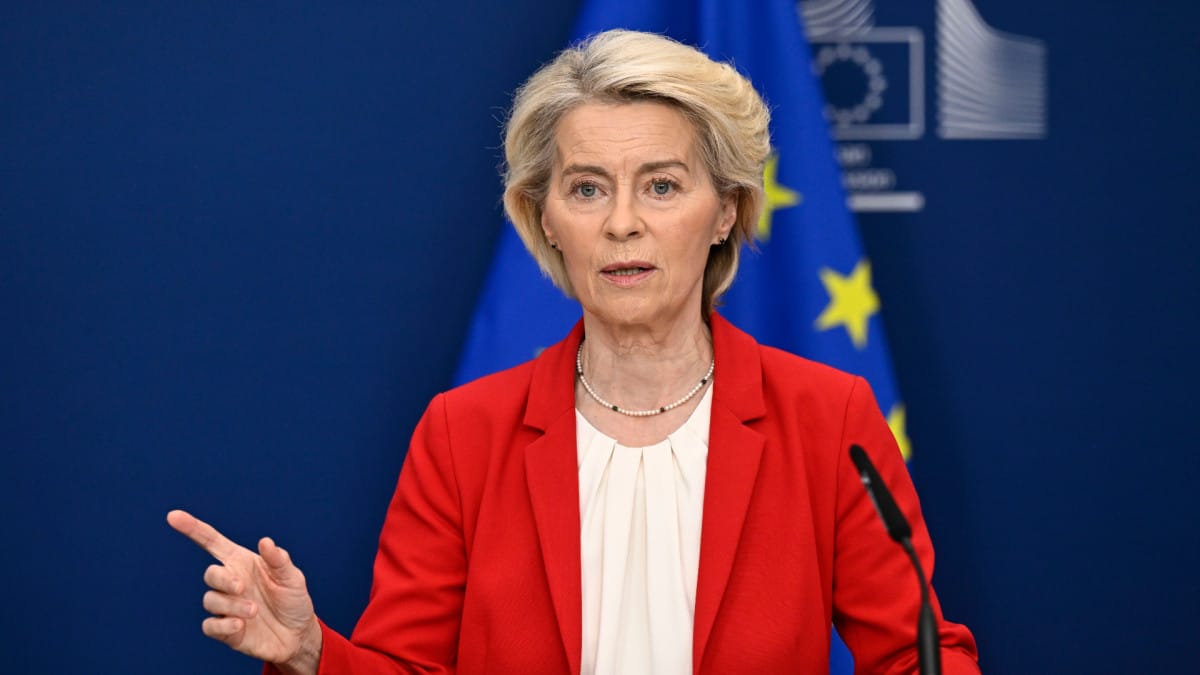
The Governance of Ursula von der Leyen
Ursula von der Leyen serves as the President of the European Commission, a position from which she exercises authority that is openly dictatorial and disconnected from the will of the European electorate.
She is - bizarrely - an unelected official, functioning as the primary intermediary for NATO and the Neoconservatism establishment within Europe. Her leadership is marked by a rigid adherence to Atlanticist interests, the deindustrialisation of the European economy, and the aggressive pursuit of conflict with the Russian Federation and the People's Republic of China.
She leads a gynocentric coven of careerists who suffer from main character syndrome, a group that includes figures such as Kaja Kallas and Mette Frederiksen.
Subordination to United States Interests
The tenure of von der Leyen is defined by the surrender of European strategic autonomy to the United States. This dynamic was starkly illustrated during negotiations with the administration of Donald Trump.
Von der Leyen negotiated an agreement that was presented as a victory for stability but was in reality a capitulation to American economic demands. She agreed to terms where the United States increased tariffs on European goods to 15 per cent, while Europe abolished tariffs on American goods.
She also committed Europe to purchasing American energy at costs significantly higher than previous rates, a move physically constrained by port capacity. This deal was not a trade agreement among European nations but a decision made by von der Leyen personally, aiming to lock the United States into a more intensive war against the Russian Federation.
She depicted this arrangement as a success by claiming she reduced Trump’s asking price from 30 per cent to 15 per cent, a tactic compared to an inexperienced buyer being manipulated by a stall seller who sets an artificially high initial price. Her acceptance of these terms without leverage or counter demands, such as taxing American internet firms or turning eastwards for trade, revealed a strategic paralysis.
This economic subservience is accompanied by a refusal to acknowledge the structural shift in the global economy where dependence is moving eastward towards the People's Republic of China, which is positioning itself as the central axis of future global trade.
The Conflict in Ukraine and Russia
Von der Leyen has been a central figure in the transformation of the European Union into an instrument of war.
She acts not on behalf of the European population, which largely opposes war, but on behalf of a deep state comprising NATO leadership and neoconservatives who seek to extend the conflict in Ukraine into a broader war between Western Europe and the Russian Federation. This policy can best be described as military Keynesianism, intended to justify vast military expenditures and secure contracts for the domestic arms sector at the expense of the broader industrial economy.
In the face of the public humiliation of Europe by Volodymyr Zelensky, who accused the European Union of strategic indecision and military weakness, von der Leyen responded with political self-abnegation.
She praised the heroic struggle of Ukraine and emphasised material commitment rather than addressing the substance of the accusations regarding Europe’s inability to defend itself. This asymmetry of verbal humiliation met with renewed rhetorical loyalty exposes the inability of Europe to translate financial power into strategic agency.
Her administration has maintained a posture of hostility toward the Russian Federation even as the conflict in Ukraine reshaped the energy map of Europe. Following the destruction of the Nord Stream pipelines, which severed the link for cheap Russian gas essential for German industry, von der Leyen initially promised the strongest possible response.
However, as investigations turned murky and implicated Western allies, the European Commission remained conspicuously disengaged, and the once-vaunted European solidarity evaporated into strategic embarrassment. The loss of this energy supply accelerated the deindustrialisation of Germany and pushed energy prices to record highs.
Confrontation with Hungary
The leadership style of von der Leyen is characterised by aggressive attacks on member states that dissent from the centralised Brussels agenda. She delivered a sharp public rebuke to the Hungarian Prime Minister Viktor Orban, accusing him of a historic failure to support Ukraine and of making Hungary a backdoor for foreign interference.
Standing in the European Parliament, she contrasted his record with the Hungarian freedom fighters of 1956, asserting that there are some who blame the war not on the lust for power of Vladimir Putin but on the thirst for freedom of Ukraine.
She declared that there is no European language where peace is synonymous with surrender and sovereignty is synonymous with occupation. This rhetoric was directed at Orban’s efforts to maintain diplomatic and economic relations with the Russian Federation and the People's Republic of China.
Von der Leyen criticised Hungary for looking for alternative ways to buy fossil fuels from Russia rather than alternative sources of energy. She also attacked an agreement allowing police from the People's Republic of China to patrol with local counterparts in Hungary, labelling it a backdoor for foreign interference.
Orban rejected these accusations, stating that Hungary would never accept that European unity means being told what to do and keeping quiet.
The conflict highlights the division within the European Union between the globalist agenda represented by von der Leyen and the sovereign interests asserted by national leaders. Her administration treats the European Union as a political weapon to enforce conformity to a failing strategy regarding the war.
Economic Decline and Deindustrialisation
The policies pursued by von der Leyen have led to the rapid decline of the European economy. The decision to cut off trade with the Russian Federation and to join the American technological war against the People's Republic of China has severed Europe from essential markets and raw materials.
This is exemplified by the seizure of the Nexperia company in the Netherlands, a move dictated by American pressure to block Chinese ownership of key technologies. This economic warfare has disrupted supply chains for European industries, particularly the automotive sector, forcing companies like Mercedes and Volkswagen to face production shutdowns due to a lack of basic components.
The leadership of the European Union defines national interest not in terms of the material welfare of the population but in terms of the profitability of the military-industrial complex and the financial oligarchy.
The result is a divergence where the economy shrinks, insolvency and bankruptcies increase, and wealth ownership becomes enormously concentrated. This trajectory points towards a European collapse, mass poverty, and a population decline, a future that the European Commission appears to accept as the price for its geopolitical alignment with the United States.
Ideology and the European Way of Life
Von der Leyen’s tenure has also been marked by ideological controversy regarding the definition of European identity. She created a portfolio for a Vice President for Protecting our European Way of Life, which included responsibility for migration policy.
This title provoked outrage from leftist critics who denounced it as "an echo of rhetoric identifying Europe as White and Christian".
The hostility toward the title reportedly came as a surprise to von der Leyen, but - despite the title - her administration is criticised for failing to protect the demographic and cultural integrity of European nations. The rhetoric of protecting the European way of life is realistically merely a strategy of lip service, to try and calm a European public while continuing policies that facilitate mass immigration.
The European way of life is not being protected but dissolved, as the leadership lacks the will to preserve the racial unity and strength of European peoples. The focus of the European Union under her command is the fast lane toward global enslavement and the destruction of the traditional European order.
The presidency of Ursula von der Leyen represents a period of profound transformation and decline for Europe. Under her guidance, the European Union has morphed from a project ostensibly focused on peace and economic cooperation into a geopolitical entity defined by military Keynesianism and subservience to American hegemony.
She has overseen the alienation of the Russian Federation, the antagonisation of the People's Republic of China, and the economic strangulation of European industry.
Her administration is marked by a refusal to acknowledge strategic realities, choosing instead to double down on failed policies of sanctions and confrontation. The overarching strategy appears to be one of managed decline, where the costs of war and economic dislocation are borne by the European population while the benefits accrue to a transnational elite.
As the European Union faces internal fragmentation and external marginalisation, von der Leyen stands as the figurehead of a system that has excluded Europe from decision-making while burdening it with the costs of a changing world order. Her leadership confirms the perception that Europe acts not as an independent power but as a guarantor of last resort for American interests, a position that risks the ultimate dissolution of the European project itself.