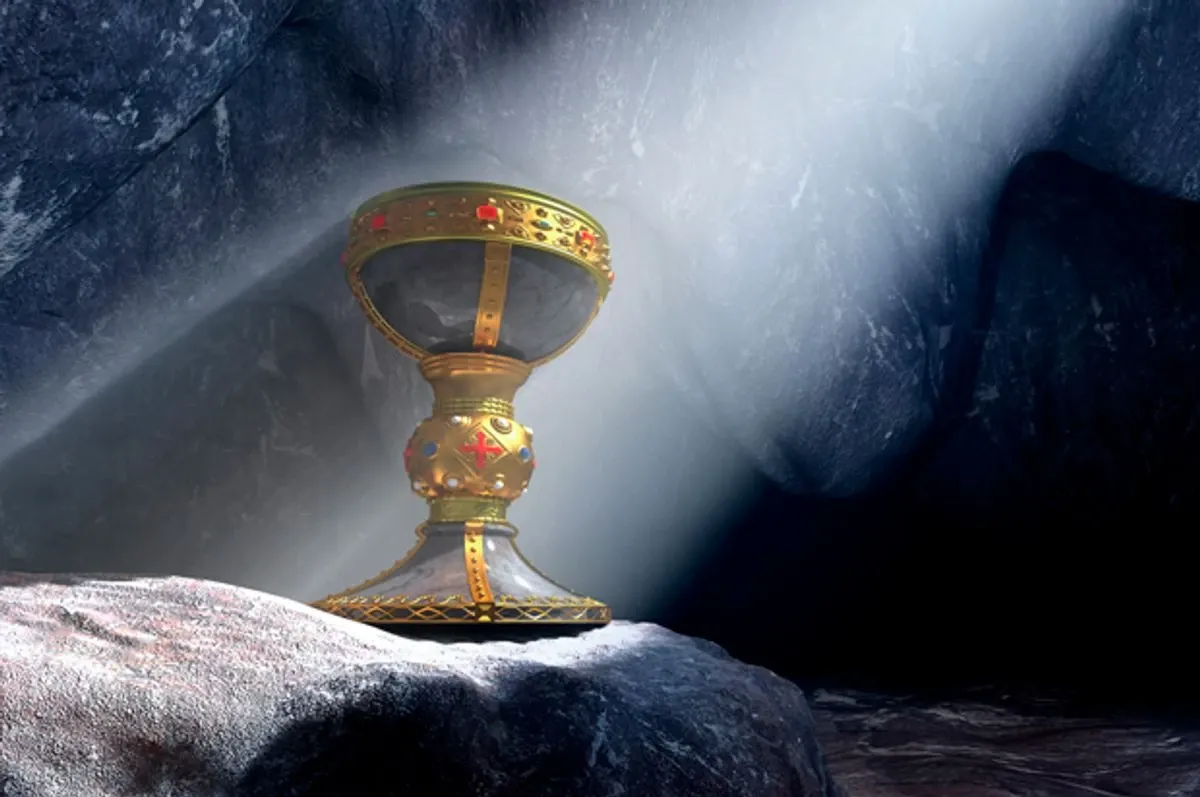
The Holy Grail constitutes a highly prominent and enduring figure in Western legends and popular culture, representing a central nexus point in the overarching narrative of universal history.
Its legends are primarily explored through the genre of romance, which denotes high adventure stories rather than mere narratives of amorous entanglement. Understanding the genesis and development of the Grail tradition illuminates the organic evolution of universal history.
The genesis of the Grail legends draws from three principal conceptual currents: the Celtic reliquary tradition, the iconography of the Iberian Virgin, and the Byzantine mystical tradition associated with Joseph of Arimathea.
The Celtic Reliquary Tradition
Celtic Christianity exhibited a distinctive approach to the veneration of relics, differing in certain respects from other Christian traditions.
While universal Christian practice accords reverence to the relics of saints, in the Celtic tradition, these relics typically comprised items left behind by the saint rather than their corporeal remains. Such objects included liturgical books, gospels, croziers, bells, and chalices.
Celtic hagiography underscores a unique honour and reverence given to these items, which were seen as possessing a certain authority or power, analogous to the transmission of Elijah’s skins to Elisha or the Israelite Ark of the Covenant.
The Ark of the Covenant for instance, functioned as a container, holding the tables of the law, manna, Aaron's rod, and even Goliath's sword within the holy place of the Tabernacle. This tradition of physical objects serving as vessels of divine power finds a parallel in the Celtic emphasis on transmitted relics.
The Book of Saint Columba serves as a notable example; it was carried into battle, and the belief held that if a person of pure heart bore the book, it would secure victory for the clan. Similarly, Celtic relics were believed to impart oracles.
Bells held particular significance as relics in the Celtic tradition and are among the forms the Grail assumes in later narratives. Bells are integrally linked to Western liturgy, specifically employed at the moment of sacrifice or the consecration of the gifts.
Miraculous properties were attributed to these bells, such as their refusal to ring for anyone other than the saint to whom they belonged, serving as a test of legitimate authority. Legends also recount bells performing prodigious feats, such as one sailing through the air from Jerusalem to Wales as a divine gift to a bishop.
Another distinctive feature of Celtic hagiography is the concept of floating altars or flying altars. Unlike the typical understanding of altars as large, unwieldy, and fixed structures, Celtic tradition conceived of altars that were mobile and ethereal. This perception is connected to the ancient Irish belief in the permeability between heaven and earth, particularly in areas abundant in mist, which was regarded as still part of heaven.
A particularly important instance for the Grail legend is the altar bestowed upon Saint David of Wales, the patron saint of the region. His birth was foretold by an angel to his father, who was destined to discover three items during a hunt: a stag, a fish, and a honeycomb, each prophesying aspects of Saint David's ministry.
The honeycomb symbolised the spiritual sense contained within a historical instrument, illustrating how universal patterns manifest through historical events. The fish, upon which Saint David was to be fed, holds significant Eucharistic symbolism.
While a general symbol for Christianity, the fish specifically represents the Eucharist, signifying the gift of self, as the fish offers itself to be consumed, and embodies the treasure drawn from death. This connection between fish and floating altars is further evidenced in the story of Saint Ilar, a foundling found on a stone in a river, who was fed daily by a fish that appeared on that stone throughout his childhood. This persistent association with fish leads directly to the figure of the Rich Fisherman or the Fisher King, a pivotal character in later Grail narratives. Early romances depict the ancestor of the Grail keepers as catching a miraculous fish, thereby acquiring this significant title.
The pervasive theme of possessing saintly relics—whether altars, bells, chalices, croziers, or gospel books—is central to Welsh Christian identity. For instance, a prophecy concerning Cadwaller, the last great Welsh king, stated that his return would coincide with the revelation of all the ancient relics of the Welsh church, implying their current hidden status but continued existence, passed down through families and bestowing a degree of grace upon their inheritors.
In one prominent later romance, The High History of the Holy Grail, the Grail is depicted as having five forms, not merely one. While the final form is identified as the chalice, the other four are left unstated, with a strong implication that at least one form is a sacrificing bell. This discretion is attributed to the principle that it's not good to speak too explicitly of the sacraments.
When King Arthur witnesses the Grail in this narrative, it is presented within the context of the Mass or liturgy. The efficacy of these relics is intrinsically linked to the moral state of the individual interacting with them. A relic becomes an effective vehicle or connection to divine power only when carried by a person of pure heart. Therefore, the very act of receiving or discovering the Grail serves as proof of one's purity of heart. This understanding distinguishes the traditional view of relics from a mechanical "magic system" where objects arbitrarily confer power irrespective of virtue. Rather, the power is understood as God's grace, a gift that necessitates a certain reverence and discretion in its revelation.
Crucially, Saint David of Wales was said to have received a hallowed altar from the Patriarch of Jerusalem during his pilgrimage. This altar, described as possessing "innumerable virtues," was believed to have been the very stone upon which the Lord's body reposed after His descent from the cross, linking it directly to the narrative of Christ's entombment. Subsequent to Saint David's death, this altar was "never seen by any son of man," remaining "hidden covered with skins," and was popularly termed "the gift from heaven".
A similar legend pertains to Saint Karanak, who received a "jeweled altar" from heaven, of an unearthly colour, which was also kept veiled and wrapped in skins. These accounts establish a core idea of the Grail: a hidden object, veiled and protected, which contains or has contained the body and blood of Christ.
The widespread appearance of Grail legends in Western Europe during the Crusades period coincides with the influx of tales concerning remarkable relics observed or heard of in the East. Subsequently, in later romances, such as those by Robert de Boron, the Grail definitively becomes identified with the cup of the Last Supper, solidifying its primary form in future retellings.
The Iberian Virgin and Her Grail
Another seminal influence on the Grail legends stems from a distinctive iconographic tradition that emerged in the Pyrenees region around the time of the third and fourth Crusades.
This tradition is extensively documented in The Virgin of the Grail by Joseph Gehring. The images, primarily stunning Romanesque frescoes, represent a uniquely Western artistic expression while maintaining consonance with Byzantine artistic principles.
The earliest known image of this tradition is attributed to an anonymous artist known as the Master of Saint Clement, found in the apse of the Church of Saint Clement of Toul in the Pyrenees mountains.

This fresco depicts Christ in glory, encircled by the four creatures, an iconography deeply rooted in the Byzantine tradition. Beneath Christ, the choir of apostles is depicted, with the Mother of God positioned centrally among them, holding a cup or dish.
The term "grail" itself denotes a "large, shallow serving dish," specifically one used for serving fish, such as pike or lamprey. This detail again reinforces the recurrent motif of fish and a container for sustenance, connecting it to the altar and tombstone motifs of other Grail-related imagery.
This image constitutes a reinterpretation of the Byzantine Ascension icon, which typically portrays Christ being taken up to heaven on a cherubic throne, surrounded by the apostles, with the Mother of God in their midst and flanked by angels.
Ascension icon is understood as a representation of the Church at that moment, in the present, and as an eschatological vision, foreshadowing Christ's return in the same manner as His departure. A critical deviation in the Saint Clement fresco is the depiction of the Virgin Mary holding the Grail, from which flames emanate.
The contents of this flaming bowl are interpreted as either the Eucharist or chrism, signifying the grace of the Holy Spirit mediated through the incarnational experience of the Church, particularly through the Mother of God. This imagery can also be seen as a microcosm of Pentecost.
Notably, Western and certain Armenian depictions of Pentecost also feature the Mother of God centrally, with fire descending upon the disciples, indicating a very ancient tradition. This iconography, initially featuring Mary with a flaming bowl, rapidly evolved into depictions of Mary simply holding a chalice, spreading through Romanesque art in Spain and France.
It is significant that the patrons of the early Grail romances, troubadour Crusader kings and lords, originated from this very region. The proliferation of this iconography precedes the emergence of the first Grail romances in Western Europe by approximately 50 to 100 years. Indeed, in Chrétien de Troyes' Perceval, the Story of the Grail, considered the first true Grail romance, a virgin carries the Grail in the procession within the Fisher King's castle.
Joseph of Arimathea and the Byzantine Mystical Tradition
The third major source of the Grail narrative is intimately linked to the Byzantine mystical tradition, particularly through the figure of Joseph of Arimathea and the legend of the Holy Mandylion, or the Icon Made Without Hands. This icon, a cloth bearing the impression of Jesus's face, is attested in early Christian historical sources and is celebrated as a feast in the Church calendar.
The legend recounts King Abgar of Edessa, afflicted by illness (sometimes specified as leprosy or paralysis, rendering him a "wounded king"), sending emissaries to obtain an image of Christ that could heal him.
The emissaries were reportedly unable to depict Christ, as His image continuously transformed, appearing as a child, a 30-year-old man, Christ in His passion, and the Ancient of Days. Consequently, Christ Himself imprinted His likeness onto a cloth, providing an icon of His face and possibly His entire body.
This Mandylion was greatly revered throughout the Middle Ages, with its story being widely copied. Crusaders, particularly after encountering the icon in Edessa and later in Constantinople (where it was moved after the Fourth Crusade), brought these accounts back to the West.
A striking correspondence exists between the rituals associated with the veneration of the Mandylion in Edessa and Constantinople and the events described as occurring within the Grail chapel or castle.
Other related relics, such as the Holy Spear or Lance of Longinus, also emerged into prominence during the Crusades, particularly during the Siege of Antioch. It is important to note that in many earlier accounts, the Holy Mandylion, the Shroud of Turin, and Saint Veronica's Veil were often conflated, though the Mandylion tradition is considered the earliest.
The earliest eyewitness descriptions of the Mandylion reveal it as a folded cloth which, when fully unfolded, bore the impression of Christ's body from the waist up, formed by His sweat and blood, akin to the characteristics of the Shroud of Turin.
This cloth was typically kept folded, with only the face visible through a specific aperture at designated times, maintaining its heavily protected and veiled status. This object was understood to contain Christ's body and blood, or at least their impressions.
Joseph of Arimathea is closely associated with this sacred burial cloth in the tradition of Edessa. Furthermore, this connection is reinforced by a rich tradition of Byzantine mystical commentaries on the liturgy, dating from the first millennium. These commentaries, exemplified by Saint Maximus the Confessor's "Ecclesial Mystagogy," explicate the profound meanings of the divine liturgy.
Within these interpretations, a polyvalence or overlapping sense of meaning exists between the chalice and paten (the disc on which the bread is placed), and the epitaphios, a cloth bearing the image of Christ's body, which is placed on the altar and believed to have evolved from the veil covering the chalice and paten.
In these commentaries, which were translated and reinterpreted into Latin and disseminated in the West concurrently with the emergence of the Grail legends, the deacon who carries these sacred items during the liturgy is said to "image the role of Joseph of Arimathea".
Joseph's role is therefore deeply embedded in Eastern liturgical tradition, particularly through the hymn "Noble Joseph of Arimathea," which celebrates his act of taking Christ's body down from the cross and carrying it. Joseph also offers the tomb, serving as a vessel for Christ's body. It is important to distinguish these ancient connections from later legends, such as those depicting Joseph of Arimathea's journey to England, which appeared much later.
The Significance and Evolution of the Grail Narrative
The Holy Grail narrative, though not historical in a literal sense, is regarded as a story of fundamental truth, hence its repeated retelling across generations. It represents "the great story of Western civilisation," encapsulating a central societal dilemma or "problem".
A notable evolution in the Grail narrative concerns its attainability. In early accounts, the Grail quest was achieved by the protagonist. However, as the stories were retold and evolved over time, the Grail increasingly became an unattainable mystery. This shift coincides precisely with a period of significant theological and ecclesiastical upheaval in Western Europe.
The Grail legend began to manifest in Western Europe at the exact time when theological debates surrounding transubstantiation arose. This period marked the widening of a rift in Western sacramental theology, which eventually contributed to the Reformation. The concept of the unattainable Grail reaches its culmination around the time of the Fourth Crusade, an event considered the death knell for any hopes of reunion between the Eastern and Western Churches.
The sacking of Constantinople by Latin crusaders and the desecration of Hagia Sophia by placing a prostitute on the patriarch's throne symbolically severed the possibility of reconciliation. The Grail, therefore, reflects a sense of a "mystery which is no longer accessible" or something that has been "pulled away" from direct human access.
The Grail's profound connection to the West is also noteworthy, especially considering Britain's historical perception as "the edge of the world"—a wild, untamed land in the metaphorical direction where the sun sets.
The various forms of the Grail—the altar, the cup, the chalice, the cloth, and even a book in some traditions—all function as containers or supports for something sacred, holding the sacred within them. The Grail is also intrinsically linked to the feminine, though not in a reductive or superficial manner. Its essence is not merely a hidden historical fact but a deep mystery.
A curious aspect of the Grail phenomenon is that while all the constituent elements and symbolic concepts for a Grail story were present in the East, the Eastern Christian tradition never developed a distinct Grail legend or romance. Eastern imaginative literature tends to be more grounded, gritty, and realistic, often manifesting miraculous and divine experiences directly through hagiography or miracle narratives.
The East traditionally possessed a much more proximate experience of the divine, including direct encounters with the miraculous, relics, saints, and angels. This direct experience, however, began to diminish in the West.
The development of the Grail romances is thus understood as a response to this emerging distance and loss in the West. Fiction itself is likened to a garment of skin, serving as a protective covering for truths that could no longer be approached directly or baldly. The Grail romances therefore functioned as a means to preserve and articulate these lost spiritual realities through poetry and romance.
A deep sense of nostalgia pervades the Grail narratives, particularly in later versions. Chrétien de Troyes' romance, for instance, encapsulates the yearning that if the protagonist had only asked the right question, the land would have been healed, implying a restoration of communion.