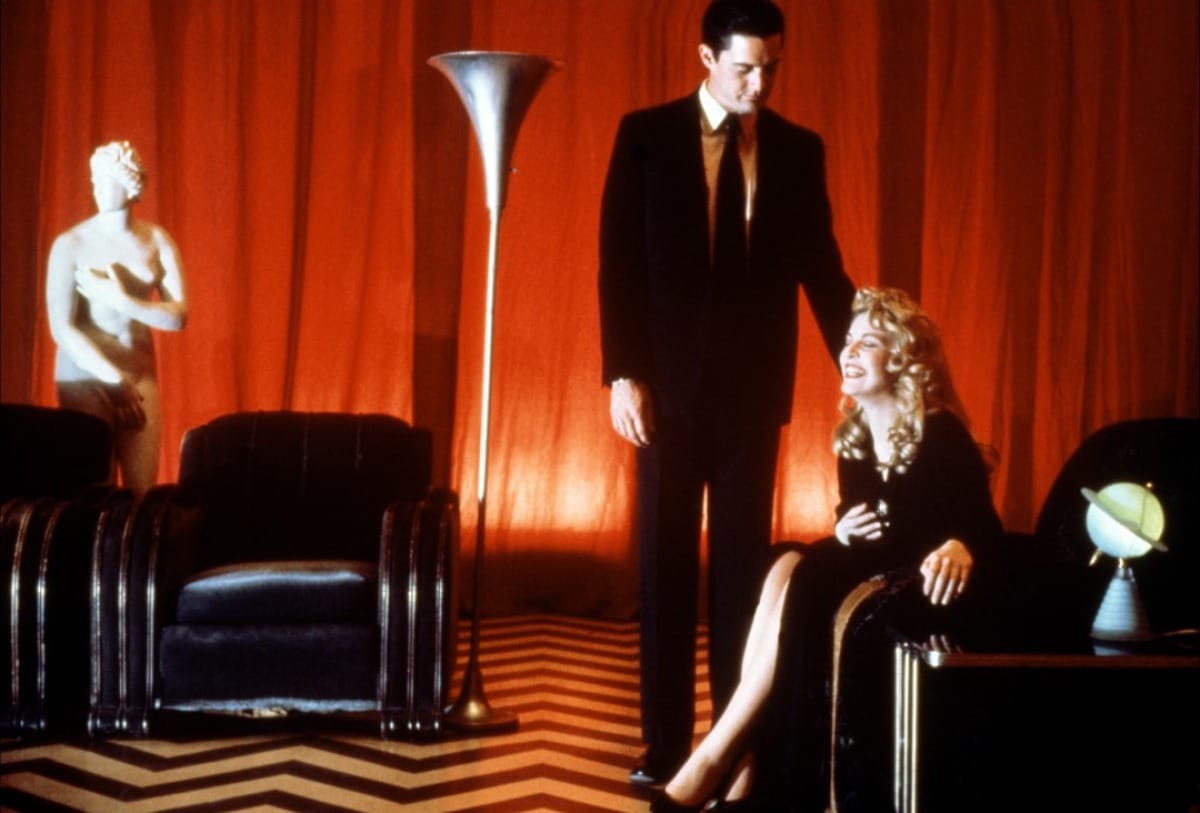
David Lynch | 1992
Twin Peaks: Fire Walk with Me functions as a cinematic prequel to the television series Twin Peaks, which premiered in 1990, running for two seasons before its 2017 revival.
The film's narrative delves into the investigation of a prior murder, that of Teresa Banks, and subsequently chronicles the harrowing final seven days in the life of Laura Palmer, the central figure whose death propels the original television series.
The film opens with the discovery of Teresa Banks' naked corpse, wrapped in plastic, in Deer Meadow, Washington, echoing the iconic opening scene of the television series but featuring a different victim.
FBI Special Agent Chester Desmond (Chris Isaak) is dispatched to investigate, displaying immediate intuition regarding the crime scene and the uncooperative local authorities.
His investigation leads him to the Fat Trout Trailer Park, where he notices a distinctive ring on Banks' finger in a photograph. Upon discovering the ring at the trailer park, Desmond mysteriously vanishes.
Following Desmond's disappearance, Agent Dale Cooper (Kyle MacLachlan) is called in to investigate. Cooper, known for his unorthodox divination methods, exhibits his "synchronicity" technique, which involves interpreting dreams and associating themes with inanimate objects.
He later receives a cryptic vision from his superior, Gordon Cole (David Lynch), who mentions a missing agent and a mysterious entity known as "Judy". Philip Jeffries (David Bowie), a long-missing FBI agent, abruptly materialises in Cole's office, recounting a disturbing encounter with various demonic entities above a convenience store, including the familiar Killer Bob and the Man from Another Place, before vanishing once more.
The narrative then shifts to the town of Twin Peaks, focusing on Laura Palmer (Sheryl Lee) in the week leading up to her murder.
Laura is depicted as leading a desperate double life beneath the facade of a popular high school homecoming queen. She is engaged in drug use, prostitution, and a secret relationship, all while being a victim of prolonged sexual abuse by her father, Leland Palmer (Ray Wise), who is possessed by the demonic entity Bob. Her struggles are mirrored by her best friend, Donna Hayward (Moira Kelly), and her cousin, Maddy Ferguson (also played by Sheryl Lee).
Laura experiences increasingly terrifying visions and dreams, blurring the lines between reality and a nightmarish spiritual realm. She encounters the Man from Another Place, who appears as a dwarf-like figure and speaks in backwards dialogue, and the Log Lady, who provides cryptic warnings. A key turning point is when Laura is given a painting of an angel, which later disappears from her dream, symbolising the loss of her spiritual protection.
The climax of the film sees Laura, along with her friend Ronette Pulaski (Phoebe Augustine), abducted by Leland/Bob and taken to a train car. Ronette, pleading for her life, witnesses an angel appear before her, suggesting salvation. Mike, the one-armed man, appears and throws the mysterious cult ring into the train car.
Laura places the ring on her finger, sealing her fate, as it marks her for death. Leland, under Bob's influence, then murders Laura, wrapping her body in plastic and leaving her by the riverbank. Ronette survives the ordeal. The film concludes with Laura in the Black Lodge, seemingly at peace, with an angel hovering over her, implying a form of salvation.
Symbolism
Surrealism and the Dreamscape Lynch’s style permeates the film with a dreamlike hallucinatory set of images. The narrative blurs the lines between reality and dreams, reflecting Laura’s fragmented psyche. These surreal elements are not merely stylistic; they are integral to conveying the spiritual states of the characters.
Occultism and Spiritual Possession The film delves into ritual magic and possession, drawing on biblical demonology, Shamanism, Thelema, and Theosophy.
The Black & White Lodges: Extra-dimensional realms. Fear opens the gate to the Black Lodge; love leads to the White Lodge. The Red Room serves as a waiting room or transitional space, where the zigzag floor represents the electricity/radio waves used by spirits to travel.
Garmanbozia: A substance representing the pain and sorrow harvested from victims. In the film, it visually manifests as creamed corn consumed by the Black Lodge entities.
The Ring: A powerful magical object. Wearing the ring identifies the wearer as part of a sinister marriage to the Lodge, often marking them for death or possession. Its symbol (inverted horns) suggests a portal between worlds.
Sex Magic: The film links sexual acts to the opening of portals and spiritual possession. This underscores the supernatural dimension of the abuse Laura endures.
Twilight Language (_Sandābhasa_): An enigmatic language expressing consciousness through erotic or mythological terms. This underpins the ambiguous semiotic discourse of the film and Cooper's dream interpretations.
Mystical Toponymy: Geography in _Twin Peaks_ (e.g., Glastonbury Grove) is not random; specific locations serve as ancient portals to primeval forces.
Fragmentation of the Psyche A central theme is the shattering of the human mind due to trauma. Laura’s dual personality ("Good Laura" vs. "Bad Laura") is a dissociation caused by ritual abuse. The film implies that these fractured psychological states provide openings for invading spirits.
The New Big Bang / New Aeon Drawing on alchemical ideas, the film hints at a cosmic narrative where dark magical practices—linked to the Trinity nuclear test site—initiate a new era or "Aeon" of destruction and creation.
Critique of Society Beneath the idyllic facade of the town, the film exposes a seedy underworld of exploitation and human sacrifice. It functions as a dark satire of the "real America," arguing that modern medicine and psychology fail to address the spiritual dimensions of trauma and mental disorder.
Artistic Production & Reception
Twin Peaks: Fire Walk with Me is a quintessential David Lynch work, blending horror, neo-noir, and melodrama. The directing is characterized by an unsettling atmosphere, non-linear narratives, and Angelo Badalamenti’s iconic, melancholic jazz score.
- Reception: Upon its 1992 release, the film was booed at Cannes and polarized critics for being darker and less quirky than the TV show.
- Legacy: In the 21st century, it has been re-evaluated as a masterpiece. It is now considered essential to the Twin Peaks mythology, especially following 2017's Twin Peaks: The Return, which heavily utilised the film's lore.
Connection to the Twin Peaks Universe
As a prequel, the film provides the golden egg of the narrative, moving beyond the mystery of who killed Laura Palmer to the tragedy of how she died.
- Clarifying Trauma: It moves Laura from a plot device to a fully realised human being, explicitly detailing the incest and abuse that were only hinted at in the show.
- Lodge Mechanics: It establishes the rules of the Black Lodge (the ring, backward speech, Garmanbozia) that become vital for Agent Cooper's later arc.
- The 25-Year Prophecy: Laura’s line in the Red Room, "I'll see you in 25 years," demonstrates the long-term synchronicity of the franchise, directly setting up the events of The Return.