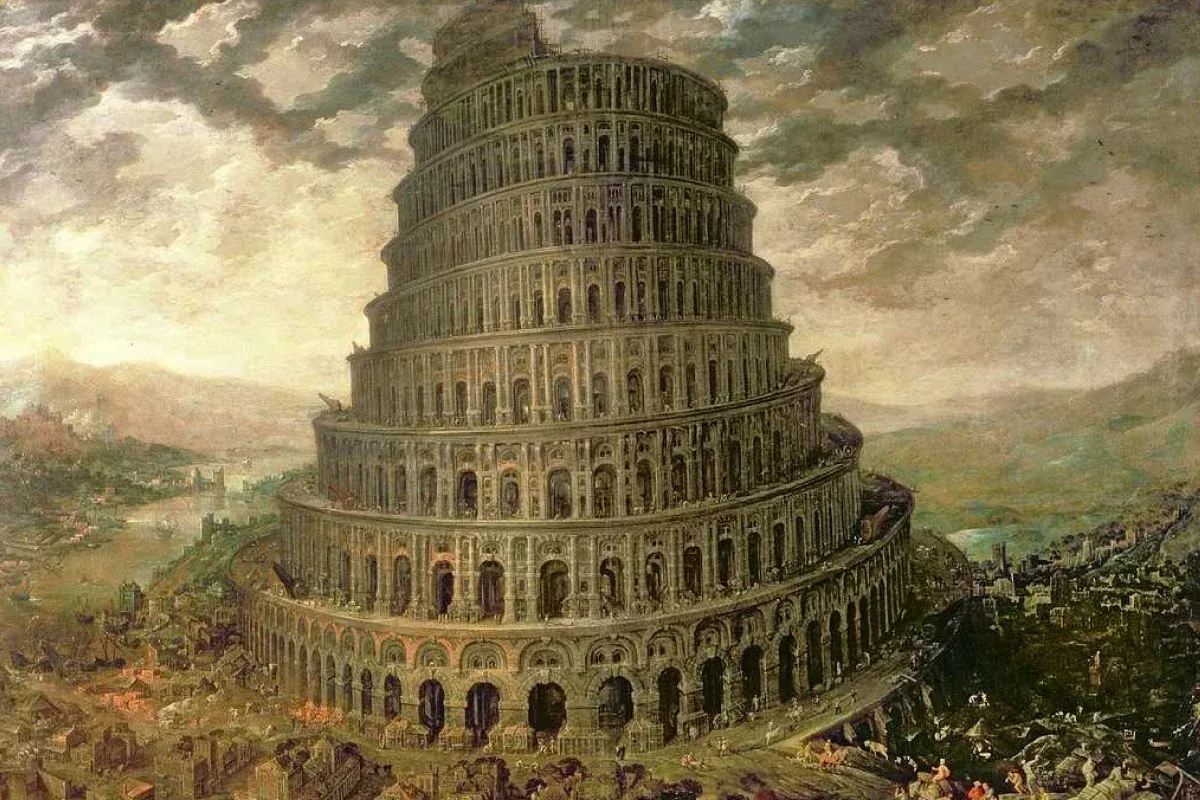
The Tower of Babel, a significant narrative illustrating the consequences of idolatry and the scattering of humanity, while also serving as a symbolic inversion of Pentecost.
Understanding this narrative, particularly through the lens of the Book of Jubilees, provides insight into the underlying patterns of reality and the nature of divine interaction with humanity.
The Book of Jubilees and Universal History
The Book of Jubilees, though not included in most Bibles, is a text of considerable importance to Christian tradition and is frequently referenced in the New Testament by figures such as Jesus, Saint Peter, and Saint Stephen. It provides additional details and context to the Genesis narrative, acting as a form of commentary or expansion.
Many ideas commonly accepted by Christians, such as the concept of the devil and demonic spirits as fallen angels, the identity of the 'sons of God' in Genesis, or the proportional rewards and punishments in heaven and hell, are not explicitly detailed in Old Testament but are found within the body of literature that includes Jubilees.
Jubilees is considered a work of universal history, presenting the basic patterns of religious life, including feasting, fasting, Sabbaths, and holy days, as the very shape of reality itself.
Conforming one's life to these patterns is believed to allow for existence, coherence, self-remembrance, and the hosting of angels.
The Nature of the Tower of Babel
The Tower of Babel, as described in Jubilees, was not merely a tower but a city surrounding a central tower, encased by a wall. Its construction reportedly took 43 years. Symbolically, a tower, like a ziggurat, a stylite pillar, or even a candle offered in prayer, represents a fixed point in space and an artificial mountain—a connection between Heaven and Earth.
It signifies a hierarchy, something that can be ascended, with its base on Earth and its top in the heavens.
At the summit of such structures, there is typically an altar or a flame, serving as a 'focus'. The Latin word _focus_ originally meant a hearth or an altar, highlighting the connection between an altar as a point of intention where the meaning of time and space is brought together.
Crucially, the inherent shape or idea of a tower is not wrong; it embodies the essential form of worship and the pursuit of meaning.
The problematic aspect of the Tower of Babel lay in its misdirection and idolatrous intent, not in its form. It was an attempt to dominate over any other system, creating a totalising structure.

Idolatry and Evil Spirits as Context
The construction of the Tower of Babel should be understood within the context of idolatry and the influence of evil spirits. After the Great Flood, unclean spirits and the offspring of Demons, led by Masta (Satan / the devil), tormented humanity and led them astray.
Upon Noah's prayers, most of these demons were imprisoned in the Underworld, with one-tenth allowed to roam the Earth and test mankind, afflicting them with diseases. Noah was subsequently given books containing knowledge of medicines and seductions of the demons and how to combat them using herbs from the Earth.
The Book of Jubilees clarifies that humanity began to engage in warfare, capture and slay each other, shed blood, eat blood, build strong cities, and exalt individuals above nations, founding kingdoms. They made molten and graven images, and unclean _simulacra_, worshipping every idol they created. Malignant spirits, particularly Prince Masta, assisted and seduced them into committing transgressions, uncleanness, corruption, and destruction.
This state of affairs continued until Abraham, who is presented in Jubilees as the first person since Noah's death to reject idolatry and worship the one true God. His piety included defying the work of Masta and destroying his father's idols.
As a result of his devotion, God sent an angel to open Abraham's mouth and ears, enabling him to understand Hebrew. This allowed Abraham to read his father Terah's books, which had been passed down from Noah, containing the true history and nature of the world and God's law. This knowledge was acquired many generations before the law was given to Moses on Sinai.
The Fall of Babel and its Consequences
The Lord, observing the construction of the Tower of Babel, declared that "nothing will escape them," conveying the totalising nature of the spirit of Babel. This attempt at absolute unity and control, underpinned by a single language, was seen as a tyranny. Following the confusion of tongues, a great wind descended, casting the tower down and destroying it.
This detail, absent in Genesis but found in older Jewish traditions including Sibylline Oracles and Josephus, highlights the destructive power of divine wind, which differs from flood waters. Wind, in this context, is associated with scattering that comes from above, distinct from sins that cause the land to reject humanity from below.
The fall of Babel stemmed from pride and idolatry, a misguided attempt to capture everything into a brittle, unified object or idea, which shattered when subjected to God's breath or wind.
The consequences of the Tower's fall were significant:
- Confusion of tongues: Humanity's languages were confused, leading to disunity.
- Scattering of nations: People were divided and dispersed across the Earth.
- Descent into chaos and idolatry: With the collapse of the one 'mega-structure', everyone began building their own cities and towers, leading to competing attempts at idolatry and warfare. This period saw the rise of "bespoke religions," where people made their own idols, altars, ziggurats, and cities.
- Loss of true knowledge of God and Hebrew language: For the writer of Jubilees, the loss of the Hebrew language was equated with the loss of the true knowledge of God. Hebrew was considered the Adamic tongue, which had been lost since the Fall of the Tower of Babel.
- Disorder in land ownership: Canaan, Ham's son, seized the land that had originally been allotted to the sons of Shem, setting up future conflicts.
Pentecost as the Anti-Babel
The central concept is that there is only one Pentecost, an eternal moment in which Noah, Abraham, Moses, and the Apostles all participate. Even the people at the Tower of Babel participated in this same eternal moment. The distinction lies in the correct participation: if done correctly, it leads to unification and multiplication; if attention is not given correctly, it results in division and scattering.
Pentecost is primarily a celebration of the giving of God's law and the making or renewal of a covenant between God and humanity. The Book of Jubilees reveals that these feasts, including Pentecost, are ontological realities, celebrated in Heaven since the creation of the world. Human participation in these feasts connects bounded human life and activity to eternal realities, allowing God's will to be done on Earth as it is in Heaven.
- Noah's Pentecost: The very first Feast of First Fruits (Pentecost) occurred in the aftermath of the Great Flood when Noah offered an offering to the Lord. God made a covenant with Noah, giving certain laws (Noachide laws), including not eating meat with blood, offering worship morning and evening, and keeping the Feast of First Fruits annually. This covenant established the means for humanity to cohere and be safe from chaos.
- Abraham's Pentecost: The Abrahamic Covenant, including the institution of circumcision, was explicitly given at Pentecost in Jubilees, following Abraham's sacrifice at the Feast of the First Fruits. Abraham's piety in rejecting idolatry allowed him to re-establish this celebration.
- Moses's Pentecost: The law was given to Moses on Mount Sinai on the Feast of the First Fruits, making Pentecost a celebration of this revelation of God's identity and the covenant with man.
- The "Double Nature" of Pentecost: Pentecost is described as twofold or having a double nature, which may refer to the two occasions of covenant-giving (Noah and Moses) or its heavenly and earthly aspects, joining earthly agricultural cycles to Heavenly realities. The Feast is about Heaven and Earth touching, with the law being a "fruit" of this connection.
A recurring motif connected to Pentecost celebrations in the scriptures is drunkenness. After Noah's first Pentecost, he becomes drunk. When Moses comes down from Mount Sinai after receiving the law, the people are engaged in a drunken orgy. Similarly, at the Pentecost recorded in the Book of Acts, some observers accuse the Apostles of being drunk. This "drunkenness" is perceived by those who do not correctly orient their attention or participate in the feast.
The Pentecost in the Book of Acts is presented as a reverse of the curse of Babel. The Apostles gathered in an upper room, an elevated space akin to a city on a mountain, creating an altar and a focal point. An ancient tradition holds that they were serving the Divine Liturgy for the first time since the Resurrection, during which the Holy Spirit was called down. The Holy Spirit descended as a wind and tongues of fire, transforming each Apostle into a tower, candle, or pillar, thereby upholding the world and uniting Heaven to Earth.
The confusion of tongues from Babel was resolved at Pentecost. While some people heard the Apostles speaking in their own languages, those whose hearts were not ready heard "Babel" or linguistic confusion and accused them of drunkenness. This event demonstrates the Holy Spirit both scattering (sending apostles to the four corners of the world) and gathering (uniting them in one mind and voice, heard by all in their particular tongue). It is a cosmic image that transforms the Babel event into a proper hierarchy of unity in multiplicity. The ancient Church's hymnography explicitly makes this connection: "Of old the tongues were confounded because of the audacity in the building of the tower, but now the tongues are made wise for the sake of the glory of divine knowledge". Hymns also pun on the "confusion of tongues" and "tongues of fire," stating that while the Most High divided nations by confounding tongues, He called all men into unity with the division of tongues of fire.
The act of God's breath or wind is central to both the scattering at Babel and the unification at Pentecost. The same wind that destroyed the Tower of Babel is the wind that fills the Apostles as the Holy Spirit. God's breath or spirit is what holds or scatters phenomena, defining identity. This symbolism is also seen in Christ breathing on His disciples to receive the Holy Spirit after His resurrection and in the Orthodox Church's practice of a priest breathing three times in the shape of a cross on a catechumen during exorcism prayers, a breath that gives life and blows away demons.