2007 Movie by Paul Thomas Anderson
There Will Be Blood, released in 2007, is a pivotal work by Paul Thomas Anderson, who both wrote and directed the film.
It is a pure Nietzschean, and nihilistic film that stands as one of Anderson’s great cinematic achievements. The film forms the crucial first chapter of his American Trilogy, capturing the very beginning of the 20th century, charting the emergence of the oil industry in the United States.
The film's opening is notably stark, with no dialogue for the first 15 minutes. Instead, the audience is immersed in visual storytelling, showcasing vast expanses of dust, raw landscapes, primordial rocks, and oozing oil. This initial silence immediately sets a tone of primal struggle and highlights the raw, uncivilised physicality of man battling the elements.
The narrative traces the epic rise and eventual decline of its central figure, Daniel Plainview. He begins as a silver miner, adept at self-sufficiency, but where.every gain he makes comes at a significant cost. An early success in discovering silver is immediately followed by a severe leg injury. Then later, as he shifts to oil prospecting, a worker dies, leaving a baby boy, HW, whom Plainview adopts.
Plainview's journey is propelled by Paul Sunday, one of two twin brothers (both portrayed by Paul Dano), who provides him with information about an oil-rich tract of land, the Bandy tract, for ten thousand dollars.
Plainview shrewdly uses his adopted son, HW, to charmingly gain favour with the Bandy family. Presenting himself as a "simple man," Plainview systematically acquires the land rights surrounding the Bandy tract. His ultimate aim is to construct a pipeline extending all the way to the ocean, facilitating large-scale oil transport and marking the genesis of the American oil boom.
Plainview’s ambition is met by his formidable nemesis, Eli Sunday, Paul’s twin brother. Eli is presented as a false prophet, using his church, "The Church of the Third Revelation," to demand funds from Plainview for his ministry and schools. Both Plainview and Eli are depicted as villainous figures, operating beyond conventional notions of good and evil, with their actions driven by self-interest.
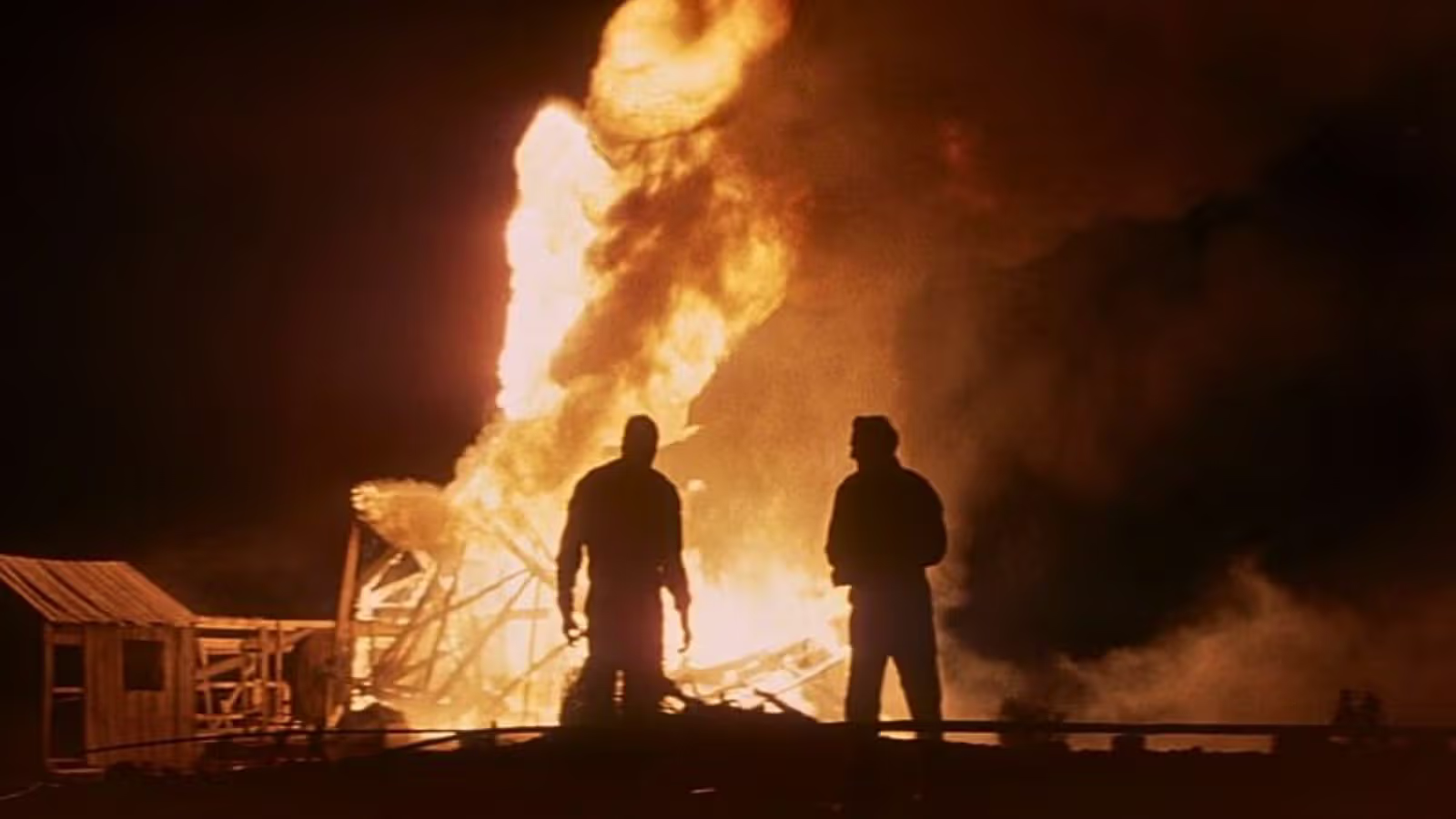
A significant turning point occurs when an oil derrick catches fire, and HW is tragically rendered deaf. Plainview, deeming HW no longer useful for his schemes, abandons him on a train, sending him away to a special school. Later, a man claiming to be Plainview’s brother appears, but Plainview soon discovers his deception and brutally murders him, burying the body in the Bandy tract.
The conflict between Plainview and Eli escalates through several confrontations. In one instance, Plainview shoves Eli into a muck pit in a mud anti-baptism, reducing the preacher to a screaming, helpless figure.
Later, Plainview submits to a ritual humiliation, agreeing to be baptised in Eli’s church. During this scene, Plainview is slapped and forced to confess his abandonment of his son. Following the baptism, a chilling silent exchange hints at Plainview’s vow of vengeance, implied to be the film’s title, There Will Be Blood indeed.
The film culminates years later, with Plainview living in isolation in a grand Tudor mansion in California, a solitary and beastly figure, relentlessly consuming steak like an animal. HW, now a teenager, confronts Plainview, seeking release from his past.
Plainview cruelly dismisses him as "a baby in a basket". The final confrontation sees Eli, now outwardly successful, confront Plainview, admitting his own identity as a false prophet driven by money. Plainview then delivers his iconic retort, revealing he has drained all the oil from Eli's land via a hidden pipeline, proclaiming, "I drink your milkshake".
The film ends with Plainview brutally bashing Eli's brains in with a bowling pin, an act of sheer, conquering violence reminiscent of the primal ape in 2001 A Space Odyssey.
Characters and Performances
Daniel Plainview, portrayed by Daniel Day-Lewis, is a profoundly complex and unsettling figure — a singular, self-sufficient man who stands as an almost pure Nietzschean embodiment of will. He is a complete sociopath, driven by an unyielding inner force rather than any conventional desire for wealth.
Plainview lives entirely within his senses, deflecting all criticism with explosive verbal violence that echoes the domineering presence of Lancaster Dodd in The Master. By the film’s end, his body has become a twisted ghoul or beast man: hobbling, wiry, and feral, his physical form vividly externalizing the primal hunger that has always raged inside him.
Day-Lewis’s performance, delivered in a distinctive John Huston drawl, earned him a well-deserved Academy Award. Emerging literally from the depths of the earth, Plainview represents an evolution of man: survival through relentless adaptation, a Nietzschean ideal of raw, productive, life-affirming energy unburdened by moral guilt.
Eli Sunday, played by Paul Dano, serves as Plainview’s primary antagonist, a cunning, manipulative false prophet. Despite his biblical name, Eli is every bit as villainous as Plainview, demonstrating how religion can be expertly exploited for personal gain and self-rationalisation. He begins as a soft, solicitous young man, but proves utterly unfit for the brutal Darwinian world Plainview inhabits. Dano’s dual performance as both Eli and his twin brother Paul (the one who first sets Plainview on the trail of oil) is nothing short of brilliant.
HW, Plainview’s adopted son, functions as both emotional anchor and strategic tool. After being deafened in a horrific oil derrick accident, HW grows into a more sensitive, human presence who ultimately confronts his abusive father and breaks free from his control. The theme of abandonment, so central to Plainview’s treatment of the boy, recurs throughout Paul Thomas Anderson’s filmography.
Themes and Symbolism
At its core, There Will Be Blood is saturated with Nietzschean philosophy. Daniel Plainview personifies the will to power: an insatiable hunger for dominance rather than mere riches. The film refuses simple moral binaries, presenting both central characters as complex, flawed, and ultimately monstrous.
It suggests that injury, death, and destruction are not obstacles to greatness but essential fuel for exceptional, energetic, and productive life. This primal drive is nowhere more visceral than in the film’s central metaphor, oil as the literal blood of the Earth.
Its extraction is filmed with demonic intensity, underscoring the violence and death required to feed industrial ambition. The pipeline Plainview builds becomes a personal artery, pumping vitality into both his empire and an entire emerging nation.
Woven through this is a sharp critique of religion and false prophecy. Eli Sunday embodies the corruption of faith for profit; his “Church of the Third Revelation” is a thinly disguised business venture that exposes the hypocrisy and self-serving nature of certain Protestant movements.
Every triumph for Plainview exacts a brutal price, illustrating that unchecked will and ruthless ambition demand profound personal and moral sacrifices, most painfully, the abandonment of his own adopted son.
Anderson masterfully uses physical deterioration as a mirror for the soul: Plainview’s final beast-like appearance and hobbling gait externalize his complete descent into primal existence, much like the unsettling physical transformations seen in The Master.
Where The Master explores breaking free from the past, There Will Be Blood offers a darker vision: total acceptance of one’s inherent nature. Plainview, the beast, exists only in the present and future, living with the same merciless drive as Magnolia’s TJ Mackey. This acceptance reaches its crescendo in the iconic line “I drink your milkshake,” which distills Plainview’s final triumph, the total annihilation of Eli’s resources and foundation, leaving his enemy with nothing.
The film’s climactic murder, Plainview bludgeoning Eli with a bowling pin, is a deliberate visual and thematic echo of the ape’s bone weapon in Stanley Kubrick’s 2001: A Space Odyssey. It is primal conquest achieved through pure, unadorned violence, closing the circle on a story that reveals ambition, power, and survival as inseparable from brutality.
Historical Basis
The film is loosely based on Upton Sinclair’s novel Oil! and draws heavily from the life of real-life oil tycoon Edward Doheny.
Doheny, like Plainview, began as a silver miner who suffered a severe leg injury early in his career. He built Pan American Petroleum Corporation into a major force, later swallowed by Standard Oil. His involvement in the Teapot Dome scandal, including a notorious $100,000 cash “loan” to a government official, mirrors Plainview’s shady dealings.
Despite public outrage, Doheny was acquitted, inspiring the cynical quip: “You can’t convict a million dollars in the United States.”
The movie captures the rise of the “new men” who forged vast enterprises outside the grip of established monopolies like Standard Oil. It vividly portrays the early 20th-century oil boom, when black gold became synonymous with national power, a foreshadowing of the geopolitical oil wars that would dominate the century to come.
PTA’s American Trilogy
There Will Be Blood serves as the chronological foundation of Paul Thomas Anderson’s American Trilogy. While The Master (mid-century, post-WWII) and Magnolia (late 1990s) examine later eras of the American experiment, this film returns to the raw, primal origins of American capitalism and industrial might.
Though stylistically and narratively distinct, the three films share a sweeping vision of America, probing themes of will, power, geopolitics, and personal reckoning. Where Magnolia ultimately offers a kind of exodus or release for its characters, There Will Be Blood delivers a more nihilistic, unresolved portrait of human nature, one that feels both timeless and unmistakably American.