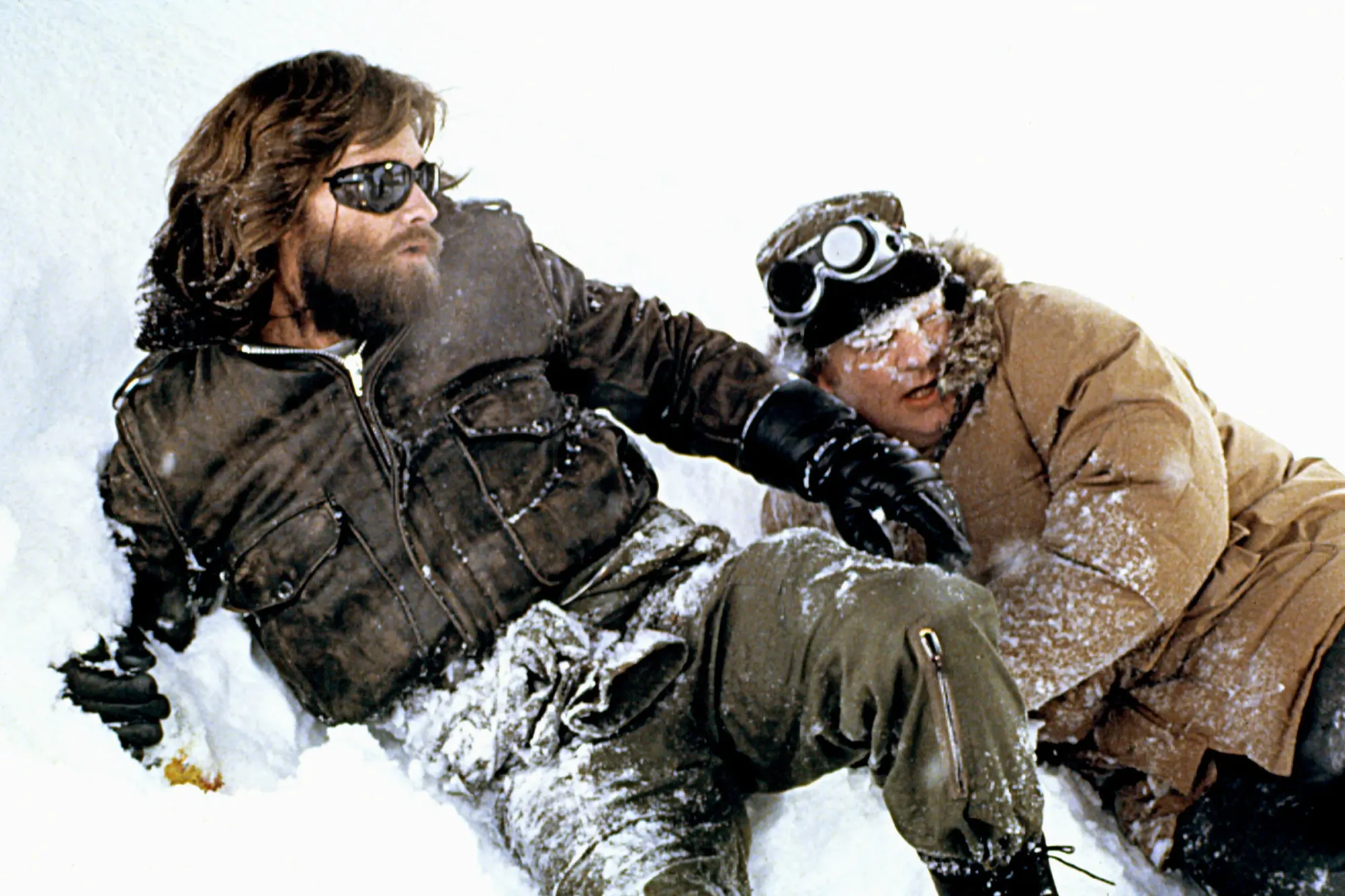
1982 film by John Carpenter
The Thing, a 1982 American science fiction horror film, directed by John Carpenter, frequently tops lists of favourite horror, science fiction, and overall films, lauded for its exploration of paranoia and identity.
Despite an initial commercial and critical failure upon its release, the film has undergone a significant re-evaluation, achieving classic status and garnering a reputation as a highly re-watchable and complex cinematic achievement.
The Thing was the third screen adaptation of John W. Campbell Jr.'s 1938 novella Who Goes There? Often considered a spiritual sequel or reimagining of Howard Hawks' 1951 film, The Thing from Another World, rather than a direct remake.
Notably, Carpenter's film incorporates a scene from the original movie, depicting the discovery of the alien spacecraft in the ice, serving as a pre-text or prologue to the events that unfold. While the 1951 film featured a vegetable creature as its alien, Carpenter’s version introduces a far more insidious and transformative entity.
A prequel film, also titled The Thing, was released in 2008, set at the Norwegian research base, though it received a less enthusiastic reception due to its reliance on computer-generated imagery.
Released between two and four years after Ridley Scott's Alien (1979) and around the same time as Poltergeist (1982), The Thing is part of a trilogy of films that fundamentally reshaped the horror and science fiction genres in the late 1970s and early 1980s.
These films introduced new archetypes and storytelling techniques that influenced countless subsequent filmmakers. While Alien famously featured one of cinema's first prominent female leads, The Thing stands in stark contrast with an exclusively male cast, similar to the all-male dynamic of Master and Commander.
The film commences with a sequence in space, revealing a flying saucer wobbling through the cosmos before being drawn into Earth's gravity, eventually shown to have crashed into an ancient, pre-human Earth. The narrative then shifts to Antarctica in 1982, establishing a passage of time and the alien’s long-dormant presence.
The story proper begins with a Norwegian helicopter relentlessly pursuing and shooting at a lone dog across the desolate Arctic landscape, even resorting to using grenades. The Norwegians’ desperate, almost manic, efforts to kill the animal remain inexplicable to the American research outpost until later revelations. The helicopter eventually crashes, and the two Norwegian occupants are either killed or succumb to their injuries, with one maniacally firing at the American base before being shot in self-defence.
The dog, the object of their pursuit, finds refuge at the American facility, where it is welcomed. The American crew, comprising roughneck, hard-living, and rugged individuals, operates a scientific research outpost that functions much like a prospector's camp. Notable members include McReady, the alpha pilot; Blair, the science officer and doctor; Childs; and Windows.
Soon after its arrival, the dog's unsettling behaviour becomes apparent. When placed in the kennel with the base's other dogs, the animals react with extreme fear, growling and whimpering at its presence. The dog then violently transforms into a monstrous, tentacled abomination, revealing itself to be the titular "Thing." McReady and the crew engage the creature with a flamethrower, seemingly destroying it.
The charred remains of the creature are brought into the base's morgue for an autopsy. Blair meticulously dissects the alien, discovering a grotesque amalgamation of organs, including six hearts, three sets of lungs, and both dog and human skeletal structures.
This examination leads to the terrifying realisation that the Thing is a mimic, an organism that absorbs the cells and DNA of living beings, taking on their form. It requires time to perfect its mimicry and is only truly killed by incineration. During the autopsy, a hidden eyeball within the seemingly inert mass appears to be watching, indicating its continued sentience and capacity to learn.
Suspicion and Paranoia
The central theme of The Thing is suspicion, which permeates every aspect of the narrative. The film effectively transforms into a deadly whodunnit, where the characters are locked in a desperate struggle to discern who among them remains human and who has been assimilated by the alien.
This pervasive paranoia is born from the Thing's ability to perfectly imitate its victims, hiding in plain sight until directly threatened.
The discovery of a ripped and bloodied pair of underwear, initially attributed to McReady, heightens this distrust, leading to accusations and counter-accusations. The characters are confronted with an existential crisis, as their deepest fear is no longer external death but the internal loss of self, leading to the repeated, desperate assertion, "I am me."
Isolation and Survival
The remote Antarctic setting amplifies the film’s themes of isolation and survival. The American base is entirely cut off from the outside world, unable to establish communication for weeks, prompting questions about standard protocols for such dangerous environments and even hinting at a potential hidden experiment.
This complete severance from external aid forces the men to confront the threat entirely on their own, highlighting their rugged Individualism and their struggle against an overwhelming, incomprehensible horror. The absence of women in the narrative further underscores this stark, isolated male struggle.
Body Horror and Practical Effects
The Thing is a masterclass in practical effects, showcasing grotesque squishy squishy body horror. The transformations are disturbing and visceral, utilising techniques that lend a reality to the creatures, despite their unearthly forms.
The dog's head splitting open into tentacles, a chest cavity turning into a monstrous toothed mouth, and a head detaching and growing spider-like legs to become a kind of head crab. These effects, crafted by artists such as Rob Bottin and with contributions from Stan Winston, are superior than computer-generated imagery for their tangible presence and ability to evoke genuine revulsion.
Lovecraftian Elements
The film draws heavily from the cosmic horror tradition, particularly H.P. Lovecraft's novella At the Mountains of Madness. The Antarctic setting, the discovery of an ancient, Eldritch horror deep within the ice, and the existential dread it provokes are distinct Lovecraftian tropes. The Thing's unrevealed "true form" and its ability to annihilate identity further align with this aesthetic, wherein the true horror lies in the incomprehensible and the erosion of the self.
Multi-Genre Narrative
The Thing deftly blends multiple genres, functioning as a horror film, a science fiction thriller, a survival drama, and even a strange kind of noir detective story.
Its narrative, structured around the crew's attempts to identify the infected, resembles a jury deliberation in 12 Angry Men in the Ice Cold, where the men argue and strategise to reach a verdict, but instead of a court, it is about survival against an unknown enemy.
This multi-layered approach allows the film to explore complex human dynamics while delivering intense suspense and horrific spectacle.
Plot Progression: Escalation of the Threat
Following the autopsy, the crew begins to unravel. Wilford Brimley's character, Blair, succumbs to extreme paranoia, convinced that the Thing will infect humanity if it escapes the base. In a manic episode, he sabotages the snow cat and destroys all radio equipment, cutting off any chance of escape or external communication.
He then attempts to attack his fellow crewmen with an axe, leading to his incapacitation and imprisonment in a shed. Blair later figures out that the Thing’s replication rate is so rapid that if it were to leave Antarctica, it could infect the entire world within approximately three years.
The Thing, however, adapts. While Blair is confined, it infects him. It then begins to build a makeshift spaceship underneath the base, utilising pilfered parts from the sabotaged snow cat and helicopter. This discovery confirms the alien's ultimate goal: to escape Earth and potentially colonise other planets.
The film's most iconic sequence, the blood test, becomes the ultimate culmination of the paranoia. Realising that every cell of the Thing is an independent organism and reacts to pain, McReady devises a crude but effective test.
He ties the remaining crew members to chairs and takes blood samples from each. He then uses a heated coat hanger tip to touch each blood sample. The blood of infected individuals reacts violently, jumping or transforming into grotesque, crab-like appendages.
This moment of extreme tension and revelation forces the men to confront the immediate threat within their own ranks, leading to brutal confrontations and horrific transformations. It is deduced that Windows was likely the first human to be infected, having been alone with the dog after its arrival.
Visuals and Sound
The film's visual aesthetic is striking, dominated by a stark colour palette of white (snow, ice) and red (flares, flashlights, the internal organs of the Thing, and the base's exterior). This contrast of fire and ice, cold and heat, is integral to the narrative and its themes.
Ennio Morricone's musical score for The Thing complements the film's atmosphere without overtly dictating audience emotion. His orchestral compositions, particularly during wide panoramic shots of the Antarctic landscape, create a cinematic grandeur that contrasts with the claustrophobic horror unfolding within the base.
The score also subtly shifts to a synthesiser-driven baseline drone, mirroring the escalating tension and the new pulse of the alien entity's presence.
John Carpenter, known for his own synth compositions, often used in his other films and his _Lost Themes_ albums, contributes to this distinct sonic landscape. The sound design is equally impactful, with specific sound effects, such as a whip-like sound accompanying the Thing's tentacles, adding to the grotesque realism of the transformations.
Legacy and Contemporary Interpretation
The Thing's initial box office failure and negative critical reception are often attributed to its release during a period dominated by more optimistic science fiction, exemplified by Star Wars.
However, its subsequent popularity through home video formats, such as VHS rentals, allowed it to find its audience and cultivate a dedicated following. It is now widely considered a cult classic and a masterpiece of the horror genre.
In contemporary discourse, The Thing has found new relevance, with audiences often drawing parallels between its themes and modern societal anxieties.
The film’s depiction of isolated individuals grappling with an invisible, transformative threat that makes people "not themselves" has resonated with discussions surrounding global events and perceived widespread paranoia.
It is seen by some as a metaphor for a war on the self or the threat of an unproven, invisible enemy that requires constant vigilance and distrust. While not an overt outbreak film, its themes of containment, internal threat, and the erosion of identity have been referenced in discussions concerning collective societal responses to perceived dangers.
The film's enduring ambiguity regarding the fate of its final two survivors, McReady and Childs, who are left to freeze to death, unsure if either is still human, leaves a chilling and unresolved conclusion, cementing its status as a timeless exploration of existential horror and suspicion.